Block Machine Price in Jordan: QT10-15 Manufacturer FOB Guide
The real cost of a block machine in Jordan is never the machine price tag.
Block machine price in Jordan ranges from mid-four-figure budgets for semi-auto mobile units to mid-six-figure investments for fully automatic PLC lines, but the final spend is shaped more by site infrastructure, logistics, and operational readiness than by the catalog number you choose.
I spent three months inside a block plant on the outskirts of Amman helping a private investor commission a QT6-15 line. The machine itself arrived in good shape, but the electrical cabinet grounding was floating, the voltage regulator was missing, and the local operator had never read a hydraulic schematic. The PLC kept throwing fault codes, the oil pump burned out twice, and the diesel generator they relied on was running contaminated fuel. By the time we stabilized the line, the downtime cost dwarfed the price difference between the semi-auto unit and a fully automatic alternative [NEED_CITE: downtime cost ratio in emerging market block plants]. That project reshaped how I approach every block machine price in Jordan conversation — I check the grid stability, the operator skill level, and the spare parts buffer before I talk model numbers.
If you are budgeting for a block plant in Jordan, the machine price is only the starting line. What follows is a field-tested breakdown of what the block machine price in Jordan actually looks like when you factor in model tiers, hidden costs, and ROI logic.
What Does the Block Machine Price in Jordan Actually Look Like Across Model Tiers?
Block machine price in Jordan is determined by automation level, daily output target, and mould flexibility — not by brand origin alone.
The market in Jordan clusters around four main model families, each serving a different investor profile. Below is a qualitative comparison matrix based on field deployments across the MENA region.
| Model Tier | Automation Level | Daily Output Range | Typical Investor Profile | Mould Flexibility | Power Demand |
|---|---|---|---|---|---|
| QT4-25 Mobile | Manual / egg-laying | Low output, small-batch | First-time investors, rural sites | Single mould at a time | Minimal |
| QT6-15 Semi-Auto | Semi-automatic with pallet loop | Moderate output for local construction | Private block yards, suburban Amman | Multi-mould changeable | Moderate |
| QT10-15 Fully Auto | PLC-controlled with auto batching | High output for commercial supply | Established plants, government contractors | Full mould library | High |
| QT12-15 / QT15-15 Heavy-Duty | Fully automatic with integrated stacking | Maximum output for large-scale projects | Industrial manufacturers, export-oriented plants | Full mould library + color feed | Very high |
The block machine price in Jordan for a QT4-25 mobile unit sits at the entry tier — affordable enough for a first-time entrepreneur testing the market. A QT6-15 semi-auto line with a basic pallet system and one or two mould sets occupies the mid-range, which is where most private Jordanian investors land. The QT10-15 and above, with PLC panels, automatic batchers, and stacking systems, represent the upper investment tier [NEED_CITE: block machine model segmentation by automation level in MENA market].
A government contractor in Jordan once contacted us for a housing project requiring consistent daily supply of hollow blocks and interlocking pavers. They initially wanted the cheapest unit available. After reviewing their daily volume requirement and the project timeline, we recommended the QT10-15 line instead. The block machine price in Jordan for that tier was substantially higher, but the payback came from eliminating manual bottlenecks and meeting the project’s delivery schedule without overtime labor costs.
The key takeaway: the block machine price in Jordan is a spectrum, and the right point on that spectrum depends on your daily demand, not your maximum budget.
Semi-Auto vs Fully Automatic — Which Model Delivers Better ROI for Jordan’s Market?
Choosing between semi-auto and fully automatic is a demand calculation, not a prestige decision.
Many first-time buyers assume the most automated line is always the best investment. In Jordan’s current construction cycle, that is not universally true. The ROI equation depends on three variables: daily block demand, available labor cost, and electricity reliability.
For a private yard in Amman producing standard hollow blocks for residential construction, daily demand often stays below the threshold where full automation becomes justified. A QT6-15 semi-auto line, paired with a simple mixer and pallet return system, can cover that demand with a small crew. The block machine price in Jordan for this configuration leaves budget room for mould variety, a spare hydraulic pump, and operator training — items that directly affect uptime.
On the other hand, a contractor executing a public housing tender or supplying multiple construction sites simultaneously needs the QT10-15 or QT12-15 class. The PLC-controlled batching ensures consistent mix ratios, the automatic pallet cycling removes human speed limitations, and the stacking system reduces labor dependency [NEED_CITE: ROI comparison semi-auto vs fully automatic block lines in Middle East markets].
| Factor | Semi-Auto (QT6-15 Class) | Fully Automatic (QT10-15 Class) |
|---|---|---|
| Labor Dependency | Moderate — requires skilled manual feeding | Low — PLC-driven cycle |
| Mix Consistency | Operator-dependent | Batch-plant controlled |
| Mould Changeover Time | Noticeably longer | Standardized quick-change |
| Grid Sensitivity | More tolerant — simpler controls | Vulnerable — requires stable power and voltage regulation |
| Spare Parts Complexity | Lower | Higher — PLC cards, sensors, servo components |
A Middle East block plant operator running a QT10-15 line without a voltage stabilizer experienced repeated PLC fault codes and servo drive failures. The monthly replacement cost for electronic components climbed to a level that exceeded the initial investment in power conditioning equipment. The lesson: higher automation demands higher infrastructure readiness, and that infrastructure cost must be included in your block machine price in Jordan calculation.
Hidden Costs Behind the Block Machine Price in Jordan That Most Buyers Overlook
The CIF invoice is not the total investment. The real block machine price in Jordan includes everything between the port of Aqaba and the first sellable block.
When buyers compare the block machine price in Jordan across suppliers, they often fixate on the FOB or CIF figure. But the landed cost includes layers of expense that never appear on the commercial invoice. Based on repeated project experience across the region, these hidden costs typically add a substantial percentage on top of the machine price.
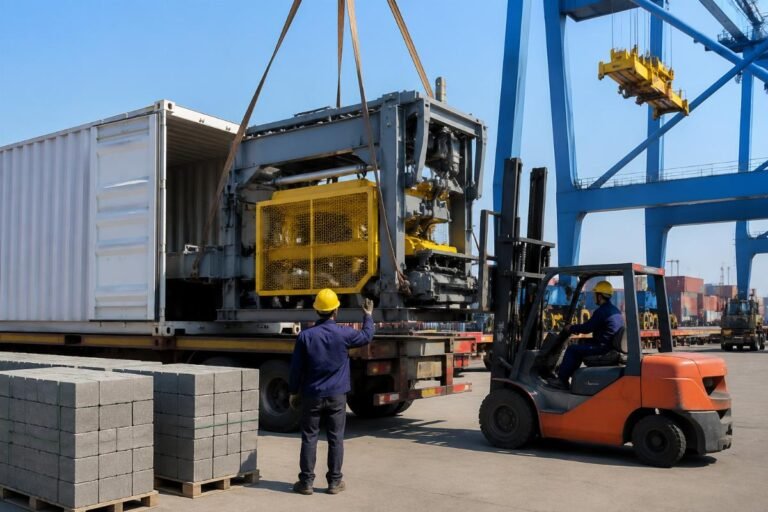
Logistics and customs clearance. CIF Aqaba covers freight and insurance to the port, but inland transport to the actual plant site — whether in Amman, Zarqa, or Irbid — requires local trucking, crane unloading, and customs brokerage. Jordan’s import duty structure for machinery varies by HS code, and misclassification can delay clearance by weeks [NEED_CITE: Jordan customs duty structure for concrete block machinery imports].
Electrical infrastructure adaptation. Jordan’s industrial grid runs on specific voltage and frequency standards. Chinese-manufactured block machines are built to order for the target market’s electrical specification, but the plant site itself may need transformer upgrades, voltage stabilizers, and proper grounding — especially in industrial zones where grid fluctuation is common. Skipping the stabilizer is the single most expensive shortcut a buyer can make.
Foundation and civil works. A fully automatic line requires a leveled, reinforced concrete foundation with embedded anchor bolts and drainage channels. This civil work is the buyer’s responsibility and is never included in the block machine price in Jordan quoted by the supplier.
Operator training and commissioning. Even the most advanced PLC line is only as productive as the people running it. On-site commissioning by the supplier’s engineer — including hydraulic calibration, mould alignment, mix ratio optimization, and operator training — typically runs over a week. Travel, accommodation, and daily service fees for the commissioning engineer are separate from the machine price.
Spare parts buffer. The first year of operation inevitably wears out certain consumables — hydraulic seals, mixer blades, pallet surfaces, vibration motor bearings. Ordering a commissioning spare parts kit at the time of purchase avoids production stoppages later, but it adds to the initial outlay.
A private investor in the Amman suburbs budgeted strictly for the block machine price in Jordan as quoted by the supplier. When the machine arrived, the additional costs for foundation work, electrical upgrades, customs clearance, and commissioning pushed the total investment well beyond the original plan. The machine itself was never the problem — the planning gap was.
How to Verify That a Supplier’s Block Machine Price in Jordan Is Genuine
A low block machine price in Jordan is only a bargain if the supplier can back it with verifiable credentials and real installation references.
The market is flooded with trading companies posing as manufacturers, quoting artificially low prices to win inquiries, then adding surcharges or delivering underconfigured lines. Protecting your investment requires a verification checklist before you commit.
Check the factory, not just the website. Request a live video tour of the production floor — not a pre-recorded marketing video. A genuine manufacturer will show you the welding stations, the machining center, the assembly area, and the testing bay. Ask specific questions about production capacity and lead times. A trading company will hesitate or deflect.
Verify certification authenticity. CE, SGS, and ISO certifications are standard requirements for Jordanian imports and for project tender documentation. But certificates can be forged or borrowed. Ask for the certificate number and verify it directly with the issuing body [NEED_CITE: how to verify CE and SGS certification authenticity for concrete machinery].
Request installation case references in the MENA region. A credible supplier will provide contactable references — not just photos — from projects in Jordan or neighboring countries. Ask the reference about commissioning duration, after-sales response time, and spare parts availability.
Confirm voltage and frequency customization. Jordan’s electrical standard must be matched at the factory before shipment. A supplier who does not ask about your site voltage during the quotation stage is not engineering the machine for your market — they are shipping a generic unit and hoping it works.
Evaluate after-sales structure. Does the supplier offer remote diagnostic support? Can they dispatch engineers for on-site service? Is there a regional spare parts warehouse, or will you wait weeks for a single hydraulic valve shipped from China? The block machine price in Jordan means nothing if the machine sits idle for months waiting for a replacement sensor.
Complete Turnkey Pricing — What the Block Machine Price in Jordan Looks Like End-to-End
A turnkey quotation collapses all hidden costs into a single transparent figure — and that is why serious buyers prefer it.
The alternative to piecing together the block machine price in Jordan from separate invoices — machine, freight, customs, foundation, electrical, training — is a turnkey package that bundles the entire scope under one supplier’s responsibility. This approach shifts the risk of coordination gaps, timeline delays, and cost overruns from the buyer to the supplier.
A turnkey package for a block plant in Jordan typically includes:
- The block making machine (model selected based on daily output requirement)
- Supporting equipment: mixer, batching plant, conveyor system, pallet loader, stacker
- Mould sets for the required block types (hollow, solid, interlocking, curbstone)
- CIF or DDP shipping to the designated site
- On-site foundation guidance and civil work drawings
- Electrical customization for Jordan’s voltage and frequency standard
- On-site installation, commissioning, and hydraulic calibration
- Operator and maintenance training for the local crew
- Commissioning spare parts kit
- Lifetime remote technical support
The block machine price in Jordan under a turnkey model appears higher on the initial quotation than a machine-only quote. But when you add up the separate costs of freight forwarding, customs brokerage, local electricians, civil contractors, and independent commissioning — not to mention the production revenue lost to delays — the turnkey figure often represents the more economical path.
A government contractor in Jordan executing a public housing supply contract chose a turnkey package for a QT10-15 line. The supplier handled everything from factory production to on-site commissioning. The line reached full production within weeks of container arrival, and the contractor met the project’s delivery milestones without labor overtime or mix quality complaints. The block machine price in Jordan for the turnkey package was transparent, and there were no surprise invoices after delivery.
Conclusion
The block machine price in Jordan is a layered figure — machine cost, logistics, infrastructure, training, and spare parts all combine to determine your real investment.
Model selection should follow your daily demand, not your maximum budget. Hidden costs between the port and the first production day are substantial and must be planned for. And supplier verification — factory authenticity, certification, regional references, voltage customization, and after-sales structure — is the only reliable defense against low-price traps. A turnkey approach consolidates these variables into one accountable package and is the preferred path for buyers who need predictable timelines and transparent costing.