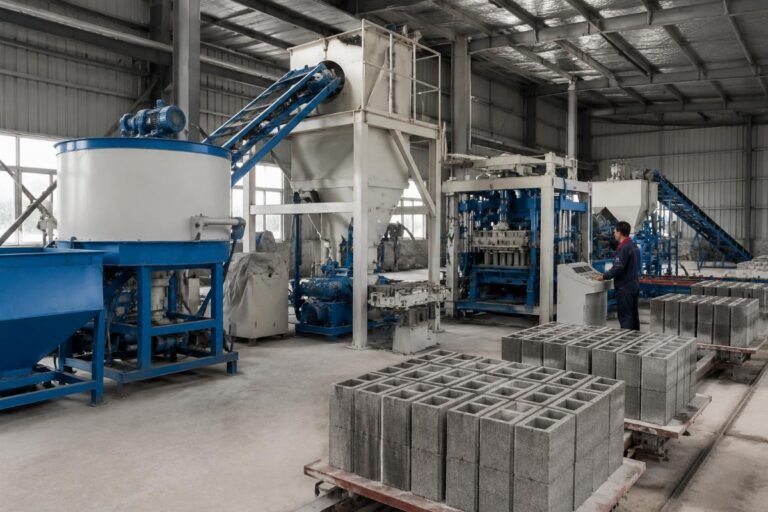
Buy QT10-15 Paver Block Machine Best Price 2026 – Wholesale Supplier
The lowest host-machine quote is almost never the best price. The real best price is the lowest total landed cost per block produced over the equipment’s lifespan.
When buyers search for a paver block machine best price 2026, they usually land on supplier pages listing a single number for the main unit. That number is misleading. A complete production line includes the host machine, batching plant, pallet loader, conveyor system, molds, spare parts, shipping, and installation support. Ignoring any of these line items creates a gap between the invoice and the actual cost of getting blocks out the gate. [NEED_CITE: total cost of ownership methodology for industrial capital equipment in emerging markets]
I learned this the hard way on a project in southern Brazil. The buyer locked in a host machine at what looked like a great rate. When the container arrived, there was no pallet feeding system, no matching batching plant, and the voltage spec didn’t match the local grid. The line sat idle for months while we reconfigured and shipped missing components. The final cost ran well past the original quote, and production revenue was lost the entire time.
Now every quotation I prepare breaks down the full system. That is the only honest way to evaluate a paver block machine best price 2026 offer.
What Should "Best Price" Actually Include in 2026?
A real best price covers the full production line, not just the host machine. Buyers must compare total landed cost per block, not per-unit host quotes.
The total cost of ownership for a concrete block line splits into several buckets: the host machine itself, auxiliary equipment (batching plant, mixer, conveyors, pallet loader, stacker), molds for each product type, shipping and import duties, installation and commissioning, and a spare-parts reserve for the first year of operation. [NEED_CITE: capital expenditure breakdown structure for concrete block manufacturing plants]
Most buyers focus on the host machine because it is the largest single line item and the easiest to compare across quotes. But auxiliaries can represent a substantial share of the total investment, especially when the batching plant capacity must match the host machine’s cycle time. A mismatch means the host sits waiting for material, destroying output per shift.
Shipping is another area where quotes diverge wildly. A full QT10-15 line requires multiple containers. The difference between FOB and CIF pricing, the choice of departure port, and the routing to the destination port all shift the final number significantly. Some suppliers quote the host machine attractively and recover margin on freight markup.
Installation and commissioning costs include technician travel, accommodation, local labor, and the time required to dial in vibration parameters, mold alignment, and mix ratios. A supplier who includes on-site commissioning in the package removes a major variable from the buyer’s budget.
A Middle American client once compared three quotes for a QT10-15 line. The cheapest host quote was noticeably lower than the others. But when we itemized the full system — including a properly sized batching plant, pallet circulation system, two sets of molds, and a container-load of wear parts — the total landed cost landed in the same range as the other two offers. The difference was transparency, not actual savings.
The lesson: request a turnkey quotation with every line item visible. A paver block machine best price 2026 evaluation only works when you are comparing apples to apples.
QT10-15 vs. Other Models — Which One Fits Your Output Target?
Model selection should be driven by daily output targets and product mix, not by the desire to buy the biggest machine available.
The QT10-15 sits in the high-output tier of stationary block machines. It handles pavers, hollow blocks, curbstones, and interlocking bricks with mold changes that take a matter of minutes. For operations targeting large-volume paving contracts or municipal supply programs, it is often the right starting point.
But not every buyer needs this capacity. The table below maps common model tiers against typical output ranges and buyer profiles.
| Model Tier | Daily Output Range | Automation Level | Typical Buyer Profile |
|---|---|---|---|
| QT4-25 / Mobile Egg-Layer | Low to moderate output | Semi-auto or manual | Small yard startups, rural block yards |
| QT4-15 / QT6-15 | Moderate output | Semi-auto with basic PLC | Growing private yards, first upgrade |
| QT10-15 | High output | Fully automatic PLC | Established plants, government tenders |
| QT12-15 / QT15-15 | Very high output | Fully automatic with advanced hydraulics | Large-scale producers, multi-shift operations |
[NEED_CITE: production capacity benchmarks for stationary concrete block machines by model class]
A distributor in West Africa initially ordered a QT10-15 for a new yard. After reviewing their actual local demand — mostly small residential builders buying in modest batches — we redirected them to a QT6-15 with an expansion path. The lower capital commitment matched their market reality, and they avoided paying for idle capacity.
Conversely, a Chilean paving contractor had been running a QT6-15 and losing bids because they could not hit volume commitments on time. Upgrading to a QT10-15 let them run multiple shifts with consistent output, and the mold-change speed meant they could produce several paver profiles within the same week.
When you evaluate a paver block machine best price 2026, the first step is confirming the model matches your real demand. Oversizing wastes capital. Undersizing loses contracts.
How to Spot Pricing Traps from Wholesale Suppliers?
Three traps dominate low-quote offers: incomplete line items, vague warranty scopes, and artificially cheap spare-parts pricing.
The first trap is the incomplete quote. The supplier lists the host machine at an eye-catching number but omits the batching plant, pallet system, or even the hydraulic station. The buyer signs, then discovers the missing components cost as much as the host itself. Always demand a line-by-line equipment list with model numbers and quantities.
The second trap is vague warranty language. Phrases like "one-year warranty" sound reassuring until you read the fine print. Does the warranty cover the PLC, the hydraulic pump, the vibration motors, or only structural steel? Are wear parts like mold liners and mixer blades excluded? What about labor costs if a technician must travel? A paver block machine best price 2026 that strips warranty coverage is not actually cheaper — it transfers risk to the buyer.
The third trap is spare-parts pricing. Some suppliers quote wear parts at rates that seem impossibly low. Once the buyer is locked into that supplier’s ecosystem — with proprietary mold dimensions or non-standard hydraulic fittings — the replacement parts jump in price substantially. Always negotiate a spare-parts price schedule at the time of the main order, covering at least the first year’s expected consumption.
A buyer in the Gulf region accepted a very low host-machine quote from a supplier who did not itemize the mold set. When the first set of paver molds wore out, the replacement quote was several times the original allocation. The total cost over the first year of operation far exceeded what a transparent, slightly higher initial quote would have delivered.
Request written confirmation of warranty scope, a spare-parts price list, and a complete equipment manifest before committing. These documents separate serious suppliers from those playing games with headline numbers.
What Certification and Documentation Do You Need for Import?
Import compliance is non-negotiable. CE, SGS, and ISO documentation must be verified against the actual machine shipped, not just the supplier’s website claims.
Different destination markets require different certification packages. Most Latin American and African countries accept CE marking for machinery imports, often accompanied by a test report from a recognized body. Some markets require SGS inspection at the factory before shipment. Government tenders typically demand ISO certificates for the manufacturing company. [NEED_CITE: machinery import certification requirements by destination country for concrete block equipment]
The critical step is verifying that the certificates cover the specific model being shipped. A supplier may hold a CE certificate for a smaller model and attempt to apply it to a QT10-15 without separate testing. This creates a customs clearance risk that can strand the equipment at port for weeks.
Documentation also includes the commercial invoice, packing list, bill of lading, certificate of origin, and any destination-specific forms such as SASO for Saudi Arabia or BVQI for certain African markets. Missing or incorrect documents trigger demurrage charges that accumulate daily.
A North African buyer’s container was held at port because the certificate of origin listed the wrong HS code for the machinery. The correction required coordination between the supplier, the freight forwarder, and the local customs broker. The delay added weeks of storage fees and postponed the project start.
Before payment, request copies of all certificates and cross-check model numbers, serial numbers, and company names. A legitimate paver block machine best price 2026 supplier will provide complete documentation without hesitation.
How to Negotiate the Real Best Price Without Sacrificing Quality?
Negotiation should focus on bundling, locking spare-parts pricing, and securing installation support — not on driving the host-machine number to the floor.
The most effective negotiation approach is to treat the entire order as a package. When you bundle the host machine, auxiliaries, molds, spare parts, and installation into a single purchase order, the supplier has room to optimize pricing across the package. Squeezing only the host-machine price forces the supplier to recover margin elsewhere — usually on spare parts or shipping.
Lock in spare-parts pricing at the time of order. Request a written schedule for molds, mixer blades, hydraulic seals, and vibration components. This schedule should cover at least the first year of operation. Without it, you are exposed to price increases once the supplier knows you are dependent on their parts.
Secure installation and training in the package. On-site commissioning ensures the line runs at designed output from day one. Operator training reduces early-stage waste and equipment misuse. These services have real cost, and including them in the negotiated package is more efficient than arranging them separately later.
A distributor in Southeast Asia negotiated a multi-container order for QT10-15 lines destined for several end buyers. By bundling the full order and committing to a spare-parts package, they secured a unit price that was meaningfully below what individual buyers would have paid, while also locking in wear-parts rates and guaranteed factory delivery windows.
The goal is not the lowest possible invoice number. The goal is the most predictable total cost with the least operational risk. That is how you arrive at a genuine paver block machine best price 2026.
Conclusion
The best price is the lowest total cost per block, not the lowest host-machine quote. Evaluate full system cost, match the model to your actual output needs, verify certifications, and negotiate packages rather than line items. A transparent supplier who itemizes everything will always deliver a better long-term result than one who wins on a headline number.