Concrete Block Machine Price in Mexico: 2026 Buyer Guide from China Manufacturer
FOB price is not the total cost. Voltage mismatch, moisture-sensitive batching, and site-specific layout engineering routinely add a hidden layer to the final capital outlay — and most buyers only discover it when the motor burns out during commissioning.
Concrete block machine price in Mexico in 2026 is driven by automation level, voltage customization for local grids, and turnkey shipping costs — not just the machine FOB price. Entry-level mobile egg-layers, semi-automatic QT4/QT6 lines, and fully automatic QT10/QT12/QT15 lines sit in clearly separated cost tiers, with transformers, moisture-adjusted mixers, and on-site commissioning adding a significant share beyond the machine itself.
I still remember a proforma we sent to Monterrey a few years back. The buyer wanted a QT6-15 semi-automatic line, and we quoted based on standard 220V/60Hz motor specs. What we didn’t confirm was whether their plant had a dedicated step-down transformer for the industrial panel. During commissioning, the main vibration motor burned out within hours. Replacing it — plus flying an engineer back — ate the entire margin on that order. That kind of voltage mismatch is the single most common reason block plant projects in Mexico go over budget, and it rarely shows up in the initial price comparison.
If you are researching concrete block machine price in Mexico right now, the shortcut is this: stop comparing FOB numbers and start comparing total installed cost per block of daily output. The rest of this guide breaks down how that cost is actually structured, where the hidden layers sit, and how to calculate whether the investment pays back in the timeframe your cash flow can tolerate.
What Determines Concrete Block Machine Price in Mexico?
Three variables dominate the final price: automation level, daily output capacity, and customization for Mexican voltage and raw material conditions.
Brand markup matters far less than buyers assume. What moves the needle is whether you are buying a mobile egg-layer that one operator can run, a semi-automatic line with a separate batching station, or a fully automatic PLC-controlled plant with pallet circulation, stacker, and color feeder. Each step up in automation roughly doubles the mechanical complexity — and the price.
The automation tier also dictates labor cost, which is a major factor in Mexico where industrial wages have been rising steadily. A manual or mobile machine needs several operators per shift; a fully automatic line can run with a small crew, but the machine itself costs considerably more upfront. The concrete block machine price in Mexico therefore reflects a trade-off between capital expenditure and operating expenditure, not just the sticker number on the proforma.
Customization is the third driver. Mexican industrial power grids run on 220V/60Hz and 440V/60Hz depending on the state and the substation. Motors, control cabinets, and hydraulic pumps must match the local frequency, or they overheat, lose torque, or fail prematurely. [NEED_CITE: Mexican industrial voltage standards and frequency specifications per CFE grid requirements] Raw material moisture also varies sharply between northern arid states and southern humid regions, which affects mixer design and water dosing calibration. A machine built for one climate without adjustment will produce inconsistent block density in the other.
A private investor in Baja California once asked why our quote was higher than a Turkish supplier’s. The Turkish quote was FOB only, with standard European voltage motors and no moisture compensation in the mixer. Once we added the transformer, the humidity-adjusted water dosing system, and the container shipping to Manzanillo, the gap narrowed to a level where the Chinese option was still cheaper — but the buyer had to see the full picture first.
Price Breakdown by Machine Type: QT4-25 to QT15-15
Concrete block machine price in Mexico separates cleanly into three tiers: entry-level mobile, semi-automatic stationary, and fully automatic high-output lines.
The table below shows how these tiers compare across the parameters that matter for a Mexican block plant investor.
| Parameter | Mobile Egg-Layer QT4-25 | Semi-Auto QT4-15 / QT6-15 | Fully Auto QT10-15 / QT12-15 / QT15-15 |
|---|---|---|---|
| Daily Output | Basic | Standard | High |
| Automation Level | Manual movement, manual feeding | Semi-auto with separate batcher | Full PLC, auto pallet loop, stacker |
| Labor Required | Noticeably higher | Moderate | Substantially reduced |
| Voltage Customization | Basic | Standard | Full batch-level verification |
| Mold Customization | Verifiable | Verifiable | Verifiable |
| Turnkey Shipping Share | Noticeably high | Moderate | Lower per unit of output |
| Suitable Investor Profile | Entry-level, single product | Small-to-medium plant | High-volume, multi-product |
The mobile egg-layer sits at the bottom of the concrete block machine price in Mexico range. It is a single machine on wheels that lays blocks directly on the curing yard. The appeal is low entry cost and the ability to start production without a factory building. The trade-off is lower output, higher labor per block, and limited product range — you cannot easily switch between block sizes and pavers without changing molds, which takes time.
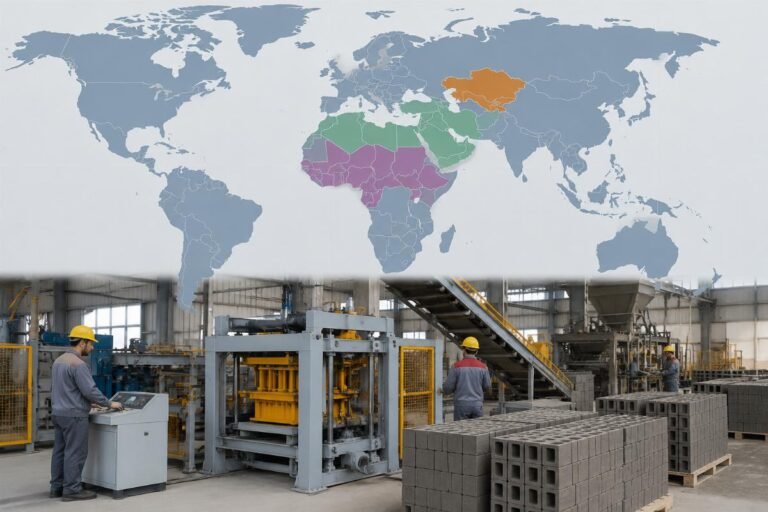
The semi-automatic tier — QT4-15 and QT6-15 — is where most first-time Mexican investors land. You get a stationary machine with a separate batching station, a conveyor, and a basic control panel. Output is meaningfully higher than the mobile option, and the machine can handle multiple mold sets for different block sizes. The price sits in a middle range that balances capital risk against production capacity.
The fully automatic tier — QT10-15, QT12-15, QT15-15 — is built for investors who already have confirmed demand or are bidding on government housing and infrastructure contracts. These lines include PLC-controlled batching, automatic pallet circulation, stackers, and optional color feeders for pavers and curbstones. The concrete block machine price in Mexico at this tier is the highest, but the cost per block drops sharply because labor is minimal and output is continuous.
A housing contractor in Mexico City ran the numbers on a QT10-15 line against his existing manual operation. The payback calculation showed that even with the higher upfront cost, the fully automatic line would recover its investment within a range of months that his cash flow could absorb — and the labor savings alone covered a significant share of the monthly loan payment. The key was matching the output to his confirmed contract volume, not buying the biggest machine available.
Hidden Costs Buyers Miss: Voltage, Shipping, and Installation
The FOB price typically represents only a portion of the total installed cost. Transformers, moisture-adjusted mixers, site layout engineering, and on-site commissioning routinely add a significant layer that most buyers do not budget for.
Voltage is the most expensive hidden cost. As I mentioned with the Monterrey example, Mexican industrial power is not uniform. Some states run 220V/60Hz, others 440V/60Hz, and some older industrial zones have unstable voltage that fluctuates during peak hours. If the machine’s motors and control cabinet do not match the local supply, you need a step-down or step-up transformer. Industrial-grade transformers are not cheap, and they add weight to the container, which affects shipping cost. [NEED_CITE: Industrial transformer requirements for imported machinery in Mexico]
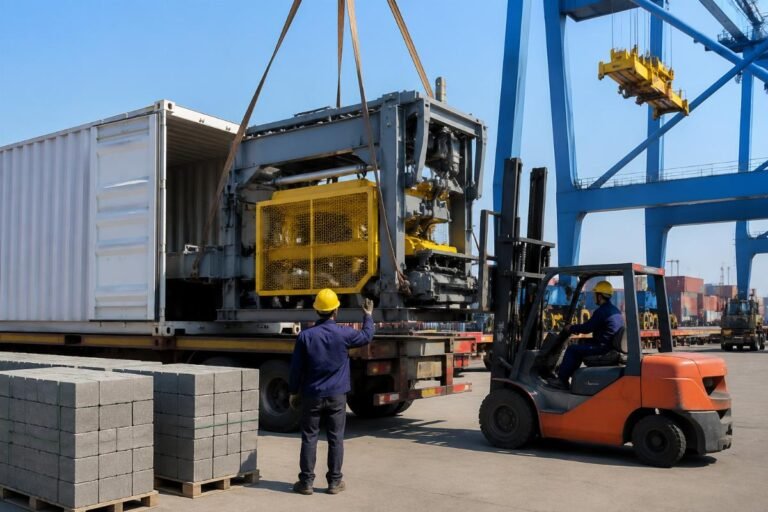
Shipping is the second hidden layer. A fully automatic line does not fit in a single container. You are looking at multiple 40HQ containers, and the shipping rate from Qingdao to Manzanillo or Lázaro Cárdenas fluctuates with global freight cycles. The shipping share of the total cost is proportionally higher for smaller machines — a mobile egg-layer takes up a full container but produces far fewer blocks per day than a fully automatic line that fills two or three containers. This is why the concrete block machine price in Mexico must always be evaluated on a cost-per-block-of-output basis, not a cost-per-machine basis.
Installation and commissioning is the third layer. A fully automatic line needs mechanical assembly, electrical wiring, hydraulic calibration, and mold trial runs. If the supplier does not include on-site engineer dispatch in the quote, you are paying for flights, accommodation, and daily fees out of pocket. If the supplier does include it — as is standard practice from established Chinese manufacturers — the cost is built into the proforma, but you need to verify that it is there.
Site layout engineering is the fourth layer, and the one most buyers skip. A block plant is not just a machine; it is a flow of raw material storage, batching, mixing, forming, curing, and finished product stacking. If the layout is wrong, you waste meters of conveyor, double-handle pallets, or create bottlenecks that kill output. A supplier who asks for your site dimensions and provides a layout drawing before the proforma is saving you money you would otherwise spend on rework.
A paver manufacturer in Baja California learned this the hard way. He bought a machine from a supplier who did not ask for site dimensions. When the machine arrived, the curing yard was too far from the press, and the pallet return loop had to be redesigned on site. The cost of the steelwork and the lost production days during the redesign exceeded what he would have paid for proper layout consultation upfront.
How to Calculate ROI for Your Mexico Block Plant
Daily output multiplied by local block selling price, minus labor, cement, aggregate, and electricity costs, gives you the daily gross margin — and from there the payback timeline.
The ROI calculation for a block plant is straightforward in principle but requires honest input data. Most buyers overestimate selling price and underestimate operating cost, which makes the payback look faster than it really is.
Start with daily output. The manufacturer’s spec sheet will give you a theoretical number based on continuous cycle time. Multiply that by a realistic utilization rate — not every shift runs at full speed, and mold changes, maintenance, and raw material delays eat into output. A conservative utilization factor gives you a more reliable daily block count.
Next, confirm the local selling price per block in your target market. This varies by block size, by state, and by whether you are selling to contractors, hardware stores, or direct to end users. Get at least three data points from local competitors or hardware distributors.
Then list your operating costs: labor per shift, cement cost per bag, aggregate cost per cubic meter, electricity cost per kilowatt-hour, and pallet wear. Cement is typically the largest variable cost, and its price fluctuates. Build your model on a mid-range cement price, not the lowest you have seen.
Daily gross margin equals daily output times selling price minus daily operating cost. Divide the total installed cost of the machine — including shipping, transformer, installation, and spare parts buffer — by the daily gross margin, and you get the payback period in days. Convert that to months, and compare it against your cash flow tolerance.
The concrete block machine price in Mexico only makes sense in the context of this calculation. A cheaper machine that produces fewer blocks per day, requires more labor, and breaks down more often will have a longer payback than a more expensive machine that runs continuously with minimal crew. The investor who focuses on the machine price alone is looking at the wrong number.
Why Chinese Suppliers Offer Lower Prices Than European and Turkish
The price gap between Chinese and European or Turkish block machines is structural, not a reflection of quality compromise. It comes from manufacturing cluster efficiency, supply chain density, and labor cost in the production region.
Linyi, Shandong, where our factory is located, sits in one of the densest construction machinery manufacturing clusters in China. Within a short radius, you have steel suppliers, hydraulic component manufacturers, motor winding shops, PLC integrators, and mold fabrication workshops. This density means that every component of a block machine can be sourced locally, with short lead times and low logistics cost. The same machine built in Europe or Turkey would carry significantly higher component and labor costs, which flow directly into the final price.
This does not mean Chinese machines are identical to European ones in every detail. European machines often use higher-specification PLCs, heavier-gauge steel in the frame, and more refined hydraulic manifolds. The question is whether those differences translate into proportional value for a Mexican investor. In many cases, they do not. A Mexican block plant operating in a dusty environment with unstable power does not benefit from a premium PLC that requires clean-room-level maintenance. It benefits from a robust, serviceable machine with locally available spare parts and a supplier who understands the operating conditions.
The concrete block machine price in Mexico from a Chinese supplier typically sits at a fraction of the European equivalent, even after adding shipping, transformer, and installation. The gap is large enough that even if you budget for a full set of spare parts and two engineer visits for commissioning, the total installed cost remains well below the European FOB price alone.
The comparison with Turkish suppliers is closer, but Turkish machines often carry a premium for geographic proximity to Europe and the Middle East, which does not apply to Mexico. Shipping from Turkey to Manzanillo goes through the Suez Canal and across the Pacific, which is not shorter or cheaper than shipping from Qingdao. The concrete block machine price in Mexico from a Turkish supplier therefore offers less advantage than the geographic map might suggest.
Conclusion
Concrete block machine price in Mexico is a function of automation tier, voltage customization, and total installed cost — not the FOB number on the proforma.
Buyers who compare only machine prices miss the transformers, shipping, layout engineering, and commissioning costs that determine whether the project stays within budget. The ROI calculation — daily output times selling price minus operating cost — is the only reliable way to evaluate whether a machine at any price point makes financial sense for your specific market and demand volume.