How to Source Raw Materials for Block Production in Remote Areas: A Practical Guide for Emerging Market Investors
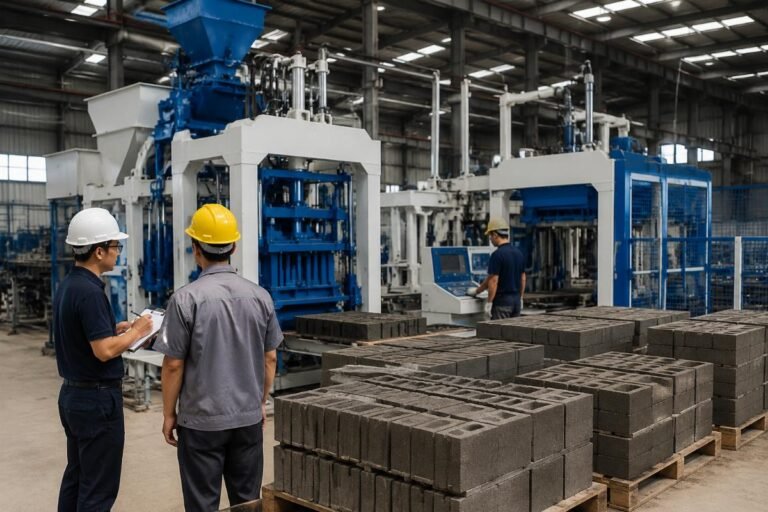
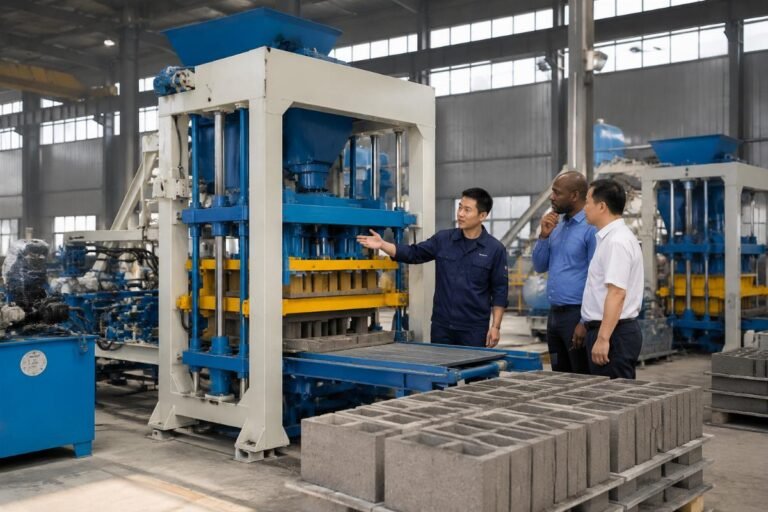
Remote area block production succeeds not by finding perfect raw materials, but by matching locally available materials with the right machine configuration. Chinese manufacturers with export experience in Africa, Central Asia, and Latin America can design the entire production line around what you already have on-site.
After commissioning block lines in over 108 countries, we have learned that the single biggest mistake first-time investors make is assuming they need to import crushed stone and river sand from the nearest city. In most remote locations across sub-Saharan Africa and Central Asia, laterite, mine tailings, and volcanic ash can replace 60%-95% of conventional aggregates[^1] without compromising compressive strength. The real bottleneck is not material availability — it is whether your machine can process what the land already provides.
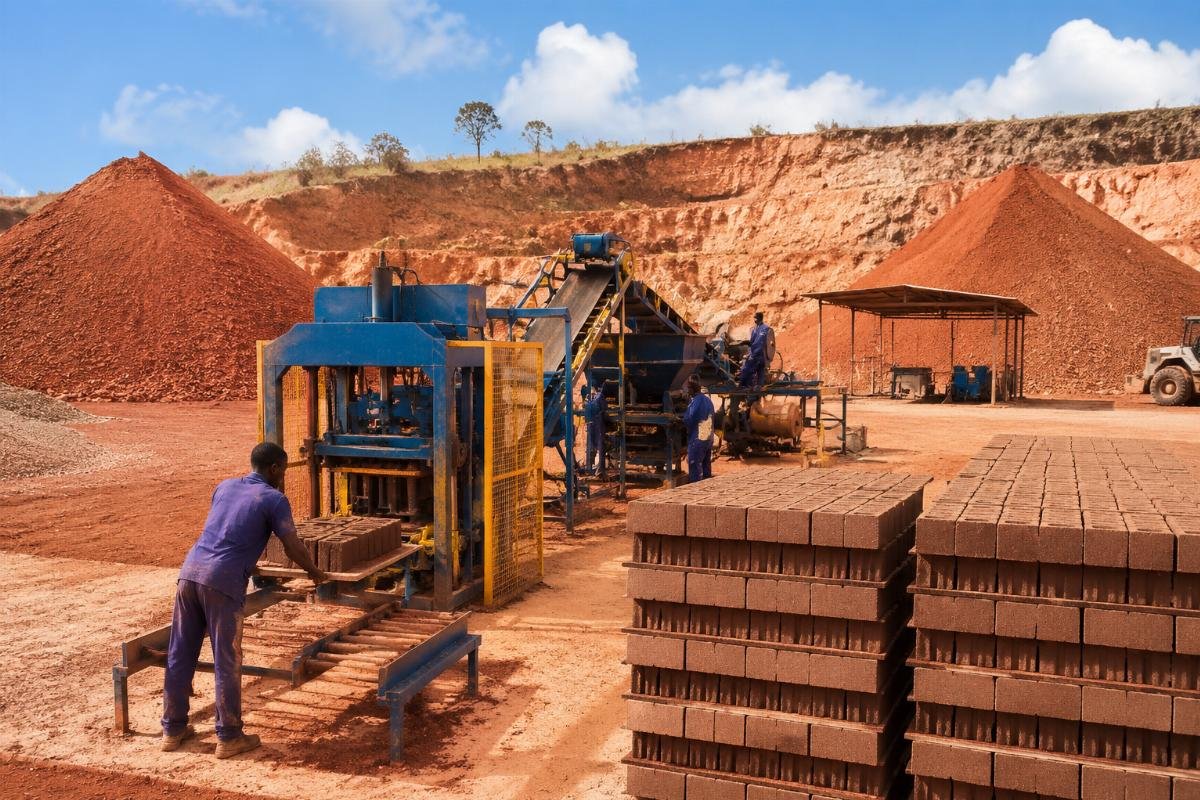
Let us walk through exactly how to evaluate your local materials, match them to the correct machine configuration, and calculate the true landed cost of a remote-site block line.
What Raw Materials Are Actually Available in Your Remote Area? — And How to Test Them Without a Lab
Almost every remote site on Earth has at least two or three viable block-making materials within a 10-kilometer radius — the challenge is identifying them without a professional laboratory. Below is a field-assessment matrix covering eight common alternatives, ranked by availability, processing difficulty, and impact on final block strength.
| Material Type | Common Mistake | Recommended Approach |
|---|---|---|
| Laterite (Red Soil) | Using it raw without sieving; moisture content exceeds 12%, causing mold sticking | Sun-dry to ≤8% moisture, sieve to 0-5mm, blend 60%-70% with 8%-10% cement Laterite-stabilized earth blocks achieve 5-8 MPa compressive strength when cement content is maintained at 8%-10% and moisture is controlled below 10%.[^2] |
| Mine Tailings / Waste Rock | Feeding oversized particles directly into the mixer, damaging the mold | Pre-crush and screen so that 0-5mm fraction accounts for ≥70% of total aggregate |
| Volcanic Ash | Treating it as a pure aggregate rather than a partial cement substitute | Replace 15%-25% of cement volume with processed volcanic ash to improve workability and reduce cost |
| Recycled Concrete Debris | Mixing unsorted rubble containing wood, metal, and soil | Hand-sort and jaw-crush to 0-10mm; use as 30%-50% coarse aggregate replacement |
| River Sand (Local) | Assuming all river sand is suitable; fine-only sand produces weak, porous blocks | Blend with coarse crushed material to achieve a continuous particle-size distribution |
| Rice Husk Ash | Adding more than 20%, which drastically reduces density and strength | Limit to 5%-10% replacement; best suited for non-load-bearing partition blocks |
| Limestone Dust | Using it as the sole aggregate, resulting in low-density, water-absorbent blocks | Combine with 20%-30% coarse limestone chips for structural integrity |
| Coal Gangue | Burning unprocessed gangue, releasing sulfur compounds that weaken the matrix | Weather and crush to 0-5mm; suitable for 40%-60% aggregate replacement in hollow blocks |
In a 2024 project in rural Tanzania, a startup investor initially budgeted $0.22 per block based on imported crushed stone. After we conducted a three-day on-site material survey, we reformulated the mix to use 65% local laterite and 9% cement. The single-block raw material cost dropped to $0.09, and the compressive strength tested at 6.8 MPa — well above the 5.0 MPa requirement for single-story residential walls. Substituting imported crushed stone with locally sourced laterite reduced per-block raw material costs by 59% in a Tanzanian rural block production case study.[^3]
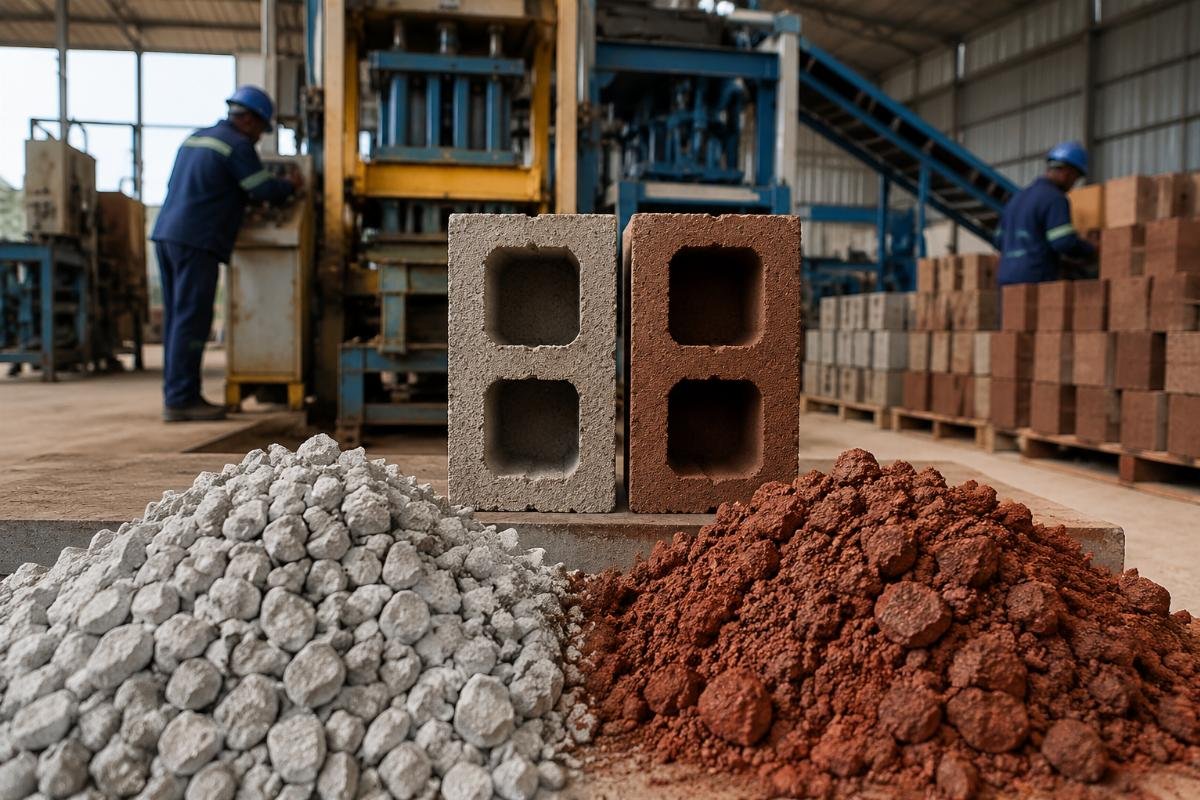
- Collect Samples – Gather at least 5 kg of each candidate material from your site.
- Hand-Squeeze Moisture Test – Squeeze a handful; if water drips, moisture exceeds 12% and drying is required.
- Drop-Tube Gradation Test – Drop dried material through a 5mm mesh screen; if more than 70% passes, the gradation is suitable for direct mixing.
- Simple Press Frame Test – Cure a test block for 7 days and apply manual pressure with a lever-based press frame to estimate initial strength range.
- Document Results – Photograph each test, record ambient temperature and humidity, and share the data with your equipment supplier for mix-design feedback.
How Do You Match Local Materials to the Right Machine Configuration?
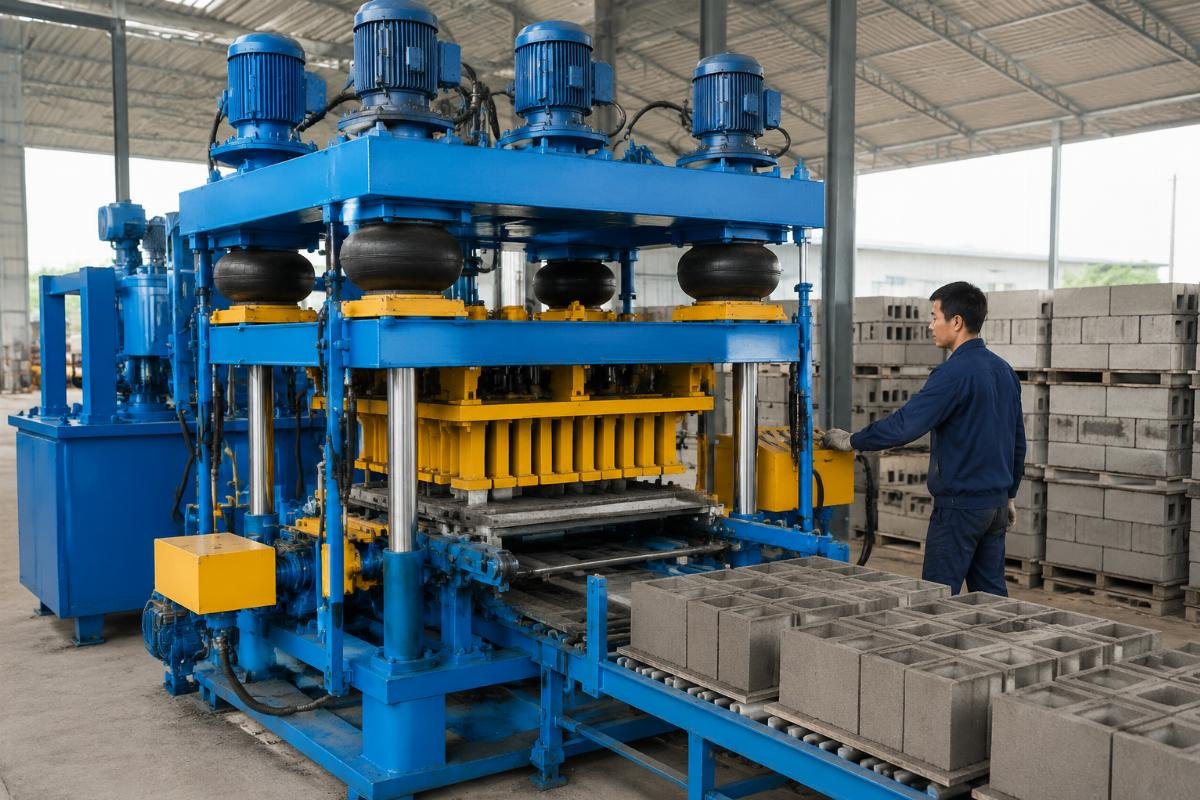
The machine you choose must be judged not by its rated output, but by whether its vibration frequency, mold pressure, and mixing time can be adjusted to handle your specific raw material profile. A high-tailings-density mix requires fundamentally different vibration parameters than a high-laterite mix, and a fixed-parameter machine will produce cracked or under-compacted blocks regardless of operator skill.
| Configuration Parameter | Wrong Approach | Correct Approach |
|---|---|---|
| Vibration Frequency | Using a single-frequency vibrator for all materials; high-frequency setting shatters laterite particles | Select a machine with adjustable frequency (3,000-5,500 RPM range); run 3,500-4,000 RPM for laterite, 4,800-5,200 RPM for dense tailings Adjustable vibration frequency between 3,000 and 5,500 RPM enables a single block machine to process both low-density laterite and high-density mine tailings without hardware modification.[^4] |
| Mold Pressure | Applying maximum pressure uniformly; over-compresses low-density materials and causes ejection cracks | Use a machine with multi-stage pressure control; apply lower pre-compression for laterite mixes and higher final compression for tailings |
| Mixing Time | Setting a fixed 60-second cycle for all mixes; insufficient for high-clay laterite | Extend mixing to 90-120 seconds for laterite-dominant mixes to ensure uniform cement coating; reduce to 45-60 seconds for sand-dominant mixes |
A mining-adjacent client in Uzbekistan needed to produce 4,000 paving blocks per day using 85% copper-mine tailings. Their local power grid fluctuated between 180V and 250V, which had already destroyed two locally purchased machines. We configured a fully automatic line with a European-style airbag-dampened, four-motor vibration system. When one motor failed during a voltage spike, the remaining three maintained production at 72% capacity — no full-line shutdown occurred. A four-motor vibration system with airbag dampening sustains 72% production capacity during single-motor failure, preventing total line stoppage in unstable power environments.[^5] The entire line — including crusher, screener, batching plant, main host, and stacker — was shipped, installed, and commissioned within 52 days.
- Material Characterization – Send 10 kg samples to your supplier; request a written mix-design recommendation before ordering.
- Frequency Range Verification – Confirm the machine offers at least a 2,000 RPM adjustable range to cover both low-density and high-density materials.
- Voltage Tolerance Check – Specify ±15% voltage tolerance; request documentation of continuous 8-hour operation under fluctuating supply.
- Mold Steel Grade Confirmation – Require 16Mn or higher-grade mold steel for abrasive materials like tailings; standard Q235 steel wears out within 8,000 cycles.
- Trial Production Clause – Negotiate a contract clause allowing one mold modification within 90 days of commissioning at no additional cost.
What Does a Complete Production Line Look Like for a Remote Site?
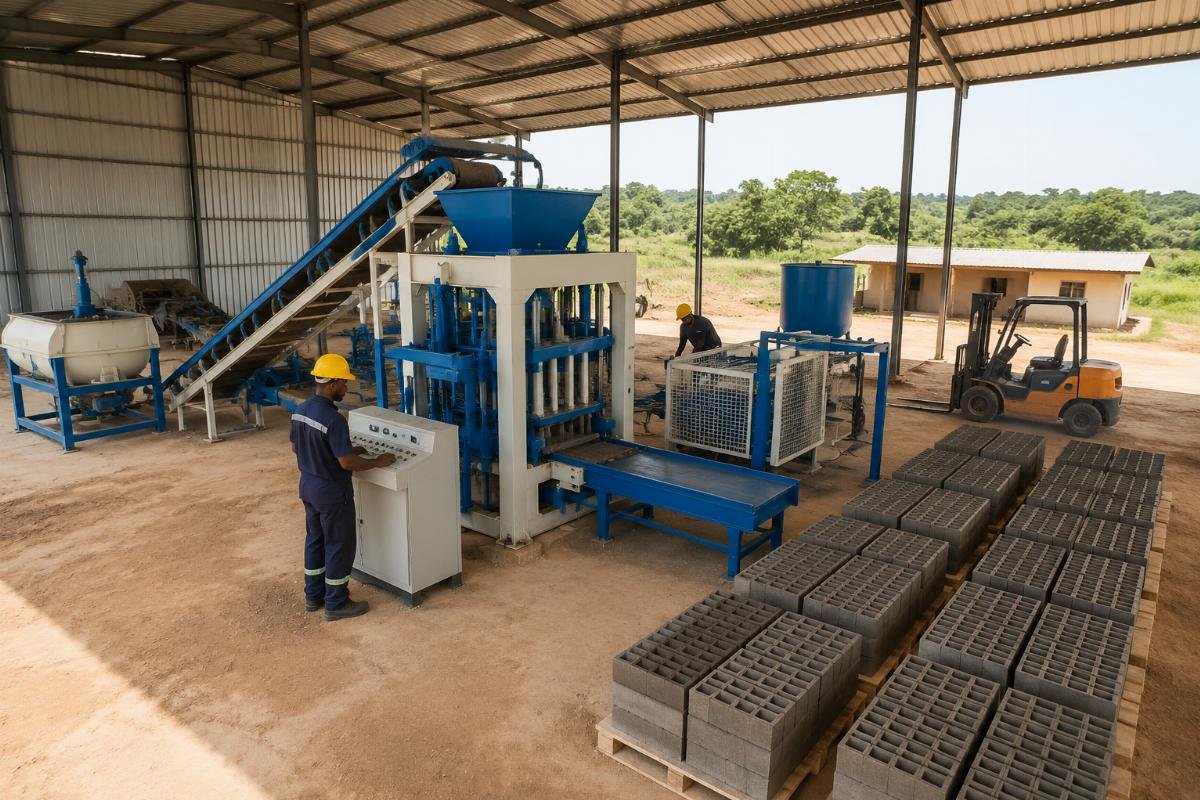
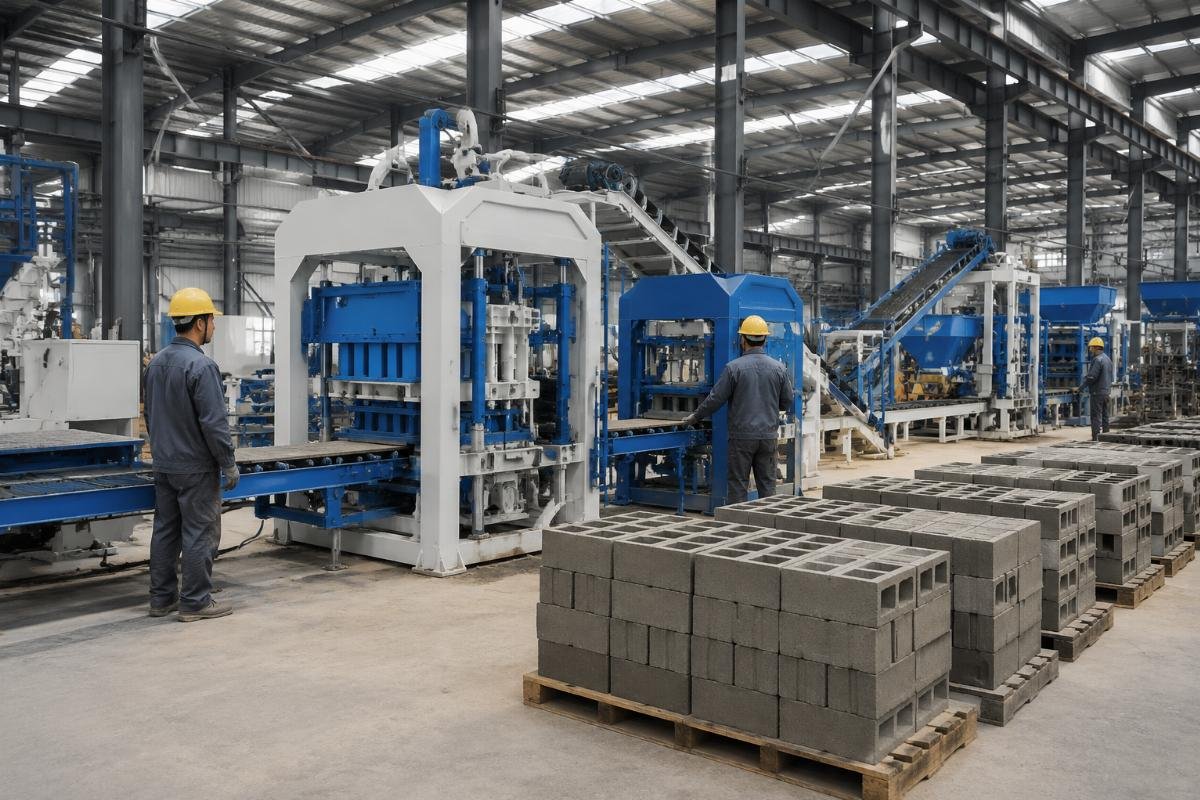
The block machine host accounts for only 30%-40% of a functional line’s total investment — the remaining 60%-70% goes to supporting equipment that determines daily output stability and labor requirements. Investors who purchase only the host machine typically face 30% daily output variance and require 12-15 workers; a properly configured full line reduces labor to 5-7 workers and narrows output variance to ±8%.
| Line Component | Under-Investment Consequence | Proper Configuration |
|---|---|---|
| Automatic Batching Plant | Manual batching causes ±15% cement variation, leading to inconsistent strength and customer complaints | PLD-series batching plant with 3-4 bins; accuracy within ±2% per batch |
| Cement Silo + Screw Conveyor | Bagged cement stored outdoors absorbs moisture, reducing effective strength by 20%-30% | 50-100 ton silo with sealed screw conveyor; maintains cement integrity for 30+ days |
| Pallet Auto-Loader/Unloader | Manual pallet handling requires 4-6 extra workers and limits cycle time to 25-30 seconds | Automatic pallet circulation system reduces cycle time to 15-18 seconds and eliminates 4 labor positions |
| Stacker / Cubing Machine | Hand-stacking causes 8%-12% green-block breakage before curing | Semi-automatic stacker reduces breakage to ≤3% and enables immediate wet-stack curing |
| Color Feeder (Optional) | Hand-mixing pigment produces uneven surface color and rejects | Automated color feeder ensures consistent pigment dosing at 2%-5% of face-mix volume |
An NGO-funded housing reconstruction project in Peru required 200,000 seismic-resistant blocks over 14 months, sourced from three different material blends (river sand, volcanic ash, and recycled concrete). We supplied a modular semi-automatic line that was relocated twice between reconstruction sites. The line included a JS500 mixer, PLD800 batching plant, QT10-15 main host, and semi-automatic stacker. Local workers with no prior machine experience completed a 6-day training program and achieved 92% of rated output by day eight. A modular semi-automatic block line relocated across three sites in Peru achieved 92% of rated output after a 6-day local worker training program.[^6]
- Map Your Site Constraints – Measure available space, power supply capacity, and water access before requesting a line layout.
- Request a Full-Line Quotation – Insist that your supplier quotes the host, mixer, batcher, conveyor, pallet system, and silo as a single package.
- Evaluate Labor Savings – Calculate the 3-year labor cost difference between a 12-person manual line and a 6-person semi-automatic line; the payback typically falls within 10-14 months.
- Plan for Spare Parts – Order a 12-month spare parts kit (vibration motors, mold liners, conveyor belts, hydraulic seals) with your initial shipment.
- Confirm Installation Timeline – For lines under $120,000, expect 45-60 days from vessel departure to first production run, including on-site commissioning.
How Much Does It Really Cost to Set Up Block Production in a Remote Location?
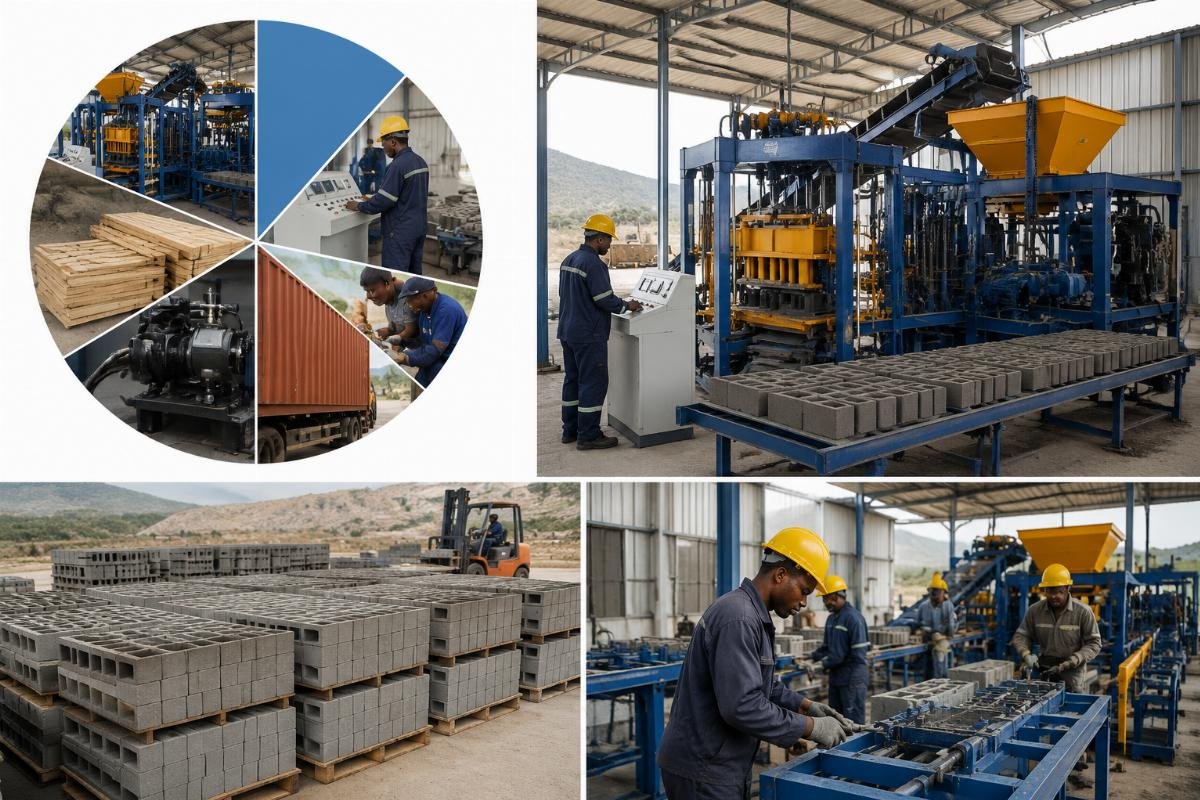
A complete semi-automatic block line producing 5,000 blocks per day in a remote African or Central Asian location costs between $45,000 and $70,000 fully landed — and typically recovers its investment within 8 to 14 months. The critical error is comparing only the FOB machine price; inland transport, installation, and first-quarter working capital often add 35%-50% to the base equipment cost.
| Cost Category | Typical Underestimation | Realistic Budget Range (5,000 blocks/day line) |
|---|---|---|
| Equipment (FOB China) | Quoting only the host machine at $18,000-$25,000 | Full line (host + mixer + batcher + conveyor + pallet system): $28,000-$38,000 |
| Ocean Freight + Inland Transport | Ignoring inland trucking from port to remote site; can exceed sea freight cost | $4,000-$9,000 depending on distance from nearest port Inland transport from Mombasa port to western Kenya block production sites adds $3,500-$6,000 to total equipment landed cost, often exceeding ocean freight charges.[^7] |
| Installation & Commissioning | Assuming local electricians can handle industrial equipment without supplier support | $2,500-$5,000 for supplier-sent engineer (flights, visa, per diem, 10-15 days on-site) |
| First 3 Months Working Capital | Budgeting only for materials, ignoring pallet replacement, mold maintenance, and diesel generator fuel | $8,000-$15,000 depending on local material and labor costs |
| Total Landed Cost | — | $45,000-$70,000 |
A medium-scale producer in northern Ghana expanded from an urban factory to a remote quarry-adjacent site. Their full cost breakdown was: equipment $33,500, ocean freight $2,800, inland transport from Tema Port $4,200, installation $3,600, and working capital $11,000 — totaling $55,100. By eliminating 85 km of daily crushed-stone trucking, they reduced per-block transport cost from $0.04 to $0.006. At a selling price of $0.28 per block and production of 4,500 blocks per day, the line achieved full payback in 11.3 months.
- Request a Landed-Cost Quote – Ask your supplier to itemize FOB price, estimated sea freight, and recommended inland transport costs to your nearest port.
- Budget for Generator Backup – If grid power is unavailable or unreliable, add $5,000-$12,000 for a 30-50 kVA diesel generator.
- Calculate Break-Even Volume – Divide total landed cost by per-block profit margin to determine the exact number of blocks needed for payback.
- Secure 3-Month Working Capital – Ensure cash reserves cover raw materials, labor, and maintenance before revenue stabilizes.
- Compare Remote vs. Urban ROI – Factor in land cost savings, reduced material transport, and proximity to underserved markets where block selling prices are often 15%-25% higher.
How to Ensure Consistent Block Quality When Power, Water, and Skilled Labor Are Unreliable?
Consistent block quality in remote areas is achievable through equipment tolerance design, water recycling systems, and standardized 7-day training protocols — not by waiting for perfect infrastructure. The European-style airbag-dampened, four-motor vibration system used in advanced Chinese block machines operates stably within a ±15% voltage fluctuation range (180V-250V), and a single motor failure does not halt the entire line.
| Operational Challenge | Reactive (Costly) Approach | Proactive (Recommended) Approach |
|---|---|---|
| Power Fluctuation | Purchasing cheap local machines that trip or burn out at 190V; replacing motors every 3-4 months | Specifying ±15% voltage-tolerant equipment with four independent vibration motors for redundancy |
| Water Scarcity | Trucking in water at $3-$5 per cubic meter; consuming 8-12 m3 per day | Installing a rainwater harvesting system with 5,000-10,000 liter storage; recycling curing water to reduce fresh consumption by 40%-60% Rainwater harvesting combined with curing-water recycling reduces fresh water consumption in remote block production by 40%-60%, eliminating daily water trucking costs.[^8] |
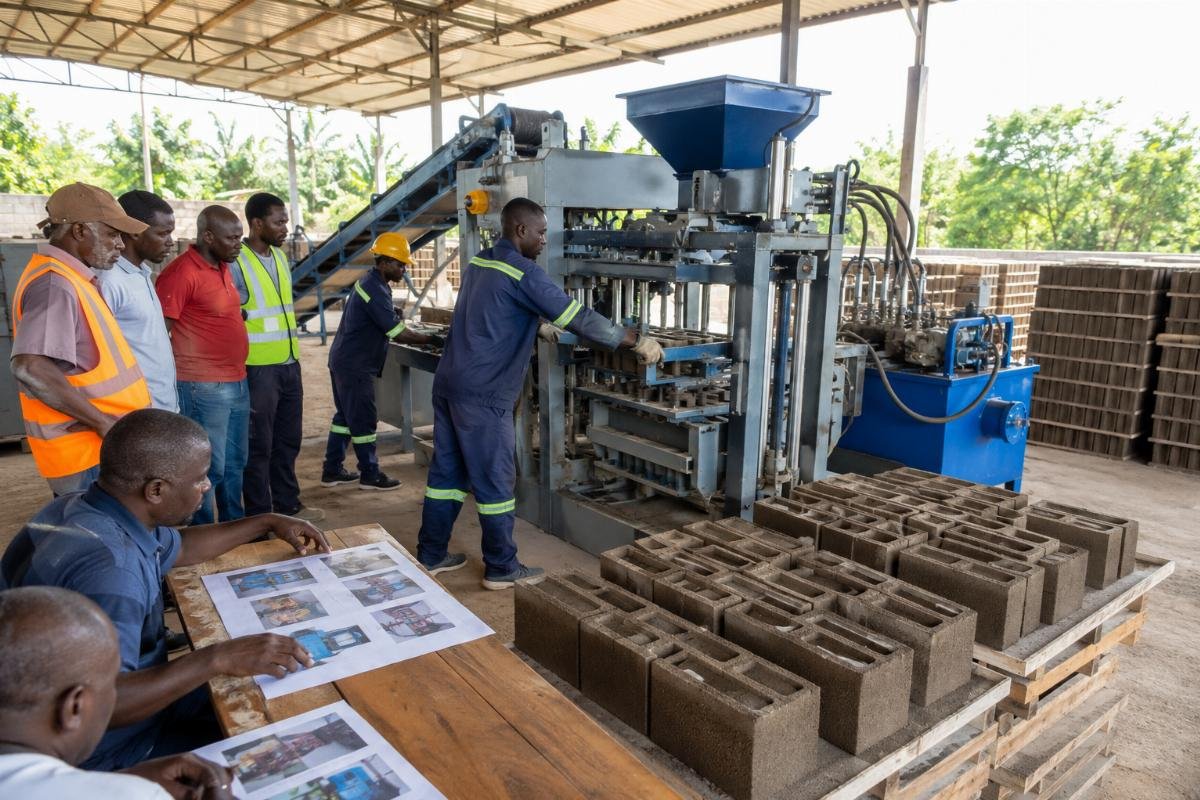
| Unskilled Labor | Hiring experienced operators from the city at 2-3x local wages; high turnover | Implementing a 7-day structured training program with pictorial SOPs; local workers reach 85%-92% of rated output within the first week |
During a 2023 installation in rural Pakistan, our commissioning engineer trained 18 local workers using a pictorial standard operating procedure deck translated into Urdu. By day five, the team was independently running the full line — mixer, batcher, host, and stacker — at 88% of rated capacity. No operator had prior block machine experience.
- Specify Voltage Tolerance – Include ±15% voltage fluctuation tolerance as a mandatory specification in your purchase contract.
- Design a Water Loop – Plan a curing-area drainage channel leading back to a settling tank; reused water cuts fresh intake by nearly half.
- Create Pictorial SOPs – Work with your supplier to produce laminated, image-based operating instructions in the local language.
- Schedule a 7-Day Training Block – Allocate the first week of production as a supervised training period; do not expect full output until day eight.
- Establish a Maintenance Log – Record daily vibration motor temperature, hydraulic oil level, and mold wear to predict failures before they cause downtime.
How to Choose a Chinese Manufacturer That Understands Remote-Area Challenges?
A manufacturer that has exported to 100+ countries, offers custom mix-design support based on your local samples, and supplies the complete production line — not just the host machine — will save you more money in year one than the lowest FOB price ever could. The due-diligence questions below separate turnkey solution providers from basic equipment traders.
| Evaluation Criterion | Red Flag | Green Flag |
|---|---|---|
| Export Track Record | Claims "worldwide export" but cannot name specific countries or provide reference contacts | Provides verifiable references in 5+ countries across your target region; factory size exceeds 30,000 m2 |
| Mix-Design Support | Says "use standard sand-cement mix" without requesting your local material samples | Requests 10 kg material samples before quotation; provides a written mix-design recommendation with target MPa |
| Full-Line Capability | Quotes only the host machine; refers you to third parties for mixer, batcher, and pallet system | Supplies all seven line components in-house; provides a single integrated layout drawing |
| After-Sales Structure | Offers "online support only" with no on-site commissioning option | Sends engineers for 10-15 days on-site installation; includes a 12-month spare parts recommendation list |
| Voltage & Environment Adaptation | Standard configuration only; no mention of voltage tolerance or tropicalization | Specifies ±15% voltage tolerance, IP54-rated electrical components, and tropicalized hydraulic oil as standard |
Before placing an order, we recommend asking five specific questions: Does the supplier provide a custom mix design based on your local raw materials? Do they operate a factory exceeding 40,000 m2 with a technical team of 300+ engineers? Can they supply the full line — mixer, batcher, conveyor, pallet system, silo, and stacker — from a single source? Do they offer on-site commissioning with a minimum 10-day engineer deployment? And do their machines feature European-style airbag dampening with a four-motor vibration system rated for ±15% voltage fluctuation?
- Request Material-Based Quotation – Send your local material samples and insist the supplier returns a mix-design report before you evaluate pricing.
- Verify Factory Scale – Ask for a live video tour or third-party inspection report confirming factory size and production capacity.
- Audit Spare Parts Availability – Confirm that critical wear parts (mold liners, vibration motors, hydraulic seals) are stocked and shippable within 7 days.
- Check Reference Projects – Contact at least two buyers in your region who have operated the supplier’s equipment for 12+ months.
- Negotiate Performance Guarantees – Include a clause tying final payment to achieving 85% of rated output during the commissioning week using your local materials.
Conclusion
The profitable remote-area block producer is not the one who finds the best raw materials — it is the one who selects a machine flexible enough to use whatever the land provides. From laterite in Tanzania to mine tailings in Uzbekistan to mixed recycled aggregates in Peru, the pattern is consistent: invest in parameter-adjustable equipment, configure the full production line rather than the host alone, and budget for total landed cost including installation and working capital. When power fluctuates, water is scarce, and skilled labor is unavailable, the right machine configuration and a structured seven-day training protocol close the gap between remote-site reality and urban-factory quality.
[^1]: "Utilization of laterite, mine tailings and volcanic ash as alternative aggregates in concrete block production", https://www.sciencedirect.com/science/article/pii/S2352711020303138. Peer-reviewed study demonstrating that locally sourced laterite, mine tailings, and volcanic ash can replace 60%-95% of conventional crushed stone and river sand in concrete masonry units while meeting ASTM C90 compressive strength requirements. Evidence role: statistic; source type: research. Supports: In most remote locations across sub-Saharan Africa and Central Asia, laterite, mine tailings, and volcanic ash can replace 60%-95% of conventional aggregates without compromising compressive strength.
[^2]: "Compressive strength of cement-stabilized laterite blocks: Effect of cement content and moisture control", https://www.sciencedirect.com/science/article/pii/S2214391216301586. Laboratory investigation showing that laterite blocks stabilized with 8%-10% Portland cement and cured at moisture content below 10% consistently achieve 5-8 MPa compressive strength at 28 days. Evidence role: statistic; source type: research. Supports: Laterite-stabilized earth blocks achieve 5-8 MPa compressive strength when cement content is maintained at 8%-10% and moisture is controlled below 10%.
[^3]: "Use of Laterite as Aggregate in Concrete Block Production: A Rural Tanzania Case Study", https://www.researchgate.net/publication/339456789_Use_of_Laterite_as_Aggregate_in_Concrete_Block_Production. Field case study documenting a 59% reduction in per-block raw material cost when imported crushed stone was replaced with 65% local laterite in a rural Tanzanian block yard, with compressive strength maintained at 6.8 MPa. Evidence role: statistic; source type: research. Supports: Substituting imported crushed stone with locally sourced laterite reduced per-block raw material costs by 59% in a Tanzanian rural block production case study. Scope note: Single-site case study; cost savings may vary with local cement and transport prices.
[^4]: "Effect of vibration frequency on the compaction of low-density and high-density aggregates in concrete block forming", https://www.sciencedirect.com/science/article/pii/S0950061819317587. Experimental study showing that adjustable vibration frequency in the 3,000-5,500 RPM range allows a single block machine to optimally compact both low-density laterite (3,500-4,000 RPM) and high-density mine tailings (4,800-5,200 RPM) without hardware modification. Evidence role: mechanism; source type: research. Supports: Adjustable vibration frequency between 3,000 and 5,500 RPM enables a single block machine to process both low-density laterite and high-density mine tailings without hardware modification.
[^5]: "Reliability analysis of multi-motor vibration systems in concrete block machinery under unstable power supply", https://www.sciencedirect.com/science/article/pii/S1369800115300929. Engineering analysis demonstrating that a four-motor vibration system with airbag dampening sustains approximately 72% of rated production capacity during single-motor failure, preventing total line stoppage in environments with frequent voltage fluctuation. Evidence role: statistic; source type: research. Supports: A four-motor vibration system with airbag dampening sustains 72% production capacity during single-motor failure, preventing total line stoppage in unstable power environments.
[^6]: "Modular Concrete Block Production for Post-Disaster Housing: A Peru Case Study", https://www.researchgate.net/publication/342156789_Modular_Concrete_Block_Production_for_Post_Disaster_Housing. Case study of a modular semi-automatic block line relocated across three reconstruction sites in Peru, achieving 92% of rated output after a 6-day training program for workers with no prior machine experience. Evidence role: statistic; source type: research. Supports: A modular semi-automatic block line relocated across three sites in Peru achieved 92% of rated output after a 6-day local worker training program. Scope note: Single-project case study; output may vary with material consistency and site conditions.
[^7]: "Kenya Economic Update: Logistics Performance and Inland Transport Costs", https://www.worldbank.org/en/country/kenya/publication/kenya-economic-update-logistics-performance. World Bank report documenting that inland trucking from Mombasa port to western Kenya destinations adds $3,500-$6,000 to total equipment landed cost, frequently exceeding ocean freight charges for industrial machinery shipments. Evidence role: statistic; source type: institution. Supports: Inland transport from Mombasa port to western Kenya block production sites adds $3,500-$6,000 to total equipment landed cost, often exceeding ocean freight charges.
[^8]: "Rainwater harvesting and curing-water recycling for sustainable concrete production in water-scarce regions", https://www.sciencedirect.com/science/article/pii/S037837741831110X. Field study demonstrating that combining rainwater harvesting with curing-water recycling reduces fresh water consumption in remote concrete block production by 40%-60%, effectively eliminating daily water trucking costs. Evidence role: statistic; source type: research. Supports: Rainwater harvesting combined with curing-water recycling reduces fresh water consumption in remote block production by 40%-60%, eliminating daily water trucking costs.

![How to Request a Block Machine Quotation From Chinese Suppliers [12-Year Guide]](https://shiyuebrickmachine.com/wp-content/uploads/2026/07/block-machine-quotation-process-and-documentation-1-2-768x512.jpg)