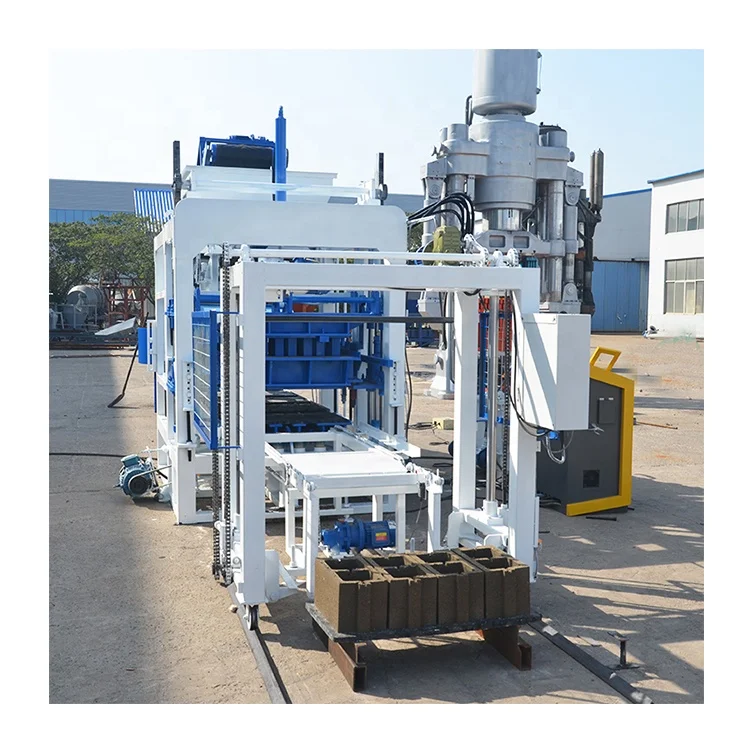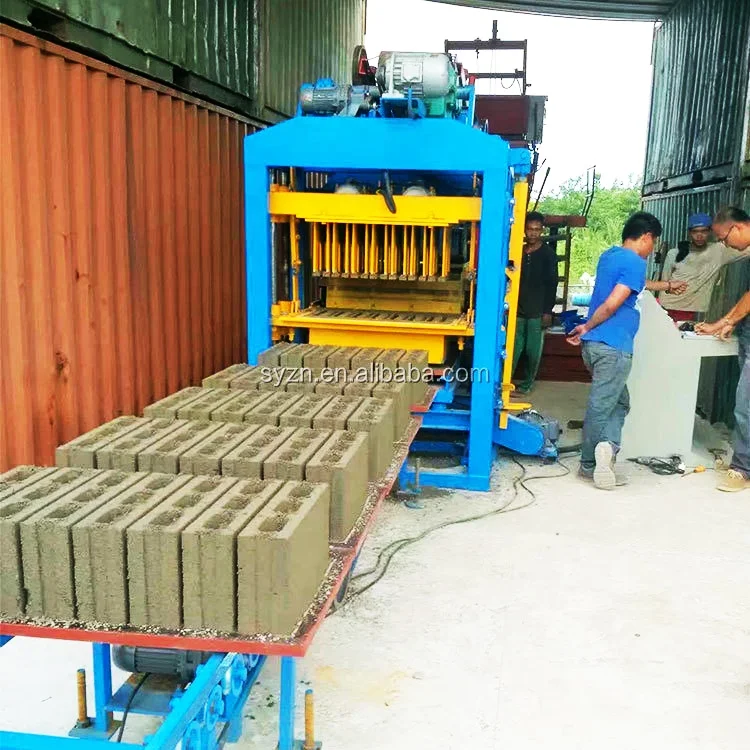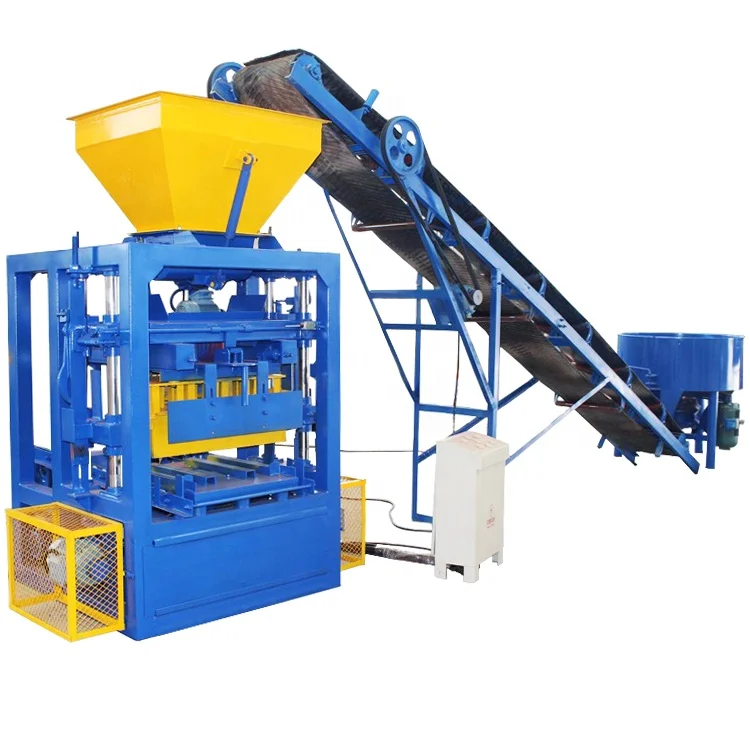
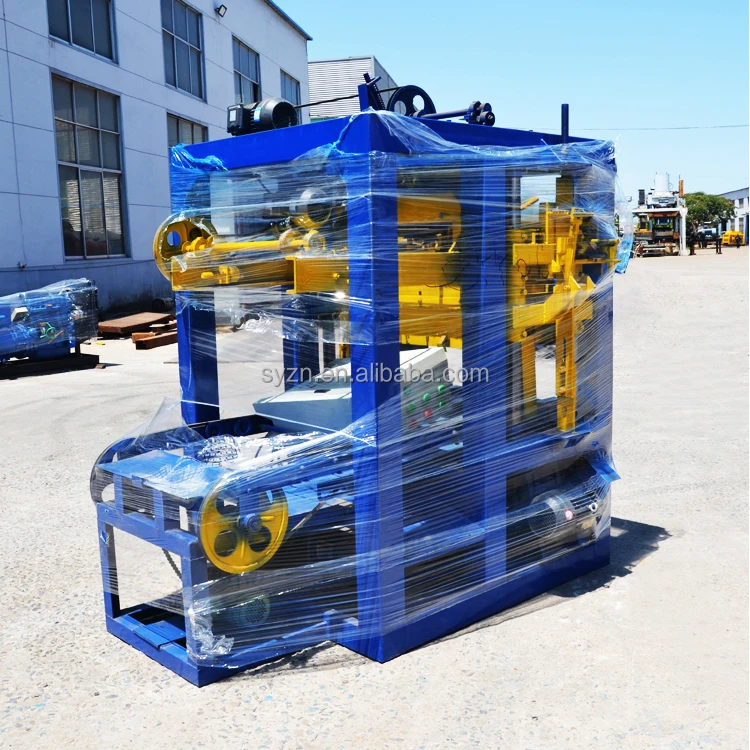
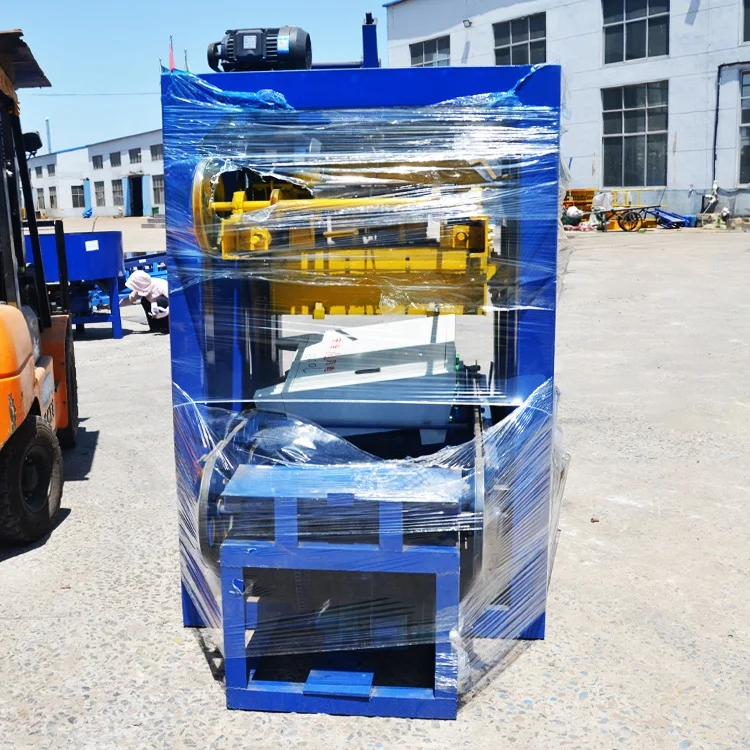
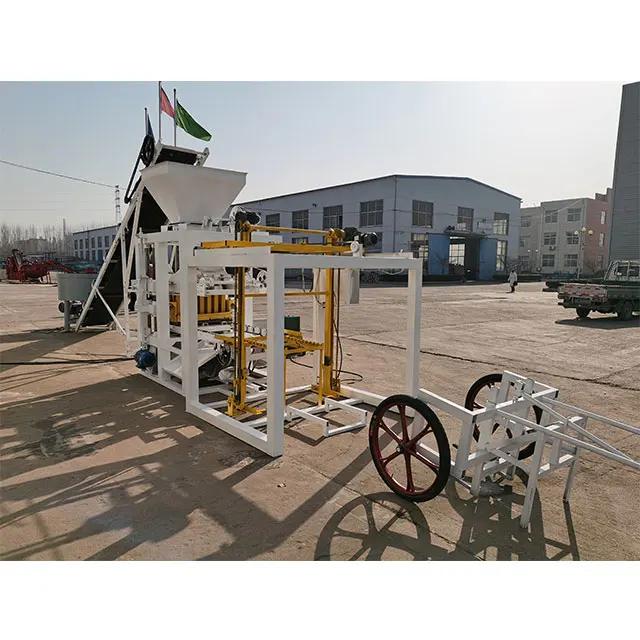


Description
Mould-Matched Capacity — every QTJ4-26 output figure is tied to a specific hollow block or solid brick size, so your daily plan reflects the format your market actually buys.
Technical Specifications
| Parameter | Value |
|---|---|
| Model | QTJ4-26 |
| Product Type | Concrete Block Making Machine |
| Overall Dimensions (L×W×H) | 2060×1730×2580 mm |
| Molding Cycle | 26 s |
| Vibration Frequency | 4200 r/min |
| Vibration Force (Exciting Power) | 35.5 kN |
| Total Power | 14.25 kW |
| Mixer Model | JQ350 |
| Pallet Size | 850×450×20 mm |
| Net Weight | 1800 kg |
| Automation Level | Semi-automatic, four guide pillars with automatic mould movement |
| Output — Hollow Block 390×190×190 mm | 4 pcs/mould, 480 pcs/h, 3800 pcs/8 hr |
| Output — Hollow Block 400×150×200 mm | 5 pcs/mould, 600 pcs/h, 4800 pcs/8 hr |
| Output — Solid Brick 240×115×53 mm | 18 pcs/mould, 2100 pcs/h, 17000 pcs/8 hr |
| Applied Products | Concrete hollow blocks (8 inch, 6 inch), solid bricks |
| Raw Materials | Crushed stones, sand, cement, dust, fly ash |
| Voltage & Frequency | To be confirmed before shipment |
| Control System | To be confirmed (PLC or relay type) |
| Certification | CE (verify unit-level declaration) |
Application Suitability
| Application | Material or Output |
|---|---|
| Small block plant producing 8-inch hollow blocks | Crushed stone, sand, cement, fly ash mix — 390×190×190 mm format at 4 pcs per cycle |
| Medium plant adding 6-inch hollow blocks to product range | Same aggregate base — 400×150×200 mm format at 5 pcs per cycle |
| On-site solid brick production for housing projects | Local sand and cement — 240×115×53 mm format at 18 pcs per cycle |
| First block plant for entrepreneurs with defined local format | Adjustable across hollow and solid formats depending on mould fitted |
Why the Block Format Decides What "Daily Output" Really Means on the QTJ4-26 Concrete Block Making Machine
Capacity without a named block size is a number you cannot plan around.
I have watched contractors in Lusaka uncrate a machine, run it for a week, and realize the quoted hourly output assumed a solid brick format while their entire order book was for 8-inch hollow blocks. The gap between the brochure figure and the actual pallet count on the curing rack can be substantial, and no amount of operator effort closes it. The QTJ4-26 concrete block making machine specifications here list three reference formats with their individual cycle counts, so you can match the machine to the format your buyers pay for — not a headline number that hides the assumption [NEED_CITE: block format and cycle time relationship in semi-automatic production].
Mould Selection and the Formats Your Market Actually Sells
The QTJ4-26 ships with moulds for 390×190×190 mm and 400×150×200 mm hollow blocks as well as 240×115×53 mm solid bricks. If your local market runs a different dimension — say a 6-inch block with non-standard height — a custom mould can be designed to buyer drawings. The 26-second molding cycle applies across formats, but the pieces per mould change with each cavity layout, which is why output must always be restated per format.
Matching Vibration Force to Your Local Aggregate
In my experience across sites in Kumasi and Lusaka, the sand and crushed stone available locally often carry higher clay content than the reference mix a machine was tested on. The 35.5 kN vibration force at 4200 r/min on the QTJ4-26 was set with standard aggregates in mind. When your actual mix deviates, the vibration and any applied pressure must be checked against that mix to ensure block density and strength meet local construction standards [NEED_CITE: vibration force requirements relative to aggregate gradation and clay content].
Reading the Specs That Decide Daily Reality
The 850×450×20 mm pallet size governs how many blocks sit on each board and how those boards stack in your curing area. If your existing racks or forklift were sized for a different pallet, you will be rearranging the curing yard before the first production run. The JQ350 mixer feeds the press, and its batch volume must align with the 26-second cycle so the mould is never waiting for material. Total power at 14.25 kW places the QTJ4-26 concrete block making machine specifications within reach of a standard three-phase industrial supply, but the exact voltage and frequency must be confirmed against your site’s transformer capacity before the machine enters production. The four guide pillars with semi-automatic mould movement keep alignment repeatable across shifts, reducing the chance that a worn guide produces uneven wall thickness in hollow blocks.
What Happens When the Pallet and Curing Area Are an Afterthought
A buyer in West Africa once told me his block line ran fine for two weeks until the curing racks could not accept the pallets the machine was producing. The boards piled up on the floor, blocks cured unevenly, and breakage during handling wiped out a meaningful share of output. Pallet dimensions, curing rack spacing, and forklift fork width must all agree before the first cycle runs [NEED_CITE: pallet handling and curing rack compatibility in block production]. When the pallet size is chosen without that check, the press itself is not the bottleneck — the downstream handling is.
Why Sourcing the QTJ4-26 Through a Format-Focused Line
Machine, mould, pallet, and handling are specified as one matched set rather than assembled from separate suppliers, which means the pallet size and mould cavity count are decided together against your target format. The configuration is set against your actual mix design and local aggregate, not a catalogue default, so the vibration force is validated for the material you can actually source. Mould design covers the formats your market sells, and custom drawings are available when standard sizes do not match. Automation level is selectable, letting you start with the semi-automatic QTJ4-26 and plan an upgrade path if volume grows. Installation support includes operator training so the crew knows the mould change procedure and daily maintenance points from the first shift.
Documentation & Verification
- Line layout with capacity calculation naming your chosen block format and cycle time
- Mould drawing and format list showing every cavity size included in your order
- Pallet specification sheet cross-referenced to your curing rack dimensions
- Voltage, frequency, and control language confirmation recorded before production starts
- Factory test record run on your specified block format before dispatch
- Operation and maintenance manual with wear parts and mould replacement list
Installation, Commissioning & Support
- Foundation pad sized to the 2060×1730 mm footprint with vibration isolation consideration
- Three-phase power supply confirmed to match the 14.25 kW total draw and site voltage
- Machine arrives with mould and pallet set matched to your confirmed block format
- First-cycle commissioning run verifies molding cycle and block dimensions on your mix
- Operator training covers the four-pillar guide system and semi-automatic mould movement
- Wear parts list and mould maintenance schedule provided at handover
What to Include in Your QTJ4-26 Inquiry
Tell us the exact hollow block or solid brick dimensions your market buys, along with the daily volume you need per format. Share a sample or description of your local sand, crushed stone, and any fly ash you plan to use so the vibration setting can be matched. Confirm your site voltage, frequency, and the PLC display language your operators will need before we finalize the QTJ4-26 concrete block making machine specifications for your order.
Frequently Asked Questions
Q: How do I verify real daily output for my specific block format on the QTJ4-26?
A: We provide a capacity calculation that names your exact block dimensions, pieces per mould, and the 26-second cycle time. This gives you a per-format hourly and eight-hour figure rather than a single headline number, so your production plan reflects the blocks you actually sell.
Q: Which mould formats are available and what is the cycle time for each?
A: Standard moulds cover 390×190×190 mm and 400×150×200 mm hollow blocks plus 240×115×53 mm solid bricks. The molding cycle is 26 seconds across all formats, but pieces per mould vary — 4, 5, and 18 respectively — which changes the hourly output for each block type.
Q: How do I confirm pallet size against my existing curing area and handling equipment?
A: The standard pallet measures 850×450×20 mm. Share your curing rack spacing and forklift fork dimensions so we can verify compatibility or adjust the pallet specification before production, avoiding downstream handling bottlenecks after the machine arrives.
Q: What mix design and local aggregate does the machine configuration assume?
A: The vibration force of 35.5 kN at 4200 r/min is calibrated for standard crushed stone and sand mixes. We ask for details on your local aggregate — including clay content and gradation — so the machine can be set to produce blocks that meet your market’s strength requirements.
Q: How long does a mould change take and what tools are required on-site?
A: The QTJ4-26 uses a four guide pillar system with semi-automatic mould movement. Mould change time depends on operator familiarity, so we include the procedure in operator training and specify the hand tools needed so your crew can switch formats within a single shift.