Buy Brick Machine for Distributors | QT10-15/12-15 Wholesale Supplier
The real margin in brick machine distribution hides in spare parts, not the mainframe.
Sourcing a brick machine as a distributor is not about chasing the lowest unit price—it is about mastering trade term decomposition, OEM flexibility, and the long-term profit structure built on spare parts replenishment. A distributor who only negotiates the CIF headline price will quietly lose logistics leverage, while one who controls EXW/FOB/CIF breakdowns, container loading ratios, and dealer margin architecture will compound profits across every reorder cycle.
I still remember standing at the Frankfurt airport after Bauma, flipping through a revised quotation for a German distributor who had spent half an hour staring at the CIF Hamburg line for a mid-range block line. His question was not about the machine—it was about whether the freight gap between FOB Qingdao and CIF Hamburg could be split so he could nominate his own forwarder. That single question reshaped how I structure every quotation going forward: EXW, FOB, and CIF must sit side by side on the first page, spare parts listed separately, and payment terms clearly mapping the switch points between L/C and T/T. Distributors do not need another machine brochure—they need a quotation that lets them run the numbers themselves [NEED_CITE: Incoterms 2020 allocation of cost and risk between buyer and seller].
If you are evaluating how to buy a brick machine for distribution purposes, the framework below covers the trade terms, container loading logic, OEM options, after-sales depth, and model selection that separate profitable dealers from those who burn through their first container.
What Trade Terms Should Distributors Request from Brick Machine Suppliers?
Always demand a three-column EXW/FOB/CIF comparison from your brick machine supplier before committing to any order. The reason is straightforward: a bundled CIF quote removes your visibility on freight, insurance, and handling charges, effectively handing logistics pricing power to the seller. Over time, that opacity erodes your landed-cost competitiveness against local rivals who control their own forwarding.
When a distributor asks a brick machine supplier to separate EXW, FOB, and CIF, three things happen. First, the factory price becomes transparent—you see exactly what the machine costs before any logistics layer is added. Second, you gain the ability to compare freight options across multiple forwarders rather than accepting a single embedded rate. Third, you create a benchmark for future orders: if ocean freight drops, your CIF quote should drop with it, and only a decomposed quotation lets you verify that [NEED_CITE: ICC Incoterms 2020 rules on cost and risk transfer points for EXW FOB and CIF].
A West African distributor I worked with placed a first-order semi-automatic block line. Instead of accepting a single CIF figure, he requested the full three-column breakdown. The result was not just a lower landed cost—he used the FOB figure to negotiate a volume freight contract with a regional shipping line, which then applied to his spare parts reorder shipments for the next several cycles. The savings on logistics alone covered the cost of his initial spare parts package.
Here is the risk checklist every distributor should run before signing:
- Confirm whether the CIF quote includes terminal handling charges at both load and discharge ports, or whether those are billed separately.
- Verify whether marine insurance covers all-risk or only free-from-particular-average terms, and whether the coverage ceiling matches the replacement value of the mainframe.
- Ask whether the FOB price includes export customs clearance, port surcharges, and inland trucking to the load port—some brick machine supplier quotations quietly exclude these.
- Clarify the currency settlement window: if the exchange rate moves between order placement and shipment, who absorbs the difference?
Distributors who treat trade terms as a one-line negotiation point leave money on the table. Those who decompose the quotation build a repeatable cost model that strengthens with every reorder.
How to Structure Dealer Pricing and Container Loading for Maximum Margin?
The profit structure of a brick machine distributor is built on a simple principle: mainframes drive volume, spare parts drive margin. A single container loaded only with a mainframe may win an order, but it leaves the distributor with a thin margin and no recurring revenue stream until the next machine sale. The real skill lies in designing a mixed-load container that balances the mainframe, molds, and high-wear spare parts into a single shipment.
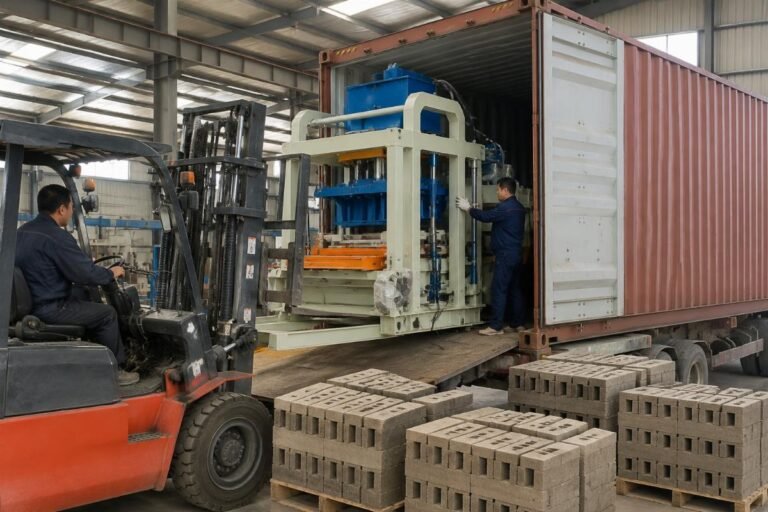
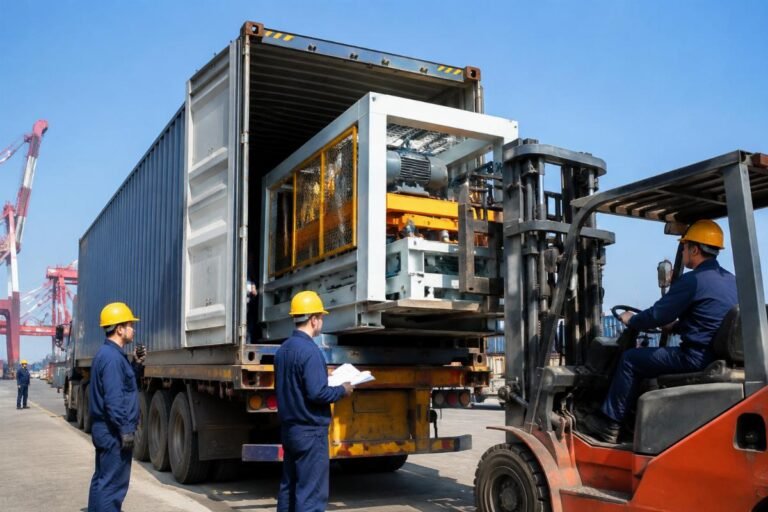
The loading logic works like this. A fully automatic block line occupies significant volume—the mainframe, the pallet system, the batcher, the conveyor, and the stacker together fill most of a 40HQ. But the space above the mainframe, inside the mold crates, and around the pallet stacks is usable for spare parts: mixer wear liners, hydraulic seals, vibration motor brushes, pallet feed rollers, and mold inserts. A distributor who plans the loading sequence with the brick machine supplier’s packing team can push the spare parts fill rate from a nominal fraction to a meaningful portion of the container without adding a second shipment.
A Latin American dealer once restructured his first container from a mainframe-only load to a mixed configuration. He added a full set of alternative molds for paver and curbstone production, plus a six-month consumption package of hydraulic hoses, seals, and mixer blades. The incremental freight cost was marginal because the parts filled dead space. But when his end customers needed mold swaps or wear replacements within the first months of operation, he had stock on hand—turning what would have been an emergency air-freight order into a high-margin local sale.
The pricing conversation with your brick machine supplier should follow the same logic. Negotiate the mainframe at a competitive dealer price that lets you win projects, but structure the spare parts pricing to protect your replenishment margin. Most experienced distributors treat the mainframe as a customer-acquisition tool and the spare parts catalog as their recurring profit engine. The dealer who underprices spare parts to win the machine sale is financing his own future margin erosion.
Key loading variables to confirm with your brick machine supplier before container sealing:
- Whether the mold crates are designed for nested loading or require flat stacking, which directly affects how many mold sets fit alongside the mainframe.
- Whether spare parts are palletized or loose-loaded, and whether the factory can label each crate with the distributor’s warehouse code for faster receiving.
- Whether the packing list separates mainframe components, molds, and spare parts into distinct line items—critical for customs clearance in markets where machinery and consumables face different duty rates.
- Whether the factory offers a container loading diagram before sealing, so the distributor can verify the fill plan matches the agreed mix.
Distributors who master container loading turn every shipment into a margin optimization exercise. Those who ship mainframes alone are leaving both freight efficiency and recurring revenue on the table.
What OEM and Private-Label Options Are Available for Distributors?
A brick machine supplier that cannot support OEM customization is not a distribution partner—it is a transactional vendor. Distributors selling under their own brand need more than a logo on the control panel. They need voltage adaptation, color scheme matching, mold geometry customization, and packaging that reflects their local market identity. The depth of OEM capability directly determines whether a distributor can build brand equity or remains a price competitor in a commoditized market.
The OEM conversation with a brick machine supplier typically covers four layers. The first is electrical: voltage and frequency must match the destination market. Markets with unstable grids may also require reinforced contactors, oversized cable sizing, or surge protection modules that are not part of the standard export configuration. The second is visual: control panel color, machine frame paint, and safety guard finishes can be matched to the distributor’s brand palette, but only if the factory’s powder-coating line supports small-batch color changes without imposing prohibitive minimums. The third is functional: mold geometry is the most impactful OEM lever, because local raw material characteristics and preferred block dimensions vary significantly across regions. A distributor serving a market that favors hollow blocks needs a different mold portfolio than one selling solid interlocking pavers. The fourth is packaging: wooden crate branding, sticker placement, and manual language all shape the unboxing experience for the end customer [NEED_CITE: OEM customization dimensions in construction machinery export including voltage color mold and packaging].
A Middle East distributor I collaborated with required a specific shade of industrial yellow for his entire fleet branding, along with control panels labeled in Arabic and English. His brick machine supplier matched the RAL color code, adjusted the HMI language package, and produced wooden crates with his company logo silk-screened on each face. The customization added a modest lead time extension, but the distributor reported that his end customers perceived the equipment as locally supported rather than generically imported—a perception that justified a premium price point.
The critical OEM parameters to lock down before order confirmation:
- Confirm the minimum order quantity for non-standard voltage or color configurations, and whether the brick machine supplier absorbs the tooling cost or passes it through.
- Request a mold sample or 3D drawing approval before production begins—mold geometry errors are the most expensive OEM mistakes to correct after shipment.
- Verify the lead time impact: standard models ship faster, while OEM-customized electrical or visual configurations typically require additional production scheduling.
- Ensure the OEM agreement covers intellectual property boundaries: the distributor’s brand assets should not appear in the supplier’s marketing materials without written consent.
OEM capability is not a luxury—it is the foundation of a distributor’s ability to differentiate, command margin, and build long-term customer loyalty in competitive markets.
How to Evaluate a Brick Machine Supplier’s After-Sales and Spare Parts Capability?
After-sales response speed and spare parts inventory depth determine whether a distributor survives the first year or builds a decade-long business. A brick machine supplier who vanishes after container delivery is a liability, not a partner. Distributors carry the local reputation risk: when a machine goes down, the end customer calls the distributor, not the overseas factory. The distributor’s ability to resolve issues—ideally without waiting for the supplier’s time zone to wake up—defines customer retention and referral rates.
The evaluation framework for after-sales capability rests on three pillars. The first is spare parts availability: does the brick machine supplier maintain a dedicated inventory of wear parts—mixer blades, hydraulic seals, vibration springs, pallet feed rollers, mold wear plates—and can they ship within a defined window after order confirmation? A supplier who stocks common wear parts and offers a standing reorder program lets the distributor maintain local inventory without tying up excessive capital. The second is technical responsiveness: when a fault occurs, can the supplier’s engineering team provide remote diagnostics through video call, wiring schematic review, or PLC parameter adjustment? The best suppliers maintain a dedicated export after-sales desk that operates across time zones, reducing the distributor’s dependency on flying in external technicians. The third is documentation quality: are spare parts catalogs, exploded drawings, and maintenance schedules provided in the distributor’s required language, with part numbers that match the physical labeling on the components? [NEED_CITE: after-sales service quality dimensions in industrial machinery export including spare parts availability technical response and documentation].
A Southeast Asian distributor inherited a block line from a supplier who provided excellent machine quality but zero spare parts structure. Every worn seal or broken mixer blade required a custom order, with lead times measured in weeks. The distributor’s end customers grew frustrated, and the machine’s reputation in the local market suffered—not because the machine was poorly built, but because the support ecosystem was absent. When the distributor switched to a brick machine supplier with a structured spare parts program and a dedicated after-sales channel, his customer complaint rate dropped noticeably, and his reorder frequency for wear parts became predictable and profitable.
Distributor-side after-sales evaluation checklist:
- Request the supplier’s spare parts catalog and verify that wear part numbers are cross-referenced to the machine model, with clear reorder thresholds.
- Ask whether the supplier offers a consignment or standing-order spare parts program, reducing the distributor’s need to pre-purchase large inventories.
- Confirm the remote diagnostic capability: can the supplier’s engineers access the PLC remotely, or at least guide local technicians through structured video troubleshooting?
- Verify whether on-site installation and commissioning support is included in the initial order, and whether the supplier can dispatch technicians for future major maintenance events.
- Check whether the supplier provides a structured training program for the distributor’s own service technicians, building local capability rather than creating permanent dependency.
A distributor’s after-sales capability is only as strong as the spare parts and technical backbone provided by the brick machine supplier. Choose the supplier whose support structure lets you build local reputation, not just sell a machine.
Which Machine Models Offer the Fastest Turnover for Emerging Market Distributors?
In markets with unstable power grids and limited maintenance infrastructure, semi-automatic and mobile brick machines turn faster than fully automatic lines. The instinct of many new distributors is to stock the highest-capacity machine, assuming that maximum output equals maximum demand. The reality in many emerging markets is the opposite: end customers prioritize reliability, simplicity, and the ability to operate without three-phase power stability or a dedicated maintenance team. Semi-automatic and mobile models match these conditions, resulting in faster sales cycles and lower after-sales burden for the distributor.
The model selection logic depends on three market variables. The first is power infrastructure: markets where three-phase power is intermittent or unavailable favor mobile egg-laying machines and semi-automatic models that can run on smaller power envelopes or even diesel-driven configurations. The second is labor cost structure: in markets where labor is abundant and relatively inexpensive, semi-automatic lines that require manual pallet feeding or simple stacking remain economically competitive against fully automatic lines that save labor but demand higher capital outlay and technical maintenance. The third is end-customer profile: government housing contractors and large-scale developers may demand fully automatic PLC-controlled lines for output consistency, while small entrepreneurs and rural block producers prefer entry-level models with quick payback periods and minimal technical complexity [NEED_CITE: brick machine model selection criteria for emerging markets including power stability labor cost and end customer profile].
A distributor in East Africa initially focused his showroom on a fully automatic line, targeting large construction firms. After an extended sales cycle with limited conversion, he added semi-automatic and mobile models to his range. The smaller machines sold within weeks—purchased by individual entrepreneurs setting up neighborhood block yards. The fully automatic line eventually sold to a government contractor, but the turnover velocity of the smaller models generated consistent cash flow and built the distributor’s customer base far more rapidly.
Model selection guidance for distributors:
- Stock semi-automatic models as the core of your range—they address the largest addressable customer segment in most emerging markets and carry the lowest after-sales complexity.
- Keep at least one mobile egg-laying model available for rural and off-grid customers who need production without fixed infrastructure.
- Reserve fully automatic lines for targeted sales efforts toward government and large private contractors, rather than holding them as showroom stock.
- Ensure every model in your range shares common spare parts platforms with the brick machine supplier, so your inventory serves multiple machine types rather than fragmenting across incompatible systems.
Distributors who align their model range with local infrastructure realities sell faster, support more easily, and build deeper customer relationships than those who chase specification sheets.
Conclusion
Buying a brick machine for distribution is a trade architecture exercise, not a price comparison. Decompose your trade terms, optimize your container loading for margin, leverage OEM customization to build brand equity, and select models that match your market’s infrastructure reality. The distributor who masters these dimensions turns every container into a compounding asset, while the one who only negotiates the headline price will always be one freight invoice away from margin erosion.