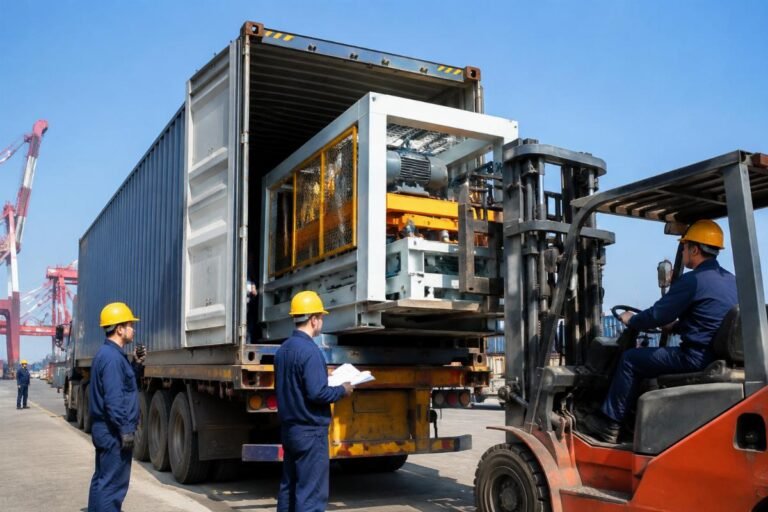
How to Become a Block Machine Distributor
Most people think low price wins the market. The real differentiator is technical localization—voltage adaptation, raw material compatibility, and after-sales infrastructure determine whether buyers reorder or abandon the brand entirely.
Becoming a block machine distributor requires technical translation capability, not just sales volume. You must bridge factory specifications to local site realities—confirming voltage tolerances, stocking critical spare parts, and coordinating on-site commissioning. The financial commitment starts at one to two container loads for territory consideration, with dealer margins ranging from fifteen to twenty-five percent on machines and forty to sixty percent on spare parts and molds.
I still remember the phone call from a West African buyer who’d purchased a QT6-15 line through a trading company. His site ran on 415V power, but nobody verified the motor specifications before shipment. The vibrating motors burned out within weeks. He blamed Chinese manufacturing quality. That failure wasn’t about product—it was about the missing technical verification layer that a proper block machine distributor should provide. [NEED_CITE: voltage mismatch failure rates in emerging market construction equipment]
The difference between order-takers and successful partners lies in understanding hydraulic pressure systems, PLC logic, and local power grid realities. Let me walk you through what actually makes or breaks a distributorship.
What qualifications do you need to become a block machine distributor?
Technical background matters more than sales network—you must understand hydraulic pressure, PLC logic, and local power grids.
Most applicants approach factories with impressive client lists but zero mechanical comprehension. They can sell a machine but cannot troubleshoot why a hydraulic pump cavities or why the PLC displays error codes. When a buyer in Latin America called about abnormal vibration patterns, the "distributor" couldn’t distinguish between unbalanced molds and worn vibration motors. The buyer switched suppliers within months.
The core qualification is the ability to translate factory specifications into local operating conditions. This means:
- Understanding three-phase power systems and voltage tolerance ranges
- Reading hydraulic schematics and identifying pressure relief valve settings
- Interpreting PLC error codes and basic electrical diagnostics
- Assessing local raw material availability—fly ash versus quarry dust versus river sand ratios
- Coordinating with factory engineers on customization requirements
A successful block machine distributor doesn’t need to be a mechanical engineer, but must possess enough technical literacy to ask the right questions before ordering. When a Middle East client requested a QT10-15 line, the distributor confirmed site voltage, frequency, ambient temperature range, and cement type before placing the order. That pre-shipment verification prevented the kind of field failures that destroy reputations.
Factories look for distributors who can handle first-line technical support. If every minor issue requires factory intervention, the partnership becomes a liability. [NEED_CITE: technical competency requirements for construction equipment distributors]
What are the financial requirements and dealer margins?
Initial inventory investment typically covers one to two container loads, but spare parts stock generates substantially higher margins than machine sales.
The financial structure of a block machine distributorship operates on two tiers. Machine sales provide modest margins—typically fifteen to twenty-five percent—while spare parts, molds, and after-sales services generate forty to sixty percent margins over the equipment’s operational life.
Most new distributors focus exclusively on machine sales, missing the long-term revenue stream. A Latin American dealer learned this the hard way when a client’s hydraulic seals failed. No local stock existed, and the three-month lead time for replacement parts killed the sales cycle for three additional prospects who witnessed the downtime.
The financial commitment breaks down as follows:
Initial Investment:
- One to two container loads for exclusive territory consideration
- Critical spare parts inventory representing a meaningful percentage of machine value
- Warehouse space for molds, pallets, and consumables
- Technical training costs for service personnel
Ongoing Requirements:
- Annual volume commitments to maintain exclusive rights
- Local service technician salaries
- Marketing and demonstration site maintenance
- Payment terms management—typically thirty percent deposit, seventy percent before shipment
The block machine distributor who stocks hydraulic seals, vibration motor bearings, and PLC components locally reduces lead times dramatically. When a Nigerian client’s batching plant sensor failed, the distributor had replacements on-site within hours, not weeks. That responsiveness generated referrals across the region.
Factories reward distributors who invest in spare parts inventory with better pricing tiers and priority production scheduling. The partnership becomes symbiotic rather than transactional. [NEED_CITE: spare parts inventory investment ratios for construction equipment distributors]
How do you handle voltage customization and technical adaptation?
Pre-shipment verification prevents the majority of field failures—distributors must confirm site voltage, frequency, and raw material specifications before ordering.
Voltage mismatch remains the most common cause of early equipment failure in emerging markets. A West African client’s motors burned out because his site operated at 415V while the machine was configured for 380V. The tolerance window is narrow—typically within five percent—and exceeding it destroys motors, damages PLC boards, and triggers hydraulic pump failures.
The block machine distributor’s role is to serve as the technical verification checkpoint. This requires:
Pre-Order Verification:
- Confirm exact site voltage and frequency with on-site measurement
- Document ambient temperature ranges and dust levels
- Assess raw material availability and characteristics
- Verify foundation requirements and space constraints
- Coordinate with factory engineers on customization needs
Factory Customization Capabilities:
Manufacturers like Shandong Shiyue provide voltage customization across standard ranges—380V, 415V, 440V—at no additional cost, with delivery timelines of fifteen to thirty days for standard configurations. Site-specific plant layout adjustments accommodate local space constraints and material flow requirements.
Documentation Requirements:
- Electrical single-line diagrams matched to local standards
- Hydraulic pressure settings documented for local maintenance teams
- PLC programming in local language where feasible
- Spare parts lists with local sourcing alternatives identified
A Southeast Asian distributor implemented a mandatory site survey protocol before accepting orders. The survey covered power quality, raw material sources, and operator skill levels. Field failure rates dropped noticeably, and customer satisfaction scores improved across multiple regions.
The factory provides technical support for customization, but the distributor must initiate the verification process. This is where technical translation capability becomes the competitive advantage. [NEED_CITE: voltage customization requirements for construction equipment in emerging markets]
What support does the factory provide for installation and training?
Turnkey delivery includes on-site commissioning and operator certification—distributors coordinate logistics, not technical training.
The installation and training phase determines whether the equipment achieves designed output or becomes a source of frustration. A Middle East agent sold a QT10-15 line but couldn’t operate the PLC system. The client’s operators lacked basic electrical knowledge, and the agent had no technical staff capable of providing training. Production remained at a fraction of designed capacity for months.
Successful block machine distributors understand their role: coordinate logistics, provide local support, and facilitate factory technical teams. The factory handles actual commissioning and training.
Factory-Provided Support:
- On-site installation supervision by experienced engineers
- System commissioning and parameter optimization
- Operator training covering daily operation, basic maintenance, and troubleshooting
- Certification programs for operators with documented competency verification
- Lifetime technical support via remote diagnostics
Distributor Responsibilities:
- Visa and travel logistics for factory technicians
- Local interpreter coordination where language barriers exist
- Site preparation verification before factory team arrival
- Local tool and consumable procurement
- Ongoing first-line support after factory team departure
Training duration typically spans seven to fourteen days, covering mechanical operation, hydraulic system maintenance, electrical diagnostics, and PLC interface navigation. Operator certification pass rates exceed ninety percent when training is conducted properly.
A Latin American distributor established a training facility where clients could observe operations before purchase. Prospective buyers saw actual production, met trained operators, and reviewed maintenance schedules. This transparency shortened sales cycles and reduced post-sale support demands.
The factory provides CE, SGS, and ISO certifications required for formal tenders, but the distributor must demonstrate local capability to support the equipment long-term. [NEED_CITE: installation and training support frameworks for construction equipment manufacturers]
How do you build exclusive territory rights and long-term partnership?
Exclusive agency requires annual volume commitment and local after-sales capability—factories reward technical translators, not just order-takers.
Territory exclusivity isn’t granted based on initial orders alone. Factories evaluate distributor performance across multiple dimensions: technical capability, after-sales responsiveness, market development efforts, and volume consistency.
A block machine distributor who merely forwards inquiries and collects commissions provides minimal value. The factory can handle direct sales more efficiently. The distributor who invests in technical staff, maintains spare parts inventory, and develops local market intelligence becomes an irreplaceable partner.
Territory Requirements:
- Annual volume commitments typically ranging from two to four container loads
- Demonstrated technical support capability
- Local spare parts inventory maintenance
- Market development activities including demonstrations and trade shows
- Customer reference development and case study documentation
Partnership Development:
Factories provide marketing support including product photography, technical documentation, and co-branded materials. They prioritize production scheduling for established distributors and offer preferential pricing on spare parts.
A North African distributor invested in a demonstration site where prospective clients could observe production, test different mold configurations, and receive cost analysis. The site became a sales tool that generated qualified leads across the region. The factory provided molds for demonstration at cost, recognizing the marketing value.
Long-term partnerships develop when distributors understand their role extends beyond sales. They become the local face of the brand, providing technical consultation, troubleshooting support, and market intelligence. The factory gains market access without establishing expensive local operations.
The most successful block machine distributor partnerships operate as extensions of the factory’s technical and sales capabilities, not merely as resale channels. [NEED_CITE: exclusive territory requirements for construction equipment distribution partnerships]
Conclusion
Becoming a block machine distributor requires technical capability, not just sales connections.
The partnership succeeds when distributors bridge factory specifications to local realities—verifying voltage requirements, maintaining spare parts inventory, coordinating installation, and providing ongoing technical support. Factories reward distributors who invest in technical translation capability with exclusive territories and preferential terms. The financial returns come not from machine sales alone, but from the long-term spare parts and service revenue that technical competence enables.