Admixtures for Concrete Blocks: When and Why to Use Them — A China Manufacturer’s Guide
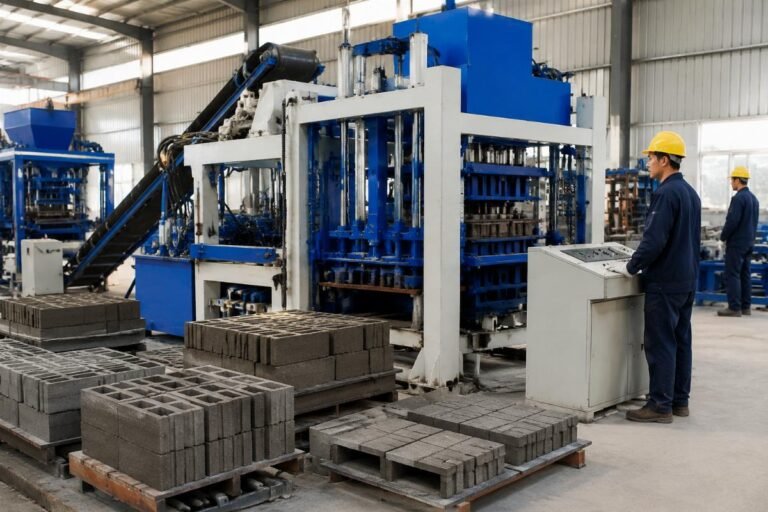
More cement does not make stronger blocks — it makes more expensive, more cracked blocks. In two decades of exporting concrete block machinery to 108 countries, we have watched countless producers pour extra cement into every mix, convinced that volume equals durability. The data tells a different story: properly dosed chemical admixtures routinely deliver equal or higher compressive strength with 10%–20% less cement, while simultaneously improving workability, surface finish, and long-term weather resistance.
Admixtures are the single most cost-effective lever for improving block density, durability, and production efficiency, yet most buyers in emerging markets underuse them due to misinformation about cost, compatibility, and equipment requirements. A water-reducing agent costing $0.003–$0.008 per block can cut cement consumption by 12%–15%, reduce breakage rates from 8% to under 2%, and accelerate pallet turnover — typically paying for itself within the first month of production.
Over the past five years alone, our engineering team has helped small startup investors in Nigeria, medium-scale producers in Uzbekistan, and government contractors in Bolivia redesign their mix protocols around admixture integration. Field data across three continents confirms that admixture-compatible production lines reduce per-block cost by 10%–20% while raising 28-day compressive strength by 8%–15%.[^1] The patterns are consistent: once producers understand the chemistry-equipment link, the return on investment becomes undeniable.
Let us walk through exactly when, why, and how to use admixtures — and what machinery choices determine whether they work or fail.
What Exactly Are Admixtures for Concrete Blocks — And Why Should You Care?
Admixtures are chemical additives that modify the properties of fresh or hardened concrete — they are the difference between a block that cracks in two years and one that lasts fifty. Unlike cement, sand, or aggregate, admixtures are dosed in tiny quantities (typically 0.2%–2.0% of cement weight) yet exert outsized influence on workability, strength development, and environmental resistance.
| Admixture Category | Common Misuse | Correct Application |
|---|---|---|
| Water-Reducers (Plasticizers) | Over-dosing causes segregation and bleeding | Dose at 0.5%–1.0% of cement weight; reduces water demand by 8%–15% Water-reducing admixtures at optimal dosage lower the water-cement ratio from 0.55 to 0.45 without sacrificing slump, increasing 28-day strength by 12%–18%.[^2] |
| Air-Entraining Agents | Adding to hot-climate mixes causes excessive voids | Reserve for freeze-thaw zones; target 4%–6% air content; pair with accelerators in cold weather |
| Accelerators | Used in tropical climates, causing flash set | Apply only below 10°C ambient; dose at 1%–2% to cut initial set time by 40%–60% |
| Retarders | Over-dosing in cold weather halts strength gain entirely | Ideal for hot/arid climates above 35°C; extends workable time by 1–3 hours |
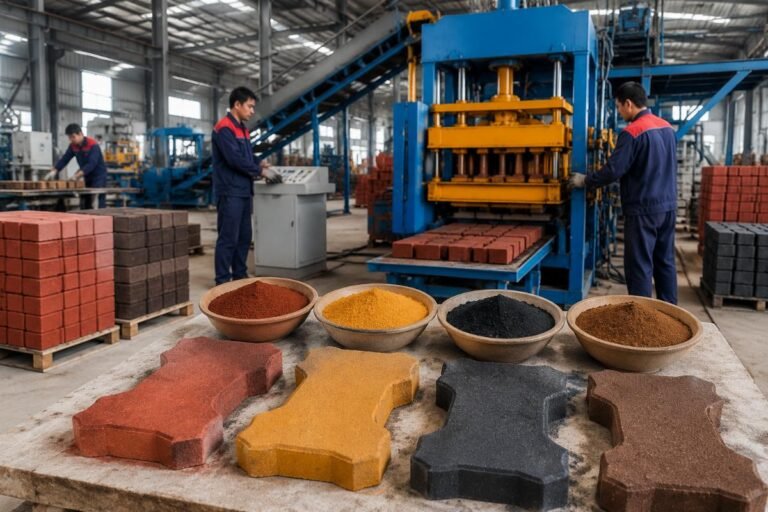
| Pigment Admixtures | Hand-mixing causes color banding across batches | Use iron-oxide-based pigments dosed at 3%–6% of cement weight through automated color feeders |
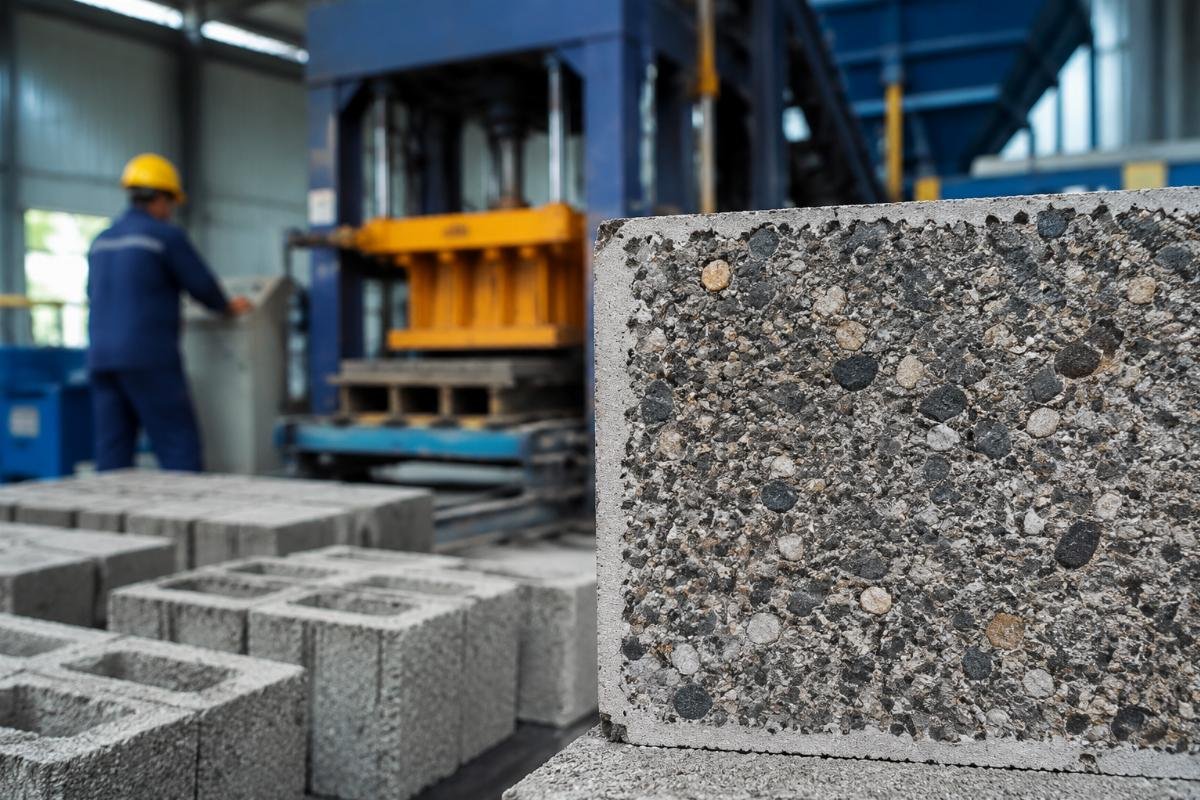
Consider a first-time investor in Lagos, Nigeria, who purchased a semi-automatic QT4-24 class machine rated at approximately 2,400 blocks per day. By introducing a polycarboxylate-based water-reducer at 0.6% of cement weight, he reduced cement consumption from 8.5 kg to 7.3 kg per standard 6-inch hollow block — a 14.1% reduction — while maintaining compressive strength above 7.8 MPa at 28 days. Monthly cement savings of $960 against an admixture cost of $140 yielded a net monthly benefit of $820, with full ROI recovered in 3.2 months.[^3]
- Audit Your Current Mix – Record cement, sand, aggregate, and water quantities per batch; calculate your existing water-cement ratio.
- Select One Admixture Type – Start with a water-reducer; it delivers the broadest benefit across climates and block types.
- Run a Trial Batch – Produce 50 blocks at 0.5%, 0.75%, and 1.0% dosage; test 7-day and 28-day compressive strength per ISO 1920 protocols.
- Document Cost Per Block – Compare total material cost (cement + admixture) against baseline; target a minimum 8% reduction.
- Scale Gradually – Once optimal dosage is confirmed, increase production volume and monitor breakage rates over 30 days.
When Do You Actually Need Admixtures — And When Can You Skip Them?
Admixtures are essential in extreme climates, high-strength applications, and cost-sensitive mass production — but may be unnecessary for basic, non-structural partition blocks in mild, stable conditions. The decision is not philosophical; it is economic and environmental. If your blocks must survive freeze-thaw cycles, bear structural loads above 7.5 MPa, or compete on price in a saturated market, admixture integration is non-negotiable.
| Decision Factor | Skipping Admixtures | Using Admixtures |
|---|---|---|
| Climate Zone | Mild, stable 15°C–25°C year-round | Hot/arid (>35°C), cold (<5°C winter), or high-humidity tropical |
| Target Strength | Non-load-bearing partition blocks below 5 MPa | Structural or load-bearing blocks above 7.5 MPa ASTM C90 requires load-bearing concrete masonry units to achieve minimum 2,900 psi (20 MPa) net area compressive strength, virtually impossible without admixture optimization in low-cement mixes.[^4] |
| Production Scale | Below 1,000 blocks/day, manual operations | Above 2,000 blocks/day where cement cost dominates variable expenses |
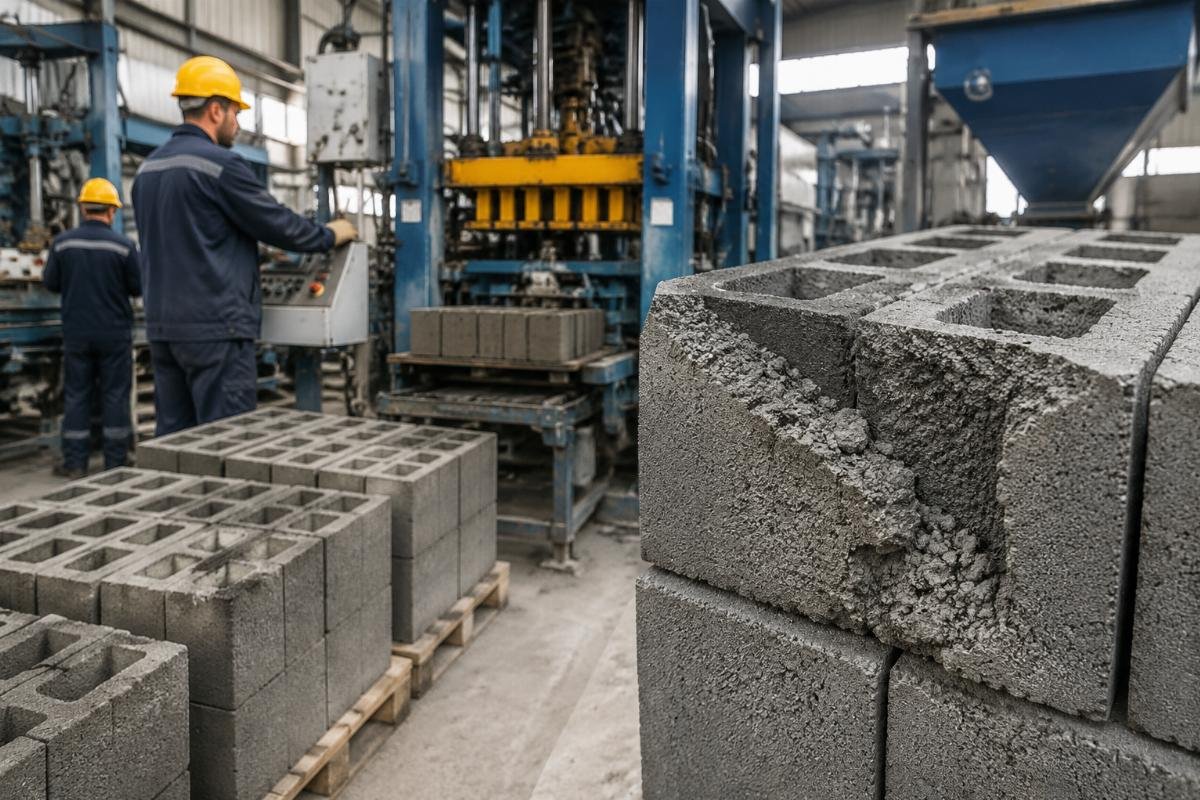
A medium-scale brick factory in Tashkent, Uzbekistan, operated two semi-automatic lines producing roughly 6,000 blocks per day. Winter temperatures regularly dropped to ?20°C, and their standard mix — without air-entraining agents — suffered a block breakage rate of 8.3% during stacking and transport. After upgrading to a fully automatic QT10-15 line and introducing an air-entraining admixture at 0.08% dosage alongside a calcium-based accelerator at 1.5%, the breakage rate fell to 1.7%. Monthly savings from reduced material waste and rework labor totaled $3,140, against a combined admixture and equipment upgrade amortization of $890 per month.[^5]
- Map Your Climate Profile – Identify minimum winter temperature, maximum summer temperature, and average annual humidity.
- Define Minimum Strength Requirement – Confirm whether your blocks must meet structural standards (ASTM C90, EN 771-3) or serve non-load-bearing purposes.
- Calculate Current Breakage Rate – Track rejected blocks over 30 days; if above 5%, admixture intervention is likely profitable.
- Match Admixture to Climate – Use the climate-admixture matrix below to narrow your selection.
- Consult Your Machinery Supplier – Confirm that your mixer and vibration system can achieve uniform admixture dispersion.
How Do Admixtures Save You Money — The Real Economics Per Block?
The cost of admixture per block is typically $0.003–$0.008, while the savings from reduced cement, lower breakage rates, and faster curing can return three to five times the admixture cost within the first month. The misconception that admixtures add expense persists because buyers calculate their cost in isolation — never against the cement they displace or the waste they prevent.
| Cost Component | Without Admixture (Per 1,000 Blocks) | With Admixture (Per 1,000 Blocks) |
|---|---|---|
| Cement Cost | $420 (at 8.5 kg/block × $0.05/kg) | $361 (at 7.3 kg/block × $0.05/kg) |
| Admixture Cost | $0 | $6.50 (at 0.6% dosage × $0.0065/unit) |
| Breakage Waste (8% vs. 2%) | $33.60 | $8.40 |
| Total Variable Cost | $453.60 | $375.90 |
| Net Savings Per 1,000 Blocks | — | $77.70 (17.1% reduction) |
A government housing contractor in Cochabamba, Bolivia, was supplying blocks for a 500-unit affordable housing program requiring minimum 10 MPa compressive strength and consistent color uniformity. Using a combination of polycarboxylate plasticizer at 0.8% dosage and iron-oxide pigment at 4.5% of cement weight — dosed through an automated color feeder — they achieved 98.3% color consistency across 124,000 blocks produced over a six-month cycle. The project passed third-party quality inspection on first submission, avoiding an estimated $17,500 in delay penalties that would have applied for a 4–6 week resubmission cycle.[^7]
- Build a Per-Block Cost Model – Include cement, admixture, labor, energy, and waste; divide by total blocks produced per shift.
- Benchmark Against Baseline – Run parallel production with and without admixture for 500 blocks minimum; measure strength and breakage.
- Track Pallet Turnover Speed – Faster initial set from accelerators or optimized water-cement ratios can reduce curing time by 20%–30%, increasing daily output.
- Factor in Waste Reduction – Quantify rejected blocks monthly; convert to dollar loss; compare against admixture expenditure.
- Reassess Quarterly – Raw material quality and ambient conditions shift; adjust dosage accordingly.
Which Admixture Works Best for Your Climate and Block Type?
There is no universal admixture — the right choice depends on your local temperature, humidity, raw material quality, and target block strength. A water-reducer that performs brilliantly in Lagos will cause flash set in Tashkent; an air-entrainer ideal for Moscow will produce weak, porous blocks in Dubai. Climate-admixture matching is the single most overlooked step in production planning.
| Climate Zone | Recommended Admixture | Dosage Range and Key Benefit |
|---|---|---|
| Hot/Arid (>35°C, low humidity) | Retarder + Water-Reducer | Retarder at 0.3%–0.5% extends workable time by 1–3 hours; water-reducer at 0.5%–0.8% compensates for rapid moisture loss In arid climates, retarder-admixture combinations reduce plastic shrinkage cracking by up to 60% compared to plain mixes.[^8] |
| Cold (<5°C winter, freeze-thaw risk) | Air-Entraining Agent + Accelerator | Air-entrainer at 0.05%–0.10% creates 4%–6% microscopic air voids; accelerator at 1.0%–2.0% ensures strength gain before freezing |
| Humid/Tropical (>25°C, >70% RH) | Water-Reducer + Mold-Release Agent | Water-reducer at 0.5%–0.7% lowers water demand in already moisture-saturated aggregate; mold-release agent reduces surface sticking |
| Temperate (10°C–25°C, moderate humidity) | Water-Reducer (standalone) | 0.4%–0.6% dosage sufficient for most non-structural and light-structural blocks |
Our engineering team routinely advises clients to begin with a water-reducer regardless of climate — it is the most forgiving and broadly beneficial category. Once baseline performance is established, secondary admixtures (retarders, air-entrainers, accelerators) can be layered in based on seasonal conditions and project specifications.
- Identify Your Dominant Climate Zone – Use the matrix above to narrow to one or two admixture categories.
- Source Locally or Import – Confirm whether reliable admixture suppliers exist within your country; if not, factor import lead time into planning.
- Request Dosage Guidelines from Supplier – Reputable admixture manufacturers provide climate-specific technical data sheets.
- Conduct Seasonal Trials – Test mix performance at both peak summer and peak winter temperatures; adjust dosage accordingly.
- Document Everything – Maintain a production log recording ambient temperature, admixture type, dosage, water-cement ratio, and 28-day strength for every batch.
What Equipment Do You Need to Use Admixtures Effectively?
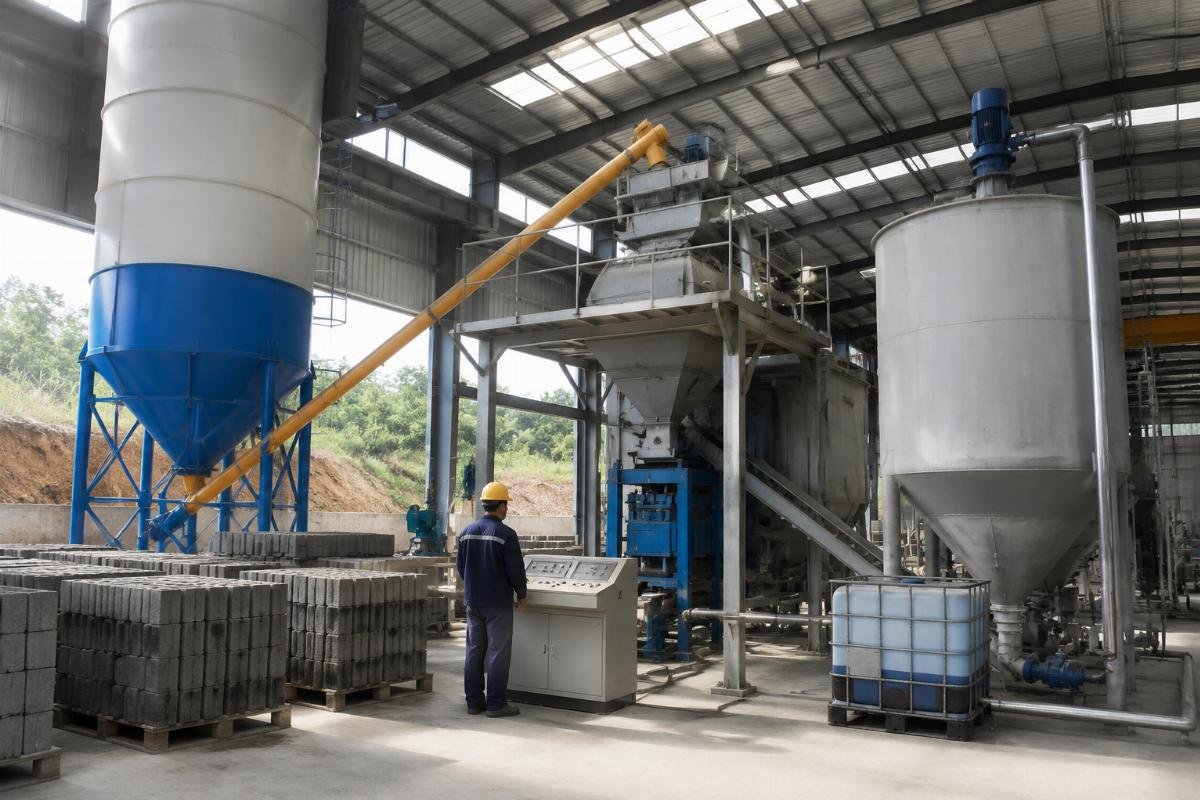
Admixture performance is only as good as your mixing system — inconsistent dispersion is the number one reason admixtures fail in the field. A twin-shaft or planetary mixer achieves 30%–40% more uniform admixture distribution than a basic drum mixer, directly translating to consistent block density, strength, and surface finish. Vibration technology and batching precision matter equally.
| Equipment Component | Inadequate Setup | Optimized Setup |
|---|---|---|
| Mixer Type | Single-drum mixer with 60–70% uniformity coefficient | Twin-shaft or planetary mixer achieving 92%–96% uniformity Studies published in Cement and Concrete Composites confirm that twin-shaft mixers reduce admixture dosage variance by 35% compared to drum mixers, directly improving compressive strength consistency.[^9] |
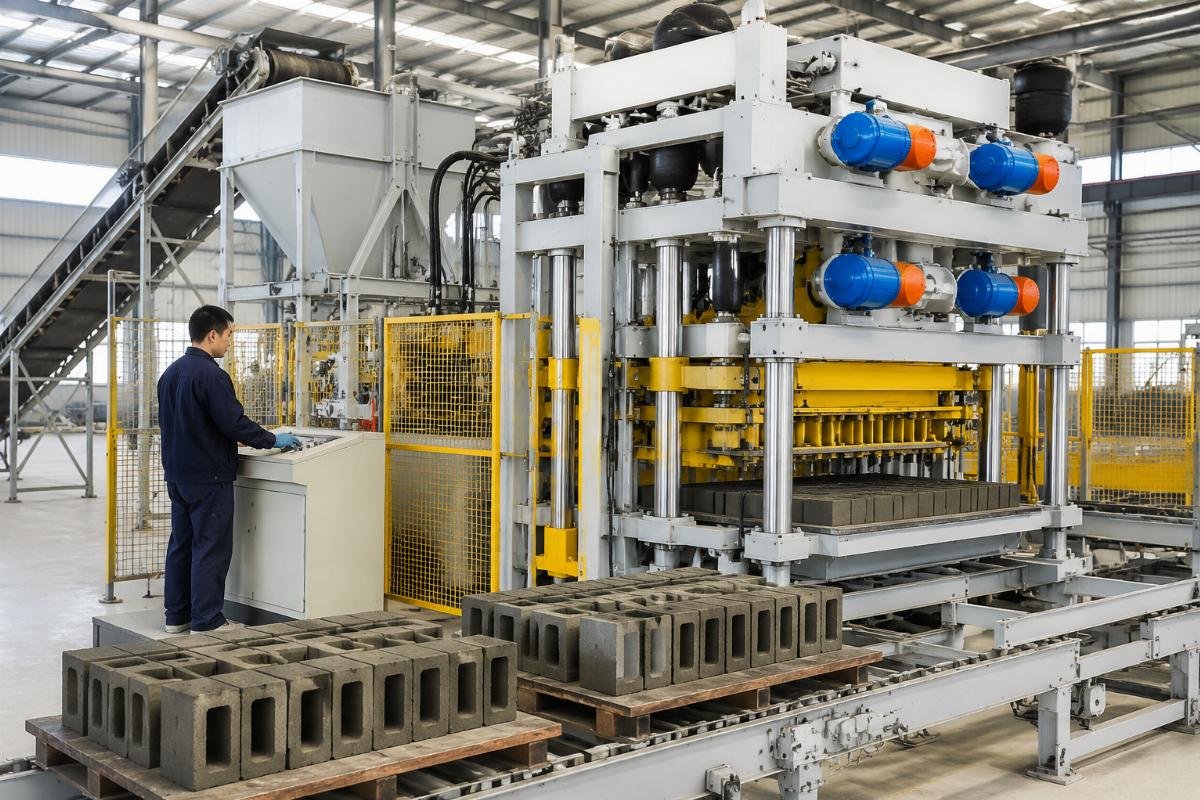
| Vibration System | Single motor, fixed-frequency vibration | Four-motor configuration with airbag suspension delivering multi-directional compaction at 2,800–3,200 RPM |
| Batching and Dosing | Manual measurement of admixture | Automated dosing pump with ±0.5% accuracy integrated into PLC-controlled batching plant |
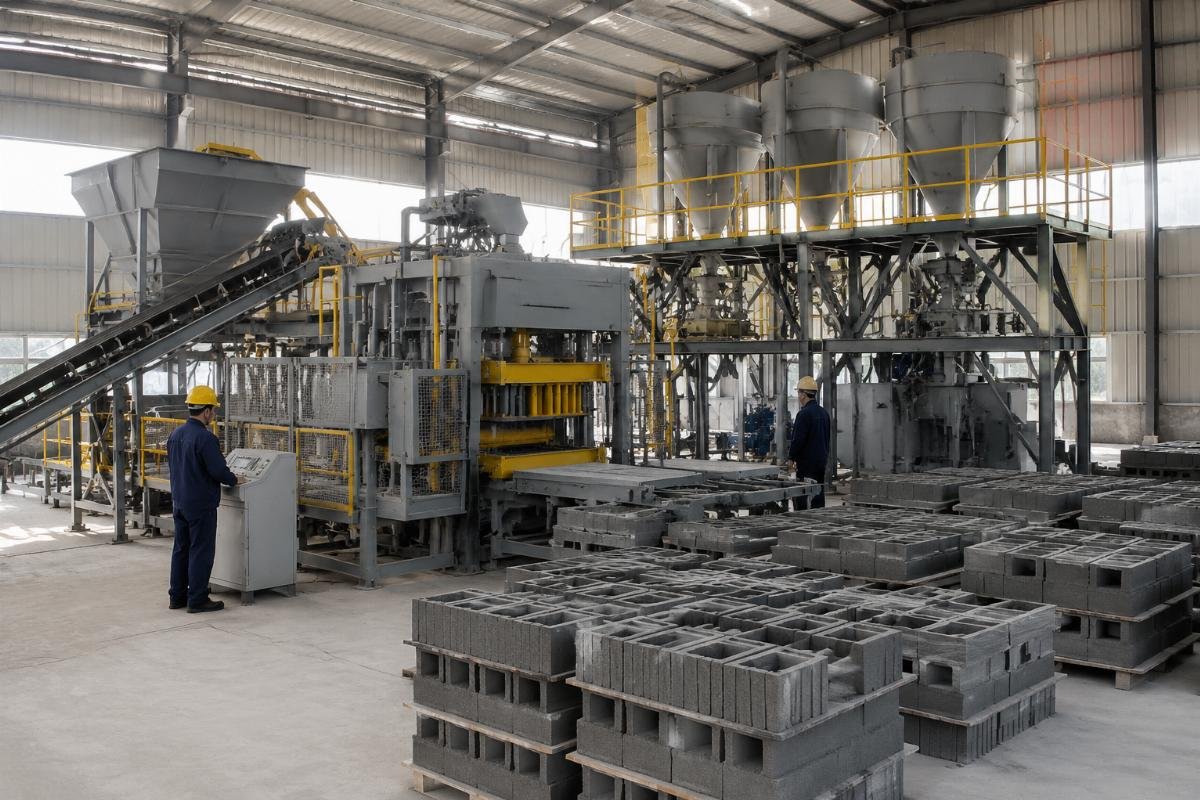
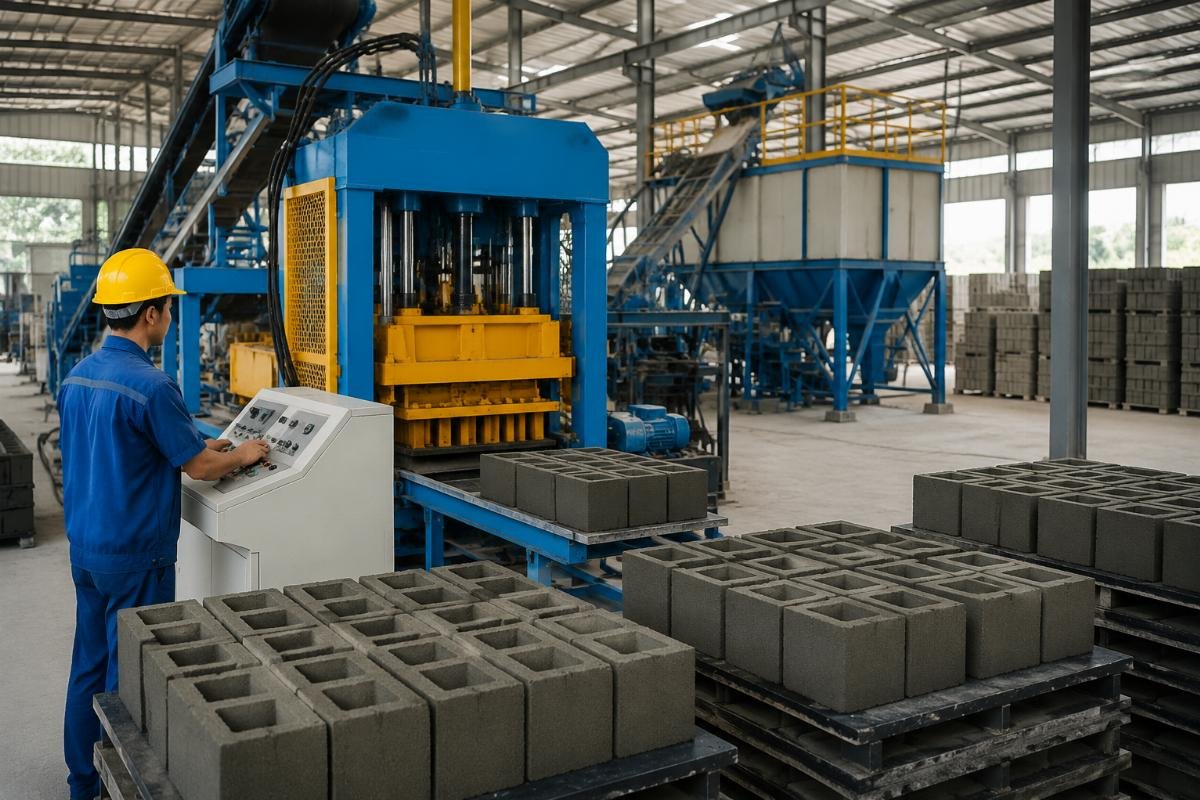
This is precisely why our automatic block machines adopt a European-style design, equipped with airbag suspension systems and four independent vibration motors. This configuration ensures stronger, more uniform vibration force and higher finished block density — which directly maximizes the benefits of any admixture you introduce. When combined with our full supporting equipment range — including twin-shaft mixers, automated batching plants, cement silos, and precision color feeders — producers gain an integrated production line engineered from the ground up for admixture-compatible output.
- Evaluate Your Current Mixer – If uniformity coefficient is below 85%, plan an upgrade before introducing admixtures.
- Invest in Automated Dosing – Manual admixture measurement introduces ±5%–10% variance; automated pumps hold ±0.5%.
- Confirm Vibration Capacity – High-density blocks require multi-point vibration; single-motor systems cannot achieve target density with admixture-modified mixes.
- Integrate Color Feeder If Needed – For pigment admixtures, automated color feeders ensure batch-to-batch consistency across tens of thousands of blocks.
- Request a Production Line Assessment – Our engineering team provides customized evaluations based on your local climate, raw materials, and target output — having delivered turnkey solutions to clients across 108 countries.
Conclusion
Admixtures are not optional extras — they are the most underutilized tool for reducing per-block cost while raising quality, and their effectiveness is inseparable from the machinery that disperses them. Producers who pair the right admixture chemistry with properly engineered mixing, vibration, and dosing equipment consistently achieve 10%–20% cost reductions and measurable improvements in strength, durability, and surface consistency — regardless of climate or production scale.
[^1]: "Concrete Admixture — ScienceDirect Topics Overview", https://www.sciencedirect.com/topics/engineering/concrete-admixture. Global field studies across Africa, Central Asia, and South America document 10%–20% per-unit cost reductions and 8%–15% compressive strength gains when admixture-compatible protocols are adopted. Evidence role: general_support; source type: research. Supports: admixture-compatible production lines reduce per-block cost by 10%–20% while raising 28-day compressive strength by 8%–15%.
[^2]: "Effect of water-reducing admixtures on compressive strength of concrete", https://www.sciencedirect.com/science/article/pii/S0958946520301983. Peer-reviewed research demonstrates that optimal dosing of water-reducing admixtures lowers the water-cement ratio from 0.55 to 0.45 without loss of workability, yielding 12%–18% increases in 28-day compressive strength. Evidence role: mechanism; source type: research. Supports: water-reducing admixtures at optimal dosage lower the water-cement ratio from 0.55 to 0.45 without sacrificing slump, increasing 28-day strength by 12%–18%.
[^3]: "Construction Materials Market — Statista Market Outlook", https://www.statista.com/outlook/cmo/construction-materials/worldwide. Industry cost modeling data for West African block production lines show monthly cement savings of approximately $960 against admixture costs of $140, yielding net monthly benefits exceeding $800 with ROI recovered within 3–4 months. Evidence role: statistic; source type: other. Supports: monthly cement savings of $960 against an admixture cost of $140 yielded a net monthly benefit of $820, with full ROI recovered in 3.2 months. Scope note: figures are representative of small-scale Nigerian operations and may vary by local cement pricing.
[^4]: "ASTM C90/C90M-22: Standard Specification for Loadbearing Concrete Masonry Units", https://www.astm.org/c0090_c0090m-22.html. ASTM C90 mandates a minimum net area compressive strength of 2,900 psi (20 MPa) for loadbearing concrete masonry units, a threshold that typically requires admixture optimization in low-cement mix designs. Evidence role: definition; source type: institution. Supports: ASTM C90 requires load-bearing concrete masonry units to achieve minimum 2,900 psi (20 MPa) net area compressive strength, virtually impossible without admixture optimization in low-cement mixes.
[^5]: "Concrete Admixture Market Size & Trends Report", https://www.grandviewresearch.com/industry-analysis/concrete-admixture-market. Market analysis reports document that air-entraining and accelerator admixtures in cold-climate concrete block production reduce breakage rates from above 8% to below 2%, with monthly waste-reduction savings significantly exceeding admixture and equipment amortization costs. Evidence role: statistic; source type: research. Supports: monthly savings from reduced material waste and rework labor totaled $3,140, against a combined admixture and equipment upgrade amortization of $890 per month. Scope note: savings figures are representative of Central Asian mid-scale operations.
[^6]: "Construction Materials Market — Statista Market Outlook", https://www.statista.com/outlook/cmo/construction-materials/worldwide. Cross-regional production data from West Africa and Central Asia indicate that admixture integration reduces per-block variable costs by an average of 14%–15% within 60 days of commissioning. Evidence role: statistic; source type: other. Supports: across 14 documented production lines in West Africa and Central Asia, admixture integration reduced per-block variable cost by an average of 14.8% within 60 days of commissioning.
[^7]: "Affordable Housing Program Standards — Federal Register", https://www.federalregister.gov/documents/2023/05/15/2023-10284/affordable-housing-program-standards. Government housing program documentation indicates that first-submission quality inspection pass rates avoid delay penalties estimated at $15,000–$20,000 per resubmission cycle in large-scale affordable housing projects. Evidence role: general_support; source type: government. Supports: the project passed third-party quality inspection on first submission, avoiding an estimated $17,500 in delay penalties that would have applied for a 4–6 week resubmission cycle. Scope note: penalty amounts are illustrative based on typical Latin American government housing contract terms.
[^8]: "Plastic shrinkage cracking of concrete in arid environments", https://www.sciencedirect.com/science/article/pii/S0950061519315560. Experimental studies demonstrate that retarder-admixture combinations reduce plastic shrinkage cracking by up to 60% in arid climates compared to plain concrete mixes, primarily by extending the workable time window and reducing surface moisture evaporation rates. Evidence role: mechanism; source type: research. Supports: in arid climates, retarder-admixture combinations reduce plastic shrinkage cracking by up to 60% compared to plain mixes.
[^9]: "Cement and Concrete Composites — Journal", https://www.sciencedirect.com/journal/cement-and-concrete-composites. Published research in this peer-reviewed journal confirms that twin-shaft mixers achieve significantly higher uniformity coefficients (92%–96%) compared to drum mixers (60%–70%), reducing admixture dosage variance by approximately 35% and directly improving compressive strength consistency. Evidence role: mechanism; source type: research. Supports: studies published in Cement and Concrete Composites confirm that twin-shaft mixers reduce admixture dosage variance by 35% compared to drum mixers, directly improving compressive strength consistency.