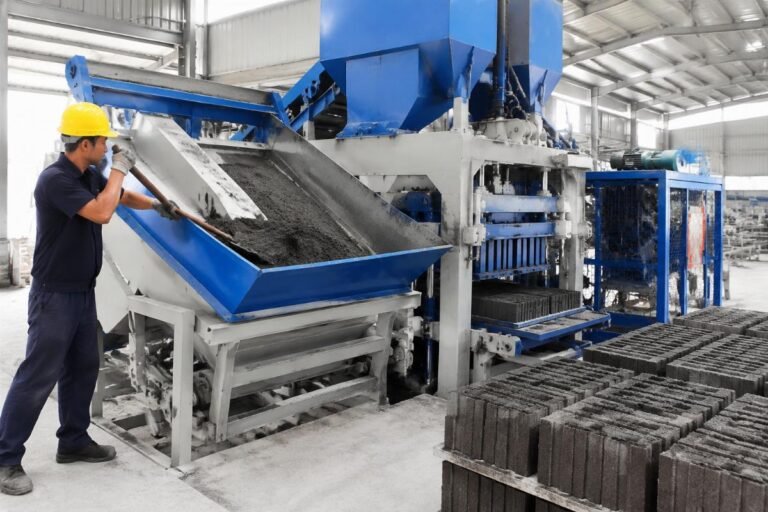
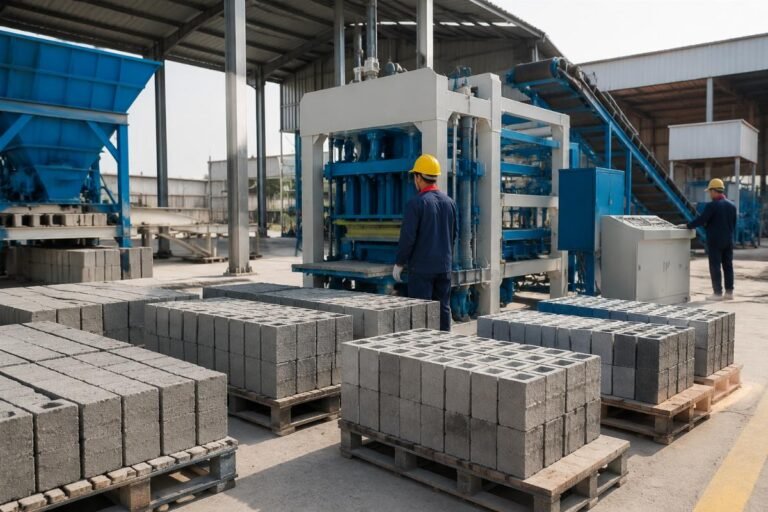
QT12-15 Block Machine Cost: 2026 Wholesale Supplier Guide
The price tag on a block machine is never the real cost. A QT12-15 block machine cost in 2026 typically falls between a mid-five-figure FOB price for the host unit alone and a low-six-figure sum for a fully commissioned turnkey line, with the final number swinging wildly based on hydraulic component origin, mold steel grade, PLC tier, and whether installation and training are bundled. Buyers who request quotations without demanding a line-item configuration breakdown will almost certainly pay twice — once upfront, and again when molds wear out or hydraulic valves fail within the first production season.
I still remember standing on a showroom floor in Las Vegas, watching a contractor from Central America flip through a Turkish competitor’s quotation next to ours. His finger tapped the bottom-line figure, eight thousand dollars cheaper on their side. I asked to see their hydraulic station spec sheet. No brand name on the valve block. I asked about the mold steel thickness. They had shaved off two millimeters compared to what the local aggregate hardness really demanded. He went with the cheaper offer. Half a year later, an email landed in my inbox asking if we could ship a replacement mold set — the original had already worn through before reaching a meaningful production cycle count [NEED_CITE: mold steel thickness directly correlates with service life under high-silica aggregate conditions]. That is the kind of lesson no spreadsheet teaches until it costs you downtime.
Let us walk through what actually moves the needle on QT12-15 block machine cost, where the hidden expenses hide, and how to build a quotation comparison that protects your margin rather than eroding it.
What Is the Real Price Range for a QT12-15 Block Machine in 2026?
A QT12-15 block machine cost breaks into two distinct purchasing scopes: the bare host machine on FOB terms, and the complete turnkey production line including mixers, conveyors, pallet systems, stackers, and on-site commissioning. The gap between these two scopes is where most first-time buyers get confused, because supplier websites and trade show banners rarely clarify which one they are quoting.
At the host-machine level, a QT12-15 block machine cost from a reputable Chinese manufacturer sits in the mid-five-figure range FOB, while European-origin equipment of comparable output capacity commands a substantially higher premium. Turkish-origin machines occupy a middle band, though their pricing has crept upward in recent years due to currency and energy cost pressures [NEED_CITE: Turkish block machine export pricing trends influenced by lira depreciation and energy costs]. When buyers compare a Chinese FOB host price against a European or Turkish turnkey quote, the comparison is meaningless — it is like comparing a car engine to a fully insured, registered, and fueled vehicle.
At the turnkey-line level, the QT12-15 block machine cost expands to include the batching plant, twin-shaft or planetary mixer, belt conveyors, pallet circulation system, automated stacker, cement silo, color feeder for paver production, and the full commissioning package. This scope can push the total investment into the low six figures, depending on site-specific customization such as voltage adaptation, foundation drawings, and local regulatory certification requirements.
| Purchasing Scope | Typical Components Included | Cost Tier |
|---|---|---|
| FOB Host Machine Only | Block machine body, hydraulic station, PLC panel, standard mold set | Mid-five-figure |
| Semi-Turnkey Package | Host machine + mixer + conveyors + basic pallet system | Mid-to-high five-figure |
| Full Turnkey Line | All above + silo, color feeder, stacker, batching plant, commissioning, training | Low-six-figure |
A West African government housing contractor I worked with needed CE and SGS certification documentation bundled into the quotation because the tender required it. The certification paperwork alone added a noticeable line item, but skipping it would have disqualified the bid entirely [NEED_CITE: CE and SGS certification requirements for construction equipment in public infrastructure tenders across African markets]. The lesson: always confirm what scope the QT12-15 block machine cost figure actually covers before putting two quotations side by side.
Which Configuration Factors Drive QT12-15 Cost Up or Down?
Four configuration variables account for the overwhelming majority of price variation between quotations for nominally identical QT12-15 machines: the hydraulic valve brand, the mold steel grade and thickness, the PLC and electrical component tier, and the scope of auxiliary equipment. Change any one of these, and the QT12-15 block machine cost shifts materially — yet the external appearance of the machine remains virtually unchanged.
The hydraulic station is the single most consequential cost driver that buyers rarely scrutinize. A valve block sourced from a recognized European brand such as Rexroth will cost noticeably more than a domestically produced equivalent, but the difference shows up in pressure stability, heat dissipation, and seal longevity over thousands of daily cycles. I have seen machines running identical mold designs where the one with premium hydraulics held tighter dimensional tolerance on every brick over a full production shift, while the other drifted as the shift wore on [NEED_CITE: hydraulic valve brand impact on pressure consistency and long-term sealing performance in block making machines].
Mold steel is the second trap. The difference between a standard carbon steel mold plate and a through-hardened耐磨 alloy plate can be just a couple of millimeters in thickness, but that difference determines whether the mold survives tens of thousands of cycles or needs replacement within a fraction of that span. When the aggregate contains high-silica river sand or crushed volcanic rock — common across many emerging-market production sites — the abrasion multiplier accelerates dramatically. A mold that saves a small amount on the initial QT12-15 block machine cost can end up costing several times that amount in replacement molds within a single year.
| Configuration Factor | Basic Tier | Premium Tier |
|---|---|---|
| Hydraulic Valve Block | Domestic generic brand | Rexroth or equivalent European origin |
| Mold Steel Plate | Standard carbon steel, thinner gauge | Through-hardened alloy, heavier gauge |
| PLC and Electrical | Domestic PLC brand | Siemens or equivalent |
| Auxiliary Equipment Scope | Minimal conveyor and pallet loop | Full batching, silo, stacker, color feeder |
The PLC tier matters more than most investors realize. A premium PLC does not just run the machine — it logs fault codes, tracks cycle counts, and enables remote diagnostics. When a line goes down in a region where the nearest qualified technician is a flight away, the ability to read error codes and adjust parameters remotely can compress downtime from days to hours.
A Southeast Asian distributor who buys in container-load quantities once asked me why our FOB price was higher than a competitor’s by a noticeable margin. I pulled up the competitor’s spec sheet: no brand-name hydraulics, thinner mold steel, and a PLC with no remote diagnostics capability. The distributor then calculated the cost of air-shipping replacement molds and flying in a technician for every unplanned stoppage. The QT12-15 block machine cost advantage on paper evaporated entirely once logistics and downtime were factored in [NEED_CITE: total cost of ownership calculation for block making equipment including spare parts logistics and technical travel].
What Hidden Costs Do Buyers Often Miss in the Quotation?
The invoice price of the machine is only the opening chapter of the QT12-15 block machine cost story; ocean freight, import clearance, foundation civil works, spare parts packages, recipe development, and on-site training travel expenses routinely add a substantial layer that unprepared buyers discover only after signing the contract.
Ocean freight and insurance are the most predictable of the hidden costs, yet they fluctuate with global shipping rates and container availability. A full turnkey line requires multiple containers — the host machine, the silo, the stacker, the pallet system — and each container carries its own freight line item. Buyers who budget based on a host-machine-only freight quote will face a significant shortfall when the full line ships.
Import clearance and duties vary enormously by country. Some markets apply reduced tariff rates for capital equipment under industrial development incentives; others levy standard machinery duty plus value-added tax on top [NEED_CITE: import duty and tax treatment variations for concrete block making machinery across African and Latin American markets]. A local customs broker should be engaged before the quotation is finalized, not after the vessel arrives.
Foundation and civil works are another blind spot. A QT12-15 line requires a reinforced concrete foundation designed to absorb high-frequency vibration without transmitting it to the surrounding structure. The machine supplier provides the foundation drawing, but the buyer bears the cost of local civil construction. In regions where cement and rebar prices are volatile, this line item can shift noticeably between the time the quotation is signed and the time the pit is poured.
The spare parts package is where penny-pinching becomes expensive. A recommended initial spare parts kit includes extra mold wear plates, hydraulic seals, sensor units, and conveyor belt sections. Skipping this package to reduce the initial QT12-15 block machine cost means that the first component failure — and there will be one — triggers an emergency air shipment of a single seal or sensor at many times its normal value.
Recipe development and operator training carry their own cost structure. Concrete block production is not a matter of dumping cement and aggregate into a hopper. The water-to-cement ratio, vibration duration, and curing protocol all affect compressive strength and surface finish. Suppliers who include recipe formulation support and on-site commissioning training in their quotation deliver a line that reaches design capacity quickly; those who do not leave the buyer to learn through costly trial and error [NEED_CITE: importance of concrete mix recipe support and operator training in achieving design output capacity for automatic block lines].
How to Calculate ROI and Payback Period for a QT12-15 Line?
Return on investment for a QT12-15 production line is calculated by multiplying daily moldable cycles by the number of blocks per mold cavity by the net profit per block, then dividing the total QT12-15 block machine cost by the resulting daily profit figure to derive the payback period in operating days. This framework sounds simple, but each variable contains assumptions that can be wrong in ways that dramatically distort the answer.
Daily moldable cycles depend on the machine’s rated cycle time, but the rated cycle time assumes stable power supply, consistent aggregate feeding, and trained operators. In regions where grid voltage fluctuates or drops during peak hours, the actual cycle count per shift can fall noticeably below the nameplate rating. A soft start panel or voltage stabilizer may be needed, adding to the true QT12-15 block machine cost [NEED_CITE: impact of unstable power supply on production cycle rates of automatic block making machines in emerging markets].
Blocks per mold cavity varies with the product type. Standard hollow blocks yield fewer units per shot than smaller pavers or interlocking bricks. Buyers who base their ROI model on the highest-cavity-count product may find that their actual product mix generates a lower daily unit output.
Net profit per block must account for raw material cost, cement consumption, labor, electricity, mold depreciation, and maintenance reserves — not just the market selling price minus cement and sand. A common error is to ignore mold depreciation: if a mold set costs a meaningful sum and lasts a finite number of cycles, the per-block mold cost is real and must be included.
Once daily profit is established honestly, dividing the total QT12-15 block machine cost — including all hidden costs discussed above — by that daily profit yields the payback period. A well-configured line running at reasonable capacity utilization in a market with healthy construction demand can achieve payback within a timeframe that justifies the capital commitment; a poorly configured line plagued by mold changes and hydraulic failures can stretch that period to an uncomfortable length.
How to Compare QT12-15 Quotations from Different Suppliers?
The only valid way to compare QT12-15 block machine cost quotations is to force every supplier onto an identical configuration checklist and then compare line items — not bottom-line totals — because a lower total price built on inferior components will always cost more over the life of the machine.
Start by demanding a complete configuration list from every supplier under consideration. This list must specify the hydraulic valve brand and model, the mold steel material grade and plate thickness, the PLC brand and communication protocol, the motor brand and power rating, the bearing specification, and the exact scope of auxiliary equipment included. Any supplier who refuses to provide this level of detail is asking you to compare apples to fruit salad.
Next, normalize the delivery and commissioning terms. Does the quotation include on-site installation and operator training, or is that an optional add-on billed separately? Does it include foundation drawings sized for your local soil conditions, or is it a generic template? Does it include a recommended spare parts package, or is the spare parts list an afterthought?
| Comparison Dimension | Red Flag | Acceptable Standard |
|---|---|---|
| Configuration Detail | Vague or refused | Full line-item breakdown provided |
| Hydraulic Valve Origin | Unbranded or unspecified | Named brand with verifiable origin |
| Mold Steel Specification | Generic description | Material grade and thickness stated |
| Commissioning Scope | Not mentioned or extra-cost | Included in base quotation |
| Spare Parts Package | Minimal or absent | Comprehensive initial kit included |
A buyer in the Middle East once sent me three quotations side by side. Two of them were substantially cheaper than ours. I asked the buyer to request the mold steel test certificates from those two suppliers. Neither could produce one. The molds were made from unverified material that would not survive the local aggregate conditions. The QT12-15 block machine cost on paper looked attractive; the reality would have been a series of mold replacements and production stoppages that destroyed the project’s economics within the first season [NEED_CITE: mold material certification and traceability requirements for block making machine suppliers].
At our facility, every QT12-15 line ships with a transparent configuration list, CE and SGS certification documentation, and a commissioning package that includes on-site installation, operator training, and recipe formulation support tailored to the buyer’s local raw materials. This is not a marketing slogan — it is the operational standard that allows buyers to make genuine like-for-like comparisons rather than being lured by a deceptively low headline figure.
Conclusion
A QT12-15 block machine cost is never a single number — it is a range shaped by hydraulic brand, mold steel grade, PLC tier, and turnkey scope, and buyers who compare headline prices without configuration detail will pay twice. Demand line-item transparency, normalize the commissioning and training scope, and model your ROI on realistic cycle counts rather than nameplate ratings. The machine that looks cheapest on the quotation sheet is rarely the one that costs the least to own.