

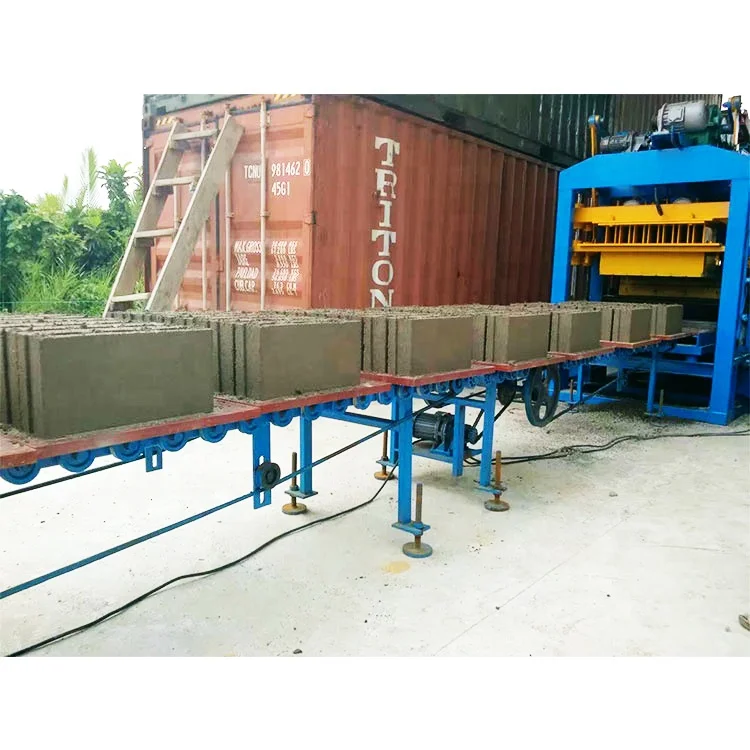

Description
Mould-Matched Output — every capacity figure on this page is tied to a specific block size and cavity count, so your daily tally matches the quote before the machine leaves the factory.
Technical Specifications
| Parameter | Value |
|---|---|
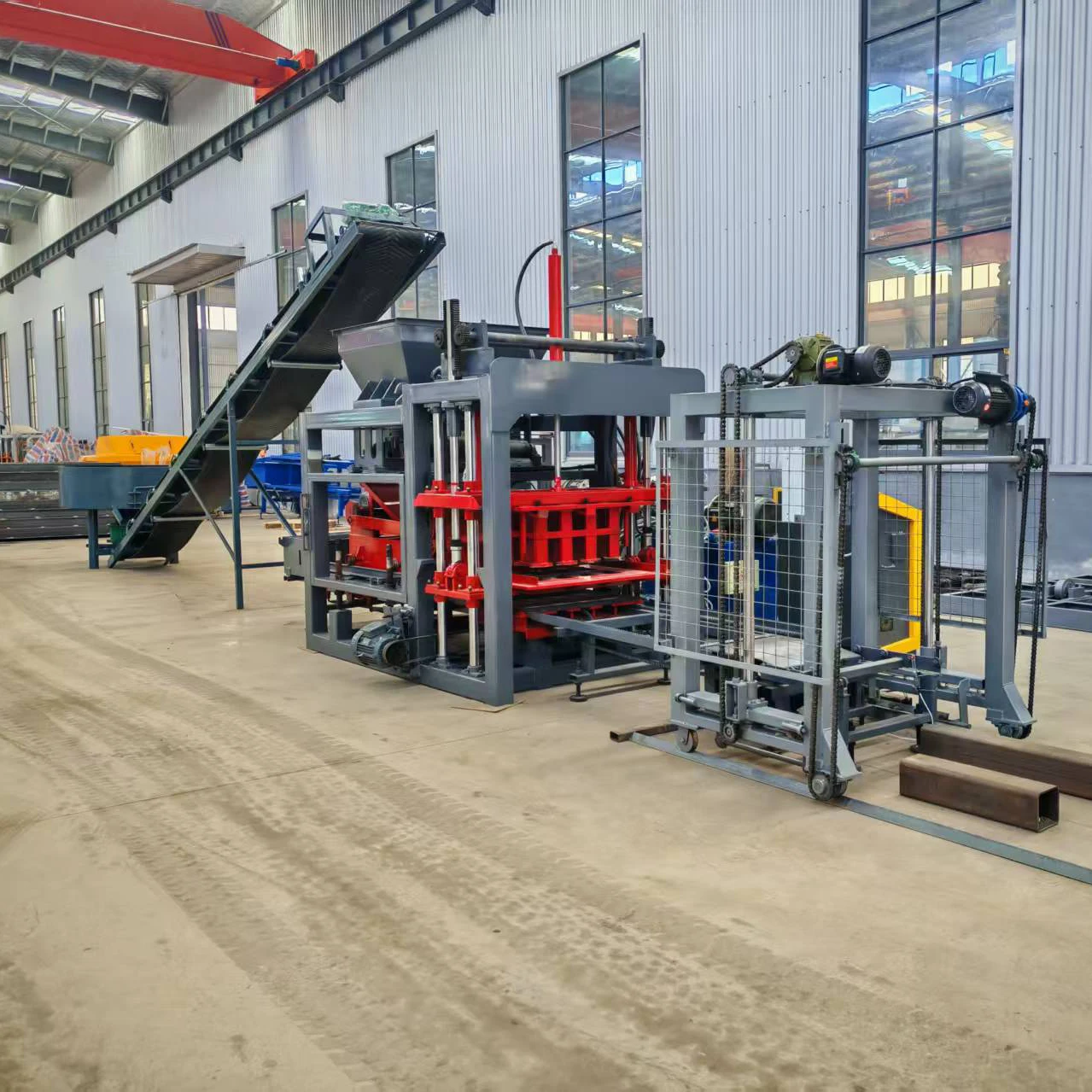
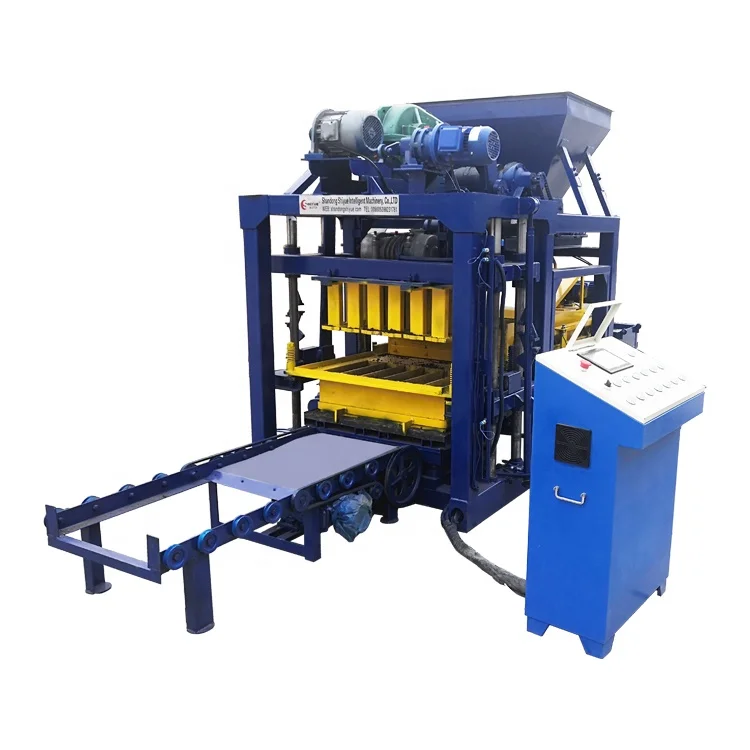
| Product Type | Automatic Concrete Block Making Machine |
| Model | QTJ4-25 |
| Overall Dimensions (L×W×H) | 6400 × 1500 × 2700 mm |
| Molding Cycle | 25 s |
| Vibration Frequency | 2800–5100 r/min |
| Exciting Power (Vibration Force) | 60 kN |
| Total Power | 17.9 kW |
| Mixer Model | JQ350 |
| Pallet Size | 850 × 550 × 20 mm |
| Net Weight | 2500 kg |
| Control System | PLC |
| Automation Level | Automatic plate-supplying, material-disturbing, brick-discharging |
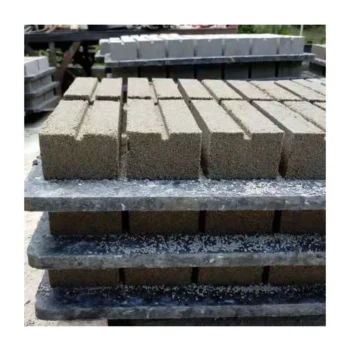
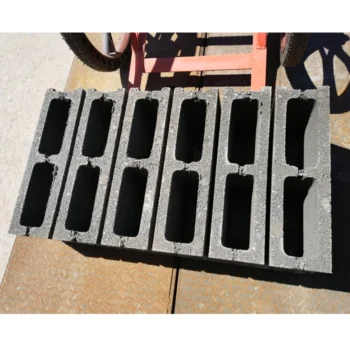
| Applied Products | Concrete hollow blocks (8-inch, 6-inch), solid bricks |
| Raw Materials | Crushed stones, sand, cement, dust, fly ash |
| Output Capacity (Hollow Block 390×190×190 mm) | 480 pcs/hr, 3800 pcs/8hr (basis: 4 pcs/mould) |
| Output Capacity (Hollow Block 400×150×200 mm) | 600 pcs/hr, 4800 pcs/8hr (basis: 5 pcs/mould) |
| Output Capacity (Solid Brick 240×115×53 mm) | 2100 pcs/hr, 17000 pcs/8hr (basis: 18 pcs/mould) |
| Mould Format Options | Hollow block (390×190×190 mm, 400×150×200 mm), solid brick (240×115×53 mm); custom formats available on request |
| Voltage & Frequency | Configurable to target market (basis to be confirmed) |
| Hydraulic Pressure | Rating to be confirmed per buyer specification |
| Mould Change Time | Method and timing to be confirmed |
| Stacking Method | Manual or automatic (basis to be confirmed) |
| Language Options | PLC display language configurable (basis to be confirmed) |
Application Suitability
| Application | Material or Output |
|---|---|
| Regional wall construction | 8-inch and 6-inch hollow blocks from crushed stone, sand and cement |
| Load-bearing masonry supply | High-density hollow blocks using fly ash blended with local aggregate |
| Paving and partition brick runs | Solid bricks 240×115×53 mm from standard concrete mixes |
| On-site contractor production | Hollow and solid formats for housing projects using locally sourced sand and dust |
| First-time block plant startup | Semi- to fully automatic line producing standard wall blocks with a single press |
What "480 Blocks per Hour" Actually Means on the Floor
The QTJ4-25 block making machine specifications only hold weight when the mould cavity count and block dimensions are stated alongside them.
Catalogue sheets love to print a single cycle-per-hour number and leave it at that. I have watched buyers sign off on a press expecting a certain pallet count by lunch, only to discover the quoted figure assumed a solid brick mould while their market actually runs 8-inch hollow blocks. The real daily output drops because each format has a different cavity count and a different demoulding behaviour [NEED_CITE: block format and cavity count influence on daily output]. The QTJ4-25 addresses this by listing capacity per format: 480 pieces per hour for 390×190×190 mm hollow blocks on a 4-cavity mould, 600 per hour for 400×150×200 mm on a 5-cavity mould, and 2100 per hour for solid bricks on an 18-cavity mould. Those numbers are the starting conversation, not the final promise — your local aggregate and mix design still decide what the press actually delivers at the discharge end.
Cycle Time and Format Matching
The 25-second moulding cycle on the QTJ4-25 block making machine specifications is measured from press close to demould, but the clock resets differently for each format. A solid brick releases cleanly at the bottom of the stroke, while a tall hollow block needs the vibration to settle the core pins before the mould lifts. That is why the same press yields different hourly counts depending on which mould sits on the table. When I size a line, I run the buyer’s target format through the cycle and write that number into the proposal, not the catalogue maximum.
Vibration Force Meets Local Aggregate
The 60 kN exciting power, delivered across a 2800–5100 r/min frequency range, is what compacts the mix against the mould walls. In Shandong I once saw a standard sand trial produce a perfectly dense block, yet the same machine shipped to a site with high-clay aggregate could not reach target strength until we retuned the frequency and adjusted the water-cement ratio [NEED_CITE: effect of local aggregate clay content on block density]. Sending a sample of your local crushed stone and sand before final configuration lets us match the vibration profile to what your mixer will actually feed.
Pallet Size and the Curing Yard
An 850×550×20 mm pallet is the interface between the press and your curing racks. If your existing forklift forks are spaced for a different dimension, or your curing yard bays were built around a legacy pallet size, every wet block coming off the line becomes a handling problem. We confirm pallet material — bamboo, steel or composite — and dimensions against your site layout before the machine enters production, so the curing area and the press speak the same language.
Reading the QTJ4-25 Block Making Machine Specifications
The 17.9 kW total power covers the main vibration motor, the hydraulic pack, the JQ350 mixer drive and the PLC cabinet. Buyers sometimes focus on the press motor alone and forget that the mixer and pallet feeder draw from the same supply; undersizing the transformer on-site leads to voltage sag during the vibration stroke, which softens block density [NEED_CITE: voltage sag impact on hydraulic press performance]. The PLC-controlled cycle handles plate-supplying, material-disturbing and brick-discharging in sequence, removing the operator from the timing loop and keeping batch-to-batch consistency once the initial parameters are locked in.
The Cost of Skipping the Format Conversation
When a machine is ordered on a single headline number, the mismatch surfaces after commissioning. I have seen a buyer in a hot climate discover that his 6-inch hollow blocks cracked during curing because the pallet material retained too much heat — a problem that never appears in the factory trial where ambient conditions are controlled [NEED_CITE: ambient temperature and pallet material effect on curing cracks]. Re-specifying the pallet and adjusting the mix cost him weeks of lost production. That is why the conversation here always starts with the block you actually sell, the aggregate you can actually source, and the yard you already have.
Why Source This Machine Through Shiyue
Block machinery is our single focus, which means the press, mould, pallet and handling equipment are specified as one matched system rather than assembled from unrelated suppliers. We set the configuration against your actual mix design and target block format, not a catalogue default. Moulds are designed for the formats your regional market moves, including custom drawings when standard sizes do not fit. Automation level is selectable — you can start with automatic plate-supplying and brick-discharging now and add full stacking later. Installation support, operator training and mould wear-part supply continue after the container is unpacked.
Documentation & Verification
- Line layout and capacity calculation stating the exact block format and cavity count for each output figure
- Mould drawing and format list confirming dimensions, cavity count and cycle time per format
- Pallet specification sheet matched to your curing rack spacing and forklift capacity
- Voltage, frequency and PLC display language confirmation signed off before production begins
- Factory test record run on your target block format with photographs and cycle timing
Installation, Commissioning & Support
- Foundation plan accounts for the 6400×1500 mm footprint and 2500 kg dynamic load during the vibration stroke
- Electrical schedule confirms the 17.9 kW total draw and dedicated breaker for the vibration motor circuit
- Machine ships dismantled for container loading with reassembly sequence documented in the manual
- First-day commissioning includes PLC parameter tuning for your specific block format and mix
- Operator training covers mould change procedure, daily greasing points and JQ350 mixer cleaning
- Wear-part list identifies hydraulic seals, vibration springs and mould liners with reorder codes
Before You Request a Quote
Send us the block format you intend to sell — dimensions, target weight and required compressive strength — along with a sample of your local sand and crushed stone. Tell us your site voltage, frequency and the PLC display language your operators read. If you already have curing racks and a forklift, share the pallet dimensions they accept. With those details we can return a configuration proposal where the QTJ4-25 block making machine specifications match what will actually run on your floor.
Frequently Asked Questions
Q: How is capacity verified per block format and what is the mould cavity basis for each figure?
A: Every output figure we quote states the block dimensions and the cavity count used to calculate it. For the QTJ4-25, the 390×190×190 mm hollow block figure assumes 4 cavities, the 400×150×200 mm assumes 5, and the solid brick assumes 18. We confirm these against your target format before the mould enters production.
Q: Which raw materials and local aggregates are compatible with the QTJ4-25 mix configuration?
A: The press handles crushed stone, sand, cement, stone dust and fly ash. Because vibration frequency and water-cement ratio must match your specific aggregate, we ask buyers to send a local material sample so we can tune the cycle and confirm block strength before the machine ships.
Q: What pallet size is required and how does it align with existing curing racks and forklifts?
A: The standard pallet is 850×550×20 mm, available in bamboo, steel or composite. We verify this dimension against your curing rack spacing and forklift fork width during the proposal stage so wet blocks move smoothly from press to yard without rehandling.
Q: How is mould change performed and what is the realistic changeover time between formats?
A: Mould change involves releasing the clamp bolts, lifting the old mould with the shop crane and seating the new one onto the locating pins. The exact changeover time depends on operator familiarity and crane availability on your floor; we confirm the procedure and target time during commissioning training.
Q: What voltage, frequency and PLC language options are available for the target market?
A: Voltage and frequency are configured to match your local supply — we confirm phase, voltage and hertz before production begins. The PLC display language is set to your operator preference so the control screen is readable from day one of commissioning.