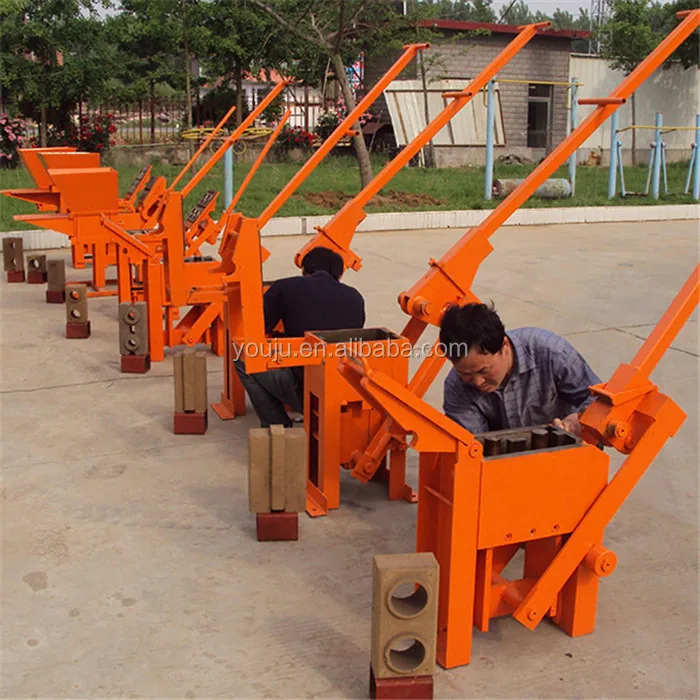
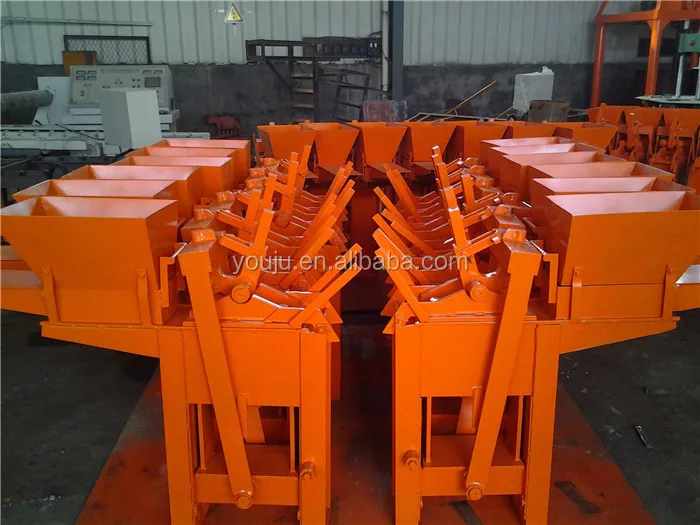
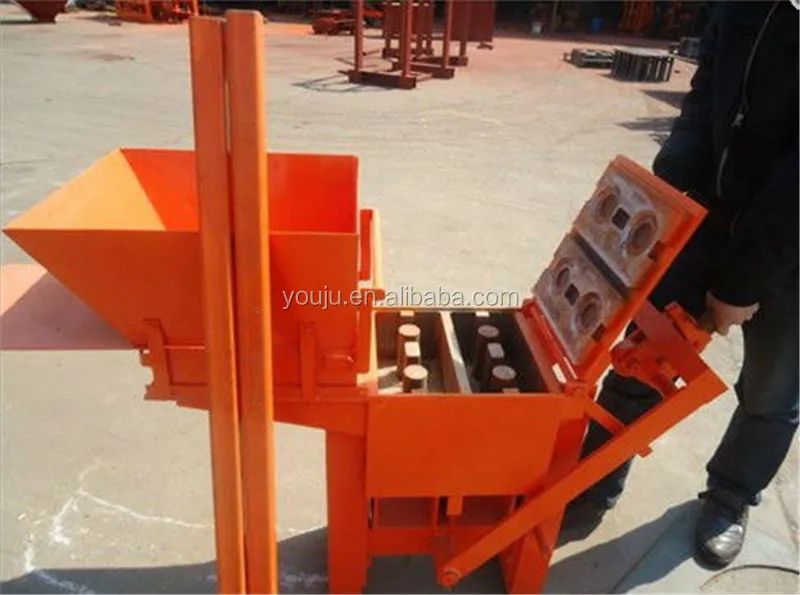
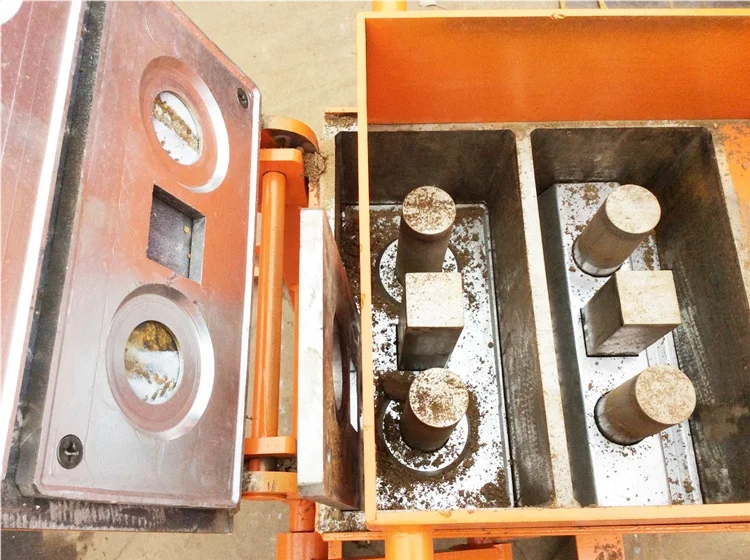
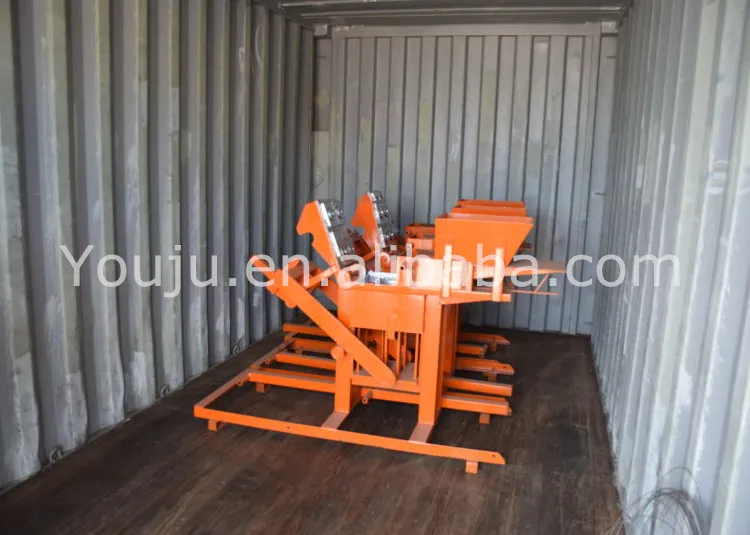
Description
Matched Mould and Press — every interlocking brick format is tested against your soil sample before we quote a cycle time, so the output you see on paper is what the LY2-40 actually delivers on your site.
Technical Specifications
| Parameter | Value |
|---|---|
| Model | LY2-40 |
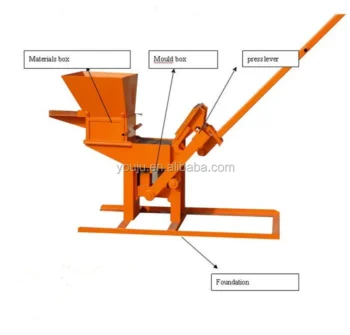
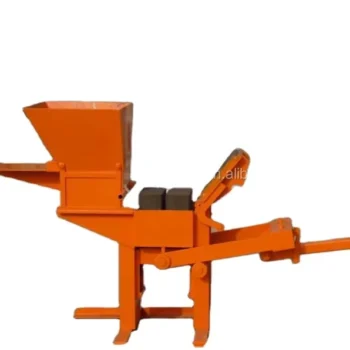
| Product Type | Manual Clay Interlocking Brick Making Machine |
| Overall Dimensions (L×W×H) | 1600 x 700 x 1200 mm |
| Net Weight | 200–240 kg |
| Total Power | No power required, completely manual operation |
| Molding Cycle | 30–40 s (basis not stated in source — confirm block format, material and thickness) |
| Output Capacity | 400–1000 pcs/day (basis not stated in source — confirm block format and shift length) |
| Lifting System | Manual lever |
| Mobility | Steel wheels for on-site repositioning |
| Mould Configuration | Changeable moulds for various interlocking brick profiles |
| Matching Mixer Options | JFA-1 mixer or JQ350 mixer |
| Warranty | 1 Year |
Application Suitability
| Application | Material or Output |
|---|---|
| Small interlocking brick plants for local housing projects | Soil-cement mixes using local clay, laterite or sandy loam |
| On-site construction where grid power is unavailable | Raw clay blended with stabiliser, mixed via JFA-1 or JQ350 |
| First brick plant with minimal capital | Low-volume ecological brick runs, 400–1000 pcs/day depending on format and shift |
| Community and rural development block production | Unstabilised or lightly stabilised clay for non-load-bearing walls |
What "400 to 1000 Pieces a Day" Really Means for Manual Clay Interlocking Brick Making Machine Specifications
Output depends entirely on which interlocking profile your mould is pressing and how long each cycle takes with your specific soil mix.
Most manual press catalogues list a single daily range without naming the brick format behind it. A standard 290 x 140 x 90 mm interlocking brick may press in 30 seconds with a well-graded sandy loam, but the same cycle stretched to 45 seconds with a high-clay mix that sticks to the mould walls. I have stood beside presses in West Africa where operators spent more time prising bricks from the cavity than actually pressing them, and the daily count dropped to a fraction of the brochure figure [NEED_CITE: effect of soil plasticity on manual press cycle time]. The only honest way to quote capacity is to tie it to a specific block format, a confirmed moulding cycle, and a defined shift length.
Mould Formats and the Cycle Time Each One Demands
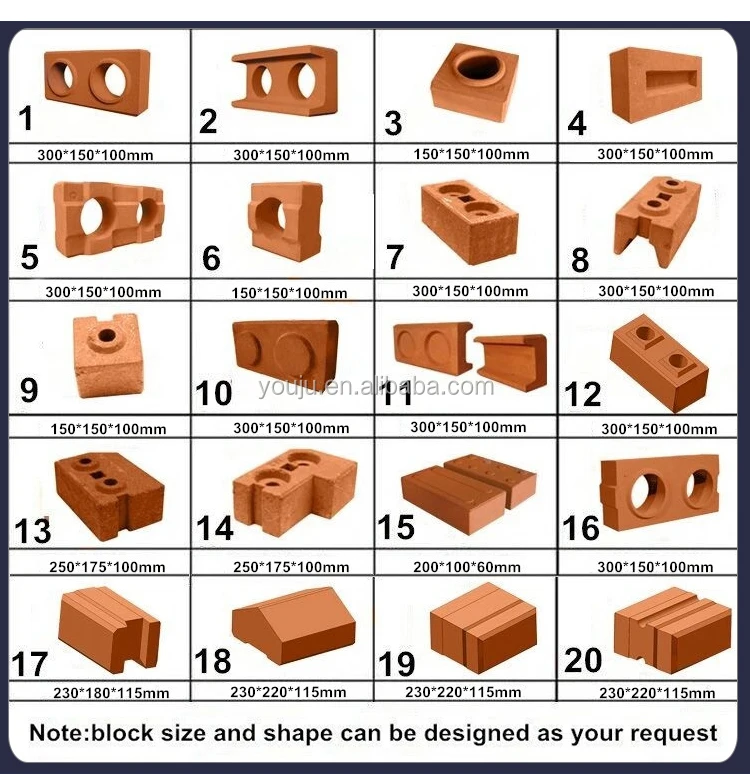
The LY2-40 accepts changeable moulds for different interlocking brick profiles, and each profile behaves differently under manual compression. A simple two-hole interlocking block with straight side walls releases quickly, keeping the manual clay interlocking brick making machine specifications close to the lower end of the 30–40 second range. A more complex profile with deep shear keys and curved interlocking lips holds the compacted soil tighter, adding seconds to every cycle as the operator eases the brick out without chipping the keys. Before you compare daily outputs between suppliers, ask each one to state the exact mould profile behind their number.
Keeping the Mixer Ahead of the Press
With a 30–40 second moulding cycle, the press is ready for a new batch roughly twice a minute. The JFA-1 pan mixer and the JQ350 drum mixer each handle this pace differently. The pan mixer produces a more uniform soil-cement blend in smaller batches, which suits stabilised interlocking bricks where cement distribution affects block strength. The drum mixer moves larger volumes but can leave dry pockets if the clay is sticky. Matching mixer choice to your local soil type prevents the press operator from standing idle waiting for the next wheelbarrow of mix [NEED_CITE: mixer selection for soil-cement interlocking brick production].
Reading the Spec Sheet Against Your Site Conditions
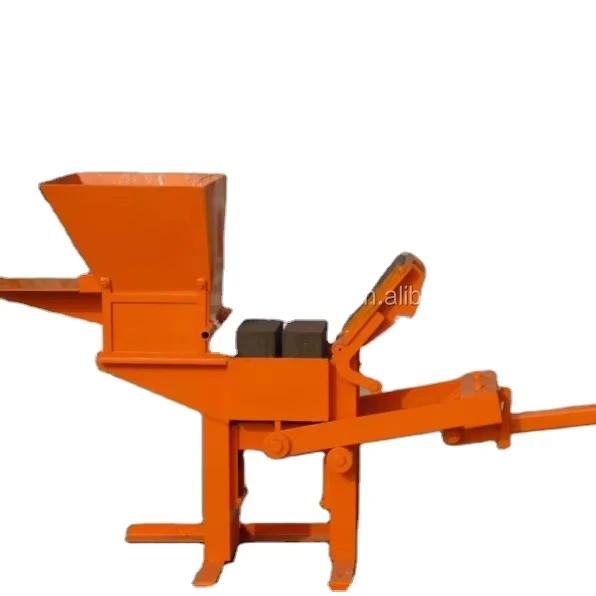
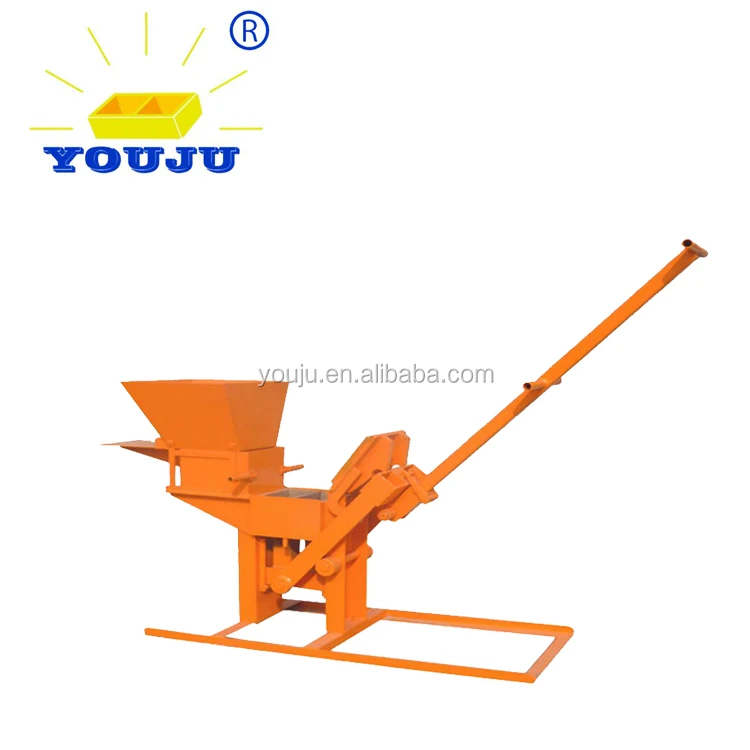
The LY2-40 weighs 200–240 kg and sits on steel wheels, so two workers can roll it across a prepared floor. At 1600 x 700 x 1200 mm it fits through a standard doorway, which matters when the curing area is under a separate shelter. Because there is no motor, the manual clay interlocking brick making machine specifications list zero kilowatts of installed power — a genuine advantage on remote sites where a generator would otherwise consume most of the project fuel budget. The trade-off is that compaction force comes entirely from the operator’s weight on the lever, so block density will vary between a 90 kg and a 70 kg operator unless you standardise the pressing stroke.
The Cost of Skipping a Soil Sample
When a buyer orders a manual interlocking press without sending a soil sample, the mould is chosen from a catalogue and the cycle time is guessed. If the local clay shrinks more than expected during drying, the interlocking keys warp and the bricks no longer stack true. If the sand content is higher than the assumed mix, the bricks crumble at the corners during de-moulding. I once saw a contractor in East Africa discard an entire week of production because the soil-cement ratio had been set for a laterite that his site did not actually have [NEED_CITE: soil variability impact on interlocking brick strength]. Sending a 5 kg bag of soil before the order lets us run test pressings, record the actual cycle time, and recommend the right stabiliser percentage.
Why Source the LY2-40 Through This Channel
Block machinery is our single focus, so the press, mould, pallet and mixer are specified as one matched system rather than sourced from separate vendors. Every LY2-40 is configured against the buyer’s actual soil sample, not a generic catalogue default. Mould design covers the interlocking profiles your local market actually builds with, and custom profiles are drawn to your dimensions. The automation level is selectable — start fully manual and add a mixer upgrade later without replacing the press. Installation guidance includes operator training on your specific soil, so the first week of production is not spent guessing the right water-to-soil ratio.
Documentation & Verification
- Line layout stating the exact interlocking brick format behind the daily output figure
- Mould drawing and profile list showing every interlocking shape available for the LY2-40
- Machine specification sheet confirming 1600 x 700 x 1200 mm dimensions and manual operating parameters
- Factory test record with cycle times measured per block format, not a single blanket number
- Packing photographs and customs documentation support for smooth clearance
Installation, Commissioning & Support
- Prepare a level concrete pad at least 2000 x 1000 mm to allow mixer and press to sit side by side
- No electrical connection required; confirm manual lever clearance of 1200 mm height above the pad
- Machine ships partially assembled; bolt on the steel wheels and lever arm on arrival
- First-day test pressing with your local soil to confirm cycle time and adjust water content
- Operator training covers mould change procedure, lever stroke standardisation and daily cleaning of the cavity
- Wear parts list identifies the mould liner and lever pivot bush for future reordering
What to Include in Your Inquiry
Tell us which interlocking brick profile your market uses, the dimensions of that profile, and your target daily output per shift. Send a 5 kg soil sample from your actual site so we can test the mix and record a real cycle time. If you already have a mixer or a specific curing area layout, describe those so we can confirm whether the JFA-1 or JQ350 fits your line.
Frequently Asked Questions
Q: How is the 400–1000 pcs/day output verified, and which interlocking brick format does it assume?
A: That range is a catalogue placeholder until we know your brick profile. We run your soil sample through the LY2-40 with the exact mould you need, time every cycle, and quote a daily figure based on a defined shift length. Without this test, any number is guesswork.
Q: What mould formats are available for the LY2-40, and how long does a mould change take?
A: Moulds cover standard interlocking profiles with two-hole, three-hole and solid variants, plus custom shapes drawn to your dimensions. A mould swap on the LY2-40 involves unbolting the cavity liner and typically takes under one shift once the operator is trained.
Q: Which mixer — JFA-1 or JQ350 — matches my local soil-cement mix and target volume?
A: The JFA-1 pan mixer gives a more uniform blend for stabilised mixes where cement distribution is critical. The JQ350 drum mixer handles larger batches of plain clay faster. We recommend one after testing your soil sample and confirming your target daily volume.
Q: How do I confirm the block strength my market requires against the manual press compaction force?
A: Compaction force depends on operator weight and lever stroke. We produce test bricks from your soil, measure dry compressive strength, and compare it to your local building code. If strength falls short, we adjust the stabiliser percentage or recommend a higher-tier press.