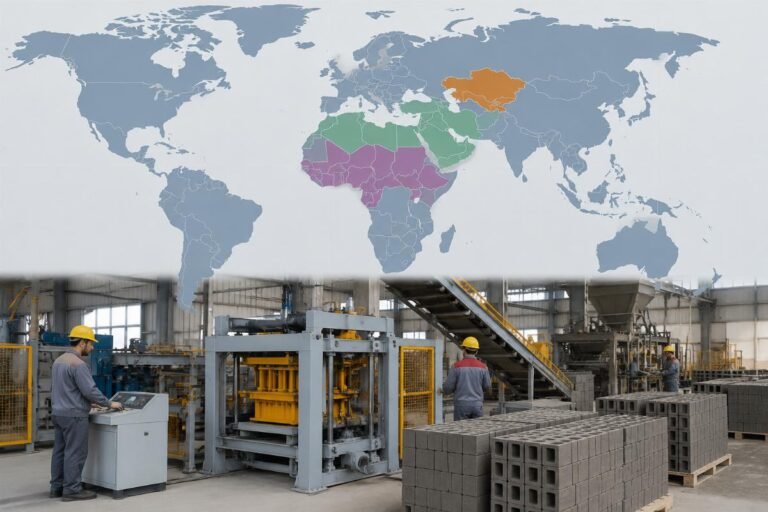
Concrete Block Machine QT10-15 Supplier UAE: China Factory Direct
The cheapest quote on paper often becomes the most expensive machine on site. When sourcing a concrete block machine supplier for UAE projects, the real cost driver is not the invoice price—it is whether the equipment survives 50°C ambient heat, handles abrasive volcanic aggregate, and tolerates unstable grid voltage without shutting down your entire production line.
A reliable concrete block machine supplier for UAE must deliver factory-direct pricing with full Middle East工况 customization—including voltage conversion, high-wear moulds, and dust-proof electrical cabinets—backed by turnkey installation and operator training within weeks, not months. [NEED_CITE: total cost of ownership methodology for capital equipment in emerging markets]
I still remember a project in Ras Al Khaimah. The buyer had picked a supplier based purely on the lowest proforma invoice. The machine arrived, plugged in, and nothing moved. The local grid ran at a different frequency than the machine’s motor rating. We spent weeks reconfiguring drives, sourcing replacement components, and explaining to the client why "cheap" had just cost him a full month of lost production. That kind of failure does not show up in a spec sheet. It shows up when you are standing in a dusty yard, watching a idle line while the client’s phone will not stop ringing.
Choosing the right concrete block machine supplier for UAE operations means looking past the brochure and into the details that actually determine whether your plant runs or stalls.
Why Choose a China Factory Direct Supplier for UAE Block Machines?
Factory-direct sourcing eliminates intermediary markups and compresses delivery timelines dramatically compared to European or Turkish alternatives. The price gap is not about cutting corners on steel or electronics—it is about supply chain density. A manufacturing cluster in Shandong Province concentrates component suppliers, skilled welders, and hydraulic system assemblers within a small geographic radius, which drives unit costs down noticeably without sacrificing build quality. [NEED_CITE: industrial cluster effect on manufacturing cost competitiveness in Chinese machinery sector]
When a buyer in Dubai or Abu Dhabi compares quotes, the European option often carries a premium that reflects brand positioning, higher labor costs at the factory, and longer shipping routes. A concrete block machine supplier for UAE operations based in China can typically deliver a comparable configuration at a substantially lower price point, with the added advantage of proximity to Qingdao Port—one of the busiest container terminals in the world, offering frequent sailings to Jebel Ali.
Consider a mid-size investor setting up a block plant in Sharjah. He received three quotes: one from a Turkish manufacturer, one from a Southern European brand, and one from a Chinese factory-direct source. The European quote was roughly double the Chinese price. The Turkish quote sat in between. But when he dug into what each included—PLC brand, hydraulic valve origin, mould steel grade, and whether installation was bundled—the Chinese quote covered more scope at a lower total. The European supplier charged extra for commissioning. The Turkish supplier used generic moulds not hardened for local aggregate. The Chinese factory-direct option included custom moulds rated for high-silica stone, a voltage-matched control panel, and on-site technician deployment.
The delivery timeline tells a similar story. A complete production line from a Chinese factory-direct supplier can reach a UAE site within weeks of order confirmation, including ocean freight. European suppliers often quote lead times measured in many months, partly because of production scheduling backlogs and partly because of longer transit routes. For a private investor paying rent on an empty warehouse, that difference is not academic—it is cash flow.
A concrete block machine supplier for UAE buyers who sources directly from the factory also gains flexibility on customization. Modifying a control panel for local voltage, swapping hydraulic hoses for high-temperature ratings, or adjusting mould dimensions for regional block standards—these changes are routine requests handled on the production floor, not through a chain of agents and sub-suppliers.
How to Match Block Machine Models to Your UAE Project Scale?
Selecting the right machine model depends on daily output targets, available floor space, workforce skill level, and budget—not on buying the largest unit available. A common mistake among first-time investors in the Gulf is assuming that the highest-capacity machine automatically delivers the best return. In practice, a machine that outruns your market demand or your maintenance team’s ability to service it becomes a liability, not an asset.
Here is a qualitative comparison matrix across the typical model range offered by a concrete block machine supplier for UAE projects:
| Model Tier | Daily Output Range | Floor Space Required | Operator Skill Level | Best Suited For |
|---|---|---|---|---|
| QT4-25 (Mobile Egg-Layer) | Low output, batch-based | Minimal footprint | Basic | Entry-level entrepreneurs, rural markets, starter operations |
| QT6-15 (Semi-Automatic) | Moderate output | Standard workshop | Intermediate | Small-to-medium investors, first production line |
| QT10-15 (Fully Automatic) | High output | Dedicated plant layout | Trained team | Established plants, government housing contracts |
| QT12-15 / QT15-15 (Heavy-Duty Auto) | Maximum output | Large industrial site | Advanced technicians | High-volume manufacturers, multi-shift operations |
[NEED_CITE: productivity benchmarks for concrete block manufacturing lines by automation level]
A private investor launching his first block yard in Ajman might be better served by a QT6-15 than a QT10-15. The QT6-15 requires fewer operators, simpler maintenance routines, and lower initial capital outlay. If his workforce has limited experience with PLC-controlled hydraulic systems, the simpler machine will achieve higher actual uptime because breakdowns are resolved faster. I have seen QT12-15 machines sit idle for days in emerging markets because the local team could not diagnose a sensor fault—whereas a QT6-15 with relay-based logic got running again within hours.
On the other hand, a contractor executing a government affordable housing program in Abu Dhabi needs the throughput of a QT10-15 or higher. These projects come with strict delivery schedules and penalty clauses for late supply. A concrete block machine supplier for UAE contractors working on public tenders must match the machine’s certified output to the project’s bill of quantities. Under-specifying here means missed deadlines. Over-specifying means paying for capacity that sits unused after the project ends.
The key is honest assessment of three variables: how many blocks you actually need to sell per month, how skilled your maintenance team is or can become, and how much capital you can deploy without jeopardizing working capital for raw materials and logistics.
What Customizations Are Critical for Middle East Working Conditions?
Standard export configurations fail in the Gulf unless specifically adapted for extreme heat, abrasive raw materials, and electrical grid instability. A concrete block machine supplier for UAE clients must treat these three factors as non-negotiable design inputs, not optional upgrades.
Voltage and frequency mismatch is the single most common cause of startup delays. The UAE grid operates at specific voltage and frequency standards. Machines configured for other regional standards will not run without drive replacements or transformer installations. I have walked into sites where a perfectly good production line sat silent for weeks because nobody checked the nameplate against the local supply before shipping. A responsible supplier verifies grid specifications at the inquiry stage and configures motors, VFDs, and control transformers accordingly. [NEED_CITE: electrical grid standards and industrial equipment compatibility requirements in GCC countries]
Mould wear from local aggregate is the second silent cost killer. Many UAE quarries produce volcanic rock and high-silica limestone that are substantially harder than the river gravel common in East Asian markets. Standard mould steel that performs well in Southeast Asia will wear out noticeably faster when pressing against this aggregate. The solution is specifying moulds manufactured from higher-grade wear-resistant steel, with heat treatment processes that extend service life meaningfully. This customization adds modest upfront cost but prevents the recurring expense and downtime of frequent mould replacements.
Dust ingress in electrical cabinets is the third factor that separates a machine that lasts from one that fails prematurely. Block plants generate enormous amounts of cement dust and fine aggregate particulate. Standard IP-rated enclosures without positive pressure or enhanced sealing will allow dust to accumulate on contactors, relays, and PLC I/O cards, causing short circuits and erratic behavior. A concrete block machine supplier for UAE operations should specify dust-proof cabinets with filtered ventilation or pressurized enclosures, particularly for the main PLC panel and hydraulic power unit controls.
A buyer in Ras Al Khaimah learned this the hard way. His first machine—sourced from a supplier who did not ask about local conditions—experienced repeated PLC failures within the first year. Each failure required flying in a technician from abroad. After switching to a supplier who specified pressurized cabinets and high-temperature-rated components, his unplanned downtime dropped to a small fraction of the previous level.
These three customizations—voltage matching, wear-resistant moulds, and dust-proof electrical design—should be confirmed in writing before order placement. They are not optional. They are the baseline for any concrete block machine supplier for UAE projects who understands the operating environment.
What Does a Turnkey Solution Include from Order to Production?
A genuine turnkey delivery covers every step from initial site assessment through operator training and first-batch quality verification—not just loading a machine onto a container. Many suppliers use the term loosely. A concrete block machine supplier for UAE buyers should define turnkey with specificity, because the gaps between "shipping the machine" and "running the plant" are where projects stall.
The process begins with raw material assessment. Different sand, gravel, and cement sources produce different concrete rheology. A competent supplier requests samples or at least detailed material specifications before finalizing the machine configuration and mix design recommendations. This step determines vibration frequency settings, pressing force parameters, and curing protocols. Skipping it means the machine arrives configured for generic conditions, not your actual quarry.
Next comes foundation and layout planning. The supplier should provide foundation drawings calibrated to the machine’s dynamic loads and the local soil bearing capacity. I have seen plants where the buyer poured a generic slab, only to discover after installation that the vibration from the main press caused micro-cracking in the floor within months. Proper foundation design prevents this.
Shipping and logistics coordination is the next phase. A concrete block machine supplier for UAE clients should handle export packing, container loading plans, and documentation for UAE customs clearance. Missing paperwork or improper packing that allows moisture ingress during ocean transit can delay a project by many weeks.
On-site installation and commissioning follow. The supplier deploys technicians who assemble the line, connect hydraulics and electrical systems, run dry-cycle tests, and then produce the first合格 blocks under local conditions. This phase also includes operator training—teaching the local team not just how to push buttons, but how to perform daily maintenance, recognize early warning signs of hydraulic or electrical faults, and change moulds efficiently. [NEED_CITE: best practices for technology transfer and operator training in capital equipment deployment]
The final element is ongoing spare parts support. A turnkey supplier maintains an accessible spare parts inventory and can ship critical components—hydraulic seals, proximity sensors, mould wear parts—within days, not weeks. This responsiveness determines whether a minor breakdown becomes a minor inconvenience or a major production loss.
How to Verify Supplier Credentials Before Placing Orders?
Before committing capital, verify that a concrete block machine supplier for UAE projects holds internationally recognized certifications, can demonstrate relevant regional installations, and commits to clear after-sales response terms in writing. Certificates alone are not enough—any factory can print a piece of paper. The question is whether the certifications are current, issued by accredited bodies, and applicable to the specific machine model being purchased.
Request CE certification for the complete machine, not just for individual components. Request SGS or equivalent third-party inspection reports covering the actual production batch, not just a generic factory audit. ISO certification for the manufacturer’s quality management system provides additional assurance of process consistency. [NEED_CITE: certification requirements for construction machinery exported to GCC markets]
Ask for references from installations in the UAE or neighboring Gulf states. A supplier who has successfully commissioned multiple lines in the region understands the regulatory environment, the logistics realities, and the maintenance culture of local workforces. A supplier whose Gulf references are limited to a single installation from many years ago may not have the current operational knowledge your project requires.
Clarify after-sales terms before signing. What is the response time for remote technical support? If on-site service is needed, how quickly can a technician be deployed? Are spare parts stocked regionally, or must they ship from the origin factory? These commitments should appear in the commercial contract, not in a separate brochure.
A buyer in Fujairah compared two shortlisted suppliers. Both quoted similar prices. Both claimed CE certification. But when he asked for the actual certificate numbers and verifying body, one supplier produced them within a day, and the other stalled for weeks with excuses. That response pattern told him everything he needed to know about transparency and reliability.
Conclusion
Selecting a concrete block machine supplier for UAE operations requires evaluating total delivered performance, not just invoice price. Voltage compatibility, mould durability for local aggregate, dust-proof electrical design, and genuine turnkey support determine whether your investment generates profit or frustration. Factory-direct sourcing from an experienced Chinese manufacturer delivers cost advantages, customization flexibility, and rapid deployment—provided you verify credentials, demand regional references, and confirm every critical specification in writing before order placement.