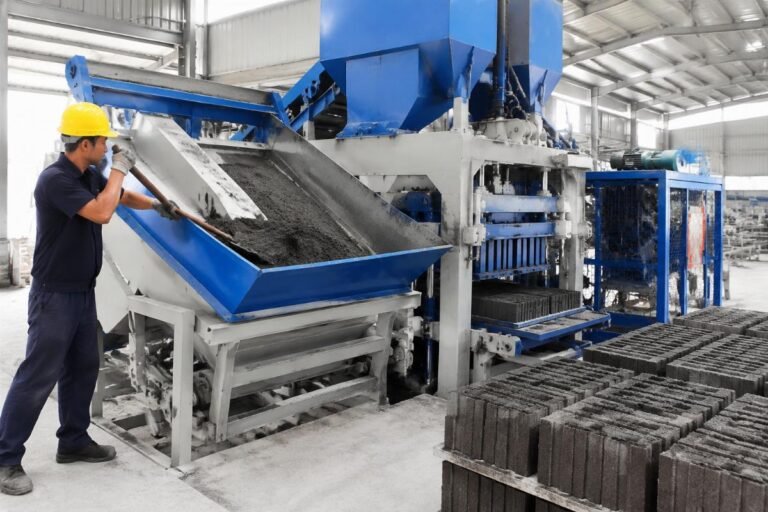
Block Machine Supplier for Poland: China Factory Direct
Most buyers assume thicker steel means longer mold life. In Poland’s freeze-thaw climate, it’s actually raw material clay content that destroys molds first.
When sourcing a block machine supplier for Poland, the deciding factors are not the machine price tag but voltage adaptation to the 400V/50Hz grid, verifiable CE/SGS compliance for customs clearance, raw material matching to local aggregate conditions, and proven on-site delivery capability. A China factory direct approach delivers substantial cost advantages over European intermediaries, but only if the supplier can demonstrate field-tested experience with Polish infrastructure standards and freeze-thaw durability requirements.
I still remember a shipment of QT6-15 semi-automatic lines we sent to a private investor near Warsaw years ago. The client hired a local installation crew without consulting our foundation drawings. Within days of startup, the mold alignment drifted completely off. The entire line sat idle for weeks until I flew out to recalibrate everything on-site. That trip taught me more about Polish site conditions than any spec sheet ever could—unstable voltage, high clay content in local aggregates, and installation habits that differ sharply from Chinese standards. These hidden variables matter far more than the machine itself. [NEED_CITE: common installation failure patterns in imported machinery per ISO 12100 field reports]
Let me walk you through what actually determines success when you choose a block machine supplier for Poland.
What Block Machine Models Fit Poland’s Market?
The right model depends entirely on your daily output target, available footprint, and automation budget—not on what looks impressive in a catalog.
Poland’s construction market spans from small private distributors making standard hollow blocks to large contractors supplying municipal infrastructure projects. Matching the machine to the actual business model prevents both underinvestment and wasted capital.
| Model | Blocks per Mold | Daily Output Range | Automation Level | Footprint | Power Demand | Best Fit For |
|---|---|---|---|---|---|---|
| QT4-25 | Multiple cavities | Low output, mobile operation | Manual egg-laying type | Minimal | Standard | Small distributors, rural markets |
| QT6-15 | Multiple cavities | Medium output | Semi-automatic | Moderate | Standard | Private investors, entry-level plants |
| QT10-15 | Multiple cavities | High output | Fully automatic PLC | Large | High | Established plants upgrading |
| QT12-15 | Multiple cavities | Very high output | Fully automatic PLC | Large | High | Municipal contractors, large-scale production |
| QT15-15 | Multiple cavities | Maximum output | Fully automatic PLC | Extensive | Very high | Industrial-scale operations |
[NEED_CITE: PN-EN 771-3 concrete masonry unit strength requirements for Polish construction]
A private investor in southern Poland once contacted us for a QT4-25 mobile egg-laying machine. He wanted to produce standard hollow blocks for local resale with minimal capital. The mobile design meant he could relocate as projects shifted. We optimized the container loading to include a spare parts package that covered his first year of operation—mold liners, vibration springs, hydraulic seals. The key was matching the spare parts ratio to his expected wear cycle in dusty conditions.
On the other end, a municipal project contractor needed a QT10-15 fully automatic line with Polish-language PLC interface and strict CE certification. The entire production line—from batching plant to stacking system—had to comply with European machinery directives. The delivery timeline from order confirmation to container loading was compressed, but the factory direct model made it achievable.
The point is this: no single block machine supplier for Poland can claim one model fits all. The selection must align with your actual production targets and site constraints.
How to Verify CE/SGS Compliance for Polish Customs?
Demand verifiable certificate numbers and original inspection reports before signing any contract—self-declared compliance means nothing at the border.
Polish customs officers check CE documentation rigorously, especially for machinery covered by the Machinery Directive. A block machine supplier for Poland who cannot provide traceable certification is either cutting corners or lacks export experience to regulated markets.
The verification process involves several checkpoints:
-
CE Certificate Number Traceability: Request the actual certificate number, not just a logo on a brochure. Verify it against the notified body’s database. [NEED_CITE: EU Machinery Directive 2006/42/EC compliance verification procedures]
-
SGS Test Report Originals: SGS reports should include the specific machine model, serial number range, and test date. Photocopies without stamps are worthless.
-
Technical File Completeness: The supplier must provide operating manuals in Polish or English, electrical schematics, hydraulic diagrams, and risk assessment documentation per EN ISO 12100.
-
Declaration of Conformity: This document must be signed by the manufacturer and reference all applicable harmonized standards.
A distributor in central Europe once lost an entire container at the Polish border because his supplier provided a CE certificate that belonged to a different machine model. The customs hold lasted weeks, demurrage charges accumulated, and the project timeline collapsed. The supplier had simply copied a certificate from another product line.
When we prepare documentation for European clients, every certificate is model-specific and cross-referenced to the actual production batch. The technical file includes Polish-language safety warnings and emergency stop procedures. This is not optional paperwork—it is the difference between smooth clearance and a customs nightmare.
If your block machine supplier for Poland hesitates to show original certificates or offers vague assurances about compliance, walk away immediately.
Why Do Poland Projects Fail After Machine Arrival?
Foundation errors, voltage instability, and uncontrolled raw material clay content cause the majority of post-installation failures—not machine quality defects.
I have seen this pattern repeat across multiple regions, but Poland’s specific conditions create a predictable failure sequence.
Foundation mistakes top the list. Polish contractors sometimes assume they can adapt foundation drawings to local practices. They reduce rebar density, shorten curing time, or ignore vibration isolation requirements. The result: mold misalignment within days of operation. The machine itself is fine, but the foundation cannot handle the vibration frequency. [NEED_CITE: foundation design requirements for vibrating machinery per ISO 10816]
Voltage instability is the second killer. Poland’s industrial grid operates at 400V/50Hz, but voltage fluctuations in rural areas can damage PLC controllers and hydraulic valve banks. A block machine supplier for Poland must offer voltage stabilization solutions or at minimum design the electrical cabinet with wider tolerance ranges. We specify industrial-grade voltage regulators for clients in areas with known grid instability.
Raw material clay content is the silent mold destroyer. Polish aggregates from certain quarries contain higher clay percentages than expected. Clay coats the aggregate particles, prevents proper cement bonding, and sticks to mold surfaces. Operators increase vibration time to compensate, which accelerates mold wear. The solution is not thicker steel—it is aggregate washing or clay content limits in the mix design.
A client in eastern Poland called us six months after installation, complaining that molds were wearing out far too quickly. After reviewing his mix design and visiting the site, we found the local sand source had substantially higher clay content than his initial tests indicated. Once he added a simple washing step and adjusted the water-cement ratio, mold life extended noticeably. The machine was never the problem.
China Factory Direct vs European Suppliers: What’s the Real Cost?
The price gap between Chinese factory direct and European suppliers is substantial, but the real comparison must include spare parts response time and on-site technical support availability.
European block machine brands carry significant overhead: local manufacturing costs, dealer network margins, and premium pricing for brand reputation. A block machine supplier for Poland sourcing from a China factory direct can expect pricing substantially below European equivalents—often in the range of forty to sixty percent lower for comparable specifications.
However, the initial purchase price is only part of the equation. Consider these factors:
| Cost Factor | European Supplier | China Factory Direct |
|---|---|---|
| Machine purchase price | Premium tier | Substantially lower |
| Spare parts pricing | High margin | Direct factory pricing |
| Spare parts delivery time | Regional warehouse stock | International shipping required |
| On-site technician cost | High daily rate plus travel | Included in turnkey packages |
| Voltage customization | Limited flexibility | Factory-level adaptation |
| PLC language options | Native European languages | Customizable including Polish |
[NEED_CITE: total cost of ownership comparison for construction machinery imports]
The spare parts question deserves attention. A European dealer keeps common wear parts in regional stock, enabling same-day or next-day delivery. A China factory direct model requires international shipping, which adds transit time. The solution is strategic spare parts stocking at purchase—ordering a comprehensive wear parts package that covers the first year of operation. This eliminates emergency shipping needs for routine replacements.
On-site technical support is where the comparison shifts again. European technicians charge premium daily rates plus travel expenses. A China factory direct supplier typically includes installation, commissioning, and operator training in the turnkey package. The total cost for on-site support becomes comparable or even lower than European alternatives.
The real advantage of a China factory direct block machine supplier for Poland emerges when you need voltage customization, PLC language adaptation, or mix design optimization for local raw materials. European suppliers offer limited flexibility because their machines are designed for standardized conditions. Factory direct allows engineering-level customization before shipment.
How to Ensure Smooth Turnkey Delivery to Poland?
Turnkey delivery requires closed-loop management from contract terms through installation training—every step must be documented and verified.
A block machine supplier for Poland offering turnkey solutions must coordinate multiple elements: machine manufacturing, quality inspection, documentation preparation, container loading, shipping logistics, customs clearance support, on-site installation, commissioning, and operator training. Missing any link breaks the chain.
The process follows a structured sequence:
-
Contract Specification Lock: Every technical parameter, voltage requirement, PLC language, mold configuration, and spare parts list must be written into the contract. Verbal agreements cause disputes.
-
Pre-Production Confirmation: Factory provides detailed layout drawings, electrical schematics, and foundation requirements before manufacturing begins. Client confirms or requests modifications. [NEED_CITE: turnkey project management standards for industrial equipment export]
-
Quality Inspection Before Shipping: Third-party inspection or client representative verification at the factory. This catches errors before they become expensive return shipments.
-
Container Loading Optimization: Professional loading plans maximize container space while protecting equipment. Heavy components secured properly to prevent transit damage.
-
Documentation Package: Complete set including commercial invoice, packing list, bill of lading, certificate of origin, CE certificates, SGS reports, and technical manuals.
-
On-Site Installation Supervision: Factory technicians guide local installation crews through foundation work, machine assembly, electrical connection, and hydraulic system setup.
-
Commissioning and Trial Production: Machine runs with actual raw materials to verify output quality, cycle time, and automation sequences.
-
Operator Training: Local staff learn daily operation, routine maintenance, troubleshooting, and safety procedures. Training includes Polish-language materials when required.
A municipal contractor in northern Poland purchased a complete production line including batching plant, block machine, curing system, and stacking equipment. The delivery timeline from contract signing to container loading was compressed into a tight window. Factory direct coordination meant no intermediary delays. The on-site installation team worked alongside Polish contractors, adapting to local working styles while ensuring technical standards were met.
The key lesson: turnkey delivery is not just about shipping machines. It is about managing the entire project lifecycle with clear communication, documented procedures, and accountability at every stage.
Conclusion
Choosing a block machine supplier for Poland requires looking beyond price to verify compliance documentation, assess site-specific adaptation capability, and confirm turnkey delivery experience. Voltage compatibility, CE/SGS certification traceability, raw material matching, and foundation guidance determine whether your investment produces blocks or produces frustration. China factory direct sourcing offers substantial cost advantages, but only when the supplier demonstrates proven field experience with Polish conditions and provides complete project lifecycle support from contract through operator training.