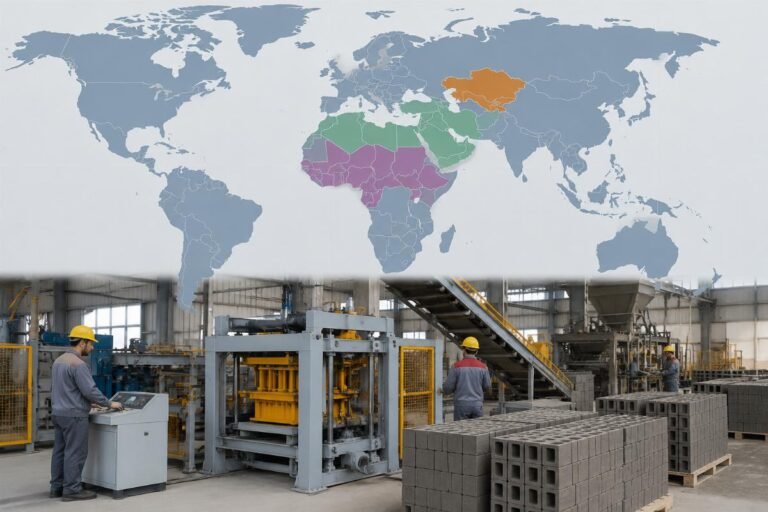
Concrete Block Machine Price in Kazakhstan: 2026 Complete Buyer Guide
The machine invoice is the smallest line item on your real budget.
A concrete block machine price in Kazakhstan typically ranges from entry-level manual units to fully-automatic production lines, but the actual cost you pay is driven by freight to Almaty, customs clearance, voltage adaptation for the local 50Hz grid, and — most critically — recipe testing against Kazakh cement setting times. Buyers who only compare FOB quotes end up spending substantially more on rework, wasted material, and delayed commissioning.
I still remember a call from a buyer near Almaty who had just taken delivery of a semi-automatic line sourced through a local trading company. His blocks were cracking in the curing yard within hours of demolding. He was convinced the vibration table was defective. When our team arrived on site, the machine was mechanically sound — but the local cement had a setting time roughly double what we calibrated for at the factory. The trading company had never asked about his raw materials. That single oversight turned a profitable first year into a mid-six-figure loss in rework and reputation. A concrete block machine price in Kazakhstan is never just the machine; it is the entire system tuned to your local conditions. [NEED_CITE: root cause distribution of block defects in Central Asian production environments]
If you are researching a concrete block machine price in Kazakhstan right now, the rest of this guide walks through what each automation tier actually costs end-to-end, which configuration matches realistic production volumes, and where the hidden expenses quietly multiply.
What Does a Concrete Block Machine Actually Cost in Kazakhstan in 2026?
The landed cost of a block machine in Kazakhstan is typically two to three times the FOB price once freight, customs, installation, and recipe adaptation are included.
Buyers often start their search with a single number — the machine price — and then get shocked by the final invoice. The structure below shows how costs stack across automation tiers when shipping to Almaty, the primary entry point for Central Asian construction equipment. [NEED_CITE: Kazakhstan customs tariff classification for concrete block manufacturing equipment]
| Cost Component | Manual / Egg-Layer Tier | Semi-Auto Tier | Fully-Auto Tier |
|---|---|---|---|
| Machine FOB Price | Entry-level range | Mid-range | Premium range |
| Freight to Almaty (CIF) | Noticeably lower | Standard | Substantially higher due to container count |
| Customs & Certification | Basic clearance | CE/SGS documentation required | Full tender-grade documentation |
| Installation & Commissioning | Minimal | Moderate crew and duration | Extended on-site team and duration |
| Recipe Testing & Calibration | Often skipped | Essential | Critical for PLC tuning |
| Total Landed Cost | Lowest entry point | Moderate investment | Highest but justified at scale |
A government housing contractor I worked with needed CE and SGS documentation for a public tender. The machine itself was a mid-range investment, but the certification package, the installation crew size, and the extended commissioning timeline pushed the total landed cost into a completely different bracket than the FOB quote suggested. The trading company he initially contacted had quoted the machine price alone — no mention of the documentation lead time or the installation crew logistics. [NEED_CITE: CE and SGS certification requirements for construction machinery imported into Eurasian Economic Union member states]
The pattern is consistent: the further you move up the automation ladder, the more the non-machine costs dominate the budget. A concrete block machine price in Kazakhstan that looks attractive on a spreadsheet can easily become a budget overrun if you only priced the hardware.
Which Machine Type Fits Your Production Goal — Semi-Auto or Fully-Auto?
Matching your automation tier to your actual daily demand volume is the single biggest factor in whether your investment pays off — and most buyers overestimate what they need.
The Kazakhstan market has a clear split: private investors building small-to-medium block yards for local residential construction, and government contractors executing large-scale infrastructure or housing tenders. Each group needs a fundamentally different machine. [NEED_CITE: Central Asia construction market demand segmentation for concrete block production]
| Parameter | Semi-Auto Tier | Fully-Auto Tier |
|---|---|---|
| Daily Output Capacity | Moderate volume | High volume |
| Labor Requirement | Noticeably higher manual involvement | Substantially reduced operator count |
| PLC Control | Basic or absent | Full PLC with recipe storage |
| Mold Changeover Time | Moderate | Quick-change systems |
| Suitability | Private investors, regional yards | Government tenders, large-scale plants |
| Payback Period | Shorter at lower volumes | Longer initial payback, higher ceiling |
A private investor in the Karaganda region started with a semi-automatic setup. His daily demand was moderate, his labor costs were low, and his product range was limited to standard hollow blocks. A fully-automatic line would have been a massive overinvestment — the payback period would have stretched uncomfortably long. He scaled profitably because he matched the machine to the market, not to the brochure.
Conversely, an established manufacturer upgrading from manual production to a high-output line needed the full automation package. The output increase ratio was dramatic, and the downtime during the transition was kept short because the installation team coordinated the switchover over a planned shutdown window. The payback period fell well within the expected range because the local block selling price and material cost structure supported high-volume margins. [NEED_CITE: ROI calculation methodology for concrete block production plants in emerging markets]
A concrete block machine price in Kazakhstan means nothing without knowing your daily target output. The wrong tier wastes a substantial portion of your budget — either by overpaying for capacity you will never use, or by underinvesting and losing tenders you could have won.
What Hidden Costs Do Buyers Usually Miss?
The three hidden costs that catch most buyers off guard are voltage adaptation for the local grid, recipe testing against regional cement chemistry, and customs classification disputes.
Let me walk through each one, because these are the expenses that never appear on a supplier’s initial quote.
Voltage and frequency adaptation. Kazakhstan runs on a 50Hz grid. Motors and vibration systems designed for 60Hz markets behave differently — the vibration frequency drops, the compaction density changes, and the block surface quality degrades noticeably. A semi-auto machine with the wrong vibration frequency for the local grid produces substantially more waste than a properly matched unit. The adaptation cost is not large in absolute terms, but if you skip it, your defect rate climbs dramatically. [NEED_CITE: motor specification adjustments for 50Hz versus 60Hz industrial power grids]
Recipe testing against local cement. This is the one I keep coming back to. Kazakh cement — depending on the supplier and the batch — has setting characteristics that differ meaningfully from the reference materials we use for factory calibration. If your supplier does not ask you for a cement sample or at least a detailed specification sheet before shipping, that is a red flag. The cost of flying a technician out to recalibrate the mix design on site runs into several times the cost of doing the recipe work before the machine leaves the factory.
Customs classification. The Eurasian Economic Union customs code for concrete block manufacturing equipment has specific subheadings. Misclassification can trigger duty rate disputes, delayed clearance at the Almaty border, and storage fees that accumulate daily. A concrete block machine price in Kazakhstan that includes proper customs documentation upfront avoids this entirely. [NEED_CITE: Eurasian Economic Union customs tariff subheadings for concrete block making machinery]
I have seen buyers save a substantial portion of their total project cost simply by requesting a detailed landed cost breakdown before signing — machine, freight, customs category, installation crew size, and recipe calibration scope. The suppliers who push back on providing this breakdown are usually the ones padding the margins elsewhere.
How Do You Verify the Price You’re Quoted Is Real?
The most reliable way to verify a concrete block machine price in Kazakhstan is to request a factory-direct quote with a full technical specification sheet — and then compare it against quotes from trading intermediaries.
Trading companies add a markup that typically falls in a noticeable range above factory-direct pricing. That markup is not inherently wrong — some trading companies provide genuine value through logistics coordination and local language support. But many provide no technical support whatsoever for recipe issues, voltage adaptation, or commissioning problems. You are paying more and getting less. [NEED_CITE: price markup structures in construction equipment distribution channels in Central Asia]
Here is what a real verification process looks like:
-
Request a detailed specification sheet from the factory — motor brands, PLC model, steel grade, vibration system type, mold steel thickness. If the trading company cannot provide this, they are reselling without technical oversight.
-
Ask for the CIF Almaty breakdown — machine FOB, freight insurance, ocean freight, inland transport to Almaty. Compare each line item against independently verifiable freight rates. [NEED_CITE: international freight rate benchmarks for heavy machinery shipped to Central Asian landlocked destinations]
-
Confirm certification authenticity — CE and SGS certificates should be verifiable against the issuing body’s database, not just a PDF attachment.
-
Request reference contacts — ask for at least a few buyers in the Central Asia or Caucasus region who have completed installation. A factory confident in its pricing and quality will provide these without hesitation.
A buyer from Astana went through this process and discovered that the trading company quote he had been working with for months was substantially above the factory-direct price — and the trading company had no ability to support the recipe calibration his local cement required. Switching to direct factory contact saved his project budget and gave him a technical team that could actually solve problems on site.
A concrete block machine price in Kazakhstan that comes from a factory with direct export experience will always include the technical details you need to make a real comparison. If the quote is vague, the price is probably inflated to cover the uncertainty.
What ROI Can You Expect From a Block Plant in Kazakhstan?
The ROI of a block plant in Kazakhstan depends on three local variables — cement cost, labor cost, and the local selling price of finished blocks — not on the machine price alone.
Here is the calculation framework I use with buyers:
Daily revenue equals daily output multiplied by the local selling price per block. Daily cost equals material cost (cement, aggregate, sand, additives), labor cost (operator count multiplied by local daily wage), energy cost, and maintenance reserve. Daily margin is the difference. Payback period is the total landed cost divided by the daily margin multiplied by operating days per month. [NEED_CITE: concrete block production profitability modeling for Central Asian construction markets]
The critical insight is that material costs in Kazakhstan — particularly cement — vary by region and by supplier. A plant in the south near Shymkent has a different cost structure than one in the north near Petropavlovsk. The machine price is the same; the ROI is not.
A buyer in the Aktobe region ran this calculation before purchasing and discovered that a semi-automatic tier gave him a faster payback than a fully-automatic line — because his local labor costs were low enough that the automation premium was not justified at his volume. He is now exploring an upgrade after the payback period, which is exactly the right sequence.
A concrete block machine price in Kazakhstan only matters in the context of what that machine earns you once it is running. The buyers who do the math before they buy are the ones who build profitable plants.
Conclusion
The real cost of a concrete block machine in Kazakhstan is the total landed cost plus recipe adaptation — not the FOB price on the invoice. Match your automation tier to your actual demand volume, verify every quote against a factory-direct technical breakdown, and run your ROI against local material and labor costs before you commit. The machine is just the starting point; the recipe and the market are what determine whether your investment works.