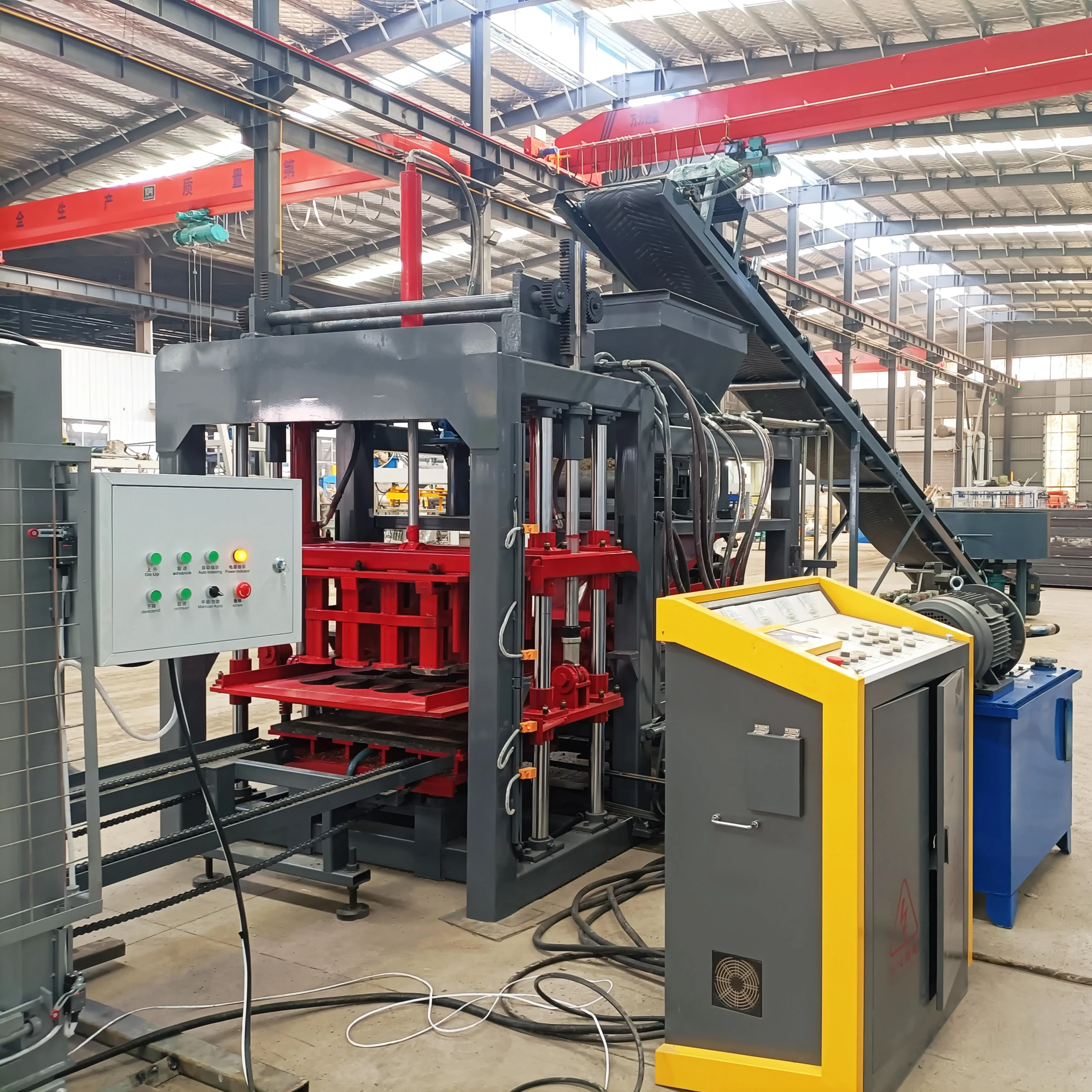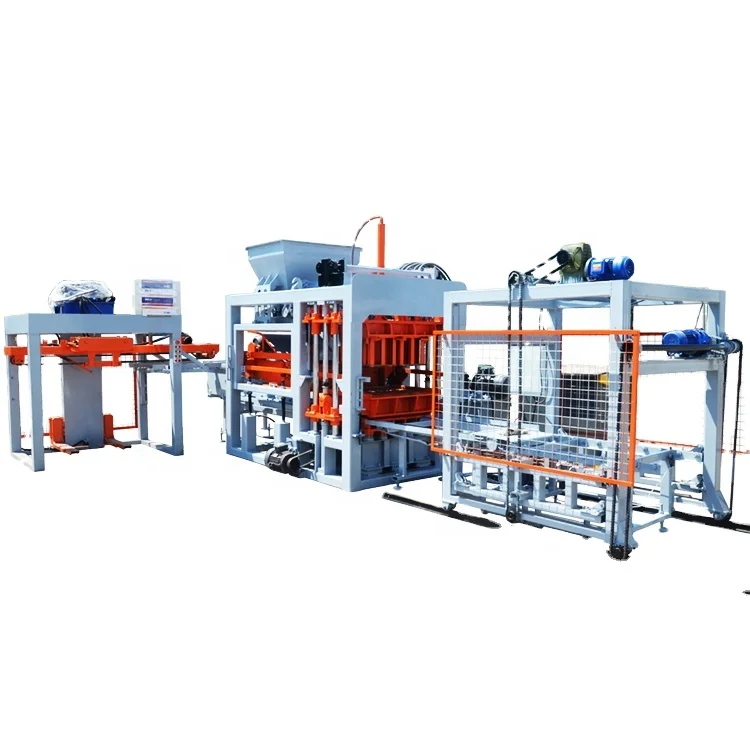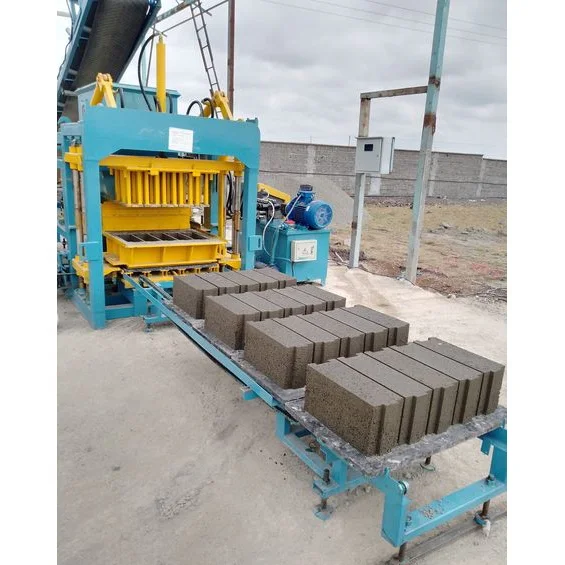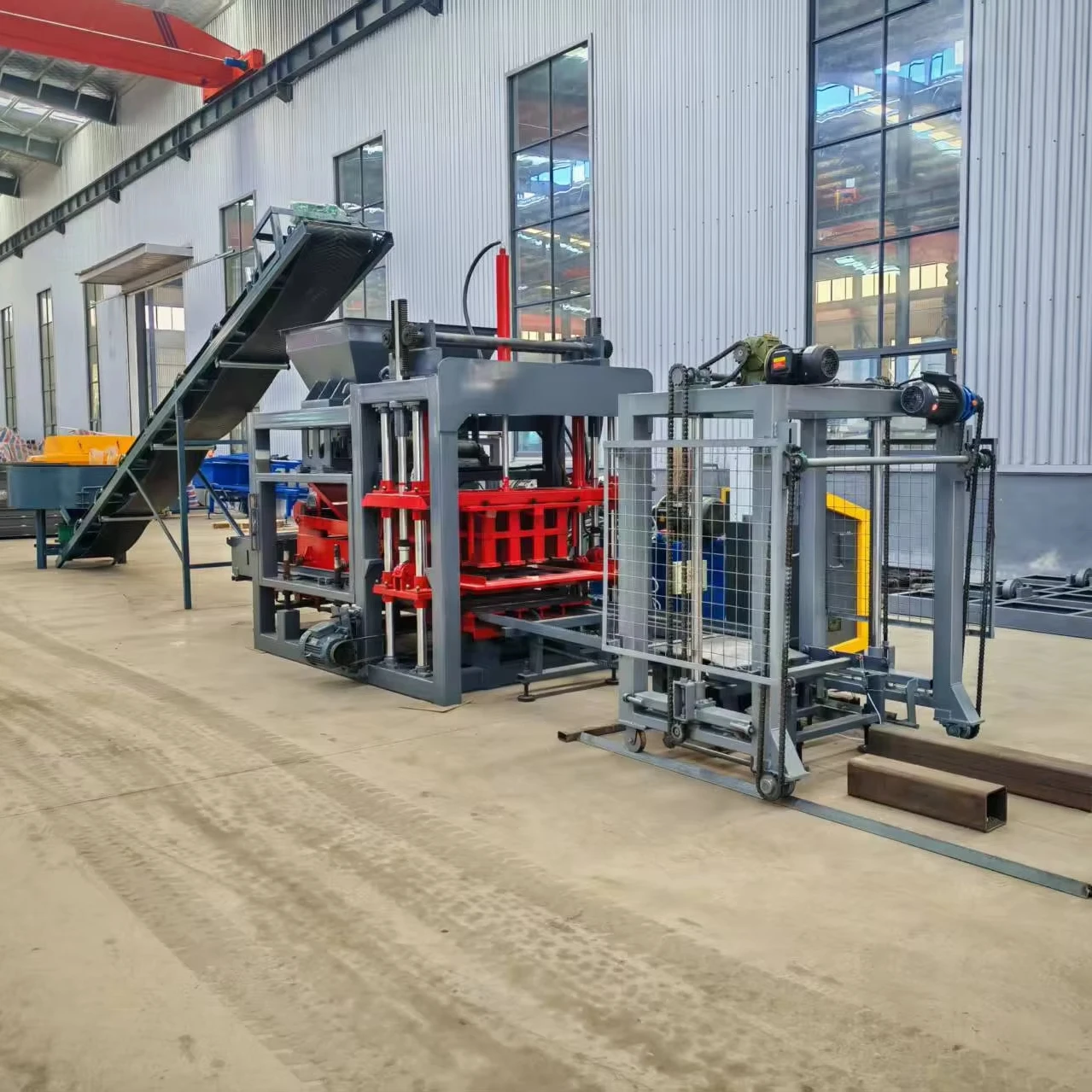


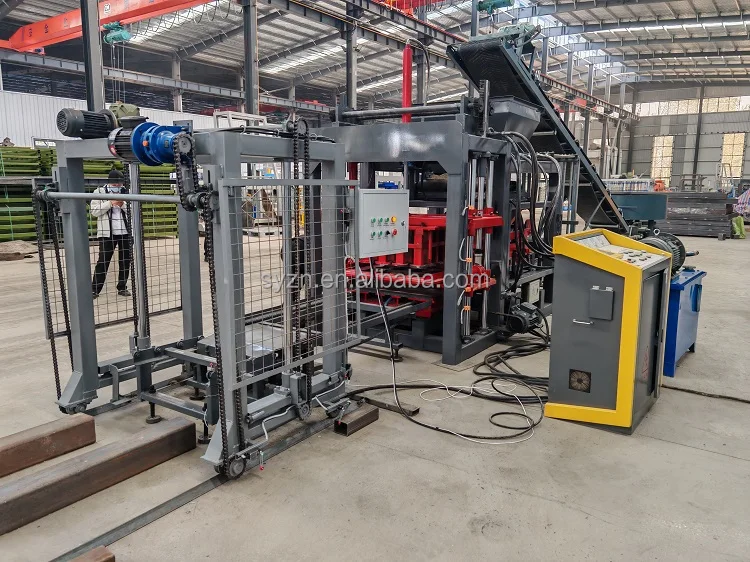
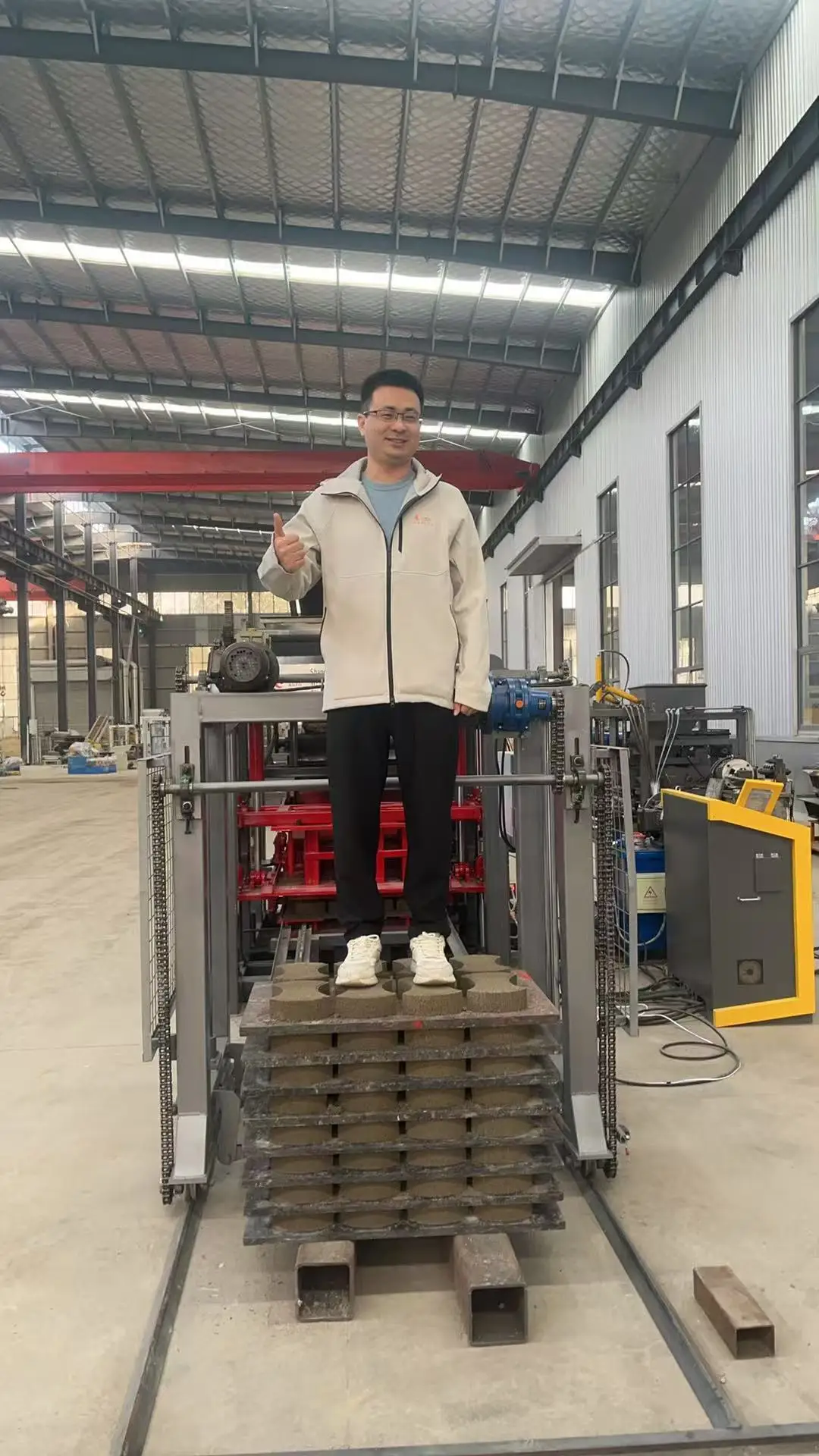
Description
Mould-matched capacity — we quote cycle time and daily output against the buyer’s specific block format and local aggregate, not a catalogue average.
Technical Specifications
| Parameter | Value |
|---|---|
| Model | QT4-18 |
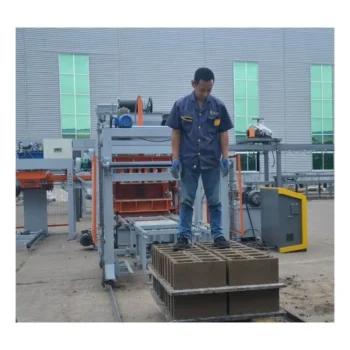
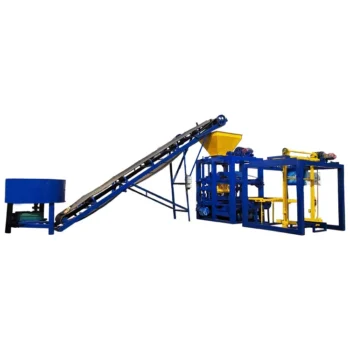
| Product Type | Semi-Automatic Concrete Block Making Machine |
| Overall Dimensions (L×W×H) | 3900 × 1600 × 2300 mm |
| Molding Cycle | 15–25 s |
| Exciting Power (Vibration Force) | 40–50 kN |
| Rated Power | 24 kW |
| Mixer Model | JQ350 |
| Pallet Size | 850 × 550 × 25 mm |
| Total Weight | 3 T |
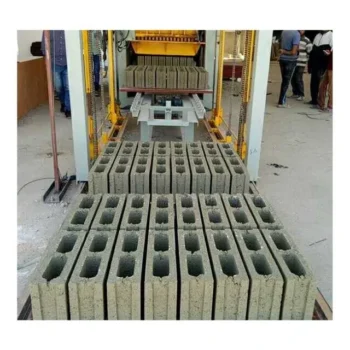
| Applied Products | Paver, solid brick, hollow block, curbstone |
| Raw Materials | Crushed stones, sand, cement, dust, fly ash |
| Output Capacity (Hollow Block 400×200×200 mm) | 1200–1680 pcs/hr (9600–13440 pcs/8 hr) |
| Output Capacity (Hollow Block 400×150×200 mm) | 1800–2400 pcs/hr (14400–19200 pcs/8 hr) |
| Output Capacity (Solid Brick 240×115×53 mm) | 3240 pcs/hr (16200–19440 pcs/8 hr) |
| Automation Level | Semi-automatic |
| Hydraulic Station | Included (high pressure, stable operation) |
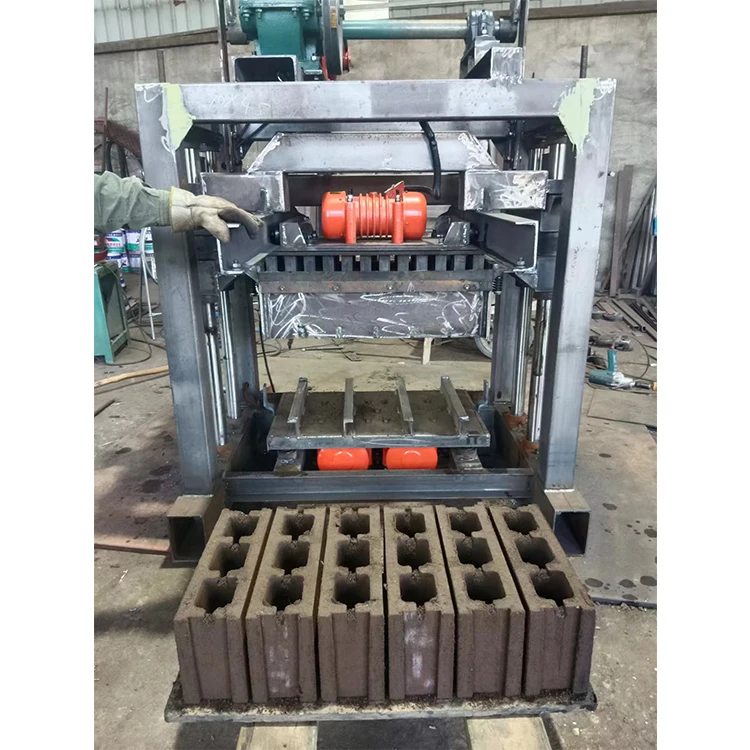
| Vibration System | Bed mould vertical vibration and upper mould compression vibration |
Application Suitability
| Application | Material or Output |
|---|---|
| Hollow block production for residential wall systems | Crushed stone, sand, cement, fly ash mixes forming 400×200×200 mm and 400×150×200 mm cavities |
| Solid brick manufacturing for load-bearing structures | Dense aggregate and cement blends pressed into 240×115×53 mm units |
| Paver and curbstone forming for municipal infrastructure | High-strength mixes compacted under full hydraulic and vibration load |
| On-site block production for construction contractors | Semi-automatic operation suited to project-scale output without a fixed batching plant |
What "1200 Pieces per Hour" Leaves Out on Every QT4-18 Block Machine Specifications Sheet
A cycle rate means nothing until you name the block format it was measured on.
Most quotations for a semi-automatic concrete block making machine capacity list a single output number without stating whether that figure assumes a 400×200×200 mm hollow block, a smaller 150 mm cavity block, or a solid brick. The difference across those formats on the same QT4-18 can be more than double the hourly count. I once saw a buyer in East Africa sign a contract based on a headline number, only to discover during commissioning that his primary product — a 200 mm hollow block — ran at roughly half that rate. The shortfall was not a machine defect; it was a quotation that never named its basis. [NEED_CITE: block format assumptions in capacity quotations]
How Format Dictates Real Daily Output
The QT4-18 block machine specifications list three reference formats with distinct output bands. At 400×200×200 mm hollow, the press produces between 1200 and 1680 pieces per hour across a 15–25 second molding cycle. Switch the mould to a 400×150×200 mm cavity and the same cycle window yields 1800 to 2400 pieces per hour because the reduced volume fills faster under vibration. A solid brick at 240×115×53 mm runs at roughly 3240 pieces per hour. These figures only hold when the raw material feed, mix consistency, and pallet indexing keep pace with the press rhythm.
Why Vibration Force Must Match Your Local Aggregate
The 40–50 kN exciting power delivered through a dual vibration system — bed mould vertical vibration paired with upper mould compression vibration — was chosen to consolidate standard river-sand and crushed-stone mixes. When a buyer sources a harder or more angular aggregate, the energy required to achieve full compaction rises. I learned this the difficult way on a site where volcanic aggregate demanded higher vibration amplitude than the default setting could supply; blocks left the press under-dense until we adjusted both hydraulic pressure and vibration timing. Before confirming any order, we request an actual material sample so the semi-automatic concrete block making machine capacity can be verified against what will really feed the hopper. [NEED_CITE: effect of aggregate hardness on block density]
Reading the Specs That Matter Beyond the Headline Numbers
The 24 kW rated power covers the hydraulic pump, vibration motors, and the JQ350 mixer simultaneously, meaning no separate power loop is needed for the mixing station. Pallet size at 850 × 550 × 25 mm determines the curing rack spacing and the forklift tine width a buyer must already have in place — a mismatch here stalls production on day one. The 3 T total weight reflects a steel frame built to absorb repeated vibration without fatigue cracking, yet light enough for a single flat-rack container. Molding cycle at 15–25 s is a range, not a fixed value, because cycle duration depends on the block height and the mix workability flowing into the mould cavity.
The Hidden Cost of Skipping Format-Level Detail
When a quotation omits pallet specification, the buyer discovers after arrival that the curing racks on site were built for a different pallet dimension, forcing either a rack rebuild or a new pallet order that delays production by weeks. Mould changeover is another gap: if the supplier ships only one mould and lead time for a second is measured in months, the format flexibility the buyer paid for sits unused. Voltage and control language left unconfirmed can strand a machine on the dock while an electrician sources a transformer or re-flashes the PLC display. [NEED_CITE: common commissioning delays in block plant installations]
Why Sourcing the Press and the Line Together Matters
Block machinery is our single focus, so the QT4-18 arrives with its mould, pallet, and handling equipment specified as one matched system. Configuration is set against the buyer’s actual mix design and target block format rather than a catalogue default. Mould design covers every format the buyer’s market sells, including custom drawings when a non-standard paver or kerbstone profile is required. Automation level is selectable, so a buyer can start at semi-automatic and add pallet feeding or stacking automation later without replacing the press. Factory testing records actual cycle time per format before the machine leaves the floor. [NEED_CITE: matched-system approach to block line procurement]
Documentation & Verification
- Line layout and capacity calculation stating each block format assumed for the QT4-18
- Mould drawing and format list reviewed before order confirmation
- Pallet specification sheet matched to buyer’s curing rack dimensions
- Hydraulic and electrical schematic for on-site troubleshooting
- Factory test record showing actual cycle time per block format
- CE declaration supplied where the destination market requires it
Installation, Commissioning & Support
- Foundation pad sized to the 3900 × 1600 mm footprint with anchor bolt template provided
- 24 kW supply confirmed at local voltage and frequency before the panel is energized
- Mixer and press shipped as separate modules for container loading, bolted together on site
- First-run commissioning includes cycle-time verification on the buyer’s actual mix and aggregate
- Operator training covers mould change procedure and daily vibration platform inspection
- Wear parts and mould list supplied so the first replacement order can be placed before stock runs out
Before You Request a Quote
Tell us the exact block formats your market demands and the daily volume you plan to sustain for each. Share a sample or lab report of your local aggregate so we can run a test batch and confirm the semi-automatic concrete block making machine capacity against your real material. Let us know the voltage and frequency at your site, the language your operators read, and the pallet dimensions your existing curing area can accommodate.
Frequently Asked Questions
Q: How is output capacity calculated and which block format does it assume?
A: Every capacity figure we quote names the exact block format, mould cavity count, and molding cycle range used to derive it. For the QT4-18, the three reference formats are 400×200×200 mm hollow, 400×150×200 mm hollow, and 240×115×53 mm solid brick, each with its own hourly band.
Q: What mould formats are available and how long does mould change take?
A: Hollow, solid, paver, and curbstone moulds are all available for this platform. Mould changeover involves unbolting the existing mould box, lifting it clear, seating the replacement, and re-tensioning the vibration coupler — a task trained operators complete within a standard shift when the correct tools are staged.
Q: How do I match pallet size to my existing curing area and forklift?
A: The QT4-18 runs an 850 × 550 × 25 mm pallet. Before order confirmation we ask for your curing rack bay width and forklift tine spacing so we can confirm compatibility or adjust the pallet dimension if the press configuration allows.
Q: What block strength can I expect with my local aggregate and mix design?
A: Block strength depends on aggregate hardness, cement ratio, and the vibration force applied. We request a material sample, run a test press at our facility, and report the resulting compressive strength so you can see the number before committing to a purchase.
Q: What documentation confirms voltage, control language, and cycle time before shipment?
A: We supply a factory test record showing actual cycle times per format, an electrical schematic with confirmed voltage and frequency, and a control language confirmation sheet so the operator interface matches your team’s working language when the machine is powered up.