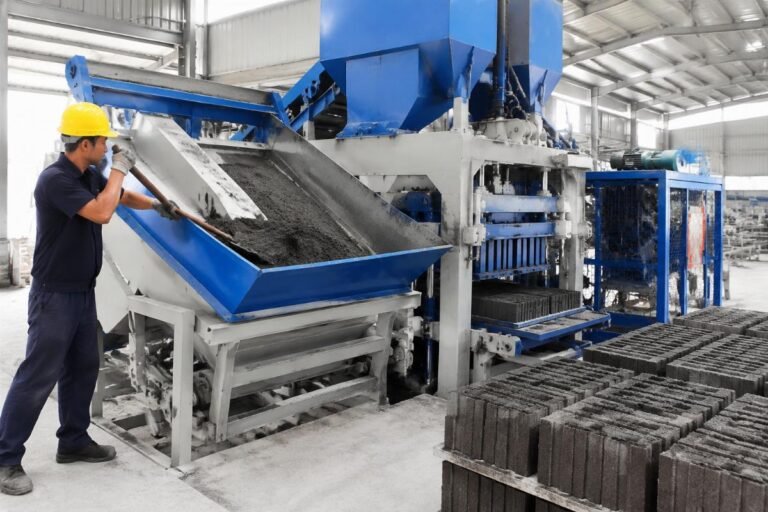
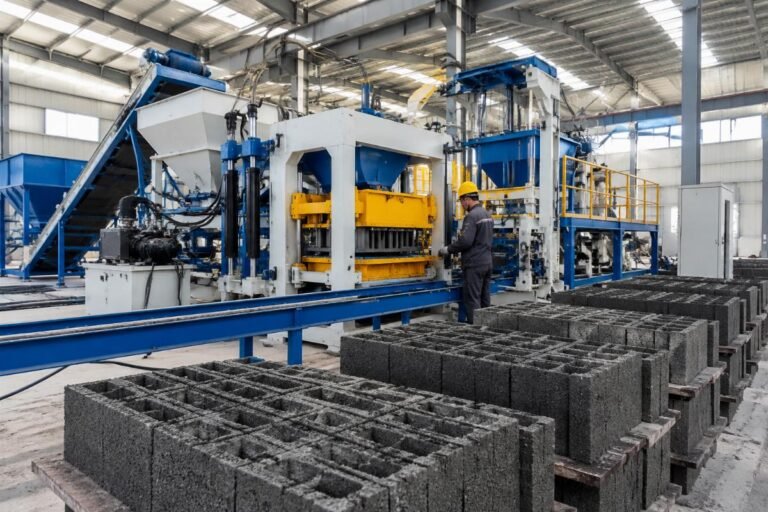
QT10-15 Block Machine Supplier for India: China Factory Direct
Most Indian buyers think the cheapest FOB quote wins the deal. The real cost trap is not the machine price—it is the first unplanned shutdown.
When sourcing a brick machine supplier for India, the three non-negotiable checks are: voltage-adapted electrical cabinets with industrial-grade stabilizers and soft starters, mold steel sourced from certified mills with verifiable hardness ratings, and an after-sales response structure that includes local spare parts buffering. Skipping any one of these turns a capital investment into a liability within the first monsoon season.
I still remember a full QT10-15 line we shipped to a block plant near Ahmedabad. The factory floor was ready, the foundation was poured, and the local electrician wired the main panel exactly as he always did. On day three of commissioning, the main motor tripped the breaker every time the vibration table hit full stroke. The grid in that industrial zone was dropping well below nominal voltage during peak hours, and the unadapted cabinet had no soft-start logic to handle the inrush. The line sat dead for days while the owner calculated losses in the hundreds of thousands of rupees. We ended up flying a technician out with a custom stabilizer bank and reprogrammed soft starters. After that, the plant ran without a single electrical shutdown for the rest of the year. That trip changed how I spec every single control panel headed to the subcontinent. [NEED_CITE: industrial voltage fluctuation tolerance standards per IEC 60038 for emerging market grids]
If you are comparing quotes right now, the rest of this guide will walk you through model selection, electrical adaptation, real landed-cost comparison, and how to separate a credible brick machine supplier for India from a catalog-only exporter.
What Should Indian Buyers Check Before Ordering a Brick Machine from China?
The shortlist of verification points is narrow but unforgiving: electrical adaptation, mold metallurgy, and after-sales architecture.
Too many first-time importers focus entirely on the machine’s cycle time and daily output on paper. In practice, a block plant in India lives or dies by three things that never appear on a glossy brochure.
First, the electrical cabinet must be built for local reality. Indian industrial feeders, especially in Tier-2 and Tier-3 zones, routinely swing between under-voltage and phase imbalance. A cabinet designed for stable European three-phase power will burn contactors and trip thermal relays within weeks. The brick machine supplier for India you choose must include a dedicated stabilizer sized to the total connected load, soft starters on every motor above a threshold rating, and a PLC enclosure rated for high dust and ambient heat. [NEED_CITE: electrical protection requirements for industrial machinery in regions with unstable grid supply]
Second, mold steel is where margins quietly disappear. A mold that looks identical to the naked eye can differ massively in wear life depending on whether the steel comes from a certified mill with controlled carbon and chromium content, or from a local trader’s yard. Ask for the mill test certificate, not just a datasheet. Hardness must fall within the standard range for hardened tool steel, and the supplier should be willing to let you verify through a third-party inspector before shipment. [NEED_CITE: standard hardness range for hardened mold steel used in concrete block machinery]
Third, after-sales is not a promise—it is a structure. A brick machine supplier for India who only offers "remote guidance" is not a supplier; he is a vendor. Real after-sales means a spare parts list tailored to the Indian climate, a buffer stock of wear items either at the factory or with a local agent, and a commissioning engineer who has physically worked on Indian sites before, not just watched a YouTube video.
| Verification Point | Credible Supplier | Catalog-Only Exporter |
|---|---|---|
| Electrical Adaptation | Controlled voltage range, soft starters, dust-rated PLC | Standard EU cabinet, no stabilizer |
| Mold Steel Traceability | Mill test certificate, verifiable hardness | Self-reported datasheet only |
| Spare Parts Strategy | Local buffer stock, wear-part kit included | Shipped on request, long lead time |
| Commissioning Support | On-site engineer with India experience | Remote video calls only |
| Certification | CE/SGS original documents available | Scanned copies of unclear origin |
A buyer from a growing block plant in northern India once told me he chose a supplier purely on price. The machine arrived, ran beautifully for a month, and then the mold wore out at an alarming rate. Replacement molds from the original supplier took weeks to arrive and cost nearly as much as the initial price difference he had saved. He ended up sourcing molds locally, which never quite matched the original tolerances. The lesson was expensive but clear: the brick machine supplier for India who wins on paper can lose you money on the floor.
Which Brick Machine Model Fits Your Production Target in India?
Match the model to your actual daily output target, your available labor skill level, and your land layout—not to the biggest number on a brochure.
Selecting the right machine is the single most consequential decision a new block plant investor makes. Oversizing leads to underutilization and cash flow strain; undersizing creates bottlenecks that no amount of overtime can fix. Here is how the typical model range maps to real Indian production scenarios.
For investors targeting modest daily output, operating with limited floor space and a smaller capital envelope, the mobile egg-laying type machine is the entry point. It produces blocks directly on the curing yard, eliminates the need for pallets and a complex conveyor system, and can be operated by a small crew with minimal training. This is the model a first-time entrepreneur in a semi-urban area would start with, and it can pay back its investment remarkably fast when demand is steady. [NEED_CITE: production capacity classification for mobile concrete block making machines]
For investors targeting a solid mid-range daily output with room to grow, the semi-automatic static machine with a pallet circuit is the workhorse. It requires a prepared foundation, a pallet return loop, and a basic batcher, but it delivers consistent quality and can be staffed with operators who have basic mechanical aptitude. Several clients who started on this model have expanded to a fully automatic line within a relatively short timeframe, using the cash flow from the first line to fund the second.
For established operators, government contractors, or large-scale developers targeting high-volume output, the fully automatic line with PLC control, auto-faces mixing, and a multi-layer rack curing system is the only rational choice. This is the tier where the QT10-15 and its larger siblings operate. The machine demands a skilled technician on site, a stable power supply (or a properly sized generator), and a disciplined maintenance routine—but the per-block cost drops significantly at scale. [NEED_CITE: output classification for fully automatic concrete block production lines]
| Model Category | Typical Daily Output Range | Automation Level | Ideal Buyer Profile |
|---|---|---|---|
| Mobile Egg-Laying | Modest output, single-shift | Manual to semi-auto | First-time investor, limited capital |
| Semi-Auto Static | Mid-range output | Semi-automatic with pallet loop | Growing plant, expanding product range |
| Fully Auto Line | High-volume output | Full PLC, auto batching, multi-layer curing | Established operator, government contractor |
As a brick machine supplier for India, we have seen the pattern repeat dozens of times: the buyer who starts with a right-sized machine and a clear expansion path almost always outperforms the buyer who over-leverages on day one. The QT4-25, QT6-15, and QT10-15 range exists precisely to serve these three distinct stages of growth, and the electrical adaptation work we do for each is tailored to the machine’s specific motor profile and the Indian grid conditions at the installation site.
How Does Voltage Instability in India Affect Brick Machine Performance?
An unadapted electrical system on a block machine in India is not a minor inconvenience—it is a production killer.
This is the single most under-discussed topic in cross-border machinery sales to the subcontinent. Most equipment datasheets assume a stable three-phase supply within a tight tolerance. Indian industrial zones, particularly those at the tail end of state electricity board feeders, routinely experience voltage swings that would trip a standard European cabinet into protective shutdown within hours. [NEED_CITE: documented voltage fluctuation ranges in Indian industrial power distribution networks]
The consequences are not just downtime. Repeated under-voltage conditions cause motors to draw excess current, which heats up windings and shortens insulation life. Phase imbalance burns out contactors. Sudden voltage recovery after a dip sends a torque spike through the gearbox and the vibration system. Over time, these electrical stresses translate into mechanical failures that have nothing to do with the machine’s actual build quality.
The solution is not optional—it is foundational. A brick machine supplier for India must engineer the electrical cabinet with three specific adaptations. An industrial-grade automatic voltage regulator sized to handle the total connected load of the line, not just the main motor. Soft starters or variable frequency drives on every motor above a defined threshold, to eliminate inrush current and allow controlled acceleration. And a PLC enclosure with an ingress protection rating appropriate for dusty, hot factory environments, with surge protection on every signal line.
| Electrical Risk | Symptom on Unadapted Machine | Corrective Adaptation |
|---|---|---|
| Sustained under-voltage | Motor overheating, thermal trips | Correctly sized automatic voltage regulator |
| Phase imbalance | Contactor burnout, single-phasing | Phase monitoring relay with auto-cut |
| Voltage dip and recovery | Torque spike, mechanical shock | Soft starter with ramp control |
| Dust and heat ingress | PLC failure, sensor drift | High IP-rated enclosure with cooling |
I have walked into plants where the owner blamed the machine for poor output, only to find that the real culprit was a three-year-old stabilizer that had never been serviced and was passing through degraded voltage. The machine was fine; the power conditioning was not. This is why a responsible brick machine supplier for India does not just ship a cabinet and wish you luck. We specify the stabilizer capacity based on the actual motor list, we commission the soft starters on site with a power quality analyzer, and we train your local electrician to read the voltage logs. The difference between a plant that runs and a plant that limps is almost always in that cabinet.
What Is the Real Cost Comparison: China vs Europe vs Turkey for India Market?
The headline price gap is substantial, but the true comparison must include landed cost, delivery timeline, and adaptation cost.
Indian buyers comparing quotes from European, Turkish, and Chinese manufacturers often fixate on the FOB number. This is a mistake. The real cost equation includes freight, customs, adaptation work, commissioning, and the cost of downtime during the first year of operation. When all of these are accounted for, the picture shifts in important ways.
European machines carry a significant price premium, often multiples of a comparable Chinese line. The engineering is excellent, the components are top-tier, and the automation is sophisticated. However, the electrical cabinets are typically designed for stable Western European grids, and adapting them for Indian conditions requires additional work—sometimes at the manufacturer’s expense, sometimes at yours. Delivery timelines are also considerably longer, and spare parts lead times from Europe can stretch into weeks. [NEED_CITE: comparative pricing structure for concrete block machinery across major manufacturing regions]
Turkish machines occupy a middle ground. They are closer to India geographically, which shortens freight times, and Turkish manufacturers have significant experience exporting to the MENA region. However, the price is still meaningfully above Chinese equivalents, and the electrical adaptation for Indian grids is not always standard.
Chinese machines, when sourced from a credible brick machine supplier for India, offer a price point that is substantially below both European and Turkish alternatives, with delivery timelines that are significantly shorter. The critical caveat is that not every Chinese factory understands Indian conditions. A factory that ships the same standard cabinet to every country will create problems for you. The right supplier builds the voltage adaptation, the dust protection, and the spare parts strategy into the base offer—not as an upsell.
| Cost Factor | European Source | Turkish Source | Chinese Source (Adapted) |
|---|---|---|---|
| FOB Machine Price | Substantially higher | Moderately higher | Noticeably lower |
| Freight Duration to India | Extended | Moderate | Short |
| Electrical Adaptation | Often additional cost | Variable | Typically included for India spec |
| Spare Parts Lead Time | Extended | Moderate | Short with local buffering |
| First-Year Downtime Risk | Low if adapted properly | Moderate | Low if supplier is India-experienced |
A distributor based in western India once told me he had bought a European line years earlier and spent a small fortune on spare parts and service calls. When he expanded with a second plant, he switched to a Chinese supplier who understood local conditions. The capital savings were significant, but the operational savings—fewer shutdowns, faster parts delivery, lower service costs—were what convinced him to make the Chinese line his standard going forward. The brick machine supplier for India who understands this total-cost picture will always win the repeat business.
How to Verify a Chinese Brick Machine Supplier’s Credibility?
A credible brick machine supplier for India will welcome scrutiny; a weak one will deflect it.
The Chinese machinery market is vast, and the gap between a serious manufacturer and a trading company with a website is not always obvious from a Google search. Protecting your investment requires a structured verification process before you sign any contract or transfer any deposit.
Start with certifications. CE and SGS certificates are baseline requirements for any supplier exporting to regulated markets. However, a scanned PDF on a website proves nothing. Ask for the original certificate number and verify it directly with the issuing body. A credible brick machine supplier for India will provide this without hesitation. [NEED_CITE: CE certification verification process for industrial machinery exported from China]
Next, request references from the Indian market specifically. A supplier who has actually installed and commissioned machines in India will have clients willing to speak about their experience. Ask for at least two references, and actually call them. Ask about the commissioning process, the electrical adaptation quality, the spare parts response time, and whether the supplier’s engineer understood local conditions. If the supplier cannot provide Indian references, treat that as a significant red flag.
Third, insist on a live factory video call, not a pre-recorded tour. Ask to see the specific machine configuration that will be built for your order. Ask to see the electrical cabinet being wired, the mold steel being inspected, and the testing bay where machines are run before disassembly for container loading. A serious manufacturer will accommodate this request immediately.
| Verification Step | What to Request | Red Flag Response |
|---|---|---|
| Certification | Original CE/SGS certificate number for verification | Blurry scan or refusal to provide number |
| Indian References | Contactable client names and phone numbers | "Confidential" or only provides written testimonials |
| Factory Inspection | Live video call showing your specific order | Pre-recorded video only or scheduling delays |
| Electrical Spec | Detailed single-line diagram with stabilizer and soft-start spec | Generic cabinet drawing without India-specific components |
| Spare Parts | Written list of wear parts included and local buffer policy | "Available on request" with no commitment |
I have seen buyers skip these steps to save a week of due diligence, only to spend months resolving problems that a thirty-minute video call would have exposed. The brick machine supplier for India who passes all five checks is the one who will still be answering your phone calls in year five, not just at the point of sale.
Conclusion
Choosing a brick machine supplier for India is an exercise in verifying adaptation, not just comparing price tags. The electrical cabinet must be built for Indian grid reality, the mold steel must be traceable and verifiable, the model must match your actual production target and growth path, and the supplier must welcome rigorous credential checks. Machines that arrive unadapted to local voltage conditions, with unverified metallurgy and no local spare parts strategy, will cost far more in downtime and lost production than any initial price saving could justify. The credible brick machine supplier for India is the one who treats these adaptation challenges as standard engineering work, not as afterthoughts.