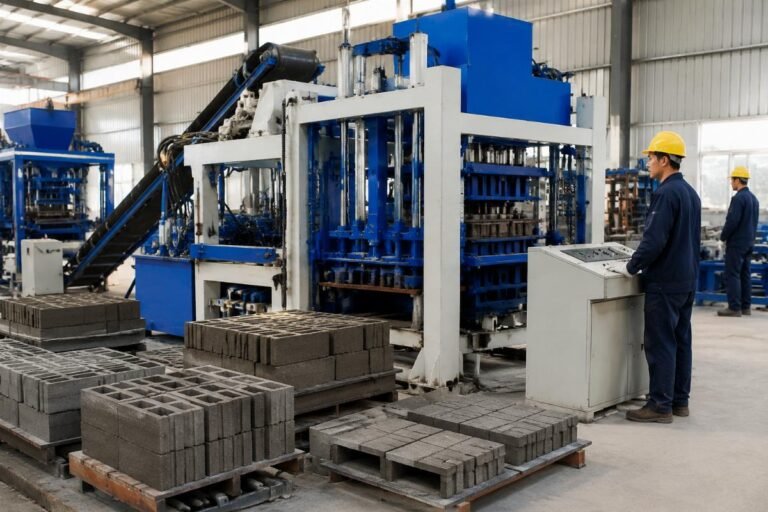
Concrete Block Machine Supplier for Russia: China Factory Direct
Most buyers assume the cheapest FOB quote wins the project. In reality, the supplier who controls container loading, customs documentation, and voltage adaptation saves you far more than the price difference on the invoice.
Sourcing a concrete block machine from China for Russia requires a factory-direct supplier who manages the full chain—from model matching to Siberian cold-proofing, from container weight distribution to GOST certification. A Linyi-based concrete block machine supplier for Russia eliminates middlemen, cuts costs noticeably, and provides turnkey support tailored to local power grids, raw materials, and climate conditions.
I grew up along the Yi River in Linyi, studied mechanical engineering, and started my career tightening bolts and welding frames on the shop floor. When our factory began taking export orders, I moved to the sales side—learning customs codes, container loading plans, and the specific demands of buyers across the CIS region. Linyi sits close to Qingdao Port, and over the years we have shipped complete block lines to multiple destinations across Russia and neighboring markets. One shipment that still sticks in my mind was a full QT10-15 automatic line heading to a site outside Moscow. The buyer arranged his own freight forwarder, who mixed cement silos and batching plant components into a single forty-foot container without respecting weight distribution limits. Russian customs inspected the load at the port of entry, flagged the imbalance, and issued a fine. The buyer came back to us claiming the loss. We ended up covering a mid-four-figure amount in penalties just to keep the relationship alive. That incident changed how I approach every loading plan—because in this business, the supplier is held responsible for everything that goes wrong after the goods leave the factory. [NEED_CITE: Russian Federal Customs Service import inspection statistics on container weight violations]
Let me walk you through what actually matters when you choose a concrete block machine supplier for Russia.
Why Choose a China Factory Direct Supplier for Russia?
Buying direct from a Chinese manufacturer removes layers of trading companies and reduces total procurement costs substantially, while giving you direct access to engineering adjustments for Russian site conditions.
The Linyi area in Shandong Province has developed into one of the largest clusters of construction machinery manufacturing in China. Dozens of block machine factories operate within a small radius, sharing a mature supply chain for hydraulic components, PLC controllers, steel molds, and motors. This clustering effect means shorter lead times and lower component costs compared to sourcing from scattered regions. [NEED_CITE: China Construction Machinery Industry Association report on regional manufacturing clusters in Shandong]
When you work through a trading company, you typically add a markup that inflates the final price noticeably. More importantly, the trading company has limited ability to modify the machine for your specific needs—whether that means adjusting the hydraulic system for sub-zero ambient temperatures or reconfiguring the PLC for local voltage fluctuations. A factory-direct concrete block machine supplier for Russia handles these customizations on the production floor, not through a chain of emails between intermediaries.
A buyer from the Volga region once ordered a semi-automatic line through a third-party agent. The machine arrived with a standard European voltage configuration. Local power at his site fluctuated well beyond acceptable tolerance, and the PLC board burned out within weeks. Replacing the board and adding a proper voltage stabilizer cost him several times what a factory-direct customization would have added to the original order. When you source directly, the engineering team can spec the electrical cabinet with industrial-grade stabilizers matched to your local grid profile before the machine leaves the factory.
Direct sourcing also means you get verified certifications—CE, SGS, ISO—issued against the actual production batch, not recycled documents from a different product line. Russian customs and certification bodies increasingly scrutinize these documents, and having traceable test reports tied to your serial numbers prevents clearance delays. [NEED_CITE: EAEU technical regulation conformity assessment requirements for imported machinery]
Which Block Machine Model Fits Your Russian Project?
The right model depends on your target daily output, available site area, raw material type, and automation preference—not on picking the most expensive option.
Selecting the correct machine is where most mistakes happen. Buyers often assume bigger means better, but an oversized line running at partial capacity wastes capital and increases per-unit cost. Conversely, an undersized machine creates bottlenecks that no amount of shift extension can fix. The key is matching the model to your actual production plan, local raw materials, and site layout.
Below is a selection matrix comparing the main QT-series models we supply to the Russian and CIS market:
| Model | Automation Level | Daily Output Capacity | Pallet Size | Suitable Raw Materials | Ideal Buyer Profile |
|---|---|---|---|---|---|
| QT4-25 | Manual / Semi-auto | Entry-level output | Standard small | Cement, sand, fly ash, furnace slag | First-time investors, small yards |
| QT4-15 | Semi-automatic | Moderate output | Standard | Cement, sand, crushed stone, industrial waste | Small-to-medium private plants |
| QT6-15 | Semi-automatic | Moderate-to-high output | Standard | Full range including lightweight aggregate | Growing operations expanding capacity |
| QT10-15 | Fully automatic PLC | High output | Large format | Full range with color feeder option | Established plants, infrastructure contractors |
| QT12-15 | Fully automatic PLC | Very high output | Large format | Full range with multi-hopper batching | Large-scale commercial producers |
| QT15-15 | Fully automatic PLC | Maximum output | Extra-large | Full range with integrated handling | Industrial-scale operations, government tenders |
[NEED_CITE: ISO 1015 concrete masonry unit production capacity classification standards]
A contractor near Yekaterinburg initially wanted the QT15-15 because it was the flagship model. After reviewing his site dimensions, raw material supply chain, and projected order pipeline, we recommended the QT10-15 instead. The QT15-15 would have required a larger curing yard, a bigger batching plant, and additional forklifts—capital he was not ready to deploy. The QT10-15 matched his actual demand curve, and he expanded to a second line once the market grew. Choosing the right concrete block machine supplier for Russia means getting honest advice on model fit, not just pushing the highest-margin unit.
For buyers working with fly ash or furnace slag—common industrial by-products in Russia’s heavy industrial regions—the mold design and vibration frequency must be adjusted. Standard molds designed for river sand and cement do not always produce optimal density with high fly-ash mixes. Our engineering team modifies the mold cavity geometry and vibration parameters based on the raw material test results you provide. This is a factory-level customization that trading companies simply cannot arrange.
How to Avoid Shipping and Customs Pitfalls?
Professional container loading plans and complete, accurate documentation are the difference between smooth customs clearance and costly port delays.
Shipping a complete block production line to Russia involves far more than booking a container. A full line includes the block machine host, batching plant, cement silo, conveyor system, pallet loader, stacker, color feeder, mixer, and spare parts. These components vary enormously in weight and dimensions. Loading them without a calculated plan invites problems at every stage.
The loading process follows a structured sequence. Heavy components like the main machine frame and cement silo go on the bottom, positioned over the container’s structural reinforcement points. Lighter but bulky items such as conveyor frames and pallet racks fill the upper layers. Pallets of spare parts and small components are secured against the walls to prevent shifting during transit. Every container requires a weight distribution calculation before loading begins—ensuring the center of gravity stays within safe limits for road and rail transport from the Russian port to the final site. [NEED_CITE: International Maritime Organization guidelines on cargo weight distribution in containerized shipments]
Documentation errors cause even more headaches than loading mistakes. Russian customs requires a specific set of documents: commercial invoice, packing list, bill of lading, certificate of origin, and technical passport of the equipment. Each document must match exactly—model numbers, serial numbers, HS codes, declared values. A mismatch of even one digit on a serial number can trigger a physical inspection, which adds weeks to the clearance timeline.
A buyer in Novosibirsk received his container with the packing list showing a slightly different model suffix than what appeared on the machine nameplate—a typo made during document preparation. Customs held the container for inspection, assessed a penalty for document discrepancy, and the demurrage charges accumulated quickly. The total cost of that single typo ran into a mid-four-figure amount. Working with an experienced concrete block machine supplier for Russia means having a dedicated export documentation team that cross-checks every field before the container is sealed.
For buyers who need GOST-EAC certification for the Russian market, the process must begin well before shipping. The certification body requires technical documentation, test reports, and sometimes sample testing. A factory-direct supplier who has handled multiple Russian certification cycles knows exactly which documents the certifying body expects and can prepare them in parallel with production, rather than scrambling after the goods arrive at port. [NEED_CITE: EAEU GOST certification procedure for imported construction machinery]
What After-Sales Support Can You Expect?
Reliable after-sales support means on-site installation, operator training, and ongoing technical guidance—not just a warranty card tucked inside the shipping container.
A concrete block machine is not a plug-and-run product. Even a fully automatic PLC-controlled line requires precise calibration of vibration parameters, hydraulic pressure settings, and material feed rates to produce blocks that meet local strength standards. Without proper commissioning, the machine may run—but it will produce blocks with inconsistent density, high rejection rates, and premature mold wear.
When we ship a complete line to Russia, the package includes派遣 of installation engineers to the buyer’s site. They supervise foundation work, assemble the machine, connect the hydraulic and electrical systems, run trial production, and train the local operators and maintenance staff. This hands-on commissioning typically runs for a defined period, during which the engineers also fine-tune the concrete mix recipe based on locally sourced raw materials.
A buyer in the Krasnodar region ordered a QT10-15 line and initially declined the on-site installation package to save on travel costs. His team managed to assemble the machine, but the vibration settings were off, and the first several thousand blocks failed compression testing. By the time they called us for remote troubleshooting, they had wasted a substantial quantity of raw materials and lost production days. The cost of re-commissioning remotely—plus the wasted materials—far exceeded what the original on-site package would have cost.
For extreme climate conditions, particularly in Siberian and Far Eastern regions, after-sales support also includes cold-weather adaptations. Standard hydraulic oil thickens at low ambient temperatures, causing sluggish cylinder response and increased pump wear. We specify low-temperature hydraulic fluid and, where needed, add heating elements to the hydraulic tank. The PLC cabinet is fitted with internal heaters and sealed against dust and moisture ingress. These modifications are standard practice for any concrete block machine supplier for Russia who has delivered machines to regions where winter temperatures drop well below freezing. [NEED_CITE: hydraulic system cold-climate adaptation standards for industrial machinery]
Remote support is available for ongoing issues. Our engineering team provides video-guided troubleshooting, sends replacement components by express courier when needed, and maintains a spare parts inventory specifically for machines operating in the CIS region. The goal is to minimize downtime—because every hour the line sits idle is revenue lost.
Conclusion
Choosing the right concrete block machine supplier for Russia is a full-chain decision, not just a price comparison.
From model selection matched to your raw materials and output targets, through container loading plans that survive customs inspection, to on-site commissioning adapted to local climate and power conditions—every link in the chain determines whether your project succeeds or bleeds money. Factory-direct sourcing from a Linyi-based manufacturer gives you engineering control, documentation accuracy, and after-sales accountability that no trading intermediary can replicate.