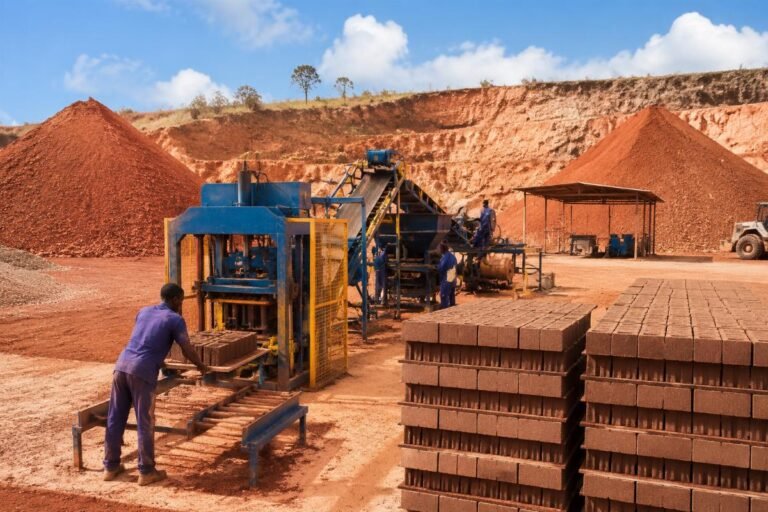
Buy QT10-15 Concrete Block Machine with CE Certificate | Wholesale Supplier
A CE certificate on a block machine is not a quality badge — it is a safety compliance baseline, and most buyers verify it wrong.
When sourcing a concrete block machine with CE certificate from China, the real challenge is not finding the lowest price — it is confirming that the certificate covers the exact model you are ordering, that the machine matches your local voltage and raw material conditions, and that the supplier can deliver turnkey support rather than just a shipping invoice.
I used to work on the procurement side in Linyi, matching African buyers with block production lines. One West African client came to me with a Turkish quotation sheet, asking me to beat the price. I went through the spec list line by line — vibration table power, feeder carriage stroke, hydraulic pressure settings — everything looked properly documented. The machines arrived at Lagos port, got cleared, and fired up for the first time. Within hours, the main motor tripped. The local grid fluctuated far beyond the motor’s rated tolerance. The entire line sat idle for weeks while they sourced voltage regulators and rewired the control panel. The retrofit cost a fraction of what the downtime cost them in lost production days. That was the moment I realized spec sheets lie if they don’t account for the actual jobsite.
The lessons below come from years of watching buyers make the same mistakes — and from building a process that prevents them.
What Does CE Certification Actually Mean for Block Machines?
CE marking confirms that a machine meets EU health, safety, and environmental protection directives — it does not grade build quality or production output.
Many buyers treat a CE certificate as a universal passport for import compliance. The reality is more complicated. The CE mark for machinery falls under the Machinery Directive, and compliance requires the manufacturer to issue a Declaration of Conformity referencing specific harmonized EN standards [NEED_CITE: EU Machinery Directive 2006/42/EC conformity assessment requirements]. The certificate must correspond to the exact model number on the machine’s nameplate — not a similar model, not a previous generation, not a different configuration.
Here is where most verification fails:
| Verification Point | What Most Buyers Check | What Actually Matters |
|---|---|---|
| Certificate holder name | Matches supplier name | Matches the legal entity on the commercial invoice |
| Model number listed | Shows a model number | Matches the exact model on the machine nameplate |
| Notified Body number | Not checked at all | Must be a real, active EU-notified body [NEED_CITE: NANDO database verification for notified body numbers under Machinery Directive] |
| EN standard reference | Not checked | Must reference applicable standards like EN ISO 12100 for safety of machinery |
| Test report availability | Assumed if certificate exists | Must be requestable and cross-referenced to the specific unit configuration |
A government housing contractor in East Africa once required both CE and SGS certification for a public tender. They received documentation from a supplier that looked complete — until the tender evaluation committee cross-checked the Notified Body number and found it had been deregistered. The entire bid was disqualified. The buyer lost months of preparation time.
When you request a concrete block machine with CE certificate, ask for three documents simultaneously: the CE Declaration of Conformity, the Notified Body test report referencing your exact model, and the machine nameplate photo showing the model number that appears on the certificate. If the supplier hesitates or provides documents for a different model, walk away.
How to Match Machine Specs to Your Local Site Conditions?
Voltage stability, raw material availability, and ambient climate determine your machine configuration far more than the brochure specifications do.
Parameter sheets from different manufacturers often look interchangeable — same cycle time, same block output per mold, same hydraulic pressure rating. But the numbers only hold true under controlled test conditions. Your factory floor is not a controlled test environment.
The voltage issue deserves special attention. Many emerging market grids experience fluctuations that exceed the standard tolerance range of industrial motors. A machine designed for a stable European grid will shut down repeatedly on an unstable African or South Asian grid unless the motor and control system are specified for wide-voltage operation [NEED_CITE: IEC voltage tolerance standards for industrial equipment in unstable grid conditions]. This means requesting motors rated for broader input ranges, soft-start or variable frequency drive configurations, and calculating the transformer capacity needed for your specific site.
Raw material variation matters equally. The same QT10-15 model running on crushed granite aggregate will behave differently than when running on laterite or recycled concrete. The vibration frequency, mold filling stroke, and hydraulic pressing force must be adjustable to compensate. A supplier who only asks for your target output without asking about your aggregate source is selling you a machine, not a solution.
Climate affects hydraulic fluid viscosity, steel thermal expansion, and electronic component reliability. A machine shipped to the Gulf region needs different cooling specifications than one shipped to highland East Africa.
| Site Factor | Standard Configuration Risk | Adapted Configuration Advantage |
|---|---|---|
| Unstable voltage grid | Frequent motor tripping, control board damage | Wide-voltage motors, soft-start systems, surge protection |
| Variable raw materials | Inconsistent block density, high rejection rate | Adjustable vibration frequency, variable feeder stroke |
| High ambient temperature | Hydraulic overheating, reduced cycle efficiency | Enhanced cooling circuits, heat-resistant seals |
| High dust environment | Sensor fouling, mechanical wear acceleration | Sealed electrical cabinets, dust-proof bearings |
A private investor in Latin America started with a semi-automatic line because the budget was limited. He chose the entry-level configuration but insisted on voltage adaptation and two additional mold sets for different block sizes. The initial investment was modest, and the ability to switch between solid blocks, hollow blocks, and interlocking pavers meant he could serve multiple customer segments from day one. The payback timeline shortened considerably because the machine matched his actual market, not a theoretical one.
Which Block Machine Model Fits Your Production Target?
Choosing between semi-automatic and fully automatic lines depends on your daily output target, available labor, and investment budget — not on which model sounds more impressive.
The model numbering in the block machine industry follows a convention where the first digits indicate the mold area capacity and the suffix indicates the cycle configuration. Understanding this helps you match the machine to your actual needs rather than overspending or undersizing.
For buyers entering the market with limited capital and limited technical staff, semi-automatic machines offer a practical starting point. They require more manual labor for material feeding and pallet handling, but the investment threshold is substantially lower, and the learning curve is gentler. A single semi-automatic unit can serve as the production core while the business builds volume and operator experience.
For government contractors executing large-scale housing or infrastructure projects, fully automatic PLC-controlled lines are usually mandatory. Tender documents typically specify minimum daily output, certification requirements, and automation levels. The machine must deliver consistent output across extended shifts with minimal manual intervention.
| Production Scenario | Suitable Configuration | Key Selection Criteria |
|---|---|---|
| Entry-level private investor | Semi-automatic single machine | Low capital entry, simple operation, mold flexibility |
| Growing block yard | Semi-automatic line with conveyor | Moderate output scaling, reduced labor dependency |
| Government housing tender | Fully automatic PLC line | High daily output, certification compliance, turnkey delivery |
| Industrial expansion | Multi-line fully automatic plant | Maximum throughput, minimal downtime, integrated batching |
The concrete block machine with CE certificate that you order must align with your production reality. A fully automatic line sitting in a yard with no trained operators generates no revenue. A semi-automatic machine that cannot meet a tender’s daily output requirement disqualifies your bid. The right choice is the one that matches where your business is today and where it plans to be in the near term.
What Should Be Included in the Technical Agreement?
The technical agreement is your only protection against specification disputes after the machine arrives at your port — treat it as the real contract, not the commercial invoice.
Most buyers focus negotiation energy on price and payment terms, then accept a brief technical appendix almost as an afterthought. This is backwards. The technical agreement defines what you actually receive. If a dispute arises — and disputes over machinery purchases across borders are common — the technical agreement is what arbitrators and customs inspectors will reference.
The agreement must specify voltage adaptation requirements in explicit electrical terms: input voltage range, frequency, phase configuration, and the type of motor protection system included. It must list every mold set included, with the exact block dimensions and cavity count for each. It must define the scope of installation support — whether the supplier sends engineers on-site, for how many days, and what training is covered.
| Technical Agreement Element | Common Omission Risk | Required Specification |
|---|---|---|
| Voltage and electrical adaptation | Generic statement only | Exact voltage range, frequency, motor protection type |
| Mold set inventory | Quantity only | Dimensions, cavity count, block type per mold |
| Installation and training scope | "Installation support included" | Number of engineers, duration, training content |
| Spare parts package | Not mentioned | List of included wear parts, quantity per item |
| Performance acceptance criteria | Not mentioned | Output rate, block quality standard, test procedure |
A buyer in the Middle East once received a machine where the technical agreement stated "installation support included" without further detail. The supplier sent a single technician for a brief visit, and when the line did not reach the expected output, both sides blamed the other. There was no written acceptance criterion to reference. The dispute consumed months.
When you finalize your concrete block machine with CE certificate purchase, insist that the technical agreement reads like an engineering document, not a marketing summary. Every parameter that matters to your production should be written in measurable, verifiable terms.
How to Verify Supplier Capability Before Ordering?
A supplier’s real capability shows in their export track record, their willingness to customize, and their after-sales structure — not in their website gallery.
Any factory can photograph a machine and publish it online. The meaningful questions are harder to answer from a brochure: Has this supplier shipped to your country or region before? Do they understand your local conditions well enough to adapt the machine proactively? Can they support you after the machine is running?
Look for evidence of real export experience across multiple regions. A supplier who has delivered to buyers across Africa, the Middle East, Latin America, and Southeast Asia has encountered a wide range of site conditions and learned to engineer solutions for them. This breadth of experience matters more than a single impressive reference project.
Check whether the supplier offers genuine customization — not just color changes on the control panel, but real engineering adaptation for voltage, raw materials, and climate. Ask specific technical questions about how they would configure the machine for your conditions. A capable supplier will ask you detailed questions in return. A supplier who simply confirms that "everything is fine" without probing your site conditions is not preparing your machine properly.
After-sales structure matters for long-term production continuity. Ask about spare parts availability, response time for technical support, and whether on-site service is available if needed. The supplier’s willingness to commit installation engineers and training programs into the contract tells you whether they view the relationship as a one-time transaction or an ongoing partnership.
Conclusion
Buying a concrete block machine with CE certificate is an exercise in verification, not comparison shopping. Confirm that the certification is real and model-specific, match the machine to your actual voltage and material conditions, choose the automation level that fits your production target, lock every technical detail into a binding agreement, and verify that the supplier has the experience and structure to support you beyond the shipping date. The machines themselves are commodities — the discipline you apply before ordering determines whether your investment produces blocks or problems.