Concrete Block Machine Price in Philippines: 2026 Buyer Guide for Sale
The cheapest concrete block machine price in Philippines listings often end up costing the most once you factor in tropical downtime, voltage failures, and missed project deadlines.
In 2026, a concrete block machine price in Philippines ranges from a few thousand dollars for a manual egg-layer to well over six figures for a fully-automatic PLC line with batching plant integration. The real number that matters is not the FOB tag—it is the landed cost plus climate adaptation plus payback speed under local grid and labor conditions.
I spent years sourcing construction equipment across the Gulf, and the single biggest mistake I kept seeing was buyers choosing machines based purely on the invoice price. One developer in Riyadh bought a Turkish-supplied line because the quote looked clean. By week two of summer operation, the hydraulic station had no cooling circuit and the machine locked up every couple of hours in fifty-degree heat. The block output collapsed, the project slipped by over a month, and the repair bill dwarfed whatever they thought they saved. That kind of lesson follows you. When I shifted to the supply side, the first thing I insisted on for every machine heading into hot, humid, dusty markets was an independent cooling loop and a sealed control cabinet. The concrete block machine price in Philippines looks attractive on paper, but only if the unit can actually survive a Philippine summer without shutting down. [NEED_CITE: tropical climate impact on hydraulic system reliability in construction machinery]
Let me walk you through how the concrete block machine price in Philippines actually breaks down across machine types, hidden costs, ROI timelines, and what to look for in a supplier who understands Southeast Asian site conditions.
Manual vs Semi-Auto vs Fully-Auto: Which Type Fits Your Budget?
The concrete block machine price in Philippines scales with automation level, but the right choice depends on your daily volume target, available labor, and whether you plan to sell blocks commercially or supply your own projects.
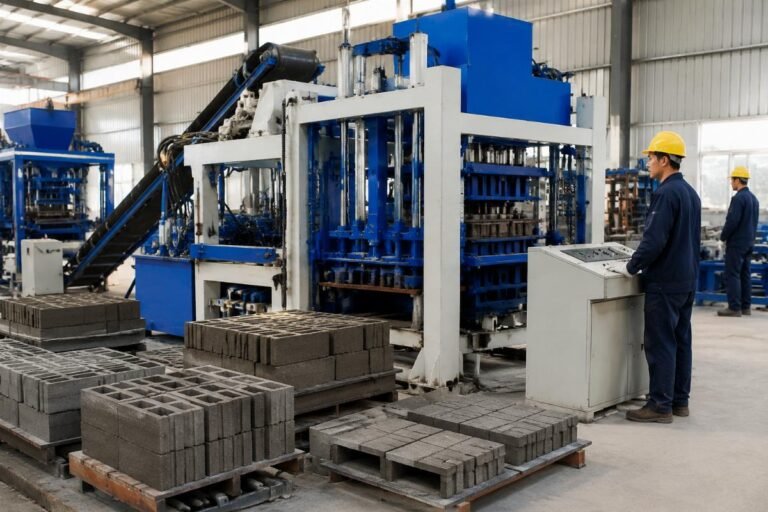
Buyers typically fall into three buckets. A small investor setting up a backyard yard in the suburbs of Manila usually starts with a manual or mobile egg-layer. A mid-size contractor in Cebu or Davao running government housing subcontracts needs a semi-automatic to fully-automatic line with a proper mixer and batching setup. A bidder on national public housing tenders usually goes straight for a full PLC line with multiple mould sets and stacking systems.
Here is how the tiers compare in practical terms:
| Factor | Manual / Egg-Layer | Semi-Auto (e.g., QT4/Q T6 class) | Fully-Auto PLC Line |
|---|---|---|---|
| Typical Output Range | Low hundreds per shift | Low thousands per shift | High thousands to tens of thousands per shift |
| Labor Requirement | Several operators | Small crew, handful of people | Minimal line operators |
| Mould Changeover | Frequent, manual | Moderate | Quick-change systems available |
| Climate Sensitivity | Low (simple mechanics) | Moderate (hydraulics need cooling) | High (PLC and sensors need dust-sealed cabinets) |
| Suitability for Philippine Grid | Tolerant | Needs voltage stabilization | Requires wide-voltage design and surge protection |
| Best For | Side business, own-site use | Growing commercial yard | Tender-backed volume production |
[NEED_CITE: Philippine construction equipment import classification by automation level]
A mid-size contractor I worked with in Southeast Asia initially wanted the biggest machine available, assuming higher output automatically meant faster payback. What he did not account for was that his raw material supply chain could not keep the hopper full, and his mould variety needs meant frequent changeovers. The large line sat idle a noticeable portion of each shift. He would have been better served by a mid-tier machine matched to his actual material flow. The concrete block machine price in Philippines for that mid-tier option was a fraction of the flagship line, and his utilization rate was far higher.
Hidden Costs: Shipping, Installation, and Tropical Climate Adaptation
The quoted concrete block machine price in Philippines is only the starting point. Freight, customs, foundation work, electrical upgrades, and climate-proofing can add a substantial layer on top.
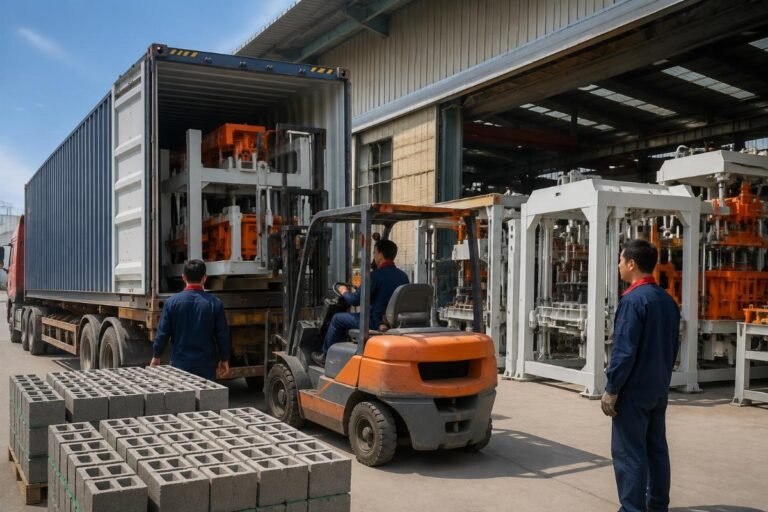
Shipping a complete line from China to Manila or Cebu involves ocean freight, port handling, inland transport, and Bureau of Customs clearance. Foundation work for a stationary line is not trivial—vibration-sensitive equipment needs a proper concrete pad, and you must plan for pallet storage, raw material bays, and cured block staging areas. Electrical supply in many Philippine industrial zones is not perfectly stable; voltage dips and surges are common, especially during typhoon season. [NEED_CITE: Philippine industrial power quality statistics and voltage fluctuation patterns]
This is where tropical climate adaptation becomes non-negotiable. High ambient temperature combined with high humidity attacks hydraulic oil viscosity and accelerates seal degradation. Fine volcanic ash and construction dust infiltrate unsealed control cabinets and destroy PLC boards. I have seen machines in similar climates fail within months because the electrical panels were basic enclosures rather than dust-sealed, climate-controlled cabinets.
A properly specified machine for Philippine conditions should include:
- An independent hydraulic cooling circuit, not just a shared radiator
- Sealed and filtered control cabinets rated for dusty, humid environments
- Wide-voltage electrical components tolerant of grid fluctuation
- Corrosion-resistant fasteners and treated structural steel
- Tropical-grade hydraulic hoses and seals
When you compare a concrete block machine price in Philippines from a supplier who includes these adaptations against one who does not, the upfront gap may look significant. But the machine without them will cost you far more in unplanned downtime, premature component replacement, and lost production during the hottest months. The real price is the one you pay when the machine stops running.
ROI Breakdown: When Will Your Block Machine Pay for Itself?
Payback speed depends on block selling price, cement and aggregate costs, labor rates, and machine utilization—not on the concrete block machine price in Philippines alone.
A useful way to think about ROI is to model your daily output against your per-block margin, then subtract fixed costs like labor, electricity, mould wear, and maintenance. In the Philippine market, hollow blocks for standard residential construction carry a modest but consistent margin, while specialized products like interlocking pavers or curbstones command noticeably higher per-unit returns. [NEED_CITE: Philippine hollow block market pricing and margin structure]
Consider two scenarios I have seen play out repeatedly:
A small investor running a semi-automatic line with a small crew, producing several thousand blocks per day for local hardware stores and small contractors. His overhead is low, his material sourcing is localized, and his payback window runs into a matter of months rather than years. The concrete block machine price in Philippines for this tier is within reach of a modest capital base.
A larger operation running a fully-automatic line, supplying a government housing project with certified blocks. His per-block margin may be tighter due to tender pricing, but his volume is massive and his labor cost per block is minimal. His payback is also fast, but his upfront capital requirement and working capital for raw materials are substantially higher.
The mistake both types of buyers make is focusing on the machine price tag rather than the margin-per-block multiplied by utilization rate. A machine that costs more but runs reliably through the rainy season and the hot season will outperform a cheaper machine that loses weeks to breakdowns. [NEED_CITE: construction equipment total cost of ownership methodology]
How to Choose a Reliable Supplier for the Philippine Market?
The right supplier is the one who asks about your site voltage, your raw material type, and your local climate before quoting you a concrete block machine price in Philippines—not the one who just sends a catalog.
After years of watching buyers get burned by suppliers who disappear after the container arrives, I have a short list of what actually matters:
Certification and documentation. Philippine government projects and institutional buyers require proper certification. CE, SGS, and ISO documentation is not optional if you are bidding on public works. A serious supplier will provide full test reports and formal tender-ready paperwork without you having to chase them. [NEED_CITE: Philippine public procurement equipment certification requirements]
Tropical and emerging-market engineering. Ask specifically about hydraulic cooling, cabinet sealing, and voltage tolerance. If the supplier cannot explain what they do differently for Southeast Asian conditions versus European installations, walk away. The concrete block machine price in Philippines from a supplier who has actually field-tested in similar climates will include these adaptations as standard, not as costly add-ons.
Turnkey delivery and on-site support. A machine sitting in crates is not a business. You need a supplier who handles complete line delivery, provides on-site installation and commissioning, and trains your operators. The gap between "we ship FOB" and "we get your line running and your people trained" is where most projects stall. Suppliers who offer full turnkey service with installation and operator training typically deliver complete lines within a matter of weeks from order confirmation, not months.
After-sales availability. Moulds wear, seals need replacement, and sensors drift. You need a supplier who keeps spare parts available and responds quickly when something goes wrong. A supplier who has exported to over a hundred countries has learned how to support distant customers—this matters far more than a slightly lower initial quote from a supplier with no export track record.
Conclusion
The concrete block machine price in Philippines is only meaningful when measured against landed cost, climate resilience, and actual production utilization. Choose your automation tier based on your real volume and material flow, not on aspirational output. Budget for shipping, foundation, electrical, and tropical adaptation as part of the real price. Model your payback on margin times utilization, not on the invoice figure. And pick a supplier who engineers for Philippine conditions and stands behind the machine long after the container is opened.