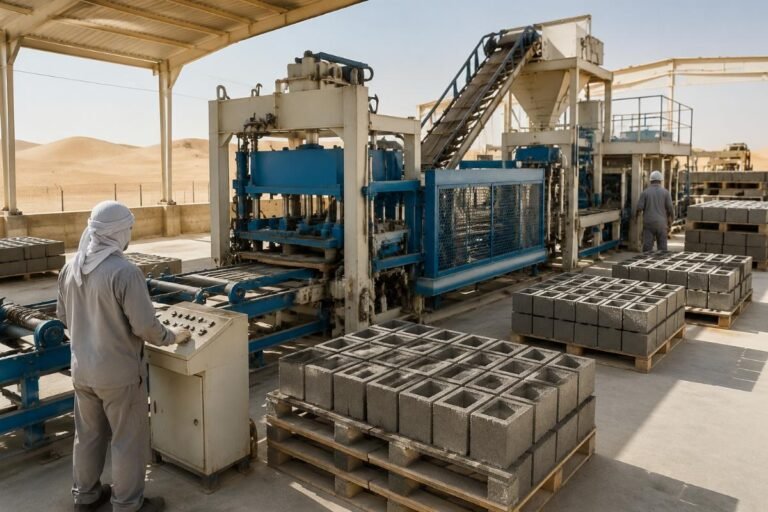
QT6-15 Block Machine Price in USD: China Factory Quote
The cheapest QT6-15 block machine price on paper often becomes the most expensive investment on site.
A realistic QT6-15 block machine price from a Chinese factory typically ranges from the mid-five-figure USD for a standalone host machine to the low-six-figure USD for a complete semi-automatic production line including mixer, conveyor, stacker, and multiple mould sets. The gap between these two figures has almost nothing to do with the steel frame and everything to do with motor brand alignment to your local grid, hydraulic component origin, PLC source, and whether the quote includes recipe support and on-site commissioning.
I still remember a container we loaded years ago bound for Lagos. The spec sheet looked clean, the price was competitive, and the client was ready to wire the balance. What the spec sheet did not show was that the motors inside were wound for a stable grid, while the actual supply at that industrial zone fluctuated wildly. Within days, two motors burned out. The client refused to release the remaining payment. The machine sat at the port for months, and the accumulated port storage fees alone wiped out the margin we had built into the QT6-15 block machine price. That container taught me something I apply to every single quote now: before discussing numbers, I need to know the voltage stability at the installation site, the raw material source, and the daily output target. [NEED_CITE: voltage fluctuation tolerance standards per IEC motor ratings]
Let me walk you through what actually moves the QT6-15 block machine price up or down, and why ignoring site conditions before comparing quotes is a mistake that costs far more than the difference between two proforma invoices.
What Is the Real Price Range for QT6-15 Block Machine from China?
The QT6-15 block machine price spans a wide band because "QT6-15" describes a production capacity class, not a fixed configuration.
When a buyer searches for a QT6-15 block machine price, they are usually comparing apples to oranges without realizing it. One factory quotes the bare host machine — just the vibrating press unit on a skid. Another quotes a semi-automatic line with a batch mixer, belt conveyor, pallet circulation system, and a stacker. A third includes three mould sets, spare wear parts, and a week of on-site commissioning. All three call their product "QT6-15," yet the price gap between the lowest and highest quote can reach several times over.
| Configuration Level | What Is Typically Included | Price Positioning |
|---|---|---|
| Bare Host Machine | Main vibrating press unit only | Entry-level |
| Semi-Auto Line | Host + mixer + conveyor + pallet system | Mid-range |
| Full Semi-Auto Package | Line + multiple moulds + stacker + spare parts kit | Upper-mid |
| Turnkey with Commissioning | Full package + on-site installation + operator training + recipe adjustment | Highest |
The bare host machine will always carry the lowest QT6-15 block machine price tag, but it assumes the buyer already owns a compatible mixer, has pallets in the correct dimension, and possesses in-house engineering capability to set vibration parameters and mix ratios. For a first-time investor in an emerging market, that assumption is almost never true. [NEED_CITE: typical configuration breakdown for semi-automatic concrete block production lines exported from China]
A West African client once came to us comparing three quotes. The lowest QT6-15 block machine price was noticeably below the other two. When we asked him to share the competitor spec sheets, the hydraulic valves were listed generically with no brand, the motor was described only by kilowatt rating without insulation class, and the PLC was a no-name unit with no documentation in English. The two higher quotes included branded hydraulics, motors matched to the local voltage class, and a PLC with multilingual HMI screens. The lowest quote saved him upfront, but the eventual downtime and replacement part sourcing would have cost multiples of the difference.
Which Configuration Items Drive the Price Up or Down?
Four components account for the majority of variation in any QT6-15 block machine price: the motor, the hydraulic system, the PLC, and the mould package.
Let me break each one down from a factory floor perspective, because this is where the real cost lives — not in the painted frame.
Motor. The motor is the heart of the vibration system. A branded motor with proper insulation class and winding tolerance for the local voltage will cost noticeably more than a generic unit. But the price difference shrinks to irrelevance if the generic motor burns out during the first rainy season when grid quality deteriorates. We specify motors after confirming the client’s actual voltage range, not the nominal national standard. [NEED_CITE: motor insulation class and voltage tolerance requirements for industrial machinery in unstable grid regions]
Hydraulic System. The hydraulic unit controls mould pressing, pallet feeding, and head box movement. Branded hydraulic pumps and valves hold pressure consistently over thousands of cycles. Unbranded units develop internal leakage over time, causing slow cylinder response and inconsistent block density. The hydraulic system represents a meaningful share of the total QT6-15 block machine price, and cutting corners here shows up as block quality variation within the first few months of production.
PLC and Control Panel. A recognizable PLC brand with an English-language touchscreen allows the operator to adjust vibration time, feeding depth, and press pressure without calling an electrician. A no-name board with Chinese-only labels forces the buyer to depend on the supplier for every parameter change — or worse, leads to operators guessing settings and damaging the mould.
Mould Package. A single mould producing one block size is the baseline. Most serious investors need at least two or three moulds to serve different market segments — hollow blocks for walls, solid blocks for load-bearing, and paving slabs for exterior work. Each additional mould adds to the QT6-15 block machine price, but the revenue diversification it enables pays for itself quickly.
| Component | Basic Tier | Branded Tier |
|---|---|---|
| Motor | Generic, unspecified insulation | Brand-rated, voltage-matched |
| Hydraulic Valves | Unbranded, self-reported specs | Certified origin, verifiable part numbers |
| PLC | No-name, single-language HMI | Recognized brand, multilingual interface |
| Moulds | Single size included | Multiple sizes with wear-part kit |
A Southeast Asian buyer shared with us that he had received a quote where the hydraulic system cost was suspiciously low. Upon inspection at our facility, he noticed the difference in cylinder wall thickness and seal quality immediately. He chose the mid-tier QT6-15 block machine price with branded hydraulics and later told us that his maintenance interval extended substantially compared to his previous machine with unbranded components. [NEED_CITE: hydraulic component quality impact on maintenance frequency in concrete block machinery]
How Do Local Site Conditions Affect Your Final Cost?
Your local voltage profile, raw material availability, and factory floor layout can shift the QT6-15 block machine price by requiring configuration adjustments that a generic quote simply ignores.
This is the section I wish every buyer would read before opening a proforma invoice.
Voltage and Power Supply. Many emerging market industrial zones experience voltage drops during peak hours, sometimes dipping well below nominal levels. A motor wound for a stable supply will draw excess current under voltage sag, overheat, and eventually fail. The fix is specifying a motor with wider voltage tolerance or adding a soft-start panel — both of which add to the QT6-15 block machine price but prevent the far larger cost of motor replacement and production stoppage. I have seen entire weeks of output lost because someone saved a small amount on the electrical panel. [NEED_CITE: industrial motor protection requirements for regions with unstable power grids]
Raw Material Variability. Sand, stone dust, fly ash, and cement ratios vary dramatically by region. A machine calibrated for one aggregate profile will produce blocks with inconsistent density if the feed material changes without parameter adjustment. Factories that include recipe support in their package adjust vibration frequency, press pressure, and water-cement ratio during commissioning to match the buyer’s actual materials. Factories that do not offer this leave the buyer to experiment at his own cost — in wasted cement, rejected blocks, and lost days.
Site Layout and Space Constraints. A compact yard with limited pallet circulation space may require a different conveyor angle or a smaller pallet buffer, which influences the conveyor and stacker specification. Ignoring this during quoting leads to equipment that physically does not fit or operates below its rated cycle time.
An East African client initially requested a bare-host quote to minimize his upfront QT6-15 block machine price. After we reviewed photos of his site and learned that his raw sand had a high silt content, we recommended upgrading the mixer specification and adding a pre-screening step. The adjusted quote was higher, but his first-month rejection rate dropped noticeably compared to what it would have been with the original configuration. He later added that the recipe adjustments our team provided during commissioning helped him reach target density from the very first week. [NEED_CITE: raw material variability impact on concrete block density and compressive strength]
Single Machine vs Full Line: Which Delivers Better ROI for Startups?
For first-time block plant investors, the full-line package with training consistently outperforms a bare-machine purchase in both speed-to-revenue and first-year output quality.
The logic is straightforward. A bare host machine at the lowest QT6-15 block machine price requires the buyer to source, fit, and calibrate every peripheral component independently. That means finding a compatible mixer, sourcing pallets in the correct dimension, arranging electrical panels, and — most critically — developing a concrete recipe through trial and error. Each of these steps carries a learning curve, and each mistake costs material, time, and market credibility.
A full-line package bundles the host, mixer, conveyor, pallet system, and stacker as an engineered unit. The components are matched at the factory before shipping. More importantly, turnkey packages from established manufacturers include on-site commissioning and operator training. Our team typically spends meaningful time at the client’s facility adjusting vibration parameters, testing mix ratios with local materials, and training operators on daily maintenance routines.
| Factor | Bare Machine Purchase | Full-Line Turnkey Package |
|---|---|---|
| Time to First Saleable Block | Extended trial period | Noticeably shorter |
| First-Month Rejection Rate | High, uncontrolled | Substantially reduced |
| Operator Readiness | Self-taught, error-prone | Trained during commissioning |
| Recipe Calibration | Buyer experiments alone | Adjusted on-site by supplier engineers |
| Total First-Year Downtime | Frequent, unresolved | Noticeably lower |
A startup investor in East Africa chose the turnkey option over a cheaper bare-host alternative. The QT6-15 block machine price was higher on paper, but he reached commercial production within a tightly compressed timeline. His operators already understood daily grease points, mould cleaning cycles, and vibration parameter adjustment before the commissioning team left. By contrast, a buyer in another region who purchased a bare machine spent months troubleshooting inconsistent block strength before eventually contacting us for recipe support — at which point significant cement had already been wasted. [NEED_CITE: operator training impact on production line utilization rate in concrete block manufacturing]
How to Verify a Factory Quote Before Paying Deposit?
Before wiring any deposit against a QT6-15 block machine price, demand a detailed configuration breakdown, motor nameplate photos, and valid certification numbers — and walk away from any supplier who refuses.
This is the step that separates experienced buyers from those who learn through costly mistakes. A proforma invoice that lists "motor 15 kW" without specifying brand, insulation class, and voltage rating is not a quote — it is a placeholder. Similarly, "hydraulic system included" without part numbers or origin documentation leaves the buyer with zero recourse if the components underperform.
Here is a practical verification checklist:
- Request a line-by-line configuration sheet that specifies brand and model for every major component — motor, hydraulic pump, hydraulic valves, PLC, touchscreen, sensors.
- Ask for motor nameplate photos showing the voltage rating, insulation class, and certification mark. Cross-check the voltage against your actual site supply, not the national nominal standard.
- Verify CE or SGS certification numbers directly on the issuing body’s database. A certificate number that cannot be found is a red flag. [NEED_CITE: CE certification verification process for machinery exported to international markets]
- Confirm mould material and heat treatment specification. Moulds made from untreated mild steel wear out within months in high-silica sand conditions. Properly hardened steel extends mould life substantially.
- Ask whether the quote includes recipe support and on-site commissioning. If not, calculate the cost of hiring an independent engineer to perform this function and add it to the total investment.
- Clarify Incoterms precisely. The quoted QT6-15 block machine price under FOB means something entirely different from CIF, and the freight and insurance gap between the two can be significant depending on destination port.
A buyer from the Middle East once shared a competitor’s quote with us where the total price was attractively low. The configuration sheet listed "imported PLC" without naming the brand. When we asked him to request the actual PLC model number, the supplier could not provide it. He chose to proceed with a transparent quote instead, and later confirmed that the machine’s control system performed reliably through extended daily operation. [NEED_CITE: importance of component traceability in concrete block machinery procurement]
Conclusion
The QT6-15 block machine price you see on a quote is only the starting point — the real cost is determined by whether the configuration matches your voltage, your materials, and your production goals.
A lower upfront number often hides compromises in motor protection, hydraulic durability, and control system transparency that surface as downtime, wasted material, and delayed revenue. A slightly higher quote that includes matched components, recipe support, and on-site commissioning typically delivers a faster path to profitable operation. Verify every line item, demand traceable specifications, and treat the factory’s willingness to answer technical questions as a stronger signal than the bottom-line figure alone.