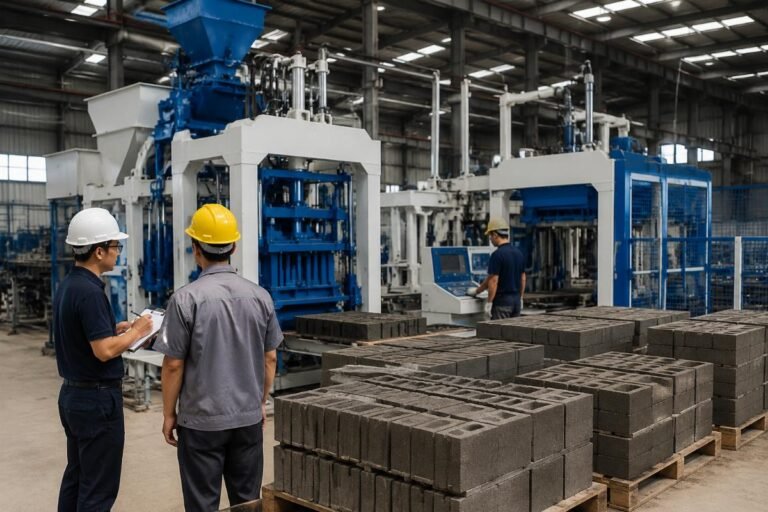
Concrete Block Machine QT10-15/QT12-15 Supplier for France: Factory Direct
Most French buyers assume CE marking is just a sticker on the box. In reality, it is a closed-loop technical documentation audit that blocks customs clearance if incomplete.
Sourcing a concrete block machine from China for France hinges on verifying CE technical file completeness under Machinery Directive 2006/42/EC, matching voltage and frequency to EN 50160 grid standards, adapting mix designs to local aggregate moisture and clay content, and confirming turnkey delivery that includes on-site commissioning and operator training—not on chasing the lowest invoice price.
I still remember standing at Qingdao Port watching a full container of semi-automatic block equipment being loaded for Marseille. Weeks later, the client called saying the line kept tripping. We assumed motor overload. It turned out the local substation had frequency deviations well outside normal tolerance, and our PLC panels—sensitive to harmonic distortion—shut down repeatedly. The line sat idle for days, and the client nearly withheld final payment. That single shipment reshaped how every order is handled now: voltage range, frequency tolerance, harmonic filters, even the cement grade used on-site get confirmed before a single drawing is finalized. French buyers are meticulous; a parameter mismatch of even a small margin can stall an entire project. [NEED_CITE: voltage quality parameters per EN 50160 standard]
Getting the paperwork right is only the starting point. The real challenge lies in aligning machine specifications with the physical realities of a French production site.
Why French Buyers Choose Chinese Block Machine Suppliers?
The cost gap between Chinese and European block machines is not about cutting corners on steel or electronics—it is the structural result of supply chain clustering and the absence of brand premium markups.
Linyi in Shandong Province hosts one of the densest clusters of construction machinery manufacturing in Asia. Within a compact radius, you find steel fabrication shops, hydraulic component suppliers, PLC integrators, and mold machining specialists all operating side by side. This proximity slashes logistics costs, shortens iteration cycles, and keeps component inventory lean. A concrete block machine supplier for France operating from this cluster can offer pricing substantially below European or Turkish competitors while using the same grade of structural steel and comparable Siemens or Schneider electrical components. [NEED_CITE: machinery industry export data from China Chamber of Commerce for Import and Export of Electromechanical Products]
What French investors often discover during factory visits is that the weld quality, plate thickness, and hydraulic valve brands on Chinese lines match what they see on European shop floors. The difference on the invoice comes from lower overhead, integrated supply chains, and the fact that European manufacturers embed decades of brand reputation into their pricing.
A private investor in northern France once compared a quotation from a well-known Italian builder against a turnkey proposal from a Chinese concrete block machine supplier for France. The Italian quote was nearly triple. After inspecting the Chinese factory’s testing bay and reviewing component sourcing lists, the investor realized the core mechanical architecture was functionally identical. The savings were redirected into additional mold sets and a color feeder system for decorative pavers—something the Italian quote had excluded to keep the headline number competitive.
Price matters, but it is useless if the machine cannot pass French customs or run on French power. That leads directly to compliance.
What CE Compliance Documents Must You Verify?
A CE certificate alone means almost nothing. French customs and labor inspectors require the full technical construction file, and missing a single annex can halt your import.
Under Machinery Directive 2006/42/EC, every concrete block machine supplier for France must provide a technical file that includes the EC Declaration of Conformity, risk assessment documentation, circuit diagrams, hydraulic schematics, safety component certificates, and test reports from a notified body where applicable. [NEED_CITE: Machinery Directive 2006/42/EC compliance documentation requirements]
Many buyers request "the CE certificate" and accept a single-page document. That page is often just the Declaration of Conformity—a self-declared statement by the manufacturer. What French DREAL inspectors (the regional environmental and labor authority) actually ask for is the supporting evidence: electromagnetic compatibility test records per EN 60204-1, noise emission data per EN ISO 3744, and structural integrity calculations for the vibrating system.
| Document Category | Basic Supplier | Certified Supplier |
|---|---|---|
| EC Declaration of Conformity | Provided | Provided |
| Full Risk Assessment File | Not provided | Verifiable |
| EMC Test Report (EN 60204-1) | Self-reported | Notified body verified |
| Noise Emission Data | Not provided | Standard-compliant |
| Hydraulic Safety Valve Certificates | None | Full batch-level |
| Electrical Schematic with French Labels | None | Controlled |
A building materials distributor in the Paris region imported a line from a supplier who only provided the declaration page. When the DREAL inspector visited the production site months later, the incomplete file triggered a formal notice. The distributor had to fly engineers from China to reconstruct the documentation—costing several times what a proper supplier would have included from the start.
Always request the complete technical file before signing a purchase order. A reliable concrete block machine supplier for France will provide it without hesitation.
How to Match Machine Specs to French Site Conditions?
Voltage stability, raw material moisture content, and factory footprint are the three variables that determine whether a block machine runs profitably or becomes an expensive paperweight.
French industrial grids generally comply with EN 50160, but regional substations—especially in older industrial zones or rural areas—can experience voltage fluctuations that disrupt sensitive PLC controllers. The motor might tolerate a dip, but the programmable logic controller reading harmonic distortion will trigger a safety lockout. Any serious concrete block machine supplier for France must confirm the exact voltage range, frequency tolerance, and whether harmonic filtering is required before finalizing the electrical cabinet design. [NEED_CITE: EN 50160 voltage quality characteristics for public distribution systems]
Raw material adaptation is equally critical. A client in northern France sourced aggregate from a local quarry with higher clay content than typical Mediterranean sand. The first batches produced blocks that failed compressive strength targets. The issue was not the machine—it was the mix design. The clay increased water demand, which reduced cement efficiency. After adjusting the water-to-cement ratio and adding a small dosage of dispersant, strength targets were met within a short recalibration window. [NEED_CITE: aggregate clay content impact on concrete compressive strength per EN 206]
Site layout constraints are common in older French industrial parks. A client near Lyon had a warehouse with restricted ceiling height and an irregular floor plan. A standard linear layout would not fit. The engineering team redesigned the production flow into an L-shaped configuration, relocating the pallet return conveyor and stacking zone to fit within the existing footprint. Production capacity remained fully intact despite the space reduction.
| Site Variable | Standard Approach | Customized Approach |
|---|---|---|
| Voltage Supply | Fixed 400V/50Hz | Range-adapted with harmonic filtering |
| Aggregate Moisture | Fixed water dosing | Moisture sensor-linked auto-adjustment |
| Factory Layout | Linear production flow | Reconfigured to match existing footprint |
| Raw Material Clay Content | Standard mix design | Recalibrated ratio with dispersant |
These adaptations are not optional extras. They are the difference between a line that produces from day one and one that requires months of troubleshooting.
Which Machine Model Fits Your Production Scale?
Choosing between semi-automatic and fully automatic block machines depends on daily output targets, labor cost structure, and product mix complexity—not on which model sounds more impressive.
French buyers typically evaluate three tiers when working with a concrete block machine supplier for France: semi-automatic entry-level models for smaller operations, mid-range models for growing businesses, and fully automatic high-output lines for industrial-scale producers.
| Parameter | QT6-15 (Semi-Auto) | QT10-15 (Mid-Range) | QT12-15 (Full-Auto) |
|---|---|---|---|
| Automation Level | Semi-automatic | Semi to full batch control | Fully automatic PLC |
| Pallet Size Range | Standard | Extended | Full industrial range |
| Daily Output Capacity | Moderate | Substantially higher | Maximum throughput |
| Labor Requirement | Noticeably higher | Standard | Noticeably reduced |
| Mold Changeover | Manual | Assisted | Rapid automated |
| Suitable For | Entry-level investors | Growing operations | Industrial producers |
A private investor in southern France started with a QT6-15 to test the local market for interlocking pavers. After the product gained traction with municipal landscaping contracts, the same concrete block machine supplier for France upgraded the operation to a QT10-15 within a short timeframe. The existing foundation and electrical infrastructure were reused, minimizing transition downtime.
For established manufacturers replacing aging manual equipment, the QT12-15 offers full automation with integrated pallet handling, stacking, and batch-level quality control. The PLC system records every production cycle, providing traceability that French public tender documentation increasingly requires.
What Does a Turnkey Delivery Timeline Look Like?
A realistic turnkey delivery from China to France spans several weeks and includes manufacturing, ocean freight, customs clearance, on-site assembly, commissioning, and operator training—not just dropping a container at the dock.
The process begins with finalizing technical specifications: voltage confirmation, mold design approval, layout drawing sign-off, and raw material sample testing. Once production starts, the concrete block machine supplier for France completes fabrication, assembly, and factory-run testing before disassembly for container loading. [NEED_CITE: typical China-to-France ocean freight transit duration]
Ocean freight from Qingdao or Shanghai to Fos-sur-Mer or Le Havre takes several weeks. During this transit window, the supplier prepares the installation team and finalizes site preparation guidelines—foundation drawings, electrical connection points, and compressed air requirements.
Upon arrival, customs clearance requires the complete CE technical file mentioned earlier. Missing documents can delay release by weeks. Once cleared, the on-site team handles mechanical assembly, electrical connection, hydraulic charging, and system calibration. Commissioning includes running trial batches with the client’s actual raw materials to verify block dimensions, surface finish, and compressive strength.
Operator training is the final phase. French labor regulations require documented training records. A thorough program covers daily maintenance, mold replacement, PLC parameter adjustment, and basic troubleshooting. Clients who skip formal training consistently report higher downtime and more frequent service calls.
| Phase | Key Activities |
|---|---|
| Pre-Production | Spec confirmation, mold approval, layout sign-off |
| Manufacturing | Fabrication, assembly, factory testing |
| Shipping | Container loading, ocean freight, documentation |
| Customs | CE file verification, duty payment, release |
| Installation | Mechanical assembly, electrical, hydraulic |
| Commissioning | Trial batches with local materials |
| Training | Operations, maintenance, PLC basics |
A turnkey approach from an experienced concrete block machine supplier for France eliminates the coordination gaps that plague buyers who handle shipping, installation, and training separately.
Conclusion
Importing a concrete block machine from China to France is a compliance and adaptation exercise, not a price-shopping exercise. Verify the full CE technical file, confirm voltage and raw material compatibility, match the model to your actual production scale, and insist on turnkey delivery that includes commissioning and training. A reliable concrete block machine supplier for France will guide you through every step with documentation and field experience—not just a quotation sheet.