Concrete Block Machine Price in Jordan: 2026 Buyer Guide for Sale
The cheapest concrete block machine price in Jordan on a quotation sheet will almost never be your real cost on the ground. The actual landed investment for a block plant in Amman, Irbid, or the Jordan Valley is built from the equipment base price plus voltage adaptation hardware, aggregate pre-treatment, CIF Aqaba freight, customs clearance, and on-site commissioning — and the bare machine price typically accounts for only a portion of that total.
For a standard semi-automatic line targeting the Jordanian market in 2026, expect the equipment FOB price to represent roughly sixty to seventy percent of your total project spend once adaptation, logistics, and commissioning are included. The remaining budget is consumed by stabilizers, wash-sand equipment, port handling, local civil works, and the first production cycle adjustments that no datasheet mentions.
I still remember a shipment I handled years ago — a QT6-15 semi-automatic line heading to a buyer on the outskirts of Amman. The quotation looked clean, the machine specs matched what the client requested, and everyone signed off. What nobody asked about was the voltage fluctuation pattern at his industrial plot and the clay content in the wadi sand he planned to use. When the line fired up, two motors burned out within the first week, and the blocks came out of the mold crumbling at the edges. The extra motors, the rewiring, the lost production weeks, and the raw material waste ended up costing a noticeable fraction of the machine price itself — and that was before we even solved the strength issue. That job changed how I approach every Jordan inquiry. Before I quote a single concrete block machine price in Jordan, I ask about the grid, the sand source, and the site dust conditions. [NEED_CITE: Jordanian industrial grid voltage fluctuation patterns and their impact on imported machinery]
What follows is a field-level breakdown of what really sits behind a concrete block machine price in Jordan, drawn from repeated installations across the Levant rather than from a catalog.
What Hidden Costs Are Buried Inside the Real Concrete Block Machine Price in Jordan in 2026?
The quotation price you receive from a manufacturer is only the starting point — not the finish line. A responsible buyer needs to stack at least four additional cost layers on top of the FOB equipment price before the figure becomes comparable to what will actually leave your bank account and start producing blocks.
The first layer is electrical adaptation. Jordan’s industrial grid, particularly in developing industrial zones around Amman and Zarqa, experiences voltage swings that can damage control boards and burn motors on machines designed for stable three-phase supply. A properly specified concrete block machine price in Jordan must include a voltage stabilizer sized to the total installed power of the line. Skipping this item saves a small amount on paper but exposes the entire electrical system to damage. [NEED_CITE: Voltage stability requirements for industrial concrete block machinery in Levant power grids]
The second layer is aggregate pre-treatment. Local sand sources in Jordan — especially wadi sand and desert-dredged material — often carry high clay and silt content. If this material goes directly into the mixer without washing, the clay coats the cement particles, prevents proper hydration, and produces blocks that fail compressive strength tests. The cost of a simple wash-sand setup is modest compared to the cost of producing an entire batch of unsellable blocks.
The third layer is freight and port handling. CIF Aqaba pricing depends heavily on whether the line ships as a full container load or as break-bulk cargo. Fully automatic lines with large silos, long conveyors, and multiple pallet systems often exceed standard container dimensions and require flat-rack or break-bulk shipping, which increases freight cost noticeably compared to a semi-automatic line that fits neatly into standard containers.
The fourth layer is commissioning and local civil works. The foundation pit, the curing area layout, the pallet circulation path, and the raw material stockyard all require local contractor work that the machine supplier cannot price from overseas. A buyer who ignores this line item will face surprise costs in the first month on site.
| Cost Layer | Typical Inclusion in Basic Quotation | Typical Inclusion in Turnkey Quotation |
|---|---|---|
| Voltage stabilization | Not provided | Standard |
| Aggregate pre-treatment guidance | Not provided | Included with layout |
| CIF Aqaba freight | Optional add-on | Bundled |
| Foundation & civil works drawings | Basic sketch | Full engineered layout |
| On-site commissioning | Optional | Standard |
A private investor in Irbid once chose the lowest concrete block machine price in Jordan he could find from a supplier who quoted a bare machine with no stabilizer, no wash-sand guidance, and FOB-only terms. By the time he added the stabilizer, built the wash pit, paid the break-bulk surcharge, and hired a local electrician to rewire the panel, his real spend had climbed well past what a turnkey-oriented quote would have shown from the start. [NEED_CITE: Total cost of ownership comparison for block machines in Jordan including adaptation costs]
How Do Different Capacity Models Compare on ROI for Jordanian Block Plants?
Semi-automatic lines recover investment faster in Jordan’s current market, while fully automatic lines offer lower per-block labor cost at higher volume — but only if demand justifies the output. Choosing the wrong capacity tier is one of the most common reasons a concrete block machine price in Jordan turns into a disappointing investment.
The QT4-25 mobile egg-layer type suits small operators producing hollow blocks and paving units for local village-level construction. It requires minimal civil works, runs on a single-phase or small three-phase connection, and can be moved between sites. Its payback window is the shortest of all tiers because the initial outlay is small and the blocks it produces — standard hollow blocks and basic pavers — move quickly in Jordan’s residential construction segment.
The QT6-15 semi-automatic stationary line is the most common configuration for private investors entering the Jordanian market. It produces a meaningful daily output of hollow blocks, solid blocks, and interlocking pavers with a small crew. The payback period sits in the mid-range — longer than the mobile type but substantially shorter than a fully automatic line. This model balances capital commitment against output volume in a way that matches Jordan’s mid-size construction demand.
The QT10-15 fully automatic line targets established manufacturers and government contractors who need certified, high-volume output for large housing or infrastructure tenders. The concrete block machine price in Jordan for this tier is significantly higher, and the payback window extends accordingly. However, the per-block labor cost drops sharply because the PLC-controlled cycle runs with minimal manual intervention, and the product consistency meets the standards required for formal tender submissions. [NEED_CITE: ROI payback period comparison for semi-automatic versus fully automatic block machines in MENA markets]
| Model Tier | Automation Level | Crew Requirement | Payback Speed | Best Fit in Jordan |
|---|---|---|---|---|
| QT4-25 mobile | Manual / semi | Minimal | Noticeably fast | Small operators, village projects |
| QT6-15 semi-auto | Semi-automatic | Small crew | Moderate | Private investors, mid-size demand |
| QT10-15 full-auto | Fully automatic PLC | Minimal per block | Extended | Contractors, tender-grade output |
A contractor in the Jordan Valley running a QT4-25 on multiple rotation sites told me his machine had paid for itself well before the end of the first construction season. A separate buyer in Amman running a QT10-15 line needed a longer runway, but once the line was calibrated and the curing process stabilized, his per-block cost dropped to a level that let him underbid competitors on a public housing tender. The right choice depends entirely on the buyer’s demand profile — not on which machine sounds most impressive.
How Do Jordan’s Grid and Aggregate Conditions Shape Machine Selection and Pricing?
A concrete block machine price in Jordan that ignores local grid instability and local sand characteristics is not a real price — it is an incomplete one. These two factors alone can determine whether a plant runs profitably or bleeds money through motor replacements and rejected batches.
Jordan’s industrial electricity supply, while nominally three-phase at standard frequency, experiences fluctuations in many industrial zones — particularly in areas where multiple heavy-load factories share the same transformer network. Motors and PLC boards on block machines are sensitive to sustained undervoltage and to sudden spikes. The adaptation required is not exotic: a correctly rated automatic voltage stabilizer, properly sized power cables, and a clean earth connection. But these items must be specified at the quotation stage, not discovered after the first motor failure. [NEED_CITE: Industrial voltage fluctuation impact on concrete machinery motors in Middle Eastern grids]
The aggregate situation is equally consequential. Jordan’s natural sand, particularly from wadi deposits and southern desert sources, often contains a meaningful proportion of clay and fine silt. When this material enters the block mixer unwashed, the clay particles coat the cement, block water access, and prevent proper hydration. The visible result is blocks that look acceptable when they leave the mold but crumble during curing or fail compressive strength tests days later. The invisible result is raw material waste — cement that was paid for but produced no usable strength.
The solution is straightforward: a wash-sand station upstream of the mixer. The cost of this station is small relative to the line, but it eliminates the majority of clay-related strength failures. Some suppliers include wash-sand guidance in their plant layout; others leave it to the buyer to discover the problem the hard way.
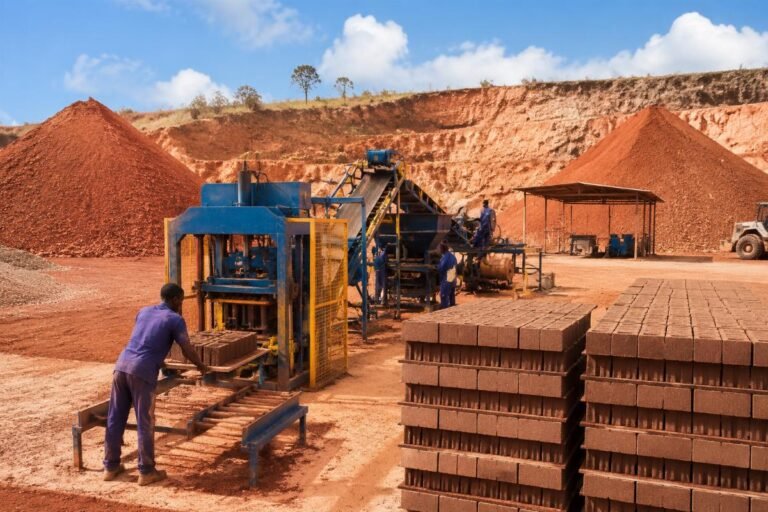
A buyer in the Jordan Valley operating a mobile block machine in a desert environment faced a third issue — dust infiltration. Fine desert dust entered the hydraulic system through inadequately sealed joints, causing repeated valve failures. The fix was simple sealing upgrades, but they needed to be specified before the machine left the factory, not after the third service call in a single month. [NEED_CITE: Dust ingress impact on hydraulic systems of block machines in arid environments]
What Are the CIF Aqaba Freight and Customs Realities for Different Machine Types?
The concrete block machine price in Jordan changes shape the moment you move from FOB to CIF Aqaba — and the difference depends heavily on machine size and shipping method. Understanding this prevents budget surprises at the port.
Semi-automatic lines like the QT4-25 and QT6-15 typically ship in standard containers. The main machine, the mixer, the conveyor, and the pallet stacker can be arranged to fit within standard container dimensions with minor disassembly. Freight cost for this configuration is predictable and relatively modest.
Fully automatic lines like the QT10-15 and above include components that exceed standard container length or height — long conveyors, large cement silos, and multi-section pallet circulation systems. These items require flat-rack containers or break-bulk shipping, which increases freight cost noticeably. The difference between full-container and break-bulk freight for a block line is substantial enough to affect the total project budget. [NEED_CITE: Container versus break-bulk freight cost differential for industrial machinery shipped to Aqaba port]
Customs clearance at Aqaba for industrial machinery follows a defined process, but the timeline depends on documentation completeness. A buyer who arrives at the port with a complete commercial invoice, packing list, certificate of origin, and any required conformity certificates will clear in a matter of days. A buyer whose paperwork is incomplete — missing a certificate, an incorrect HS code, or an unsigned conformity declaration — can face delays that extend into weeks, during which port storage fees accumulate.
The key is to confirm all documentation requirements with the clearing agent before the vessel departs the origin port. A reliable supplier will provide the full document set aligned with Jordanian customs requirements; a supplier who treats documentation as an afterthought transfers that risk to the buyer.
How Can a Buyer Verify a Concrete Block Machine Price in Jordan and Avoid Low-Price Traps?
The lowest concrete block machine price in Jordan is rarely the best deal — it is usually the deal with the most hidden costs still waiting to appear. Verifying a quotation requires looking past the headline number and checking what is actually included.
First, request a detailed breakdown showing what is included in the quoted price and what is excluded. A transparent quotation lists the main machine, the mixer, the conveyor, the pallet system, the control panel, the mold set, and any adaptation items like voltage stabilizers or dust seals. A vague quotation that simply states "complete line" without itemization leaves room for surprise costs later.
Second, ask for references from installations in similar operating conditions — specifically in Jordan or the broader Levant region. A supplier who has placed machines in Amman, Irbid, or the Jordan Valley can point to those installations and explain how they handled local grid conditions, local aggregate, and local dust. A supplier who has no Levant references cannot credibly claim to understand the adaptation your plant will need. [NEED_CITE: Verification methods for block machine supplier claims in Middle East markets]
Third, confirm certification status. CE marking, SGS inspection reports, and ISO quality management certification are not decorative — they are evidence that the machine has been built to recognized standards and that the manufacturer maintains documented production processes. A supplier who cannot produce current certificates when asked is signaling that either the certificates do not exist or the production process does not meet the claimed standard.
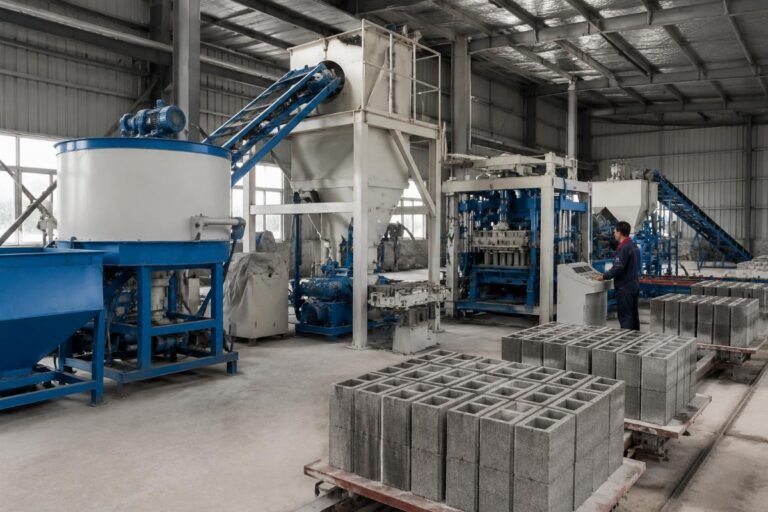
Fourth, visit — or arrange a video walkthrough of — the manufacturing facility. The condition of the assembly floor, the organization of the parts warehouse, and the testing area where machines run before shipment tell you more about build quality than any brochure. Shandong Shiyue Intelligent Machinery, for example, operates a large production facility in Linyi near Qingdao Port, with engineers who have installed lines across multiple regions including the Levant, and holds CE, SGS, and ISO certifications that can be verified independently. The ability to customize machines for local voltage, local aggregate, and local site layout — and to provide on-site commissioning and operator training — is what separates a workable concrete block machine price in Jordan from a misleading one.
Conclusion
A real concrete block machine price in Jordan is never the number on the first page of a quotation — it is the sum of equipment, adaptation, freight, clearance, and commissioning costs stacked together. Buyers who evaluate only the headline price will discover the hidden layers the hard way; buyers who request a full breakdown, verify references in similar conditions, and confirm certification before committing will arrive at a plant that runs from day one.