


Description
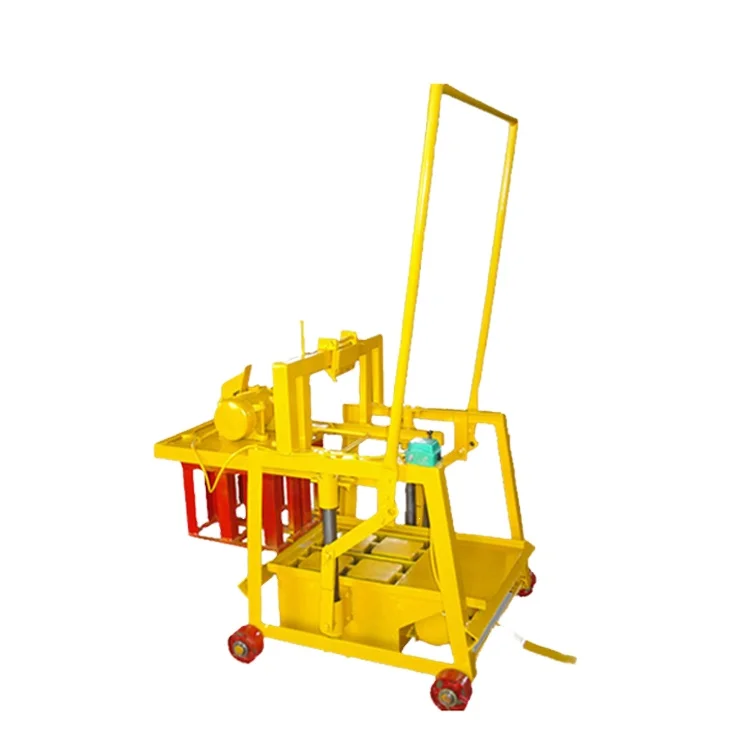
Configuration Set Against Your Actual Mix — we match the QMJ2-45 vibration and cycle time to your local aggregate and target block format before confirming the order, so the capacity you see on paper is what you get on site.
Technical Specifications
| Parameter | Value |
|---|---|
| Model | QMJ2-45 |
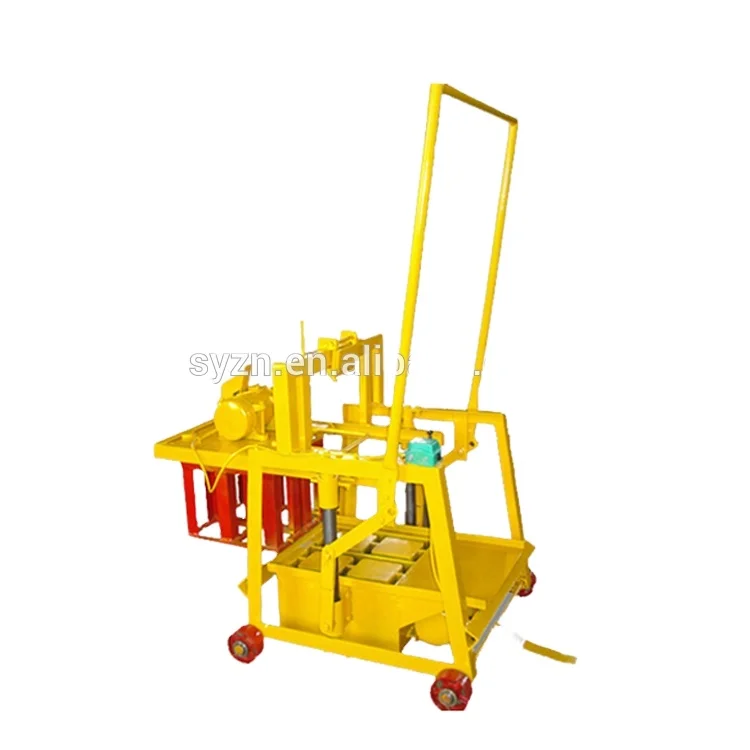
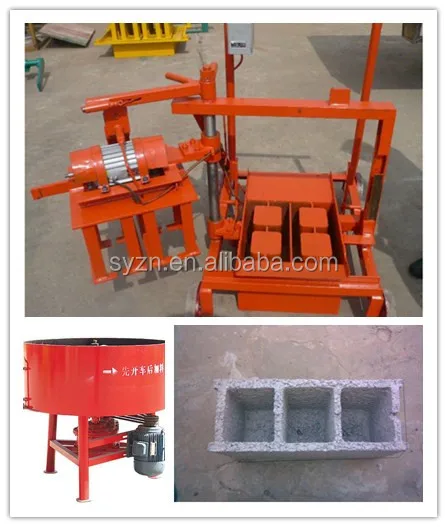
| Product Type | Mobile Egg-Laying Hollow Block Making Machine |
| Rated Power | 1.5 kW |
| Exciting Power | 2 vibrators |
| Vibration Type | Bed mould vertical vibration + upper mould compression vibration |
| Molding Cycle | 45 s |
| Output Capacity | 1200 pcs / 8 h (based on 400×200×200 mm hollow block, 2 pcs/mould) |
| Output Capacity | 1760 pcs / 8 h (based on 400×150×200 mm hollow block, 3 pcs/mould) |
| Mould Format | 400×200×200 mm / 400×150×200 mm hollow block |
| Control System | Manual / semi-automatic operation with top die push-pull and automatic scraper |
| Pallet Requirement | Not required (egg-laying on ground) |
| Net Weight | 400 kg |
| Overall Dimensions | 1300×1300×1150 mm |
| Voltage & Frequency | According to buyer’s local standard (basis to be confirmed before order) |
| Assembly State | Fully assembled (verify against manufacturer catalog) |
Application Suitability
| Application | Material or Output |
|---|---|
| Small-scale hollow block production | Concrete, sand, cement, fly ash, lime, gypsum |
| On-site construction block making | Crushed stone and cement mixes laid directly on ground |
| First-time block plant startups | Low-capital entry with pallet-free operation |
| Contractor self-production | Hollow blocks for residential and peri-urban building projects |
| Rural block supply businesses | Mobile production across multiple job sites |
What "1200 Pieces per Shift" Actually Means for the QMJ2-45 Mobile Block Machine
Every output figure here is tied to a specific block size and cavity count — no single headline number.
I once shipped a small egg-laying machine to a contractor in West Africa who read "1200 pieces" on a competitor’s flyer and assumed that applied to every block size he planned to run. When his 150 mm partitions came out at nearly 1800 per shift but his 200 mm load-bearing blocks barely reached 1100, he thought the machine was faulty. The machine was fine; the expectation was wrong. With the QMJ2-45 mobile block machine specifications, the 1200-piece figure assumes a 400×200×200 mm hollow block at 2 pieces per mould, while 1760 pieces assumes a 400×150×200 mm format at 3 pieces per mould. [NEED_CITE: block format and cavity count impact on daily output]
Your real daily throughput also depends on how quickly your crew feeds the mixer, moves the machine along the curing yard, and manages the wet blocks. The 45-second cycle is the press time only — loading, stripping, and repositioning add to the rhythm of a full shift.
Matching Mould Formats to What Your Market Actually Buys
The QMJ2-45 mobile block machine specifications confirm two hollow block formats — 400×200×200 mm and 400×150×200 mm — which cover the load-bearing and partition wall segments common across many African and South Asian markets. Before we confirm a mould package, we ask which sizes your local hardware distributors move in volume, because running a format you cannot sell locally wastes every minute of a shift. Custom mould design to buyer drawings is available if your market demands a size outside the standard pair.
How Pallet-Free Egg-Laying Changes Your Site Layout
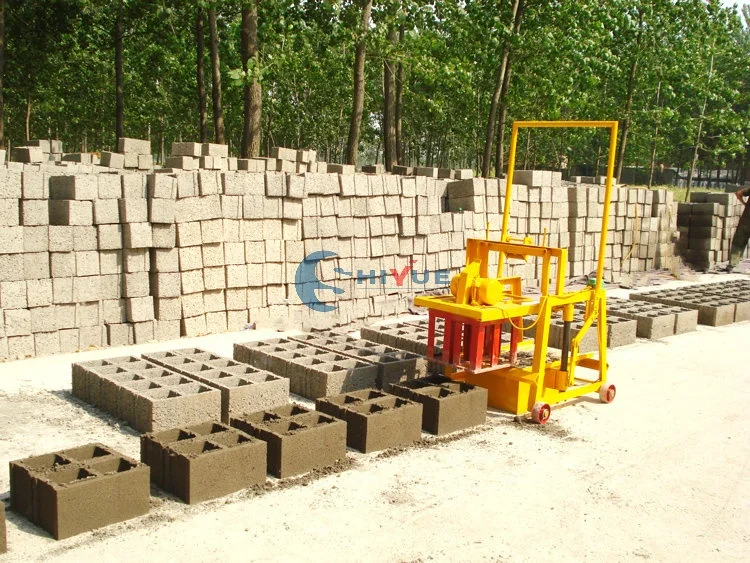
Egg-laying machines drop the block directly onto the ground and walk forward, which removes the entire pallet loop — no pallet purchase, no pallet return conveyor, no pallet cleaning, no curing rack handling. For a contractor producing blocks on a building site or an entrepreneur laying down a concrete slab as a first curing yard, this keeps the capital outlay and the footprint small. The trade-off is that the ground surface must be level and firm enough to accept wet blocks without settling, and you need enough linear yard space for a full shift’s output to cure in place. [NEED_CITE: ground preparation standards for egg-laying block production]
Vibration, Compression, and the 45-Second Cycle Explained
The dual vibration system pairs bed mould vertical vibration with upper mould compression vibration, which compacts the concrete from both directions during the 45-second cycle. This matters because single-direction vibration tends to leave the top face of a hollow block less dense than the bottom, affecting stacking strength. The 1.5 kW rated power drives both vibrators through a mechanical linkage rather than a hydraulic circuit, keeping maintenance to belt tension and bearing checks. The semi-automatic top die push-pull mechanism, assisted by an automatic scraper, ensures the squeeze head aligns with the mould cavity every cycle without the operator having to position it by hand. For the mix itself, the vibration force on a machine of this weight class suits lean concrete with fine aggregate — if your local sand carries high silt content, the振捣 time effectively has to increase, cutting into the 45-second cycle and reducing hourly output.
What Happens When Mix Design and Vibration Are Mismatched
A buyer in East Africa once called me frustrated because his egg-laying machine was producing blocks that crumbled at the corners. The issue was not the machine — his river sand had a silt content far above what the vibration settings were tuned for, and the extra moisture was extending the cycle while weakening the green block. We walked through a sieve analysis over the phone, adjusted his cement-to-sand ratio, and the blocks came back to strength within a day. When mix design and vibration are mismatched, you do not just lose block quality; you lose the output numbers you planned your business around. [NEED_CITE: effect of aggregate silt content on block compressive strength]
Why Buy the QMJ2-45 from a Block-Machinery-Focused Supplier
Block machinery is our single focus, which means the QMJ2-45 is specified as a matched system — machine, mould, and ground-curing guidance — rather than assembled from unrelated catalogue pages. We set the configuration against your actual mix design and target block format before production, not after the machine arrives and underperforms. Every quotation includes a capacity calculation document that states the exact block format and pieces per mould behind each output number. Mould drawings and format lists are supplied with the quotation so you can verify cavity count against your local market demand before you commit. We also confirm voltage, frequency, and phase in writing before production starts, because a machine wired for the wrong supply sits idle for weeks while a transformer is sourced locally.
Documentation & Verification
- Line layout and capacity calculation stating the block format and pieces per mould assumed for the QMJ2-45
- Mould drawing and format list showing cavity count and block dimensions before order confirmation
- Voltage, frequency, and phase confirmation recorded in writing prior to production
- Factory test record run on your specified block format before dispatch
- Operation and maintenance manual with wear parts and mould replacement list included at delivery
Installation, Commissioning & Support
- Level concrete slab preparation with minimum thickness to support the 400 kg machine weight and wet block loading
- Power supply matching confirmed voltage and phase with a dedicated circuit for the 1.5 kW motor
- Machine arrives fully assembled — verify assembly state against packing list on arrival
- First-cycle parameter setting including vibration duration adjusted to your local aggregate and mix
- Operator training covering top die push-pull operation, scraper alignment, and mould change procedure
- Wear parts list and mould inventory supplied at delivery for first replacement planning
Preparing Your Inquiry
To size the QMJ2-45 mobile block machine to your project, share the block formats your local market sells, your target daily output per format, and the source and type of your sand and aggregate. Include your site voltage, frequency, and phase so we can wire the motor correctly before shipment. If you already have a curing yard or slab in place, tell us its dimensions so we can estimate how many linear meters of egg-laying space one shift will consume.
Frequently Asked Questions
Q: How is daily output calculated and which block format does each number assume?
A: The 1200-piece figure assumes a 400×200×200 mm hollow block at 2 pieces per mould over an 8-hour shift, while 1760 pieces assumes a 400×150×200 mm block at 3 pieces per mould. Both figures reflect the 45-second press cycle and do not include loading, repositioning, or crew pacing, which vary by site.
Q: Which block formats can the QMJ2-45 run and how long does a mould change take?
A: The standard configuration covers 400×200×200 mm and 400×150×200 mm hollow blocks. Custom mould sizes are available to buyer drawings. Mould change involves unbolting the mould box and swapping the squeeze head, which a trained crew completes within a single shift break once familiar with the procedure.
Q: What voltage and frequency does the machine need and is the control language configurable?
A: Voltage and frequency are configured to the buyer’s local standard and must be confirmed in writing before production. The control system is manual and semi-automatic with mechanical operation, so language configuration mainly applies to any labels and the operation manual rather than a PLC display.
Q: How should the mix design and local aggregate be matched to this machine?
A: The dual vibration system suits lean concrete with well-graded fine aggregate. High silt content in river sand extends the effective cycle time and reduces green block strength. We review your sieve analysis and cement ratio before finalizing vibration settings so the 45-second cycle holds under your actual material conditions.