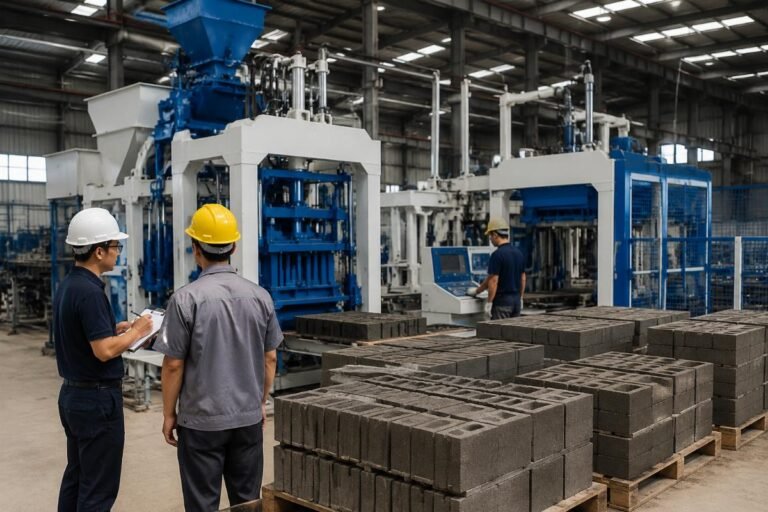
Buy Cement Brick Machine Wholesale QT Series Manufacturer
Bigger output ratings on spec sheets rarely translate to bigger profits when the local grid cannot hold stable voltage or the raw sand varies wildly between batches.
When you buy cement brick machine wholesale, the real decision is not picking the highest-tonnage model. It is matching the machine’s electrical tolerance, mould-change cycle, and spare-parts availability to your actual site conditions, because a semi-automatic line running at full uptime consistently out-earns a fully automatic line sitting idle waiting for a voltage stabilizer or a replacement proximity sensor.
I still remember a container that reached Lagos years ago. The QT6-15 inside was a solid machine on paper, but the control cabinet fried within the first week because the site voltage swung between levels that no standard relay could handle. I ended up flying out the next day and spent weeks on the ground sorting stabilizers, rewiring panels, and retraining operators. That trip changed how I approach every order: spec sheets are marketing, but voltage logs and dust levels are reality. [NEED_CITE: voltage fluctuation impact on industrial control panels per IEC 60038 standards]
If you are sourcing for a new block plant, an upgrade, or a dealership stock, the following breakdown walks through model selection, electrical compatibility, wholesale terms, supplier vetting, and post-arrival ROI, all from the perspective of someone who has stood in the dust next to these machines.
What Cement Brick Machine Models Suit Wholesale Buyers?
The right model is determined by your daily block target, your available footprint, and the stability of your power supply, not by the highest number in the model name.
Wholesale buyers usually fall into three buckets: a first-time investor testing the market, a growing plant adding a second line, or a dealer stocking multiple models for different clients. Each bucket maps to a different point on the QT series range.
| Buyer Profile | Recommended Model Range | Automation Level | Typical Site Power Requirement | Mould Change Frequency |
|---|---|---|---|---|
| First-time investor, limited capital | QT4-25 mobile egg-layer | Manual to semi-auto | Single-phase tolerant | Low, fixed product range |
| Growing private plant | QT4-15 or QT6-15 | Semi-automatic | Three-phase with basic stabilizer | Moderate, multiple products |
| Contractor or dealer with volume orders | QT10-15 to QT15-15 | Fully automatic PLC | Three-phase with industrial stabilizer | High, frequent product swaps |
A mobile egg-laying model like the QT4-25 makes sense when the buyer wants to produce directly on a curing yard without a pallet circuit. It is the lowest entry cost and the simplest to maintain, but it locks you into a narrow product range. [NEED_CITE: mobile block machine productivity benchmarks in low-infrastructure environments]
Stepping up to a QT6-15 semi-automatic line gives you pallet-based production, which opens up hollow blocks, solid bricks, pavers, and curbstones from the same machine with mould swaps. This is where most private investors in West Africa and Southeast Asia start, because the machine tolerates moderate voltage swings better than a fully PLC-dependent line, and spare parts are mechanically straightforward.
The QT10-15 and QT12-15 fully automatic lines are built for contractors who need to supply multiple job sites simultaneously or for dealers who sell into government housing tenders. These lines include automated batching, mixing, pallet circulation, and stacking. The trade-off is that they demand stable three-phase power, a trained PLC operator, and a disciplined maintenance schedule. [NEED_CITE: fully automatic block plant uptime dependency on power quality per industry field reports]
The counterintuitive point here is that in markets with unreliable grids, a well-maintained QT6-15 running twelve hours a day often produces more sellable blocks per month than a QT10-15 that spends three of those hours in fault reset.
How to Verify Voltage and Power Compatibility Before Ordering?
Never place a wholesale order until the supplier confirms in writing that the control cabinet, motors, and heating elements match your site voltage, frequency, and phase, and that they supply a voltage tolerance range rather than a single nominal value.
This is the single most expensive oversight in emerging-market equipment imports. Machines are routinely built for a clean three-phase supply that simply does not exist at the destination.
The verification process should cover several layers. First, confirm the nominal voltage and frequency at your site, not just the national standard. A country may list a standard supply, but the actual voltage at an industrial zone can drop significantly during peak hours. [NEED_CITE: industrial voltage tolerance requirements per IEC 60034 motor standards]
Second, ask the supplier what voltage range the control cabinet accepts without damage. A properly configured cabinet for unstable grids will include a wider input tolerance, oversized contactors, and phase-failure relays that shut down cleanly rather than burning out.
Third, clarify whether a voltage stabilizer is included in the quote or sold separately. Some suppliers bundle a three-phase stabilizer rated for the full machine load, while others quote the machine at a lower price and leave the stabilizer as an afterthought. The stabilizer cost is not trivial, and skipping it is what leads to the Lagos-style control cabinet failure I mentioned earlier.
Fourth, check the motor winding configuration. Motors wound for one frequency will overheat and lose torque when run on another. A motor wound for a specific voltage-frequency pair must be matched to the site supply, or the supplier must provide a rewinding service before shipment.
Fifth, confirm the control voltage for the PLC and relay circuits. Some machines use a control voltage that differs from the main power voltage, and the transformer must be correctly tapped.
| Verification Item | What to Request from Supplier | Risk if Ignored |
|---|---|---|
| Site voltage and frequency log | Actual measured range at your location, not just national standard | Motor burnout, PLC failure |
| Control cabinet input tolerance | Written voltage range the panel accepts | Cabinet destruction on first power-on |
| Voltage stabilizer inclusion | Whether bundled or quoted separately | Unexpected cost, or no protection at all |
| Motor winding spec | Winding voltage and frequency confirmation | Overheating, reduced torque, premature failure |
| Control circuit voltage | Transformer tap setting confirmation | PLC or relay board damage |
A Middle East contractor once received a full QT10-15 line at a port city where the grid was nominally correct but suffered frequent phase loss. The machine had no phase-monitoring relay installed, and a single phase dropout melted the main contactor within days. The fix was straightforward once diagnosed, but it required flying in a technician and cost the project weeks of lost production. [NEED_CITE: phase loss protection requirements for industrial three-phase motors]
What Are the Wholesale Pricing and Payment Terms?
Wholesale pricing for cement brick machines runs substantially below European and Turkish equivalents, but the real comparison must include spare parts packages, mould sets, and on-site commissioning, because these hidden costs can erase the apparent price advantage.
When you buy cement brick machine wholesale, the unit price is only the starting point. A responsible wholesale quote should itemize the machine, the mould set, a recommended spare parts package, pallets if applicable, and the commissioning service.
The wholesale discount versus retail or small-quantity pricing is meaningful, typically reflecting volume manufacturing efficiencies and direct factory supply without intermediary margins. However, some suppliers quote an attractively low machine price and then charge separately for items that should be included, such as the initial mould set or the commissioning visit.
Payment terms in this industry generally follow a deposit-against-production model, with the balance paid before shipment or against copy of the bill of lading. For first-time buyers, this is standard and acceptable. For repeat orders or dealership stock, open account terms or letter of credit arrangements become more common. [NEED_CITE: standard international payment terms for capital equipment exports]
The critical point is to negotiate the spare parts package as part of the wholesale deal, not as an add-on. A proper spare parts package for a QT6-15 or QT10-15 should include wear parts for the first year of operation: vibration motor bearings, mould wear plates, hydraulic seals, proximity sensors, and relay contacts. Without this package, the buyer faces downtime while waiting for air-shipped parts that cost many times their original value.
A Southeast Asian dealer started with a single QT4-15 as a trial order, negotiated a spare parts box into the wholesale price, and within a short period placed a second order for a QT10-15 line with full pallet circuit. The first order’s success was built on the fact that when a proximity sensor failed in month several, the replacement was already in the spare parts box, and the machine was back online the same day.
| Wholesale Component | Should Be Included in Base Quote | Risk if Excluded |
|---|---|---|
| Initial mould set | Yes, at least one mould | Cannot produce intended product on arrival |
| Spare parts package | Yes, first-year wear parts | Extended downtime on first failure |
| Commissioning service | Yes, or clearly quoted separately | Incorrect setup, reduced output, voided warranty |
| Operator training | Yes, during commissioning | Poor operation, accelerated wear, safety risk |
| Voltage adaptation | Yes, confirmed in writing | Machine incompatibility with site power |
When evaluating wholesale quotes, compare the total landed cost including spare parts, commissioning, and any required voltage adaptation equipment, not just the machine FOB price.
Which Supplier Capabilities Matter for Long-Term Partnership?
The supplier you choose for a wholesale cement brick machine order must demonstrate proven export experience to your region, on-site installation capability, and a spare parts supply chain that outlasts the warranty period.
Factory size and certification are visible and verifiable, but they do not guarantee that the supplier understands your local conditions. A manufacturer with extensive export experience across multiple regions will have encountered the voltage, dust, raw material, and operator skill variations that define emerging markets, and will have engineered solutions for them.
The key capabilities to verify include export track record to your specific region, because a supplier who has shipped to your country before will already understand the documentation, port procedures, and common site conditions. [NEED_CITE: Chinese construction machinery export destinations and market penetration data]
On-site installation and commissioning capability is non-negotiable for fully automatic lines. A machine that is not correctly installed will never reach its rated output, and the buyer will blame the machine rather than the installation. Suppliers who include commissioning in their wholesale offer take responsibility for the machine’s performance from day one.
Spare parts availability over the long term is what separates a transactional supplier from a partnership supplier. A machine’s working life spans many years, and the supplier must be able to supply wear parts, moulds, and replacement components long after the initial sale.
A West African block plant operator initially bought from a supplier who offered the lowest price but had no service presence in the region. When the hydraulic system needed attention months later, the operator waited weeks for parts and technical guidance. Switching to a supplier with regional service experience cut response time to days, and the machine’s productive life extended substantially.
| Supplier Capability | What to Verify | Why It Matters |
|---|---|---|
| Export experience to your region | Countries served, references available | Understands local voltage, dust, material conditions |
| On-site commissioning | Included in quote, technician dispatched | Correct setup, rated output achieved |
| Spare parts supply chain | Long-term availability, not just warranty period | Minimizes downtime over machine life |
| Technical documentation | Manuals in your language, wiring diagrams | Enables local maintenance |
| Raw material recipe support | Mix design guidance for local materials | Achieves block strength with available inputs |
Shandong Shiyue Intelligent Machinery, based in Linyi near Qingdao Port, represents the type of supplier that checks these boxes. With a manufacturing facility spanning a substantial area, a large engineering team, and export experience across over a hundred countries, the company has built its reputation on adapting machines to local conditions rather than expecting local conditions to adapt to the machines. Their product range covers the full QT series from mobile egg-layers to fully automatic lines, and their commissioning service includes operator training and raw material recipe support.
How to Ensure Quick ROI After Machine Arrival?
Return on investment after a wholesale cement brick machine arrives depends less on the machine’s rated output and more on the supplier’s support with raw material recipes, operator training, and ongoing technical access.
The machine itself is only half the equation. The other half is the ability to produce sellable blocks from locally available materials, at a cost that undercuts competitors, and at a quality that meets local building codes.
Raw material recipe support is critical. Cement is expensive, and the sand, stone dust, fly ash, or quarry waste available at your site will vary in grading and moisture content. A supplier who provides mix design guidance based on your actual materials will help you achieve the required block strength while minimizing cement usage. [NEED_CITE: concrete block mix design optimization for local aggregate variability]
Operator training during commissioning ensures that the machine is run correctly from day one. Incorrect vibration timing, improper mould oiling, or wrong pallet alignment all reduce output and accelerate wear. A well-trained operator is the single biggest factor in machine longevity.
Ongoing technical access means that when a problem arises, the operator or plant manager can reach the supplier’s engineers for guidance rather than guessing and potentially causing damage. This is especially important for PLC-controlled lines where fault codes need interpretation.
A Latin American block plant investor purchased a QT6-15 line with full commissioning and recipe support. The supplier’s engineer spent time on-site testing local quarry dust and adjusting the mix design until the blocks met the required compressive strength with minimal cement. The plant reached break-even within the first year of operation, and the investor placed a second order for a QT10-15 line to expand capacity.
| ROI Factor | Supplier Support Required | Impact on Payback Period |
|---|---|---|
| Raw material recipe | Mix design for local materials | Reduces cement cost, ensures block quality |
| Operator training | On-site during commissioning | Maximizes output, minimizes wear |
| Technical access | Remote support post-commissioning | Fast fault resolution, avoids costly mistakes |
| Spare parts availability | Long-term supply commitment | Minimizes downtime |
| Mould variety | Multiple mould options for product range | Opens multiple revenue streams |
The path to quick ROI is not buying the biggest machine you can afford. It is buying the right machine for your conditions, from a supplier who stands behind the sale with recipe support, training, and long-term parts availability.
Conclusion
Buying a cement brick machine wholesale is a capital decision that demands attention to electrical compatibility, total cost of ownership, and supplier capability, not just the headline price. Match the QT series model to your actual site conditions, verify voltage tolerance in writing, negotiate spare parts into the wholesale deal, and choose a supplier with proven regional experience and long-term support. Machines that run consistently at moderate output will always outperform machines that sit idle waiting for parts or power stability.