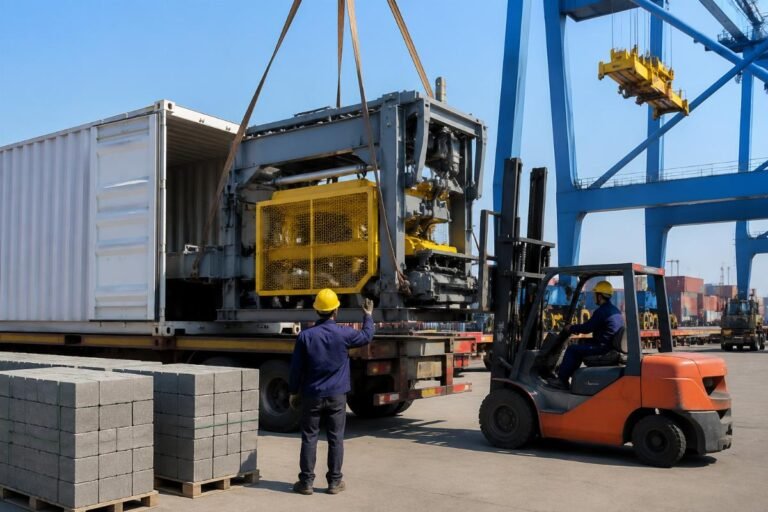
Buy Paver Block Machine Factory Direct | QT Series Wholesale Supplier
Buying paver block machines factory direct is not about chasing the lowest invoice price — it is about verifying whether the factory can deliver a complete production system matched to your local voltage, raw materials, and daily output targets.
When you buy paver block machine factory direct, the real cost gap lies in voltage adaptation, on-site commissioning, and whether these are embedded in the quoted price or billed later as surprises. Most first-time buyers focus on the machine sticker price, only to discover that transformer upgrades, stabilization modules, and engineer travel fees can double the effective investment. [NEED_CITE: hidden cost structure in turnkey block plant procurement]
Let me walk you through what I have seen on the ground — from Lagos ports to Southeast Asian dealer yards — and break down the model range, factory verification checkpoints, real cost anatomy, delivery timelines, and after-sales benchmarks you should demand.
What Models Are Available When Buying Paver Block Machines Factory Direct?
Model selection depends on your daily output target, site footprint, and labor skill level — not on whether a machine looks "advanced" in a catalog.
When you buy paver block machine factory direct, factories typically offer three tiers covering different investment scales. The table below maps the QT series range against core operational parameters.
| Model Tier | Automation Level | Daily Output Range | Mold Changeover | Voltage Flexibility | Typical Buyer Profile |
|---|---|---|---|---|---|
| QT4-25 Mobile Egg-Layer | Manual / Semi-mobile | Low to moderate output | Single mold fixed | Basic 380V/50Hz | Entry-level investors, rural sites |
| QT6-15 Semi-Auto Line | Semi-automatic with conveyor | Moderate output | Multi-mold swap capable | Customizable 50Hz/60Hz | Small plant operators, first-time buyers |
| QT10-15 / QT12-15 / QT15-15 Fully Auto | PLC-controlled full line | High-volume output | Hydraulic quick-change | Full transformer + filter integration | Government contractors, large distributors |
[NEED_CITE: comparative output capacity ranges across semi-auto and fully automatic block machine tiers]
A West African distributor once ordered a QT6-15 expecting to produce interlocking pavers for a municipal road project. The machine arrived, but the local grid fluctuated between voltage bands that the standard control panel was never rated to handle. Within the first week, the mainboard burned out twice. The replacement parts had to be air-freighted, and the project lost nearly half a month of production time. The lesson: model selection is meaningless if voltage compatibility is not confirmed before the contract is signed. [NEED_CITE: impact of unstable power grids on block machine control systems in Sub-Saharan markets]
The right model is the one that matches your raw material supply stability, operator training capacity, and local grid infrastructure — not the one with the highest brochure output figure.
How Do You Verify a Factory’s Ability to Customize for Local Conditions?
The critical verification points are voltage adaptation, raw material trial runs, and on-site installation training — all of which must be written into the contract, not promised verbally.
When you buy paver block machine factory direct, many factories will claim "customization available." The real test is whether they ask you the right questions before quoting. A credible manufacturer will request your local voltage standard, frequency, raw material type (crushed stone ratio, sand moisture content, cement grade), and site layout dimensions before finalizing the configuration.
Here is a verification checklist I use when evaluating factories:
- Voltage and frequency confirmation: Does the factory supply a transformer and stabilization module matched to your grid profile? For regions with frequent fluctuation, a filter module is non-negotiable. [NEED_CITE: voltage adaptation requirements for block machines exported to emerging markets]
- Raw material trial: Does the factory offer to run a test batch using your actual raw material samples before shipping? This confirms mold compatibility and mix ratio accuracy.
- On-site commissioning clause: Is engineer travel, installation, and operator training explicitly included in the contract with defined duration and scope?
- Certification documentation: Are CE, SGS, or ISO certificates verifiable through issuing body databases, not just PDF attachments? [NEED_CITE: certification verification methods for construction machinery exports]
A Southeast Asian dealer once switched suppliers after his previous factory refused to adjust the mold cavity depth for a specific interlocking brick profile his market demanded. The new factory ran a trial with his raw material samples, adjusted the mold within a week, and included a site visit for operator training in the contract. The difference was not price — it was process discipline.
If a factory cannot show you evidence of past customization work — photos, trial reports, or client references — treat the "customization available" claim as marketing language, not a deliverable commitment.
What Is the Real Cost Breakdown of a Direct Factory Purchase?
The machine price is only one component — transformer upgrades, spare parts packages, and commissioning travel are the hidden cost items that separate a working production line from a stranded asset.
When you buy paver block machine factory direct, the invoice for the machine itself typically represents a portion of the total landed cost. Buyers who only compare machine quotes end up underestimating the full investment required to reach production-ready status.
| Cost Component | What It Covers | Risk If Omitted |
|---|---|---|
| Base machine price | Main unit, standard mold set, basic control panel | Incomplete delivery |
| Voltage adaptation package | Transformer, stabilization module, filter unit | Control board failure, downtime |
| Spare parts package | Wear parts, seals, hydraulic hoses, sensors | Extended停机 waiting for air-shipped parts |
| Commissioning and training | Engineer travel, on-site assembly, operator training | Improper setup, reduced output, safety risk |
| Auxiliary equipment | Batch mixer, conveyor, pallet loader, stacker | Bottleneck in production flow |
[NEED_CITE: total cost of ownership structure for block making machines in emerging market installations]
A Latin American housing project contractor once received a competitive quote for a fully automatic line — but the quote excluded the voltage adaptation package and the spare parts kit. When the machine arrived, the local grid required a transformer upgrade that cost several times what the savings on the machine price had been. The project budget was blown before the first brick was cast.
The factory I work with in Linyi includes voltage customization based on the buyer’s grid profile as a standard step in the configuration process. The spare parts package is quoted alongside the machine, not as an afterthought. This is not generosity — it is the difference between a factory that ships equipment and a factory that delivers a working production system. [NEED_CITE: turnkey block plant cost components including voltage adaptation and spare parts]
Always request a full system quote — not just a machine quote — and verify that voltage adaptation, spare parts, and commissioning are line items, not verbal promises.
How Long Does Full Turnkey Delivery Take from Order to Production?
Standard complete lines ship within a defined production window, but on-site production readiness requires additional time for installation, commissioning, and operator training.
When you buy paver block machine factory direct, the delivery timeline has two phases: factory production and shipping, followed by on-site assembly and commissioning. The factory production phase for a complete line — from batcher to mixer to forming machine to stacker — typically falls within a standard manufacturing window. [NEED_CITE: typical manufacturing lead time for complete concrete block production lines]
However, the on-site phase is where many buyers miscalculate. Installation of a fully automatic line involves mechanical alignment, hydraulic system pressure testing, electrical wiring to local standards, PLC parameter configuration, and mold trial runs. Operator training adds further time — especially when the local workforce has no prior experience with automated block equipment.
A government infrastructure contractor in East Africa once planned a project timeline assuming the machine would be producing within days of container arrival. The reality was that electrical infrastructure at the site needed upgrading, the foundation required curing time, and the operator training took longer than expected because the crew had never worked with a PLC-controlled system. The project was delayed by weeks, not because the machine was defective, but because the timeline did not account for site readiness.
The factories I have dealt with build commissioning time into their project plans and send engineers who stay until the line runs stably and local operators can manage daily production independently. This is what "turnkey" should mean — not just "delivered to your port." [NEED_CITE: on-site commissioning and training duration for automatic block machines in emerging markets]
What After-Sales Support Should a Reliable Factory Provide?
Lifetime spare parts supply and remote technical support are the core indicators that separate a manufacturing entity from a trading company.
When you buy paver block machine factory direct, after-sales support is the longest-term variable in your investment. Machines wear. Molds degrade. Hydraulic seals need replacement. The question is not whether you will need parts — it is whether the factory will still be able to supply them years after the sale.
A reliable factory maintains:
- Spare parts availability: Original mold drawings, hydraulic component specifications, and PLC program backups are retained for every machine shipped. [NEED_CITE: spare parts lifecycle support standards for block machine manufacturers]
- Remote technical diagnostics: Video-based troubleshooting and PLC parameter adjustment support for issues that do not require physical site visits.
- Wear part supply chain: Standardized wear parts (mold liners, mixer blades, conveyor belts) are stocked and shippable within defined lead times.
A Middle East block plant operator once faced a mold wear issue two years after purchase. The trading company he originally bought from had gone offline — no response, no parts catalog, no technical drawings. He had to commission a local workshop to reverse-engineer the mold, which cost significantly more than the original and never matched the precision of the factory-original specification.
The factory I represent in Linyi retains full technical documentation for every machine exported and provides lifetime spare parts supply. Remote video support is available for real-time troubleshooting. This is not a marketing promise — it is a structural capability that requires a real manufacturing base, not a mailbox address. [NEED_CITE: after-sales support infrastructure requirements for block machine exporters]
Conclusion
Buying paver block machine factory direct is a systems procurement decision, not a price comparison exercise. The model you choose must match your output target, grid stability, and operator skill level. The factory you select must demonstrate voltage adaptation capability, raw material trial discipline, and contractually committed commissioning. The cost you budget must include transformer packages, spare parts, and training — not just the machine invoice. And the after-sales relationship must be backed by retained technical documentation and lifetime parts availability. These are the filters that separate a production line that runs for years from one that becomes an expensive monument to a bad procurement decision.