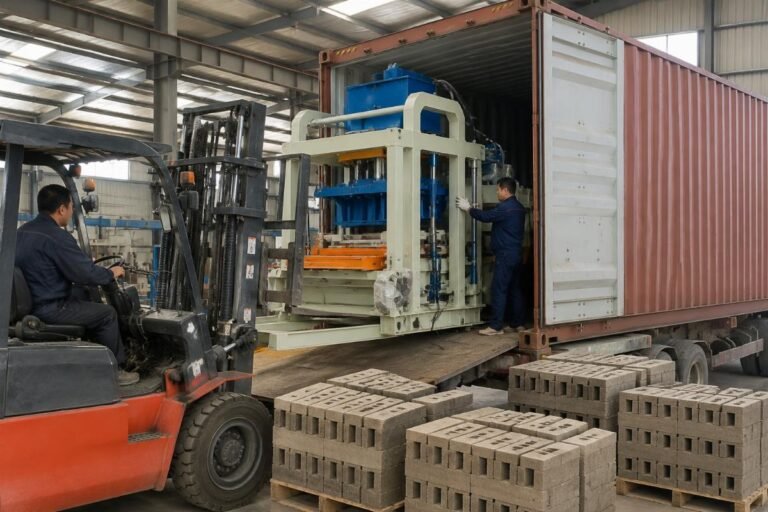
Block Machine Payment Terms T/T L/C Guide for Sale
Most buyers assume the cheapest payment method is the safest. In reality, the wrong payment terms for a block machine can wipe out your entire profit margin before the first brick is ever laid.
When importing concrete block making equipment from China, the optimal payment structure balances capital security with supplier trust: T/T with staged milestones suits most private investors, while irrevocable L/C at sight protects large government tenders — but only if soft clauses are eliminated before signing.
I still remember a shipment bound for West Africa a few years back. The buyer insisted on D/P terms to save on bank charges. The machine arrived at the port, sat there for weeks while the buyer "arranged funds," and by the time demurrage bills started piling up, the total landed cost had ballooned to a point where selling to a local middleman at a steep discount was the only way out. A full container of heavy machinery doesn’t just sit — it bleeds money every single day it occupies port space [NEED_CITE: demurrage cost structure for heavy machinery imports at West African ports]. That case reshaped how I approach every single contract negotiation.
Let me walk you through what actually works, what quietly destroys deals, and how to protect yourself regardless of which route you choose.
Why Payment Terms Matter More Than Price for Block Machines?
A block making machine is not an off-the-shelf consumer product — it is a custom-configured capital asset, and your payment terms are the only leverage you hold between signing and commissioning.
Unlike standardized goods, a complete brick production line involves mould customization, voltage adaptation, PLC programming for local raw material conditions, and sometimes site-specific structural modifications. Once production begins, the equipment is essentially built to your specification. If something goes wrong at the payment stage, you cannot simply redirect the machine to another buyer. This asymmetry is exactly why payment terms for block machine deals carry more weight than the unit price itself [NEED_CITE: impact of customization on machinery resale value in international trade].
I have seen buyers negotiate aggressively on the machine price — squeezing out every last dollar — and then casually agree to unfavorable payment conditions that exposed them to far greater financial risk. The logic is backwards. A slightly higher unit price with secure, milestone-based payment terms will always cost you less in the long run than a rock-bottom price paired with full advance payment or uncontrolled documentary terms.
Consider this: when a buyer pays the full amount before shipment, the supplier has zero incentive to expedite after-sales support, send replacement parts promptly, or respond urgently to commissioning issues. The leverage has shifted entirely. Conversely, when payment is structured so that a meaningful balance remains outstanding until the machine is verified running at your site, both parties stay aligned.
The key principle is simple: retain leverage until performance is confirmed. Every payment term discussion should revolve around this single idea.
T/T vs. L/C: Which is Best for Your Brick Machine Order?
T/T works best for orders under a mid-range budget with established supplier relationships, while L/C is the appropriate instrument for high-value tenders or first-time transactions in unfamiliar markets — provided the credit is truly irrevocable and free of soft clauses.
Telegraphic Transfer remains the most common payment method in the block machine industry, and for good reason. It is fast, low-cost, and flexible. The standard structure I recommend to buyers involves an initial deposit upon contract signing, a progress payment after the machine frame and core hydraulic components are assembled, and a final balance paid against the copy of the bill of lading before original documents are released [NEED_CITE: standard T/T milestone structure for capital equipment exports from China]. This three-stage approach ensures the supplier has working capital to proceed while the buyer retains control over the final disbursement until shipment is confirmed.
A private investor from Southeast Asia once placed an order for a semi-automatic block line. We structured the deal as a deposit at contract signing, a second installment after the mainframe was assembled and photos were shared, and the remainder against the B/L copy. The entire process took roughly a month from deposit to container loading, and the buyer had visibility at every stage. No bank involvement, no document discrepancies, no waiting.
Now, L/C enters the picture when the order value climbs significantly, or when the buyer’s country has foreign exchange controls, or when the transaction is part of a government infrastructure tender requiring formal banking instruments. An irrevocable L/C at sight, confirmed by a reputable bank, gives both parties a high degree of security. The bank acts as intermediary, and payment is released only when the supplier presents compliant documents.
However, here is where most buyers stumble. They assume L/C is automatically safe. It is not — not if the credit contains soft clauses. A soft clause is a non-standard requirement embedded in the L/C that makes compliant presentation practically impossible without the buyer’s cooperation. Examples include requiring an inspection certificate issued by the buyer’s nominated agent, or demanding a specific shipping line approved by the applicant, or stipulating that all documents must bear a consular legalization that takes weeks to obtain. If the buyer chooses not to cooperate, the supplier cannot present compliant documents, and the bank will refuse payment. At that point, the L/C is functionally no different from an open account — except the supplier has also paid bank charges for the privilege [NEED_CITE: common soft clause types in machinery trade L/Cs per UCP 600 guidelines].
I once worked with a South American government contractor whose L/C contained a clause requiring a pre-shipment inspection certificate signed by a specific local agency. That agency had no presence in the manufacturing region, and arranging the inspection would have delayed shipment by weeks. We caught it during the draft review, flagged it immediately, and had the clause removed before the credit was issued. The buyer later told me their previous supplier had not bothered to check — and ended up missing the shipment window entirely, triggering penalty clauses in the tender contract.
For buyers working with Chinese manufacturers on block machine orders, the practical recommendation is this: if your order fits within a moderate budget and you have verified the supplier through factory visits or prior transactions, T/T with milestone payments is efficient and cost-effective. If the order is substantial, or your country requires L/C for import clearance, or you simply want the bank guarantee, go with L/C — but insist on reviewing the draft terms before the credit is opened, and eliminate anything that puts compliance outside your supplier’s control.
What Are the Hidden Risks in D/P and D/A Terms?
Documents against Payment and Documents against Acceptance shift virtually all risk to the supplier, and when the supplier bears the risk, the buyer ultimately pays for it through higher prices, reduced after-sales commitment, or outright refusal to trade.
Under D/P terms, the supplier ships the goods and sends the shipping documents through banks. The buyer can only collect the documents — and therefore claim the goods — by paying the full amount at the bank. On paper, this sounds balanced. In practice, once the container arrives at the destination port, the buyer is under no legal obligation to pick up the documents. If market conditions shift, if the buyer’s financing falls through, or if the buyer simply changes their mind, the goods sit at the port. The supplier then faces a terrible choice: pay to ship the machine back, absorb demurrage charges that compound daily, or sell at a steep discount to a local buyer who knows the goods are stranded [NEED_CITE: risk exposure for exporters under D/P terms in emerging market destinations].
That West Africa case I mentioned earlier is not unique. I have heard similar stories from colleagues shipping to various ports where customs procedures are slow and storage fees are punitive. A block machine is heavy, oversized, and requires specialized handling. It is not the kind of cargo you can quietly redirect to a nearby warehouse. Every day it sits at the terminal, the cost grows.
D/A is even more exposed. Under Documents against Acceptance, the buyer receives the documents simply by accepting a time draft — promising to pay at a future date, typically several weeks or months later. The buyer has the goods. The supplier has a promise. If the buyer defaults, the supplier must pursue international debt collection, which is expensive, slow, and often futile depending on the jurisdiction.
Some buyers request D/P or D/A because they genuinely want to preserve cash flow. That is understandable. But the rational response from a supplier is to either decline, or to price the risk into the machine. If a supplier agrees to D/A, they will either raise the price or reduce the level of service — because the financial exposure is real and quantifiable.
For buyers, the takeaway is straightforward: requesting D/P or D/A on a first-time order for custom machinery signals that you are asking the supplier to finance your purchase without any collateral. Most established manufacturers will not accept this, and those who do will build the risk premium into the quotation. You are better off proposing a structured T/T arrangement that protects both sides, or using L/C if formal banking instruments are required.
How to Avoid "Soft Clauses" in L/C for Machinery?
The defense against soft clauses begins before the L/C is issued — by insisting on a draft review, cross-checking document requirements against industry standards, and refusing any condition that depends on the buyer’s unilateral action.
Under the Uniform Customs and Practice for Documentary Credits, the governing framework for international letters of credit, banks deal only in documents, not in goods. This means if the documents presented by the supplier do not match the L/C terms exactly, the bank can refuse payment — regardless of whether the machines are sitting in perfect condition at the port [NEED_CITE: document compliance principles under UCP 600 for capital goods shipments].
Soft clauses exploit this principle. They insert requirements that are technically possible but practically dependent on the buyer’s cooperation. Here are the most common ones I have encountered in block machine transactions:
- Buyer-nominated inspection certificates: The L/C requires an inspection report from a specific company or individual chosen by the buyer. If the buyer delays or refuses to arrange the inspection, the supplier cannot present compliant documents.
- Consular legalization or embassy certification: Some countries require documents to be legalized by their embassy in the country of export. This process can take weeks and is outside the supplier’s control.
- Beneficiary certificate requirements: The L/C asks the supplier to issue a certificate confirming something the buyer should be confirming — creating a circular dependency.
- Vessel or shipping line restrictions: The credit specifies that shipment must be on a particular vessel or through a particular carrier, which may not align with the supplier’s logistics schedule.
The solution is systematic. When an L/C is required, request the draft text before the issuing bank finalizes it. Review every document requirement line by line. Ask yourself: can the supplier produce this document independently, within the stipulated timeframe, without any action from the buyer? If the answer is no, the clause must be removed or rewritten.
I always advise buyers to work with their banks and suppliers to align the L/C terms with standard shipping documentation — commercial invoice, packing list, bill of lading, certificate of origin, and any third-party inspection reports from internationally recognized agencies such as SGS or Bureau Veritas. These agencies have offices in major Chinese manufacturing hubs and can complete inspections within days. That is a reliable, controllable process.
One more point: if you are importing from a manufacturer that regularly exports to your region, they will likely have experience with your country’s L/C requirements. Leverage that experience. A manufacturer who has shipped block making machines across multiple continents will know which document patterns trigger delays and which pass through customs smoothly. That institutional knowledge is worth more than any bank charge you might save by drafting the credit yourself.
Conclusion
Payment terms are not a footnote — they are the structural foundation of a safe machinery import transaction. Whether you choose T/T with staged milestones, an irrevocable L/C with clean document requirements, or a combination tailored to your specific order value and market conditions, the goal remains the same: maintain alignment between payment release and verified performance. Avoid D/P and D/A on custom equipment, scrutinize every L/C draft for soft clauses, and remember that the cheapest payment method is rarely the safest one.