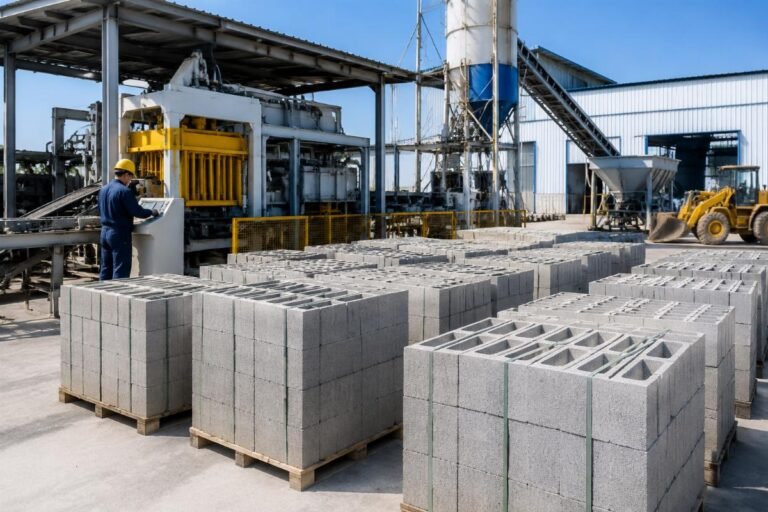
Buy Block Machine Bulk Order Deal
The real cost of a bulk block machine order is not the unit price — it is the field validation gap between factory specs and your actual site conditions.
When you place a bulk order for block machines, the critical step is not negotiating a discount. It is verifying that every unit in the shipment is engineered for your local voltage stability, raw material alkalinity, and daily output target before the container doors are sealed. A bulk order that skips this validation will face on-site failures that multiply your commissioning timeline and spare parts costs.
I used to sign off on every hydraulic pressure test and vibration table calibration before a machine left the factory floor. Then I moved into export sales and started spending more time in Riyadh and Doha than in Linyi. On one project in the Riyadh residential zone, the client received a full order of automatic block lines. Within weeks, PLC boards started burning out. Their site engineer was crouched in front of the control cabinet with a multimeter, cursing the inconsistency. The root cause was not the machine build — it was the Gulf region’s voltage fluctuation range, which the factory test protocol had not simulated. [NEED_CITE: IEC 60038 standard voltage tolerance bands for industrial grids in GCC countries] That incident reshaped how I handle every bulk order for block machines from that point forward.
The lesson was simple: a bulk order is not a volume transaction. It is a site-specific engineering commitment.
What Should You Validate Before Placing a Bulk Block Machine Order?
You must validate three site parameters through live video evidence — local voltage fluctuation range, raw material composition including alkalinity and aggregate gradation, and confirmed daily output demand — before any commercial terms are finalized.
Parameter sheets from the factory tell you what the machine can do under ideal conditions. They do not tell you what it will do in your yard. When I started requiring clients to send video recordings of their site power supply, aggregate stockpiles, and existing production rhythm, the commissioning success rate on bulk orders shifted noticeably.
Consider a residential development project on the outskirts of Riyadh. The investor planned to install multiple automatic block machines to meet a tight housing delivery schedule. The factory parameter sheet showed standard voltage compatibility. But the actual site grid experienced frequent dips and surges that fell outside standard tolerance. [NEED_CITE: IEEE 1159 recommended voltage sag and swell thresholds for industrial motor-driven equipment] Without a pre-order voltage audit, the PLC systems would have been vulnerable from day one.
The validation checklist for any bulk order for block machines should include:
| Validation Item | Standard Factory Check | Site-Specific Validation |
|---|---|---|
| Voltage Stability | Rated voltage match | Live grid fluctuation range recorded over multiple days |
| Raw Material Suitability | Generic concrete recipe | Local aggregate alkalinity and moisture content tested |
| Output Demand | Nominal cycle time | Actual shift pattern and target daily volume confirmed |
| Ambient Conditions | Standard operating temperature | Peak summer temperature and dust exposure level verified |
| Foundation Readiness | General pit drawing | Soil bearing capacity and drainage conditions inspected |
The gap between the left column and the right column is where bulk orders succeed or fail.
A West African distributor once placed a bulk order for block machines without providing any raw material samples. The aggregate available locally had a noticeably higher alkalinity level than the reference material used in factory mold trials. Within a short operating period, mold wear accelerated far beyond the expected cycle. The replacement mold cost and the downtime for changeovers erased the price advantage the distributor had negotiated. [NEED_CITE: Effect of aggregate alkalinity on concrete mold abrasion lifecycle per ACI material durability guidelines]
The takeaway is that pre-order validation is not a bureaucratic step. It is the single most effective cost-control measure in a bulk purchase.
How Do You Match Machine Specs to Site Conditions in Bulk Deals?
Every unit in a bulk order must receive customized configuration adjustments — particularly in PLC protection ratings, hydraulic system pressure calibration, and mold steel grade selection — based on the validated site data, even when all units share the same model number.
This is where many buyers make a costly assumption. They believe that ordering multiple units of the same model guarantees identical performance. In reality, the same model running on an unstable grid in one country and a stable grid in another will exhibit dramatically different failure patterns.
On a municipal brick plant expansion project in Doha, the client was replacing older manual lines with fully automatic equipment. The production target was aggressive, and the downtime window for switching from the old line to the new line was extremely tight. The factory initially prepared all units with identical hydraulic pressure settings and standard PLC input protection. But the site audit revealed two critical differences: the local power supply had a fluctuation pattern that required enhanced surge protection on the PLC input modules, and the local sand source contained trace minerals that demanded a higher-grade mold steel treatment. [NEED_CITE: Hydraulic system pressure calibration standards per ISO 4413 for industrial fluid power]
Shandong Shiyue handled the configuration split for this order. The PLC cabinets received upgraded voltage tolerance components matched to the recorded grid profile. The hydraulic manifolds were recalibrated to compensate for the higher ambient temperature range typical of the Gulf summer. The mold steel was specified with enhanced wear resistance to handle the abrasive local aggregate. These adjustments were not visible on the exterior of the machine, but they determined whether the line would run continuously or require repeated intervention.
For a bulk order for block machines, the configuration matrix should look like this:
| Configuration Element | Standard Specification | Site-Adapted Specification |
|---|---|---|
| PLC Input Protection | Standard surge rating | Enhanced tolerance matched to recorded grid fluctuation |
| Hydraulic Pressure Setting | Factory default | Recalibrated for local ambient temperature range |
| Mold Steel Treatment | Standard hardening | Upgraded wear resistance for local aggregate abrasiveness |
| Cooling System Capacity | Standard radiator | Oversized for sustained high-temperature operation |
| Electrical Component Rating | Standard IP rating | Dust-resistant rating for arid or high-particulate environments |
The manufacturer’s production facilities can execute these configuration splits within a single production batch, provided the site data is submitted before the production schedule is locked.
The critical point is that a bulk order is not a catalog purchase. It is a series of individual engineering decisions applied to each unit based on shared site intelligence.
What Is the Optimal Container Loading Strategy for Multi-Unit Orders?
The container loading plan for a bulk order must balance host machines, mold sets, and wear-part spare parts according to failure probability — not according to physical volume alone.
Many buyers assume that maximizing the number of host machines per container minimizes shipping cost. This is a false economy. If a single machine goes down because a critical wear part is unavailable and the spare parts container is still in transit, the entire production line stops. The lost output value dwarfs the shipping savings.
A West African distributor’s first container order illustrates this clearly. The buyer loaded the containers to maximum host machine density, with minimal spare parts allocation. When a vibrator motor bearing failed on one unit during the commissioning week, the replacement part was not on site. The entire batch of machines sat idle while waiting for an air-shipped component. The delay cost far more than the freight saved by squeezing in extra machines. [NEED_CITE: Optimal spare parts inventory ratio for continuous production equipment per maintenance reliability standards]
For a bulk order for block machines, the loading allocation should follow a risk-based ratio:
| Component Category | Loading Priority | Rationale |
|---|---|---|
| Host Machines | Secondary | Core production capacity, but non-functional without consumables |
| Mold Sets | Primary | Each product type requires dedicated molds; no substitution possible |
| High-Wear Spare Parts | Primary | Vibrator bearings, hydraulic seals, mixer blades fail within early operating hours |
| Electrical Spares | Primary | PLC input modules, contactors, and sensors are vulnerable to grid instability |
| Structural Spares | Secondary | Frame components rarely fail early; can be ordered later if needed |
The optimal loading model ensures that every container carries enough high-wear and electrical spares to sustain continuous operation for an extended initial period without requiring emergency shipments.
Shandong Shiyue structures its container loading plans using this risk-based allocation model. For a typical multi-unit order, the spare parts complement is sized to cover the failure probability window of the initial commissioning and ramp-up phase, ensuring that no single component failure can halt the entire line.
How to Structure Delivery and Commissioning for Large-Scale Projects?
Phased shipment scheduling aligned with on-site installation readiness reduces warehousing cost, prevents equipment damage from prolonged storage, and ensures that commissioning teams can work continuously without idle gaps.
A common mistake in large-scale block plant projects is shipping all units simultaneously. The site may not be ready to receive and install every machine at once. Equipment sitting in a yard in extreme heat and dust for extended periods suffers from seal degradation, electrical contact oxidation, and hydraulic fluid contamination before it even runs.
On a multi-line block plant project in the Middle East, the investor wanted all machines delivered at once to "get it over with.*o of the three production bays. The machines destined for those bays were stored outdoors for an extended period before installation. When commissioning finally began, hydraulic hoses had become brittle from UV exposure, and electrical connectors showed corrosion. The rework required before those machines could run added significant cost and delay.
The structured approach for a bulk order for block machines follows a phased delivery logic:
| Phase | Shipment Content | Site Readiness Requirement |
|---|---|---|
| Phase One | First-line host machines, primary molds, full spare parts set | Foundation complete, power supply connected, raw material stockpiled |
| Phase Two | Second-line host machines, additional mold sets | First line commissioned and producing; foundation for second line cured |
| Phase Three | Auxiliary equipment, color feeders, pallet replenishment | Main lines operational; auxiliary integration points prepared |
Shandong Shiyue supports this phased delivery model with a full delivery cycle that spans from order confirmation to final commissioning across the complete installation timeline. The on-site installation and commissioning teams are deployed in alignment with each shipment phase, ensuring that engineers are present when each batch of equipment arrives and ready for integration.
The advantage of this approach is that commissioning momentum is maintained. Each phase builds on the previous one, and the installation team does not face the bottleneck of trying to commission all machines simultaneously with insufficient support staff on site.
What After-Sales Support Should a Bulk Order Include?
A bulk order must include contractually binding commitments for on-site operator training, remote diagnostic access, and guaranteed spare parts availability for the full operational life of the equipment.
After-sales support is often treated as an afterthought during procurement. For a bulk order for block machines, it should be a central negotiating point. The reason is straightforward: when you operate multiple machines across one or more production lines, a support gap on any single unit creates a disproportionate impact on total output.
A distributor in West Africa learned this when his first bulk order was delivered without a structured training program. The local operators had experience with smaller manual machines but were unfamiliar with PLC-controlled automatic lines. Within weeks, operator errors caused repeated fault codes and unplanned stops. The distributor had to fly in external technicians at significant cost, and production targets were missed for an extended period.
The after-sales framework for a bulk order should include:
| Support Element | Minimum Standard |
|---|---|
| On-Site Training | Comprehensive program covering operation, daily maintenance, and basic fault diagnosis for all local operators |
| Remote Diagnostics | Access to technical support team for real-time fault code interpretation and guided troubleshooting |
| Spare Parts Supply | Guaranteed availability of all wear parts and critical components for the full service life of the equipment |
| Response Time | Defined maximum response window for both remote support and on-site dispatch if required |
Shandong Shiyue includes lifetime after-sales support and lifetime spare parts supply as standard commitments with every bulk order. The on-site installation and commissioning service includes structured operator training, ensuring that the local team can manage day-to-day operation and routine maintenance independently. Remote diagnostic support provides an additional layer of technical access for fault resolution without waiting for physical dispatch.
Conclusion
A bulk order for block machines is an engineering project, not a price negotiation. Validate your site conditions before ordering, customize each unit to match those conditions, load containers based on failure risk rather than volume, phase deliveries to match installation readiness, and bind after-sales support into the commercial terms. Every step you skip at the procurement stage will cost you multiples of its value on site.