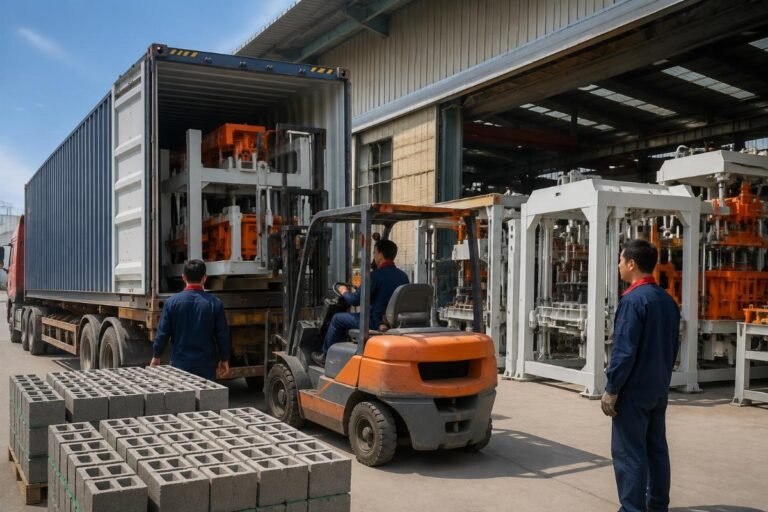
Block Machine CE SGS ISO Certified Manufacturer for Sale
CE, SGS, and ISO do not mean the same thing, and treating them as interchangeable is the single most common reason block machines get stuck at customs.
CE covers European market access, SGS verifies pre-shipment condition, and ISO certifies the factory’s quality system — buyers must match each certificate to their destination country’s import rules, not chase "all three" blindly.
I spent years welding machine frames on the shop floor before moving into export sales focused on Latin American routes. A buyer from São Paulo state once sourced a complete block plant from a cheaper supplier who held only a generic CE certificate issued by a small, unaccredited lab. When the line arrived at Santos port, Brazilian customs demanded INMETRO certification for the electrical components — a standard completely separate from CE. The control cabinets sat in port storage for months. The buyer eventually reached out to our team to retrofit the panels. From the workshop to the dock, I have watched too many people confuse "having a certificate" with "having the right certificate." CE is Europe’s gateway; Latin America, Africa, and Southeast Asia each run their own systems, and you need to confirm your papers will clear your specific port before you sign anything [NEED_CITE: country-specific electrical certification requirements published by national standards bodies].
Let me walk you through what each certificate actually covers, how to match them to your country, and how to verify whether a supplier’s papers are genuine.
What Do CE, SGS, and ISO Actually Cover for Block Machines?
Each certificate governs a different dimension — machine safety, shipment condition, and factory management — and none can substitute for another.
CE marking applies to machinery sold into the European Economic Area. For a block machine CE SGS ISO certified manufacturer for sale, the CE file must address the Machinery Directive, the Low Voltage Directive, and the EMC Directive [NEED_CITE: European Union official directive database covering machinery safety requirements]. The Machinery Directive covers guarding, emergency stops, hydraulic pressure relief, and operator safety zones. The Low Voltage Directive addresses the electrical cabinet — wiring, insulation, contactor ratings. The EMC Directive ensures the machine’s motors and variable frequency drives do not cause electromagnetic interference. A proper CE technical file includes a risk assessment, a circuit diagram, a parts list, and a Declaration of Conformity signed by the manufacturer.
SGS, by contrast, is a third-party inspection company, not a certification body in the regulatory sense. When buyers request an SGS report for a block machine, they are usually asking for a Pre-Shipment Inspection. The inspector visits the factory, checks the machine against the purchase order specifications, witnesses a test run, verifies packing, and issues a report. This report confirms that the specific batch shipped met the agreed standard at the time of inspection [NEED_CITE: SGS official public report template structure and PSI process nodes]. It does not certify ongoing production quality — it certifies that particular lot.
ISO 9001 is a quality management system standard. It certifies that the factory has documented processes for design, procurement, production, inspection, and corrective action, and that an accredited auditor has verified those processes are being followed [NEED_CITE: ISO 9001 quality management system requirements and certification audit process]. It does not certify the machine itself. A factory can hold ISO 9001 and still ship a defective unit — the standard governs the system, not the individual product.
| Dimension | CE Marking | SGS Inspection Report | ISO 9001 |
|---|---|---|---|
| What it covers | Machine safety compliance for EEA market | Condition of specific shipped batch | Factory quality management system |
| Who issues it | Manufacturer (self-declaration) or Notified Body | Third-party inspection company | Accredited certification body |
| Validity scope | European Economic Area | Single shipment lot | Factory system, typically three-year cycle |
| Customs acceptance | Required for EU entry | Required by some importing countries for PSI | Required for government tenders |
| Covers ongoing production | No — file-based | No — snapshot only | Yes — system-level |
A government contractor in West Africa once bid on a public housing project. The tender documents explicitly required ISO 9001 plus an SGS pre-shipment inspection report. The competitor they were up against had CE only. The evaluation committee disqualified the CE-only bidder because CE does not substitute for ISO system certification, and no PSI report was submitted. The ISO-plus-SGS bidder won. Documents had to match the tender clauses exactly [NEED_CITE: government procurement tender documentation requirements for construction equipment in African markets].
Which Certification Does Your Country Require for Import?
The destination country’s import regulations determine which certificate you need — not the supplier’s marketing brochure.
This is where most buyers go wrong. They see "CE certified" on a supplier’s website and assume the machine will clear any port in the world. It will not. CE is legally valid only within the European Economic Area and a handful of countries that adopt EU standards by reference. Beyond that, each region runs its own framework.
For Latin America: Brazil requires INMETRO certification for electrical components used in industrial machinery [NEED_CITE: INMETRO certification requirements for electrical components in industrial machinery imported into Brazil]. Mexico requires NOM compliance. Chile has its own SEC electrical safety requirements. A block machine CE SGS ISO certified manufacturer for sale exporting to Brazil must ensure the control cabinet components carry INMETRO marks — CE alone will not satisfy Brazilian customs. I have seen entire shipments held because the contactors and circuit breakers inside the panel lacked INMETRO approval, even though the machine frame and hydraulic system were perfectly compliant with European norms.
For Africa: Many Sub-Saharan African countries require a Conformity Assessment Programme before shipment. This typically involves a physical inspection (often conducted by SGS, Intertek, or Bureau Veritas) and a Certificate of Conformity issued against the destination country’s national standard [NEED_CITE: conformity assessment programme requirements for construction equipment imports in Sub-Saharan African countries]. Government tenders in this region frequently combine ISO 9001 as a bidder qualification with SGS pre-shipment inspection as a shipment condition. Missing either document means disqualification or port rejection.
For Southeast Asia: Countries like Indonesia require SNI marks for certain product categories. Vietnam has CR marking requirements. The Philippines requires BPS certification. A distributor in Southeast Asia once asked a shortlisted supplier to provide CE certificates for online verification. The supplier’s CE certificates were issued by a body that could not be found in the EU’s NANDO database. The distributor dropped the supplier immediately — unverifiable certificates signal unacceptable risk.
| Destination Region | Primary Certification Required | Common Additional Requirement |
|---|---|---|
| European Union | CE Marking | Notified Body involvement for high-risk categories |
| Brazil | INMETRO for electrical components | ISO 9001 for government tenders |
| Mexico | NOM compliance | Pre-shipment inspection |
| West Africa | CoC via conformity assessment | ISO 9001 plus SGS PSI |
| Southeast Asia | National marks (SNI, CR, BPS) | Verifiable CE from EU Notified Body |
The lesson is straightforward: ask your customs broker or import agent which certificates your specific port requires before you place an order. Do not assume.
How to Verify If a Supplier’s Certificate Is Real?
A certificate is only as valuable as your ability to independently confirm it — every document a supplier hands you should be cross-checked against the issuing body’s official records.
CE certificates are the most frequently misrepresented. Because CE marking is largely a self-declaration system, any manufacturer can print a CE logo and a Declaration of Conformity. The question is whether the technical file behind it is legitimate and whether any Notified Body was genuinely involved for the categories that require one [NEED_CITE: EU NANDO database for verifying Notified Body involvement in CE certification]. To verify a CE certificate, check the EU’s NANDO database for the Notified Body number listed on the certificate. If the number does not appear, or if the body’s scope does not cover machinery, the certificate is not valid for EU market access.
For ISO 9001, the verification path runs through the International Accreditation Forum. ISO itself does not issue certificates — accredited certification bodies do. The key is whether the certification body that issued the ISO certificate is a member of an IAF-recognized national accreditation body [NEED_CITE: IAF member directory for verifying accreditation status of ISO certification bodies]. If the certificate was issued by a body that lacks IAF multilateral recognition, customs authorities in many countries will not accept it. I have seen certificates from small, unknown "certification companies" that looked official but were essentially worthless because no recognized accreditation authority stood behind them.
SGS reports can be verified directly through SGS. Every legitimate inspection report carries a reference number, and the issuing SGS office can confirm whether the report is genuine [NEED_CITE: SGS official report verification process and reference number validation]. If a supplier cannot provide the report number or hesitates when you ask to verify it through SGS directly, treat that as a red flag.
A distributor in the Middle East once received a CE certificate from a shortlisted block machine supplier. The certificate listed a Notified Body number. A quick check in the NANDO database showed that the number belonged to a body whose certification scope covered medical devices — not machinery. The supplier had either copied a number from an unrelated certificate or obtained it through an intermediary. The distributor removed that supplier from the shortlist.
Verification steps you should always follow:
- Request the CE Declaration of Conformity and cross-check the Notified Body number in the NANDO database
- Request the ISO 9001 certificate and verify the certification body’s IAF accreditation status through the IAF member directory
- Request the SGS report reference number and confirm authenticity through the issuing SGS office
- Ask for the CE technical file — risk assessment, circuit diagrams, component list — and confirm it matches the machine model you are ordering
- Confirm that the name and address on the certificate match the actual manufacturing entity, not a trading company
What Documents Should You Request Before Ordering?
Before you commit to a purchase, collect the full documentation package — not just the certificate logos — and confirm every document matches the exact machine model and your destination port.
Requesting certificates is not enough. You need the underlying technical documents that prove those certificates apply to the machine you are buying. A block machine CE SGS ISO certified manufacturer for sale should be able to provide a complete documentation package without hesitation. If a supplier stalls or offers only glossy scans of certificate logos, that is a warning sign.
For CE, request the full technical file. This includes the Declaration of Conformity, the risk assessment document, the electrical circuit diagram, the hydraulic schematic, the component list with part numbers, and the user manual in your required language. Confirm that the model number on the Declaration matches the model you are ordering. I have seen cases where a supplier provided a CE file for one model but shipped a different model without updated documentation. The mismatch caused delays at customs because the paperwork did not correspond to the physical machine.
For SGS, request the original inspection report — not a summary letter. The report should include photographs of the machine during the test run, measurements taken against the purchase order specifications, packing details, and the inspector’s conclusions. Confirm the report references the correct machine model and serial number.
For ISO 9001, request a current certificate scan showing the certification body’s name, the accreditation mark, the scope of certification, and the valid dates. Ask for evidence of the most recent surveillance audit. ISO certificates require annual surveillance audits to remain valid — a certificate without current surveillance records may have lapsed.
A construction materials investor in East Africa was preparing to import a fully automatic block production line. The tender required submission of CE documentation, an SGS pre-shipment inspection report, and a valid ISO 9001 certificate. The investor requested the full package from three shortlisted suppliers. One supplier provided only a one-page CE "certificate" with no technical file. Another provided an ISO certificate that had expired the previous year and showed no surveillance audit record. Only one supplier delivered a complete, verifiable package — and that was the supplier the investor proceeded with.
Document checklist before placing an order:
- CE Declaration of Conformity with matching model number
- CE technical file: risk assessment, circuit diagram, hydraulic schematic, component list
- SGS pre-shipment inspection report with original reference number
- ISO 9001 certificate with current validity dates and surveillance audit evidence
- Confirmation that all documents reference the same manufacturing entity
- Confirmation that electrical components match destination country requirements
What Happens When Certifications Don’t Match Your Port?
Mismatched certifications do not just cause paperwork headaches — they cause financial losses measured in port storage fees, machine modification costs, and forfeited contracts.
A buyer in Central America imported a block production line from a supplier who held only a generic CE certificate. The machine arrived at the port, and customs officials requested local electrical compliance documentation. The CE certificate did not cover the national standard required. The machine was held at port. Storage fees accumulated daily. Eventually, the buyer had to engage a local electrical engineering firm to assess the control cabinet, replace non-compliant components, and obtain local certification. The modification cost a significant fraction of the original machine price, and the production delay meant lost revenue from projects that could not start on schedule [NEED_CITE: cost impact of customs delays and machine modification due to certification mismatch in Central American imports].
A government contractor in North Africa had prepared a bid for a public infrastructure project. The tender documentation specified that bidders must hold ISO 9001 certification and provide an SGS pre-shipment inspection report for the equipment being proposed. The contractor sourced equipment from a supplier who had CE marking but no ISO 9001 and no arrangement for SGS inspection. The bid was disqualified at the document review stage. The contractor lost the entire tender — a contract worth a substantial sum — because the equipment documentation did not meet the tender’s mandatory requirements.
A distributor in South Asia was evaluating multiple block machine suppliers for an exclusive dealership agreement. As part of the evaluation, the distributor requested CE certificates for online verification. One supplier’s certificates were issued by a body that could not be located in any recognized accreditation database. The distributor could not verify the certificates’ authenticity. That supplier was eliminated from consideration, and the contract went to a competitor whose documentation was fully verifiable. The loss was not just one order — it was the entire dealership opportunity.
These cases share a common pattern: the cost of getting certifications wrong is always higher than the cost of getting them right upfront. Port storage fees, modification costs, forfeited bids, and lost business relationships all add up to far more than the effort of confirming your documentation requirements before ordering.
Conclusion
CE, SGS, and ISO each serve a distinct purpose in block machine procurement — matching them to your destination country’s requirements before you order is the only reliable way to avoid customs delays, bid disqualification, and costly modifications. Verify every certificate through official databases, request complete technical files rather than certificate logos, and confirm that all documents reference the exact machine model and manufacturing entity you are purchasing from.