Buy Solid Block Machine for Sale | QT10-15/QT12-15/QT15-15 Manufacturer
Most buyers chase the biggest output number on the spec sheet—and end up with a machine that sits idle half the year.
Buying a solid block machine isn’t about the cheapest unit price; it’s about matching output capacity, mold flexibility, and site infrastructure (power stability, floor space, raw material logistics) to your actual production plan, because mismatched capacity is the single largest cause of idle debt in emerging-market block plants.
I still remember the first overseas commissioning job that went sideways. A client in Lagos had ordered a high-output line based purely on cycle-time claims from a trade fair brochure. Within two weeks, the main vibration motors burned out—one after another—because the local grid voltage swung so violently that the soft-start cabinet couldn’t compensate. We flew out, tore down the control panel, and rewired the entire system on-site with local stabilizers. That single trip taught me a rule I now apply before every quotation: never quote a machine without first understanding the grid, the foundation soil, and the real daily demand within a twenty-kilometer radius of the plant. [NEED_CITE: root cause distribution of early motor failures in emerging-market block plants]
Let’s walk through what actually matters when you decide to buy a solid block machine for sale.
What Types of Solid Block Machines Are Available for Sale?
Solid block machines fall into three functional classes—manual, semi-automatic, and fully automatic—and the right choice depends on your target daily output, labor cost structure, and available capital, not on which model sounds most impressive.
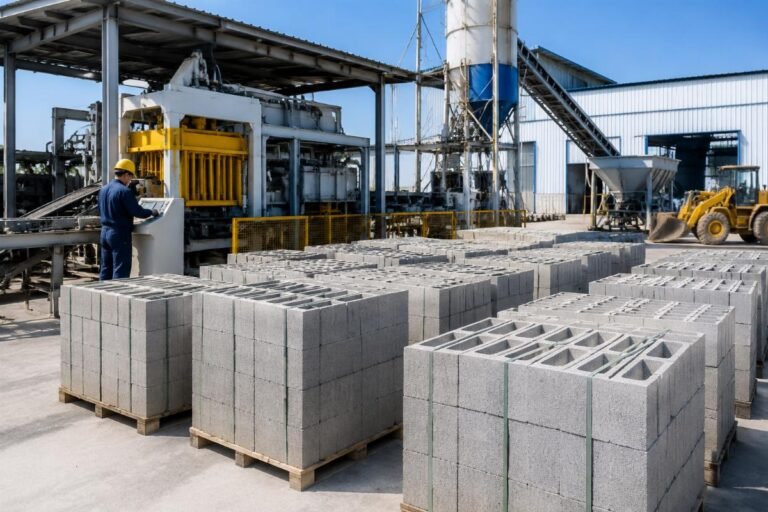
Manual egg-laying machines (such as the QT4-25 class) move on wheels across a curing yard and produce a few hundred blocks per cycle. They suit first-time investors with limited capital and abundant cheap labor. Semi-automatic lines (QT4-15, QT6-15) add a stationary frame, hydraulic pressing, and a basic pallet return loop; they bridge the gap between artisan production and industrial scale. Fully automatic lines (QT10-15, QT12-15, QT15-15) integrate PLC-controlled batching, automatic pallet circulation, finger-car stacking, and cross-conveyors—designed for plants targeting tens of thousands of blocks per shift.
| Machine Class | Typical Daily Output Range | Labor per Shift | Power Load Profile | Mold Changeover | Best Buyer Profile |
|---|---|---|---|---|---|
| Manual Egg-Layer | Low | High | Minimal | Frequent, manual | First-time micro-investor |
| Semi-Automatic | Moderate | Moderate | Standard | Scheduled | Growing private plant |
| Fully Automatic | High | Low | Heavy, stable | Rapid, programmed | Contractor or tender-bound project |
A private investor in West Africa once chose the QT6-15 over the larger QT10-15 despite wanting higher output. The reason was not ambition—it was the local grid. The QT10-15 demands a stable three-phase supply that his area simply could not guarantee; the QT6-15 tolerated voltage fluctuation far better and still delivered enough volume to service his neighborhood housing contracts. Choosing the smaller machine was not a compromise; it was the only rational decision. [NEED_CITE: power load assessment guidelines per machine tier for block production lines]
How to Calculate the Real Cost of a Solid Block Machine?
The base machine price typically represents only a fraction of your total first-year investment; molds, pallets, spare parts, foundation work, and loader equipment complete the picture, and ignoring them is the most common budgeting mistake.
When a buyer asks for the price of a solid block machine for sale, I always reply with a second question: which product mix, and for how long? A single block mold may cost a few hundred dollars, but a plant running six different block sizes—solid wall blocks, hollow blocks, interlocking pavers, curbstones—needs multiple mold sets. Pallets are another hidden line item: bamboo pallets are cheapest but wear fastest, PVC pallets last longer but cost more upfront, and composite pallets sit in the middle. Over a multi-year horizon, pallet replacement often exceeds the base machine cost. [NEED_CITE: total cost of ownership breakdown for concrete block production lines]
Spare parts deserve equal attention. I recommend every first-time buyer to secure a two-year consumables package at the time of purchase—vibration rubber springs, hydraulic seals, mixer blades, conveyor belts. Shipping a single replacement seal from China to a remote site in East Africa can cost more than the seal itself, and the machine sits idle while waiting.
| Cost Component | Relative Weight in Year One | Notes |
|---|---|---|
| Base machine | Moderate | Often overestimated by buyers |
| Mold sets | Noticeable | Scales with product variety |
| Pallets | Noticeable to High | Recurring replacement cost |
| Spare parts package | Moderate | Critical for uptime |
| Foundation and civil works | Moderate | Site-specific |
| Loader and forklift | Moderate | Often forgotten in budget |
An upgrading client in East Africa replaced two manual lines with one semi-automatic line. The labor reduction was dramatic—his payroll for block production dropped substantially—but the payback period only made sense because he had budgeted for pallets and spare parts from day one. Buyers who only count the machine invoice are in for a surprise.
What Site Conditions Must You Check Before Buying?
Power stability, foundation integrity, and raw material availability determine whether your solid block machine survives its first year—not the brand name on the control panel.
I have seen perfectly good machines fail within months because the site was never properly assessed. Voltage fluctuation is the leading cause of early electrical failures in emerging markets. A simple site audit should measure peak and trough voltage over a full working day, check transformer capacity, and confirm whether a dedicated line is available. If the grid is unstable, a voltage stabilizer is not optional—it is mandatory. [NEED_CITE: voltage fluctuation impact on industrial motor lifespan in block manufacturing]
Foundation matters more than most buyers realize. A fully automatic line exerts significant dynamic load during vibration compaction. If the concrete pad is too thin or the soil beneath it is not properly compacted, micro-cracks develop within months, the frame goes out of level, and mold alignment drifts—producing off-spec blocks that get rejected. I always ask for a soil test report before approving a foundation drawing.
Raw material logistics are equally critical. A machine is only as good as the concrete mix feeding it. If cement supply is intermittent, or if local aggregate grading is inconsistent, no amount of automation will fix the output quality. I once worked with a client whose sand contained a high clay content that nobody had tested before purchase; the blocks kept crumbling until we adjusted the mix design and added a washing step.
How to Compare Suppliers When Buying a Block Machine?
Certification depth, installation support quality, spare parts availability, and verifiable reference projects separate genuine manufacturers from trading companies reselling the same catalog.
When you evaluate any supplier offering a solid block machine for sale, start by asking for third-party certification—CE, SGS, ISO—not just a self-printed certificate, but one you can verify against the issuing body’s database. Certification matters most if you are bidding on government housing tenders, where documentation compliance is non-negotiable. [NEED_CITE: CE and SGS certification requirements for concrete block machinery in international tenders]
Next, probe installation support. A real manufacturer sends engineers who understand soil conditions, voltage profiles, and mix design—not just mechanics who bolt the frame together. Ask for references in your region and actually call them. A supplier who cannot provide verifiable project references in your country or neighboring markets is a significant risk.
Spare parts supply is the third filter. Ask specifically: do you stock wear parts for this model, and what is the typical lead time for shipment to my port? A manufacturer with regional warehousing or established logistics channels will get you back online in days; a trader will leave you waiting weeks.
Shandong Shiyue Intelligent Machinery, where I work, ticks these boxes because we have built our overseas operation around them. We hold CE, SGS, and ISO certifications verifiable on public registers. We have completed on-site installations and commissioning across more than a hundred countries, with engineers who have worked through grid instability, dusty environments, and remote logistics chains. Our pricing sits substantially below European and Turkish competitors because we manufacture in-house in Linyi, near Qingdao Port, and ship complete lines within a compressed delivery window. But I would rather you verify these claims by calling our clients than by taking my word.
What Should Your First Order Include?
A turnkey package covering machine delivery, on-site commissioning, operator training, and a two-year spare parts list prevents the costly downtime that kills most new block plants in their first year.
The biggest mistake first-time buyers make is ordering the machine alone and treating everything else as an afterthought. A proper first order should include: the main machine with all standard molds, a complete pallet set sized for your shift plan, a two-year consumable spare parts package, a foundation drawing tailored to your soil report, and—critically—on-site commissioning with operator training delivered by the manufacturer’s own engineers. [NEED_CITE: turnkey commissioning checklist for concrete block production line startups]
Training is not a formality. I have walked into plants where operators were pouring too much water into the mix because nobody had taught them the correct slump range, or where they were overloading the pallet feeder because the cycle timing was never properly calibrated. A few days of structured training on-site changes the entire trajectory of the plant.
I also recommend negotiating a remote support channel—video call access to the manufacturer’s engineering team—for the first six months. Most problems in the early stage are not mechanical failures; they are adjustment and process issues that a fifteen-minute video call can resolve.
Conclusion
The right solid block machine is the one that fits your site, your grid, your product mix, and your budget—not the one with the largest number in the model name. Match capacity to real local demand, budget for the full cost of ownership including molds and pallets, audit your site before you sign any contract, and choose a supplier whose certifications, references, and spare parts supply you can independently verify.