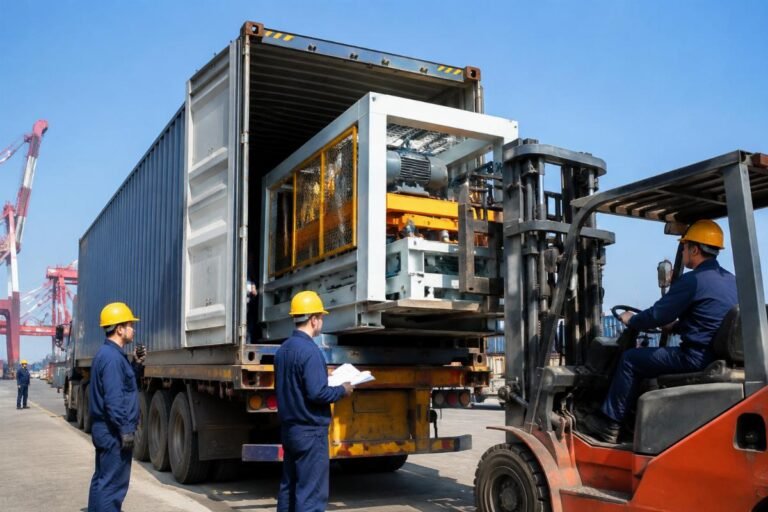
Block Machine Import Duty by Country: Landed Cost Guide
The FOB price on your proforma invoice is just the starting line, not the finish.
Block machine import duty by country varies dramatically, and when combined with port fees, VAT, and clearing agent charges, these hidden costs can inflate your real landed expense by a substantial margin. Buyers who skip HS code verification before signing a contract routinely face cash flow shocks and multi-week port delays.
I still remember a QT10-15 line we shipped to Apapa Port in Lagos a few years back. The buyer had compared three CIF quotations and picked the lowest one. Nobody walked him through the tariff structure beforehand. When the container arrived, Nigerian customs applied a duty classification he had never budgeted for. The landed cost spiked hard, the machine sat on the dock for weeks, and demurrage charges kept piling up [NEED_CITE: Nigeria Customs Service tariff classification rules for machinery under HS 8474]. That situation could have been avoided entirely with a thirty-minute HS code check before the deposit was wired.
If you are sourcing a concrete block making machine for a project in Africa, the Middle East, or Latin America, understanding block machine import duty by country is not optional paperwork—it is the single biggest variable between a profitable plant and a financial headache.
Let me walk you through what actually determines your real cost at the dock, how tariff codes work for block plants, and what levers experienced buyers pull to keep numbers under control.
Why Does Landed Cost Matter More Than FOB Price?
Because import duties, port handling charges, and clearing fees routinely consume a large share of the total project budget, making the machine price itself only a portion of what you actually pay.
Most first-time buyers focus almost entirely on the equipment quotation. They compare CIF prices, negotiate a few hundred dollars off, and feel confident they have secured a good deal. What they miss is the cost stack that begins the moment the vessel docks.
The real landed cost formula looks like this:
- FOB equipment price
- Ocean freight and marine insurance
- Import duty (percentage of CIF value)
- Value Added Tax or GST
- Port handling and terminal charges
- Customs clearing agent fees
- Inland transport from port to site
Each of these line items is real, each is payable in local currency or hard currency, and most are non-negotiable once the ship arrives. A buyer who only budgets for the CIF price is essentially planning a construction project without knowing the price of cement [NEED_CITE: World Bank trade logistics indicators on hidden import costs in Sub-Saharan Africa].
I have seen projects where the duty and tax layer alone accounted for a significant fraction of the equipment value. In some West African countries, the combined duty and VAT on construction machinery can reach a steep percentage. In others, port demurrage for delayed clearance can cost more per day than the machine’s weekly depreciation.
The mistake is not choosing a high-priced supplier. The mistake is treating the invoice total as the project total.
How to Identify the Correct HS Code for Block Machines?
The HS code determines your duty rate, and a single block plant may fall under multiple codes depending on whether customs views the shipment as a complete machine, a set of parts, or a collection of moulds.
The Harmonized System code is the universal language of customs. For block making equipment, the relevant headings generally cluster around a few key categories [NEED_CITE: WCO Harmonized System explanatory notes for machinery for working mineral materials]:
- Machinery for forming concrete blocks and pavers typically falls under the heading for machinery for working mineral materials or molding concrete products.
- Spare parts and wear components may be classified separately under parts headings.
- Moulds for concrete or cement products often carry their own distinct code.
- Hydraulic power units and electrical control panels can attract different rates entirely.
This is where inexperienced buyers get trapped. If you ship a complete QT12-15 production line as a single declared item, customs in some countries will assess the highest applicable rate across the entire shipment. But if you separate the invoice—listing the main machine, the mould sets, the hydraulic station, and the control system as distinct line items with their respective codes—you may qualify for lower blended rates.
I worked with a buyer in East Africa who restructured his invoice this way. The main block machine carried a standard duty rate, but the mould sets and certain spare parts qualified under a lower category. The overall duty burden dropped noticeably, and clearance moved faster because each line item matched its supporting documentation [NEED_CITE: East African Community Common External Tariff schedule for machinery and parts].
The lesson is straightforward: before you sign a purchase contract, ask your supplier for a detailed packing list with proposed HS codes for every major component. Then verify those codes with your local clearing agent. This step costs nothing and can save a substantial amount.
What Are Typical Import Duty Rates by Region?
Duty rates for block making machinery vary widely by region, and knowing the baseline range for your target market prevents budget surprises and helps you evaluate whether a duty exemption is worth pursuing.
While exact rates change with policy updates, the general ranges across major importing regions follow recognizable patterns [NEED_CITE: WTO tariff download facility for construction and building material machinery]:
West Africa (ECOWAS / CEMAC zone): Countries in this region tend to apply relatively high duties on imported construction machinery. The Common External Tariff framework sets baseline rates, but individual countries may add surcharges or levy additional VAT. Buyers should expect the combined duty and tax burden to be on the higher end of the spectrum.
East Africa (EAC zone): The East African Community applies a common external tariff. Machinery for industrial production often qualifies for a moderate duty band, but the VAT component remains significant. Some countries in this region offer investment incentives that can reduce or eliminate duty for registered projects.
Middle East and North Africa: Duty structures here are more varied. Gulf states generally maintain lower tariff barriers, while North African countries may apply higher rates with additional regulatory fees. Free zone registrations can provide duty relief in several markets.
Latin America (MERCOSUR and Pacific Alliance): Countries in this bloc apply common external tariffs on capital goods. Block making machinery typically falls into a moderate duty category, but anti-dumping measures or safeguard duties can occasionally apply depending on the origin and product specifics [NEED_CITE: MERCOSUR Common Nomenclature tariff rates for concrete working machinery].
South and Southeast Asia: Many countries in these regions offer reduced duties for capital equipment under industrial development policies, though the approval process requires documentation and lead time.
The pattern is clear: the headline duty rate is only part of the picture. VAT, surcharges, and port fees layer on top. And in every region, the possibility of duty exemption exists for qualified investors—but it requires advance planning.
How Can Buyers Reduce Landed Cost Legally?
There are three proven strategies that experienced importers use to bring down the real cost of a block machine shipment without cutting corners on quality or compliance.
Strategy 1: Invoice Structuring with Accurate HS Codes
As mentioned earlier, breaking a complete production line into separately declared components can shift the blended duty rate. This is not evasion—it is correct classification. The key is that each line item must be genuinely separable, supported by its own documentation, and classified according to the actual product description. Your clearing agent and your supplier should collaborate on this before the goods leave the factory.
Strategy 2: Duty Exemption Applications
Many governments offer duty waivers or reductions for investors in priority sectors such as affordable housing, infrastructure materials, or industrial manufacturing. The process typically involves registering with a national investment authority, obtaining a project approval letter, and presenting that letter to customs at the time of importation [NEED_CITE: Investment promotion agency duty exemption procedures for manufacturing equipment in developing economies].
I have seen buyers in Ethiopia and Tanzania secure meaningful duty relief through this route. The application takes time—often several weeks—so it must be initiated well before the shipment departs China. The payoff is real: duty rates can drop from a standard band to a minimal or zero rate for eligible projects.
Strategy 3: DDP or Door-to-Door Shipping Arrangements
For buyers who want cost certainty, requesting a delivered-duty-paid quotation shifts the import complexity to the supplier or their logistics partner. The price is higher than FOB or CIF, but it includes all duties, taxes, and delivery to site. This eliminates surprise charges and simplifies budgeting. Shandong Shiyue Intelligent Machinery offers CIF and DDP shipping options alongside standard FOB terms, allowing buyers to choose the level of cost transparency they need.
Each strategy has trade-offs. Invoice restructuring requires coordination. Exemption applications require lead time. DDP pricing requires trust in the supplier’s logistics network. But all three are legal, all three are routinely used, and all three can meaningfully reduce the gap between the quotation and the final cost at your gate.
What Documents Are Required for Smooth Customs Clearance?
Missing or incorrect paperwork is the single most common cause of port delays, and every document must align perfectly with the physical shipment and the declared HS codes.
Customs authorities across every region require a core set of documents. Inconsistencies between these documents—such as a mismatch between the invoice weight and the packing list, or a missing certificate of origin—can trigger inspections, hold-ups, and penalties.
The essential document package includes:
- Commercial Invoice: Must list every item with its HS code, unit price, total value, and Incoterms. The invoice value forms the basis for duty calculation.
- Packing List: Must detail the number of packages, gross and net weights, dimensions, and container numbers.
- Bill of Lading or Air Waybill: The transport document that proves shipment and serves as the title to the goods.
- Certificate of Origin: Required by many countries to determine whether preferential tariff rates apply. This must be issued by a recognized chamber of commerce in the exporting country [NEED_CITE: Rules of origin requirements under regional trade agreements for machinery imports].
- CE Certificate or SGS Inspection Report: Increasingly required by African and Middle Eastern customs as proof of quality and safety compliance. Some countries will not clear machinery without a pre-shipment inspection certificate.
- Insurance Certificate: Required under CIF and CIP terms to verify coverage.
- Import License or Permit: Some countries require a specific import permit for construction machinery, obtained before shipment.
When we prepare a shipment at Shandong Shiyue, we compile a complete documentation package including the CE certificate, SGS test report where applicable, and a certificate of origin, ensuring that the buyer’s clearing agent has everything needed to process the entry without delays.
The cost of preparing these documents is minimal. The cost of arriving at the port without them can be enormous—in demurrage, in storage fees, and in project delays.
Conclusion
Block machine import duty by country is the hidden variable that turns a good equipment deal into an expensive lesson. Understanding HS code classification, regional duty ranges, exemption pathways, and documentation requirements before you sign a contract is the only way to lock in your real project cost. The buyers who plan for landed cost—not just FOB price—are the ones who get their plants running on schedule and on budget.