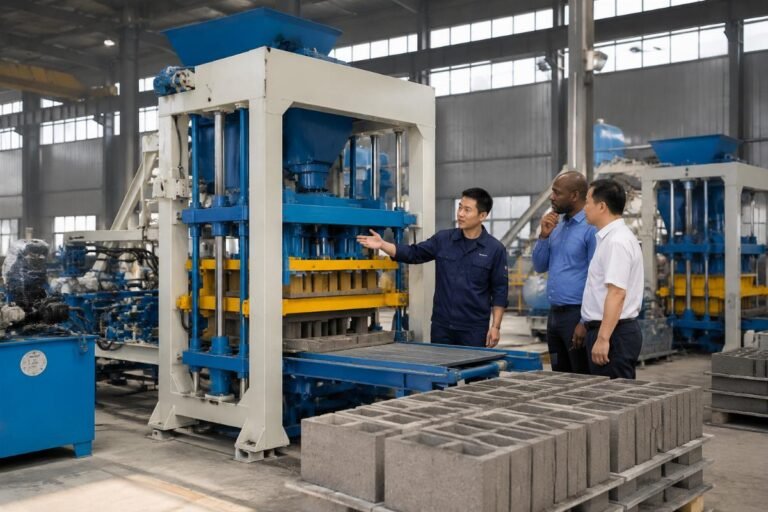
Concrete Block Machine Price in Ghana: 2026 Manufacturer Guide
The cheapest machine on the quotation sheet is rarely the cheapest machine on your factory floor.
A realistic Concrete Block Machine Price in Ghana for a complete semi-automatic line in 2026 runs significantly higher than the FOB invoice suggests once you add voltage stabilization, spare parts buffers, on-site commissioning, and operator training — and for buyers who only compare unit prices, the gap between the quote and the real landing cost is where ROI disappears.
I have spent years walking through block yards from Accra to Kumasi, watching investors celebrate a low purchase price only to discover weeks later that the machine cannot run through a Ghanaian afternoon without tripping the breaker. One buyer I met near Tema had purchased a second-hand Turkish unit at what he thought was a bargain; within days, voltage surges fried the control board, and the停产 lasted weeks — a loss that dwarfed what a proper stabilizer would have cost. [NEED_CITE: Ghana Grid Company industrial voltage fluctuation patterns and their impact on imported machinery] That kind of story repeats across West Africa because the Concrete Block Machine Price in Ghana is never just the machine price. It is the price of a running production line.
Let me walk you through what the real cost looks like, which machine type actually fits your project, and where the hidden expenses hide.
What Is the Real Cost of a Block Machine in Ghana in 2026?
The Concrete Block Machine Price in Ghana must be calculated as a full landing cost, not a factory-gate number.
When a supplier quotes you a figure, that number typically covers the machine itself, sometimes a mould set, and possibly a wooden crate. It does not cover what you will actually spend before you sell your first block. A proper cost model for Ghana includes at least seven layers: the FOB machine price, ocean freight to Tema or Takoradi port, import clearance and GSA compliance documentation, inland transport to your site, foundation and installation work, electrical adaptation including step-down transformers and stabilization panels, and commissioning with operator training. [NEED_CITE: World Bank trade logistics cost breakdown for heavy machinery imports into West Africa]
I once reviewed a quotation where a buyer in the Greater Accra Region compared three suppliers purely on the machine headline price. The lowest quote looked attractive until we added the cost of a three-phase stabilizer rated for local grid conditions, a full spare parts kit for the first year, and a technician’s on-site stay. The "cheap" option ended up costing noticeably more than a mid-range quote that had included most of these items from the start.
Here is how the cost layers typically stack up for a standard semi-automatic line:
| Cost Layer | Typical Coverage | Risk If Omitted |
|---|---|---|
| FOB Machine Price | Main unit, basic mould set | Baseline only — incomplete picture |
| Sea Freight & Insurance | Container to Tema/Takoradi | Delays and demurrage charges |
| Import Clearance & Duties | GSA paperwork, customs, port fees | Seized or held cargo |
| Inland Transport | Port to site | Damage from poor road handling |
| Foundation & Installation | Civil works, mechanical assembly | Misaligned frame, cracked base |
| Electrical Adaptation | Transformer, stabilizer, wiring | Board burnout, frequent trips |
| Commissioning & Training | Technician stay, operator handover | Extended downtime, poor brick quality |
The buyers who budget only for the first row almost always face surprise invoices later. A credible Concrete Block Machine Price in Ghana should be presented as a turnkey package, or at minimum with every optional item clearly listed so you can decide rather than discover.
Which Block Machine Type Fits Your Ghana Project?
Matching machine capacity to your actual daily output target — not your aspirational one — is the single biggest lever for controlling the Concrete Block Machine Price in Ghana.
Three model families dominate the Ghanaian market for private investors: the mobile egg-laying type suited for very small yards, the semi-automatic stationary line for medium-scale operations, and the fully automatic PLC-driven line for high-volume plants supplying infrastructure projects. Each has a different cost profile, a different labor requirement, and a different sensitivity to Ghana’s power conditions.
| Parameter | Mobile Egg-Layer (e.g. QT4-25 class) | Semi-Auto Stationary (e.g. QT6-15 class) | Full-Auto Stationary (e.g. QT10-15 class) |
|---|---|---|---|
| Daily Output Range | Low volume, manual pallet handling | Medium volume, semi-automated cycling | High volume, PLC-controlled cycling |
| Labor Requirement | Noticeably higher per block | Moderate | Substantially lower per block |
| Power Demand | Basic three-phase | Standard three-phase with stabilizer | Heavy three-phase with robust stabilization |
| Mould Changeover | Simple, fast | Standard procedure | Requires trained technician |
| Best Suited For | Startup yards, rural sites | Growing private plants | Government contractors, large developers |
| Spare Parts Sensitivity | Low | Moderate | High — PLC boards are critical |
A contractor I worked with near Kasoa initially wanted the largest automatic line because a European brand had sold him on the output figures. After we walked his site and reviewed his power supply agreement with the local utility, we stepped him down to a semi-automatic configuration. His Concrete Block Machine Price in Ghana dropped meaningfully, his stabilization costs stayed manageable, and his brick quality remained consistent enough to win residential contracts. Had he insisted on the full-auto line without upgrading his transformer first, he would have faced the kind of PLC failures that can stall production for extended periods.
Conversely, a buyer who starts with a manual or mobile unit and then tries to scale by adding more of the same often finds his per-block labor cost eating into margins. At a certain output threshold, the ROI of a semi-automatic line overtakes the apparent savings of a cheaper machine. [NEED_CITE: ROI comparison of manual versus semi-automatic block production in Sub-Saharan African markets]
Hidden Costs That Kill ROI in West Africa
Voltage instability, spare parts scarcity, and skipped training are the three silent budget-killers behind any Concrete Block Machine Price in Ghana.
Let me be direct: Ghana’s industrial grid is improving, but voltage fluctuation remains a daily reality in many industrial zones and peri-urban areas. A machine designed for a stable European supply will suffer repeated control board failures if connected directly to a line that swings outside tolerance. I have seen PLC mainboards replaced multiple times within a single year because the buyer assumed a basic surge protector was sufficient. It was not. A properly rated industrial stabilizer is not an accessory — it is part of the machine’s survival kit. [NEED_CITE: Ghana Standards Authority industrial voltage tolerance specifications for imported machinery]
The second hidden cost is spare parts. When you buy a machine from a supplier who has no regional stock and no willingness to ship small emergency orders, a single failed sensor can idle your entire line. The cost of that idle time — lost contracts, idle labor, demurrage on outbound deliveries — quickly exceeds the price difference between a supplier who includes a first-year spare parts package and one who does not.
The third is training. I have walked into yards where the machine was mechanically sound but the operators did not understand mix ratios, curing cycles, or mould maintenance. The blocks came out inconsistent, the moulds wore prematurely, and the buyer blamed the machine. A supplier who includes on-site commissioning and structured operator training removes this risk entirely.
| Hidden Cost Category | What Happens Without It | Typical Impact |
|---|---|---|
| Voltage Stabilization | Control board burnout, PLC failure | Extended停产, costly replacements |
| Spare Parts Buffer | Single-component failure idles full line | Lost production days, missed deadlines |
| On-Site Training | Poor mix ratios, mould abuse, inconsistent output | Reduced brick quality, accelerated wear |
A West African distributor once told me that his most profitable clients were not the ones who negotiated the hardest on the Concrete Block Machine Price in Ghana, but the ones who asked the most questions about what happened after the container was opened.
How to Compare Supplier Quotes Without Getting Tricked
A lower Concrete Block Machine Price in Ghana on paper can mask a higher real cost if the quotation scope is not identical across suppliers.
When you receive three quotations, the first thing to check is not the bottom-line figure but the item list. Does each quote include the same mould set, the same number of pallets, the same batching plant capacity, the same commissioning days? If Supplier A quotes significantly lower than B and C, the gap is almost always hiding in omitted scope rather than genuine manufacturing savings.
Here is what a reliable quotation should transparently cover:
- CE or SGS certification documentation verifiable against the issuing body
- A detailed spare parts list with quantities for the first year of operation
- On-site installation and commissioning with named technician allocation
- Operator training scope — how many days, how many operators, what curriculum
- Electrical adaptation plan — whether the supplier has reviewed your site power and specified stabilization accordingly
- Mould material grade and expected lifespan before re-chroming or replacement
- Post-commissioning support channel — response time for remote troubleshooting, spare parts dispatch procedure
I have reviewed quotations where the "low price" supplier had excluded the batching plant entirely, assuming the buyer would source it locally. The local sourcing then cost more than if it had been included in the original shipment, because the local mixer did not match the machine’s cycle timing. Another quotation omitted the pallet loader, forcing the buyer to handle pallets manually — which added labor and slowed the line below its rated output.
A trustworthy supplier will welcome detailed comparison. When we prepare a quotation for a Ghanaian buyer, we list every component, every optional item, and every assumption about site conditions. If the buyer later chooses another supplier, at least he does so with eyes open. The Concrete Block Machine Price in Ghana should be a transparent number, not a trap.
What Should You Include in Your RFQ?
A well-structured RFQ protects your Concrete Block Machine Price in Ghana from scope creep and surprise invoices later.
Most buyers send a one-line inquiry: "Price for block machine." This invites vague quotations that are impossible to compare. A proper RFQ should specify your target daily output, your available site area, your power supply details including voltage and phase, your preferred block types and sizes, and your expectation regarding installation and training. It should also ask explicit questions about certification, spare parts, and after-sales response.
Here is a practical RFQ checklist for a Ghana-based buyer:
- State your target blocks per day and block dimensions — this determines the correct model class.
- Provide your site’s three-phase voltage rating and any known fluctuation history — this determines electrical adaptation scope.
- Request a full itemized quotation including batching plant, conveyor, pallet system, stacker, and mould set.
- Ask for CE or SGS certificate numbers you can independently verify.
- Request a spare parts list with first-year recommended quantities and pricing.
- Ask how many commissioning and training days are included, and whether they cover mix design.
- Clarify the supplier’s remote support process and spare parts dispatch timeline.
- Ask for references from at least two installations in West Africa.
A buyer who sends this kind of RFQ will quickly separate suppliers who sell machines from suppliers who deliver running production lines. The quotations that come back will be directly comparable, and the Concrete Block Machine Price in Ghana will reflect reality rather than marketing.
Conclusion
The real Concrete Block Machine Price in Ghana is the sum of every cost from factory gate to stable daily production — not the headline figure on a quotation.
Buyers who calculate the full landing cost, match machine capacity to actual output needs, and budget for voltage stabilization, spare parts, and training consistently achieve faster payback than those who chase the lowest unit price. The market rewards thorough inquiry, not aggressive negotiation on an incomplete scope.