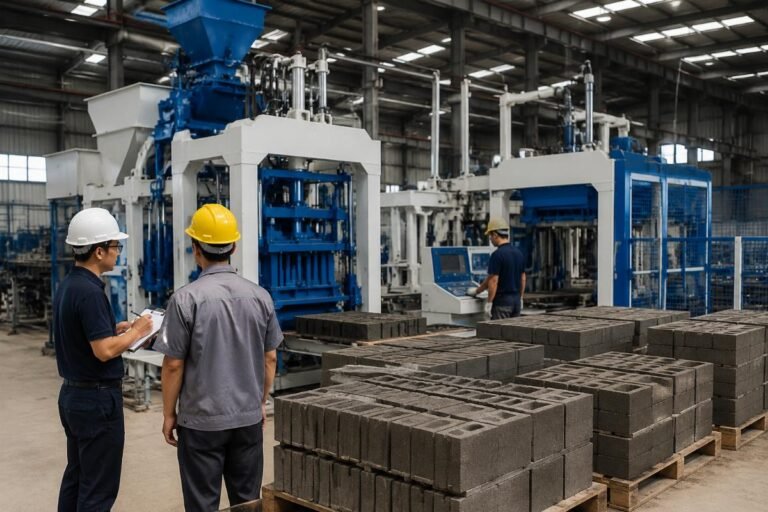
Buy Hollow Block Machine Turnkey Solution Manufacturer
Most buyers fixate on the host machine’s rated output, but the real bottleneck hiding in every hollow block plant is the mismatch between vibration frequency, feeding logic, and local grid stability.
A hollow block machine turnkey solution is not just a stack of hardware shipped in containers—it is a calibrated system where electrical adaptability, mold flexibility, and site layout determine whether the line survives its first year or becomes a costly monument to poor planning.
I still remember the phone call from a client in West Africa. He had bought a semi-automatic line from a different source, and within weeks, the frequency converters were popping one after another. The local grid swung wildly, and the machine’s standard electrical package had no tolerance for it. We ended up redesigning the entire control cabinet with wide-range frequency drives and voltage stabilizers before the line could run continuously. That kind of field reality is what shapes every hollow block machine turnkey solution we put together today. [NEED_CITE: voltage fluctuation impact on industrial motor lifespan per IEC standards]
If you are evaluating options, the questions below will separate a workable investment from a stranded asset.
What Capacity Range Fits Your Market?
Selecting the right capacity tier means working backward from daily local demand, not chasing the largest tonnage on the spec sheet.
Many first-time investors assume that bigger always means better. The truth is more nuanced. A machine rated for higher output can underperform if the feeding system cannot keep pace, if the vibration table is mismatched to the mold cavity count, or if the curing yard cannot absorb the daily volume. [NEED_CITE: production bottleneck analysis methodology in concrete block manufacturing]
Here is how the typical capacity tiers stack up against real-world deployment scenarios:
| Capacity Tier | Typical Mold Cavities | Daily Output Range | Best-Fit Buyer Profile | Grid & Site Requirement |
|---|---|---|---|---|
| Entry-level mobile type | Single cavity, egg-laying design | Low to moderate | Private entrepreneurs, rural markets | Minimal infrastructure, basic power |
| Semi-automatic mid-range | Multiple cavities, static host | Moderate | Small private plants, starter dealers | Standard three-phase, manual pallet handling |
| Fully automatic high-output | Multi-cavity, PLC-controlled | High | Government housing tenders, large distributors | Stable grid, automated batching, large curing yard |
A private investor in Southeast Asia once ordered a top-tier automatic line because the unit price per block looked attractive on paper. But his market only needed a fraction of that output, and his curing space was limited. The line sat idle half the time, and the ROI stretched far beyond projections. A mid-range semi-automatic hollow block machine turnkey solution would have matched his actual demand and freed capital for a second shift or a paver mold expansion. [NEED_CITE: ROI sensitivity analysis for small-scale block plant investment]
Conversely, a government contractor in the Middle East needed certified documentation, high throughput for a public housing tender, and a delivery timeline that left no room for custom fabrication delays. The fully automatic tier with CE and SGS certification packages was the only viable path.
The lesson: map your daily block requirement, your curing space, and your labor availability first. Then match the tier. The hollow block machine turnkey solution should be sized to your market, not to the manufacturer’s catalog pride.
How to Match Electrical Systems to Local Grids?
A hollow block machine turnkey solution that ignores local power conditions will fail—often within the first month of operation.
This is the single most overlooked dimension in international block plant procurement. Specifications list motor kilowatts and total connected load, but they rarely address what happens when the supply voltage drops below nominal, spikes above it, or phases out unexpectedly. [NEED_CITE: industrial equipment failure modes related to power quality in developing economies]
In regions with unstable grids—parts of West Africa, South Asia, and certain Latin American industrial zones—standard electrical packages are a liability. Frequency converters designed for stable European or East Asian grids will overheat, trip, or burn out when confronted with sustained voltage swings. The cost of repeated converter replacement, combined with production downtime, can dwarf the initial savings of a cheaper electrical package.
The corrective approach involves three layers:
- Voltage stabilization: A dedicated stabilizer cabinet that clamps incoming voltage within the tolerance band the drives expect.
- Wide-range frequency converters: Drives engineered to accept a broader input voltage window without faulting.
- Phase loss and surge protection: Relays and surge arrestors that shield the PLC and sensor network from transient damage.
When we configured a hollow block machine turnkey solution for a client in a region where the grid routinely dropped below nominal voltage during peak hours, we specified a stabilizer rated for the full connected load and wide-input drives across all vibration motors. The result was a dramatic reduction in unplanned stoppages. The client later confirmed that electrical faults, which had previously consumed a large share of maintenance time, became rare events.
This is not a premium upsell. It is baseline engineering for any market where grid reliability is not guaranteed. A supplier who does not ask about your local voltage profile during the quotation stage is not building a turnkey solution—they are shipping a box.
What Does a True Turnkey Include?
A genuine hollow block machine turnkey solution covers everything from the first site sketch to the last trained operator—not just the machinery itself.
The term "turnkey" is used loosely in this industry. Some suppliers ship the host machine, a mixer, and a conveyor, then call it a complete line. A real turnkey package goes substantially further. [NEED_CITE: turnkey project scope definition in international construction equipment supply]
A credible scope includes:
- Site layout and flow planning: Positioning the batching plant, host machine, pallet circulation, and curing area to minimize handling distance and avoid bottlenecks. A poorly laid-out yard can cut effective output by a significant margin, regardless of machine speed.
- Foundation and utility guidance: Civil drawings for machine foundations, drainage, power entry points, and water supply. Skipping this step leads to costly rework on arrival.
- Electrical package customization: As discussed, matched to local voltage, frequency, and phase configuration.
- Mold package and recipe support: A set of molds matched to the buyer’s product mix—hollow blocks, solid blocks, pavers, curbstones—plus concrete mix ratios tested for local raw materials.
- Installation, commissioning, and training: On-site engineers who do not just bolt the machine down but run trial production, tune vibration parameters, and train local operators and maintenance staff.
- Spare parts initialization: A starter inventory of wear parts—mold liners, vibration springs, seals—sized to cover the lead time for reorder in the buyer’s region.
A distributor in East Africa once received a line from another source with no layout guidance. His team installed the host machine in the corner of the yard, with pallet return running against the natural flow of the loader. Production was choked within weeks. When we later assisted with a re-layout under a new hollow block machine turnkey solution contract, we repositioned the curing racks, reversed the pallet loop, and added a second staging lane. Output rose noticeably without any hardware change to the host machine.
The difference between a machine delivery and a turnkey solution is the difference between owning equipment and running a business.
How to Verify Supplier Capability Before Ordering?
Before committing to a hollow block machine turnkey solution, validate the supplier through certification, reference projects, and spare parts responsiveness—not through brochure claims alone.
The market is crowded with traders posing as manufacturers and manufacturers overstating their engineering depth. A disciplined verification process protects your capital.
Certification audit. Request current CE, SGS, or ISO certificates and verify them against the issuing body’s database. For government tenders, ensure the certificates cover the specific machine model being quoted, not a generic company-level scope. [NEED_CITE: certification verification procedures for construction machinery in international trade]
Reference project inspection. Ask for at least two installed lines in markets with conditions similar to yours—similar grid quality, similar raw material profile, similar climate. If the supplier cannot provide verifiable references, or if the references are all in ideal-condition markets, treat the claim with caution.
Spare parts commitment. A true turnkey supplier will provide a recommended spare parts list at the quotation stage, with lead times for each item. If the conversation stops at "we have a warehouse," press for specifics: which parts are stocked, what is the dispatch timeline, and how are customs-sensitive items handled?
Technical responsiveness during quotation. A capable engineering team will ask detailed questions: What is your local voltage and frequency? What raw materials are available—crushed stone, river sand, quarry dust? What is your target product mix? What is your daily block demand? If the supplier accepts your order without asking any of these, they are not engineering a solution.
We have seen buyers save themselves from costly mistakes simply by asking for a video call with an engineer currently commissioning a line in a comparable market. The depth of technical conversation in that call reveals more than any glossy catalog.
Conclusion
A hollow block machine turnkey solution succeeds or fails on the details that never appear in a headline specification: electrical resilience, mold-market alignment, site flow logic, and supplier accountability.
Match capacity to actual demand, not aspiration. Engineer the electrical package for the grid you have, not the grid you wish you had. Insist on a turnkey scope that covers layout, training, and spare parts—not just machinery. And verify your supplier through certificates, references, and technical depth before signing. These are the disciplines that turn a capital expenditure into a working, profitable plant.