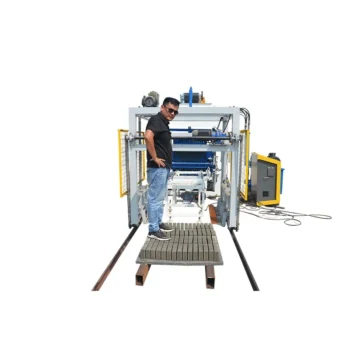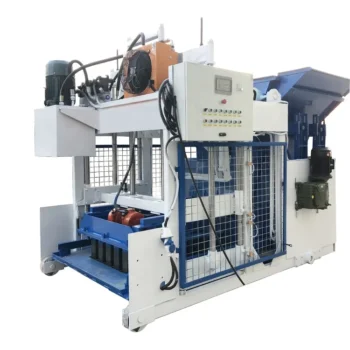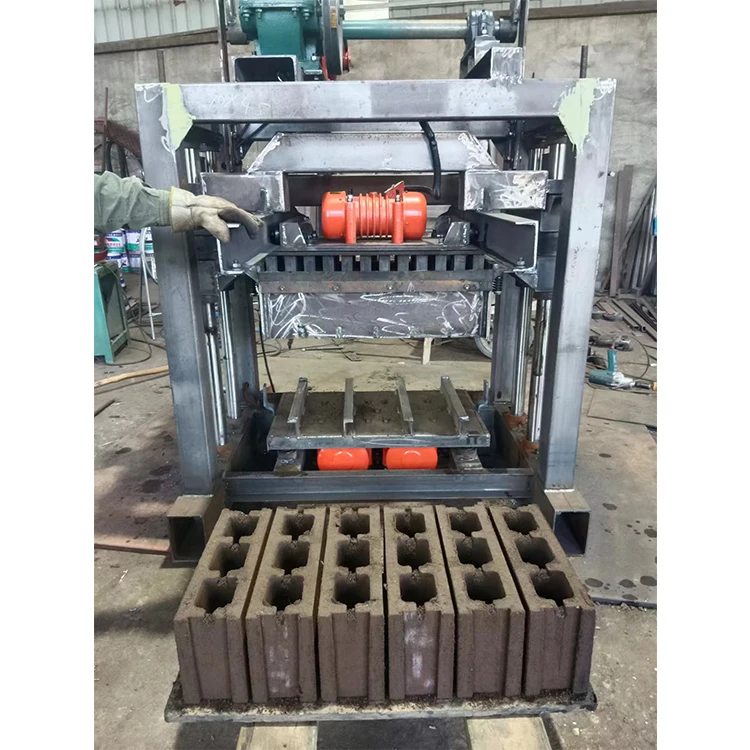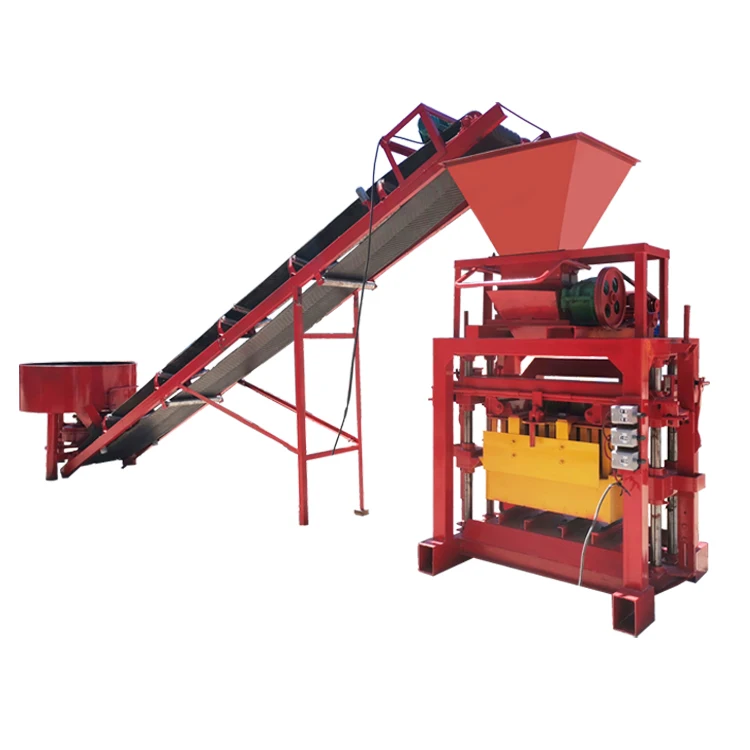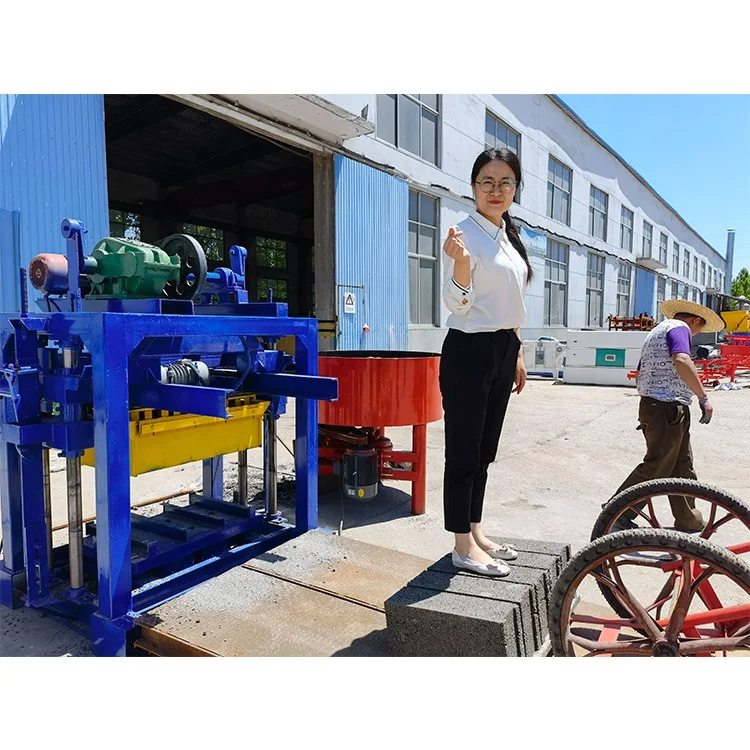
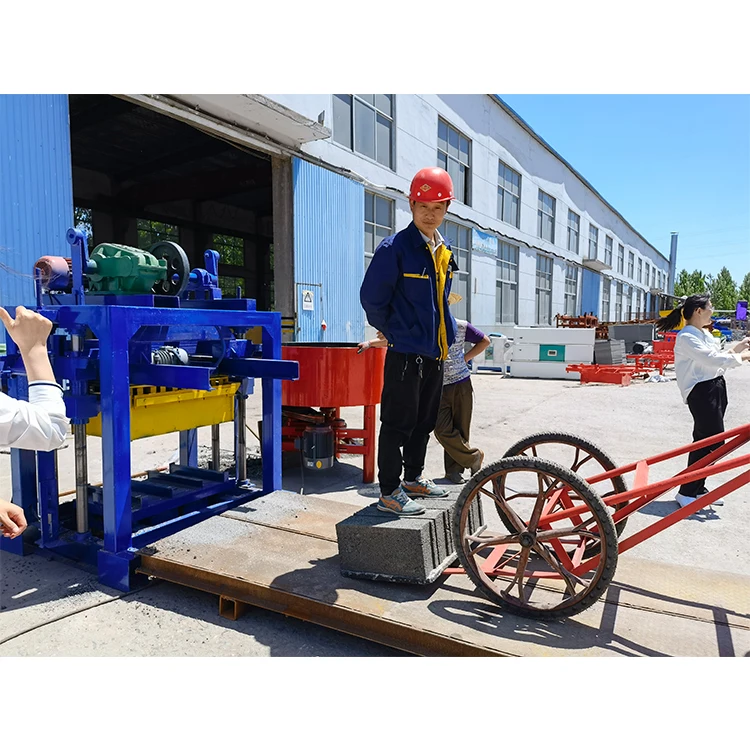


Description
Capacity by Mould Format — The QTJ4-40 block machine specifications capacity by format are quoted against the exact hollow block, solid brick or interlocking paver you intend to produce, so your daily output matches the market you sell into.
Technical Specifications
| Parameter | Value |
|---|---|
| Model | QTJ4-40 |
| Product Type | Semi-Automatic Concrete Block Making Machine |
| Machine Power | 10.4 kW |
| Molding Cycle | 40 s |
| Theoretical Productivity | 360 pcs/h on 400×200×200mm hollow block (4 pcs/mould) |
| Theoretical Productivity | 450 pcs/h on 400×150×200mm hollow block (5 pcs/mould) |
| Theoretical Productivity | 800 pcs/h on 225×112.5×60mm solid brick (9 pcs/mould) |
| Raw Material Compatibility | Concrete, sand, cement, fly ash, lime, gypsum |
| Machine Weight | 1 T |
| Overall Dimensions | 1350 × 1460 × 1800 mm |
| Pallet Size | 850 × 450 mm |
| Voltage | Configurable to buyer’s local supply (frequency and phase to be confirmed) |
| Control System | Semi-automatic (top die push-pull, automatic scraper, bed mould vertical vibration, upper mould compression vibration) |
| Mould Format Support | Hollow block, solid brick, interlocking formats |
Application Suitability
| Application | Material or Output |
|---|---|
| Small to medium hollow block plants | 400×200×200mm or 400×150×200mm blocks from crushed stone and cement |
| Solid brick production for local builders | 225×112.5×60mm bricks from fly ash, sand and lime blends |
| On-site block production for contractors | Hollow blocks and interlocking pavers using locally sourced aggregate |
| First plant for entrepreneurs | Semi-automatic production with lower initial investment and manual pallet handling |
Why "Cycles per Hour" Means Nothing Without a Block Size
The QTJ4-40 block machine specifications capacity by format ties every output number to a specific mould and block dimension.
Most quotations state cycles per hour and leave it at that, so buyers discover on commissioning day that their 6-inch hollow block takes a longer cycle or yields fewer pieces per mould than the catalogue implied. The QTJ4-40 runs a 40-second cycle across the listed formats, but the pieces per cycle change with each mould — four for a 200mm hollow block, five for a 150mm hollow block, and nine for a standard solid brick. Without stating the format, a single daily output figure is misleading. [NEED_CITE: block machine capacity calculation standards per format]
Matching the Mould to the Block Your Market Buys
The QTJ4-40 block machine specifications capacity by format start with the product you actually sell, not a generic brochure number. A buyer in a market that moves 400×200×200mm hollow blocks will see a realistic daily target tied to that specific mould, while a buyer producing 225×112.5×60mm solid bricks works from a completely different throughput calculation. Mould selection drives the entire output conversation.
Vibration and Compression for Uniform Density
The bed mould vibrates vertically while the upper mould applies compression vibration simultaneously, working the mix from both directions. This dual action settles the concrete into the mould cavity more evenly than single-source vibration alone, which matters when your local aggregate includes fine sand or fly ash that tends to segregate. The result is a block with consistent density across its cross-section, reducing the chance of weak corners or uneven faces that fail a drop test. [NEED_CITE: concrete block density uniformity testing methods]
Reading the Specs That Actually Matter on Site
A 10.4 kW total machine power keeps the QTJ4-40 within reach of a standard workshop supply, but you still need to confirm voltage, frequency and phase before production starts — a 220V/60Hz market requires a different motor winding than a 380V/50Hz one. The 850 × 450 mm pallet size must match your existing curing racks and forklift tine spacing, otherwise you are rebuilding the curing area from scratch. At 1 T machine weight and 1350 × 1460 × 1800 mm overall dimensions, the QTJ4-40 fits inside a standard 20-foot container for shipment and does not require a reinforced slab beyond a level concrete floor. The semi-automatic control handles top die push-pull and automatic scraper functions, but pallet feeding and block removal remain manual, which defines the labour you need on the line.
What Happens When the Mix and the Machine Disagree
A QTJ4-40 configured for a clean-graded aggregate will struggle if your local sand carries a high clay content, producing blocks that crumble before reaching curing strength. Vibration force and hydraulic pressure set at the factory assume a specific mix design; when the actual material differs, block strength drops and breakage during pallet handling rises. Buyers who skip the trial batch before shipment often discover this mismatch during the first week of production, when half the output fails a simple drop test and the daily sellable count falls well below the plan. [NEED_CITE: aggregate clay content effect on concrete block compressive strength]
Why Source the QTJ4-40 Through This Line
The QTJ4-40 is specified as a matched system — machine, mould, pallet and handling — rather than assembled from unrelated suppliers, so cycle times align across every station. Mould design covers the formats your market actually moves, and custom drawings are available when your buyer requests a non-standard size. The automation level is selectable, letting you start semi-automatic and add automatic pallet feeding or stacking later as volume grows. Every capacity figure in the proposal names the block format it assumes, so there is no gap between quoted output and real daily production. Installation support includes operator training on mould change and mix adjustment for your local material. [NEED_CITE: block machinery supplier matching machine to local aggregate]
Documentation & Verification
- Line layout with capacity calculation naming the exact block format per output figure
- Mould drawing and format list confirming included and optional moulds
- Pallet specification cross-checked against your curing rack and forklift dimensions
- Voltage, frequency and control language confirmation before production starts
- Factory test record on your target block format before dispatch
- Operation and maintenance manual with wear parts and mould replacement list
Installation, Commissioning & Support
- Level concrete floor sufficient for 1 T machine weight without a reinforced pit
- Dedicated circuit matching confirmed kW and local voltage before connection
- Machine shipped assembled with mould removed for container loading
- First-run parameter adjustment on your actual mix design during commissioning
- Operator training on 40-second cycle, top die push-pull and scraper function
- Wear parts list covering vibration springs, scraper blades and mould liners
What to Include in Your Enquiry
Tell us the block format your market buys most, the daily output you need to hit, and the local aggregate you plan to use — including any fly ash or sand with known clay content. Confirm your site voltage, frequency and the language you want on the control panel so the QTJ4-40 arrives ready to run.
Frequently Asked Questions
Q: How do I verify realistic daily output for my specific block format?
A: Output depends on the mould you run. We calculate daily capacity per format — for example, 400×200×200mm hollow blocks yield a different hourly figure than 225×112.5×60mm solid bricks. We state the assumed format alongside every output number so you can match it to your delivery schedule.
Q: Which moulds are included in the base price?
A: The base quotation covers the mould for the primary block format you specify. Additional moulds for other sizes or interlocking pavers are listed separately. Mould change on the QTJ4-40 involves unbolting the bed mould and swapping the upper die, which a trained operator completes within a shift.
Q: Will the 850×450 mm pallet fit my existing curing racks?
A: Measure your rack spacing and forklift tine width before ordering. The 850×450 mm pallet is standard for this machine, but curing area layout must accommodate it. We provide the pallet specification in the proposal so you can cross-check against your current setup.
Q: How is block strength matched to my local mix design?
A: We request a sample of your local aggregate and cement to run a trial batch before shipment. Vibration force and cycle settings are adjusted to that specific mix, ensuring the block reaches the compressive strength your market requires without changing the material source.
Q: What voltage and control language options are confirmed before shipment?
A: Voltage, frequency and phase are confirmed in writing during the quotation stage. The control panel language is set to your preference — English, French, Spanish or others — so operators can read cycle status and fault codes from day one without translation delays.