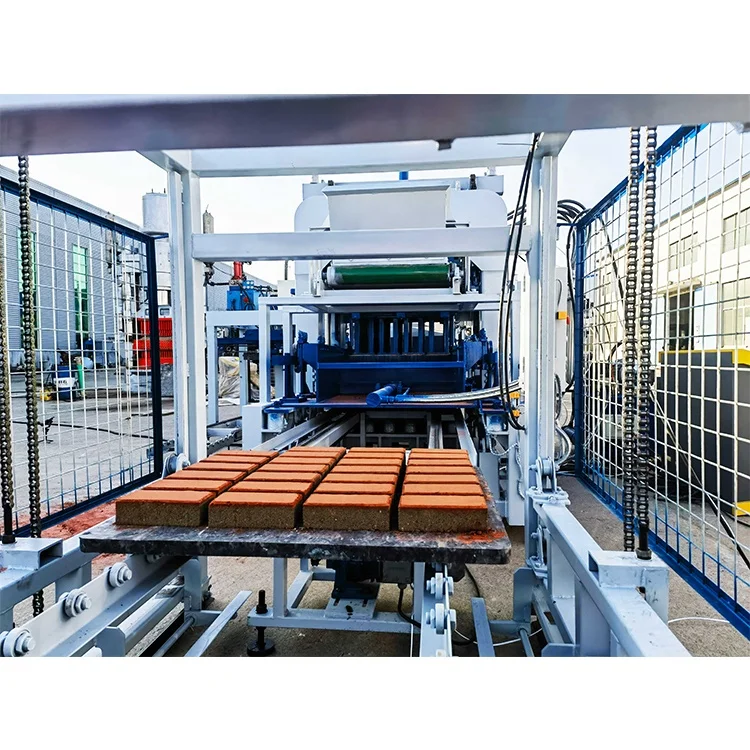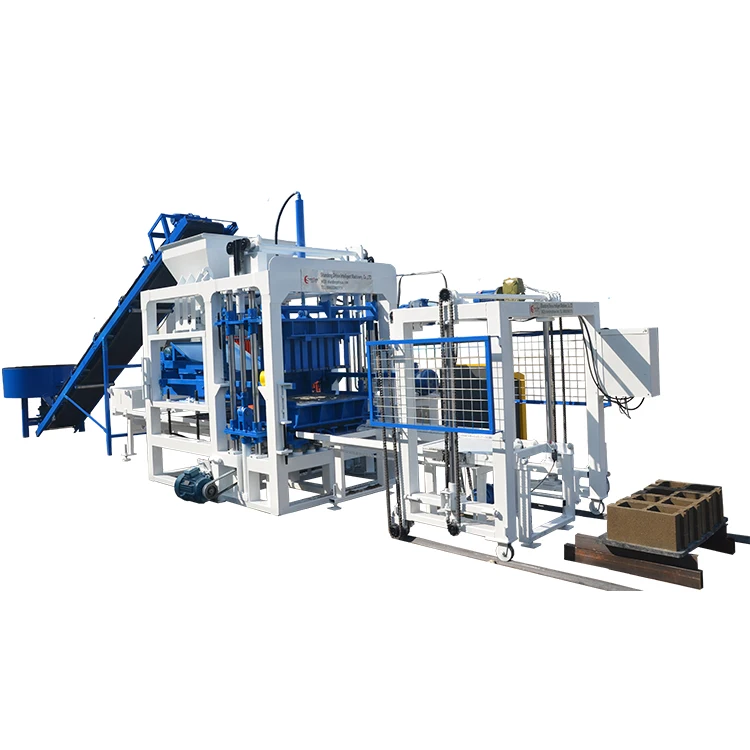
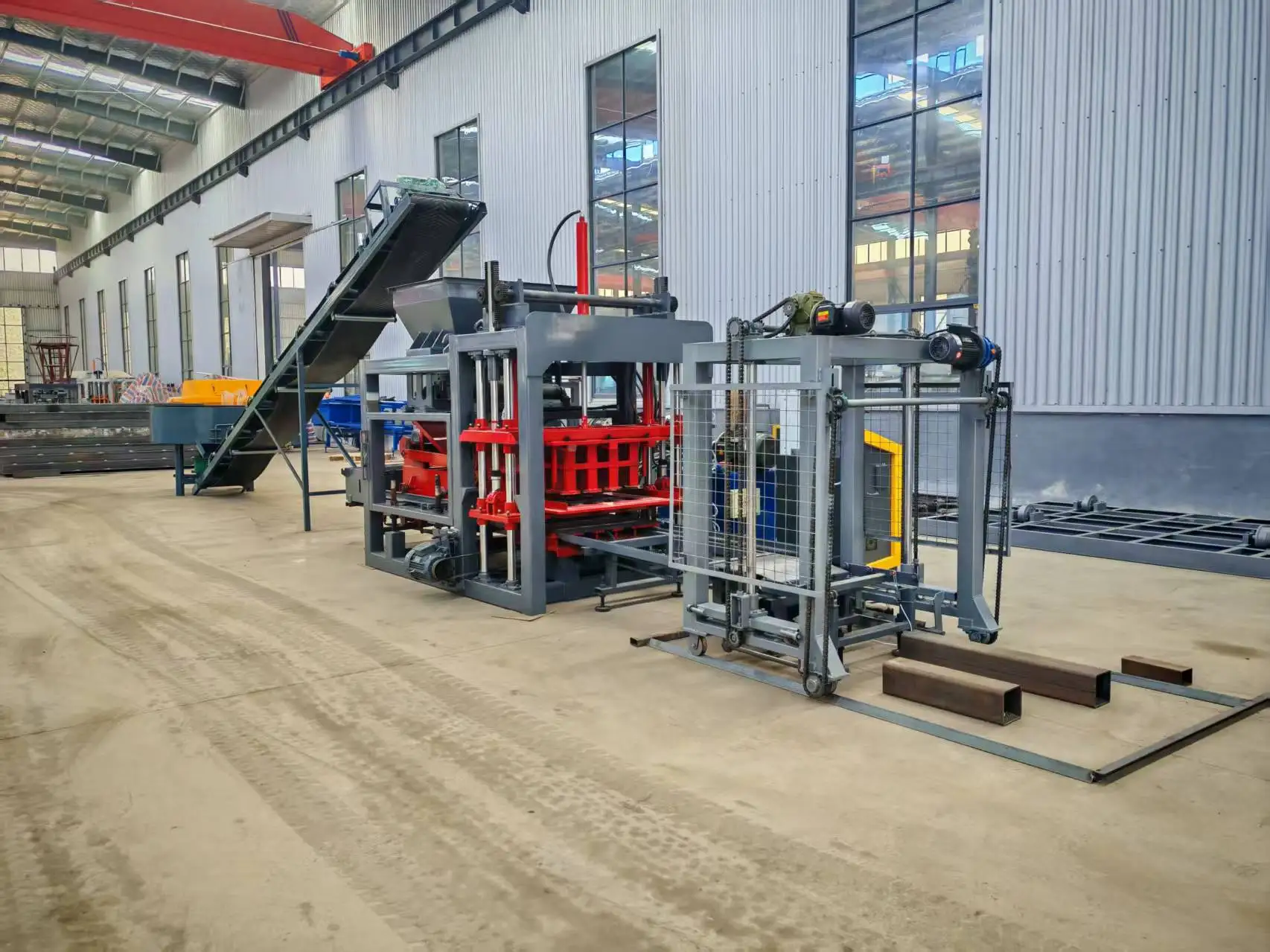
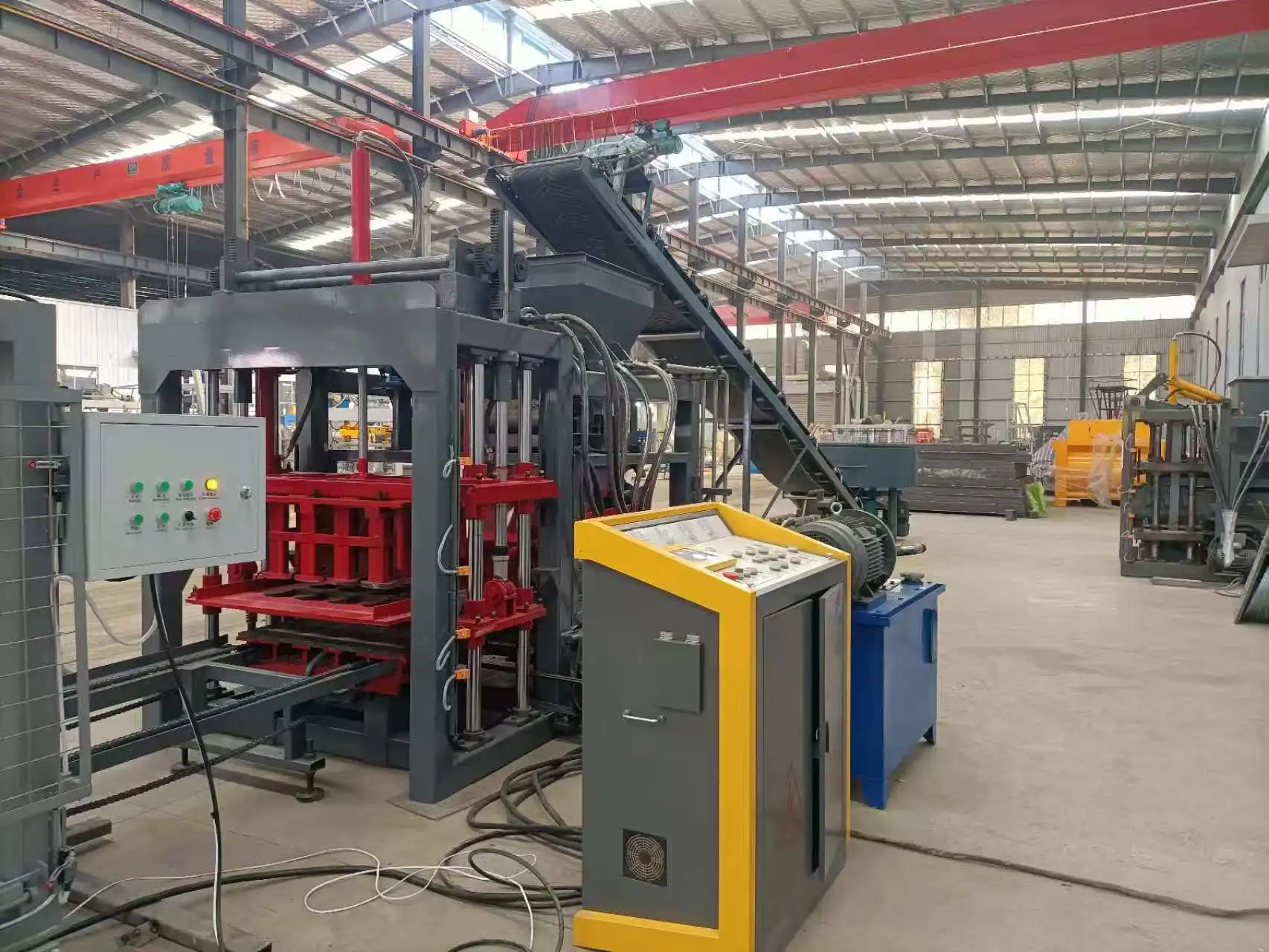
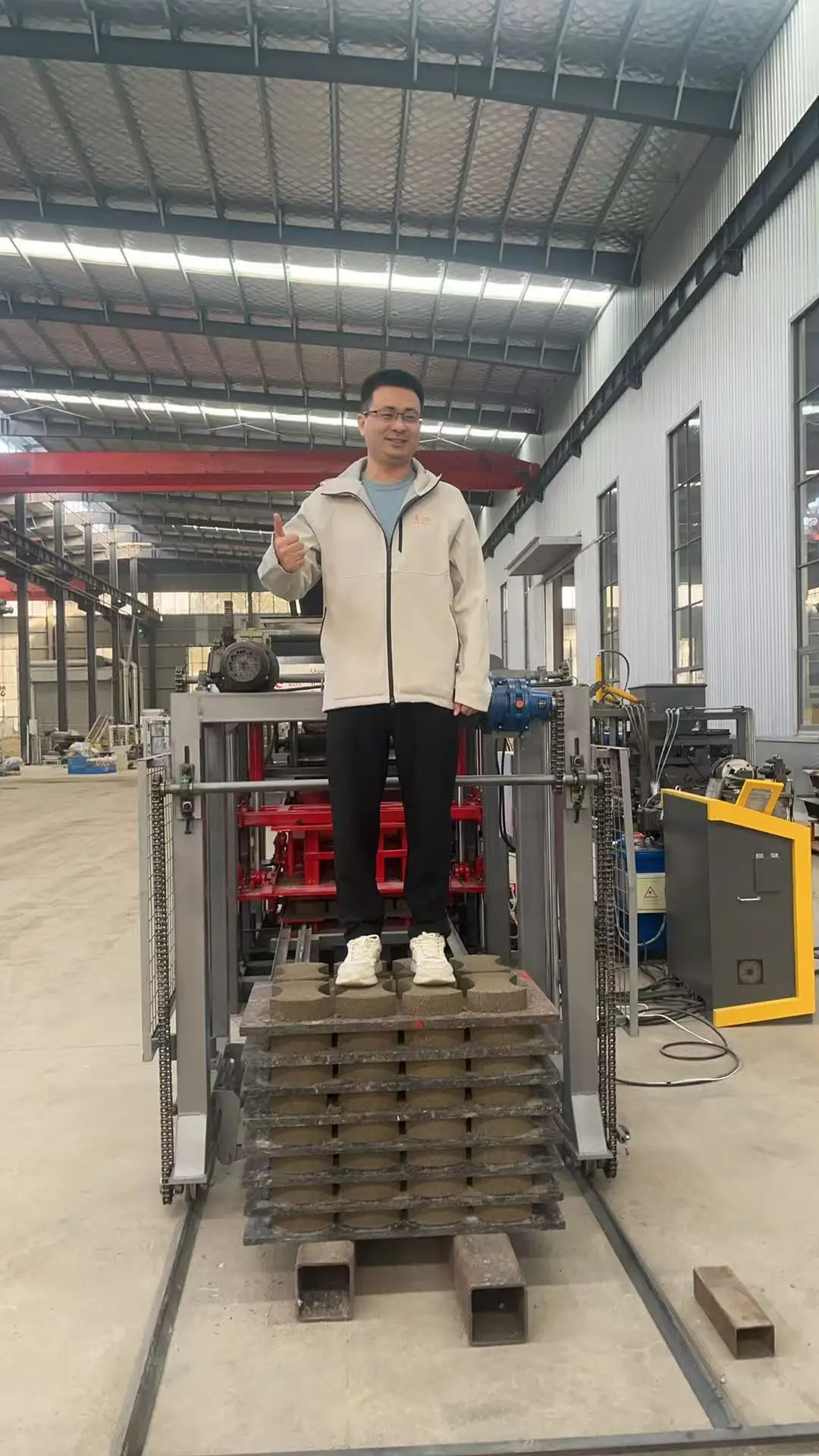

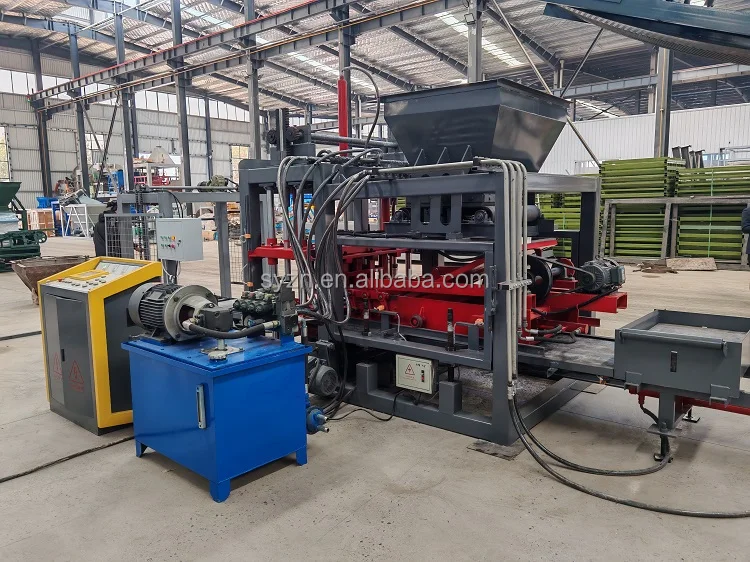
Description
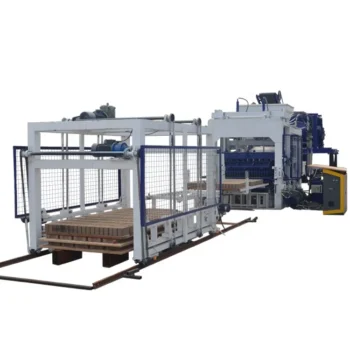
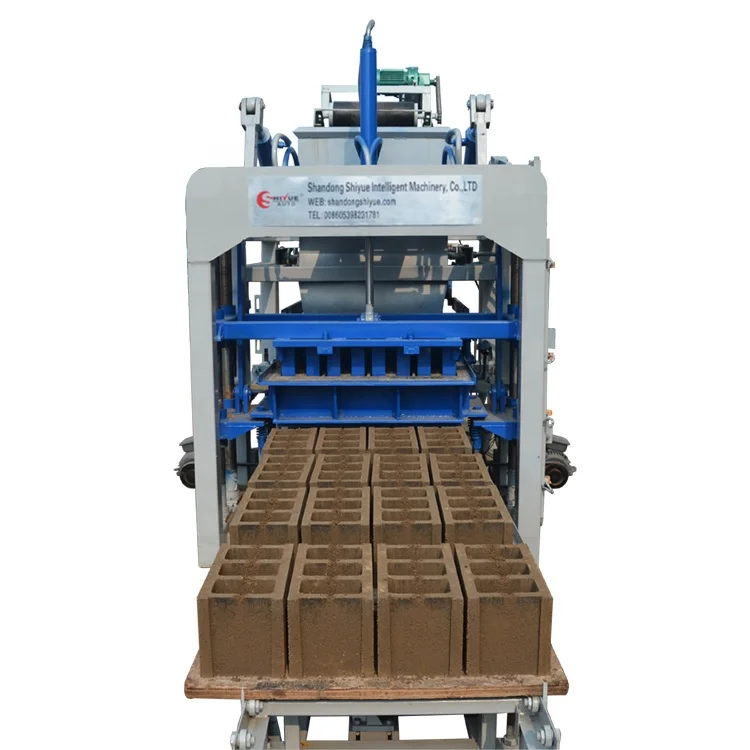
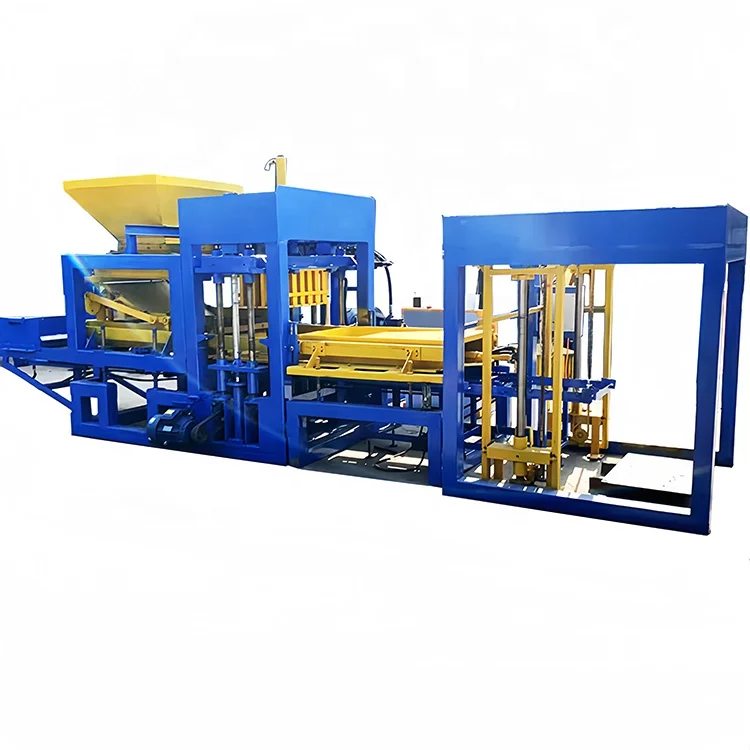
Format-Matched Configuration — The QT4-15 block machine is specified around the exact block format, pallet size, and local aggregate the buyer will actually run, not a generic catalogue default.
Technical Specifications
| Parameter | Value |
|---|---|
| Model | QT4-15 |
| Product Type | Fully Automatic Concrete Block Making Machine |
| Overall Dimensions (L×W×H) | 4100×1600×2600 mm |
| Rated Pressure | 16-21 MPa |
| Main Vibration Form | Platform Vibration |
| Vibration Frequency | 4200 r/min |
| Vibration Force | 55 kN |
| Pallet Size | 880×550 mm |
| Molding Cycle | 25-30 s (basis not stated in source — confirm block format / material / thickness) |
| Overall Power | 18.45 kW |
| Total Mass | 4 T |
| Demolding Method | Hydraulic |
| Factory Area Required | 300 m² |
| Applied Products | Concrete blocks, hollow/solid blocks, pavers, interlocking blocks, curbstone, colored pavers |
| Raw Material Compatibility | Crushed stone, sand, cement, dust, fly ash, gravel, slag |
| Automation Level | Fully automatic |
| Mould Format | Custom moulds available to buyer’s drawings |
| Warranty | 1 year (excluding spare parts) |
| Loading | 1×40HQ container (basic equipment) |
Application Suitability
| Application | Material or Output |
|---|---|
| Hollow block production for residential walls | Crushed stone, sand, cement blend |
| Solid block manufacturing for load-bearing structures | Gravel, cement, fly ash mix |
| Interlocking paver production for driveways and walkways | Fine aggregate with cement and pigment |
| Kerbstone forming for road and pavement edging | Coarse aggregate with high cement content |
| Colored paver production for landscape projects | Sand, cement, oxide pigment additives |
| Porous block manufacturing for drainage systems | Open-graded aggregate with reduced fines |
What "25-30 Seconds per Cycle" Actually Means for the QT4-15 Block Machine Specifications
A cycle time is only meaningful when the block format behind it is named.
I have watched buyers receive a QT4-15 fully automatic block machine and discover that the quoted cycle assumed a thin paver while their actual product was a 200 mm hollow block requiring longer vibration and slower demolding. The daily output gap between a catalogue figure and a format-specific calculation can be substantial [NEED_CITE: block cycle time variance by format and thickness]. Without that clarity, a plant owner commits to a production target the machine was never configured to meet. The QT4-15 block machine specifications on this page flag every figure that still needs format confirmation so no capacity claim arrives unexamined.
Matching Vibration Force to Your Local Aggregate
Platform vibration at 4200 r/min delivers 55 kN across the mould cavity, but that number only produces consistent block strength when matched to the density and particle shape of the aggregate available at the buyer’s site. Desert sand with high fines content absorbs vibration differently from washed river gravel, meaning the same QT4-15 block machine specifications will produce different compaction results unless the vibration duration and pressure are adjusted to the actual mix. I once spent a week on a Middle East project recalibrating vibration parameters because the local sand was far finer than the material used during factory testing.
Pallet Size as a System Constraint, Not an Accessory Choice
The 880×550 mm pallet on this fully automatic concrete block making machine must align with three things the buyer already has: the curing rack spacing, the forklift tine width, and the floor area allocated for wet-block storage. A pallet chosen in isolation creates downstream friction — racks that do not accept the pallet dimensions, forklifts that cannot lift a loaded curing rack, or a curing yard that runs out of space before the shift ends [NEED_CITE: pallet handling logistics in block production plants]. Confirming pallet compatibility before the QT4-15 block machine specifications are locked prevents rework after delivery.
How Hydraulic Pressure and Vibration Work Together in Block Forming
The rated pressure of 16-21 MPa and the 55 kN vibration force do not operate independently. Hydraulic pressure compresses the mix from above while platform vibration rearranges particles from below, and the balance between them determines whether a block emerges with uniform density or with weak edges and internal voids. A higher cement content may need less vibration but more pressure, whereas a lean mix with fly ash often requires extended vibration to achieve the same strength. The QT4-15 block machine specifications list both values so the buyer’s mix design can be validated against the machine’s forming envelope before production begins.
The Cost of Skipping Voltage and Language Confirmation
A machine configured for 380V/50Hz arrives at a site running 440V/60Hz and the motor burns out before the first shift completes. I have seen PLC screens displaying in a language the operators cannot read, turning a fully automatic system into one that requires an engineer on call for every parameter change. These are not theoretical failures [NEED_CITE: voltage and frequency standards by export market]. They happen because voltage, frequency, and control language were never confirmed in writing before the QT4-15 block machine specifications were finalized for production.
Why Buyers Source This Machine Through a Format-First Process
Block machinery as a single focus means the press, mould, pallet, and handling equipment are specified together rather than assembled from unrelated suppliers. Configuration starts from the buyer’s actual block format and local aggregate sample, not a showroom default. Mould design covers every format the buyer’s market demands, including custom drawings when standard options do not match local dimensions. Automation level is selectable so a plant can begin with semi-automatic operation and add stacking or cubing later. Installation includes operator training so the crew understands mould changeover and parameter adjustment from the first day.
Documentation & Verification
- Line layout with capacity calculation stating the exact block format assumed for each output figure
- Mould drawing and format list covering all block types the buyer intends to produce
- Pallet specification sheet matched to the buyer’s curing rack system and forklift dimensions
- Hydraulic and electrical schematic showing circuit layout for the confirmed pressure rating
- Voltage, frequency, and PLC display language confirmation signed before production begins
- Factory test record run on the buyer’s target block format prior to dispatch
Installation, Commissioning & Support
- Foundation pad sized to the 4100×1600 mm footprint with anchor bolt plan provided before pour
- Dedicated electrical circuit matching confirmed voltage and the 18.45 kW total power draw
- Machine arrives dismantled in one 40HQ container with reassembly supervised on site
- First-run parameter tuning calibrated to the buyer’s actual mix design and aggregate sample
- Operator training covers mould change procedure, vibration adjustment, and daily maintenance checks
- Wear parts list identifies hydraulic seals and vibration components with reorder part numbers
What to Prepare Before Requesting a Quotation
Share the exact block format dimensions you intend to produce, including wall thickness for hollow blocks and surface texture for pavers. Provide a sample or description of the aggregate available locally so the mix design can be tested against the machine’s vibration and pressure envelope. Confirm your site voltage, frequency, and preferred PLC display language. If you already have curing racks or forklifts on site, send their dimensions so the pallet specification can be matched before the QT4-15 block machine specifications are finalized.
Frequently Asked Questions
Q: What block format does the 25-30 s cycle time assume, and how does output change with hollow blocks versus pavers?
A: That cycle figure has not been tied to a specific format in the source data. Hollow blocks typically require longer vibration due to deeper cavities and thicker walls, while thin pavers cycle faster. A format-specific capacity calculation will be provided with the quotation, stating the exact block dimensions and mix assumed for each output figure.
Q: How is the QT4-15 configured when local aggregate or cement differs from the standard mix design?
A: The buyer sends an aggregate sample or detailed material description before configuration is finalized. Vibration duration, hydraulic pressure, and mould fill depth are then adjusted to match that specific mix. This step prevents inconsistent block strength caused by running factory-default parameters on unfamiliar material.
Q: What is the mould change procedure and realistic changeover time between formats?
A: Mould change involves releasing the clamp system, lifting the current mould, placing the replacement, and recalibrating the fill and press stroke. The exact time depends on the format difference and operator experience. Changeover duration will be confirmed during commissioning and operator training on your specific mould set.
Q: Which pallet size and material are recommended for my existing curing area and handling equipment?
A: The standard 880×550 mm pallet must be verified against your curing rack spacing and forklift capacity. Pallet material — steel, bamboo, or composite — is selected based on the block weight, curing method, and expected service life. This confirmation happens before the order is finalized, not after delivery.
Q: What documentation is provided to verify capacity, mould compatibility, and electrical configuration before shipment?
A: Buyers receive a line layout with per-format capacity calculations, mould drawings for every format ordered, a pallet specification matched to site equipment, and a written confirmation of voltage, frequency, and PLC language. A factory test record run on the buyer’s target format is included with the shipping documentation.