


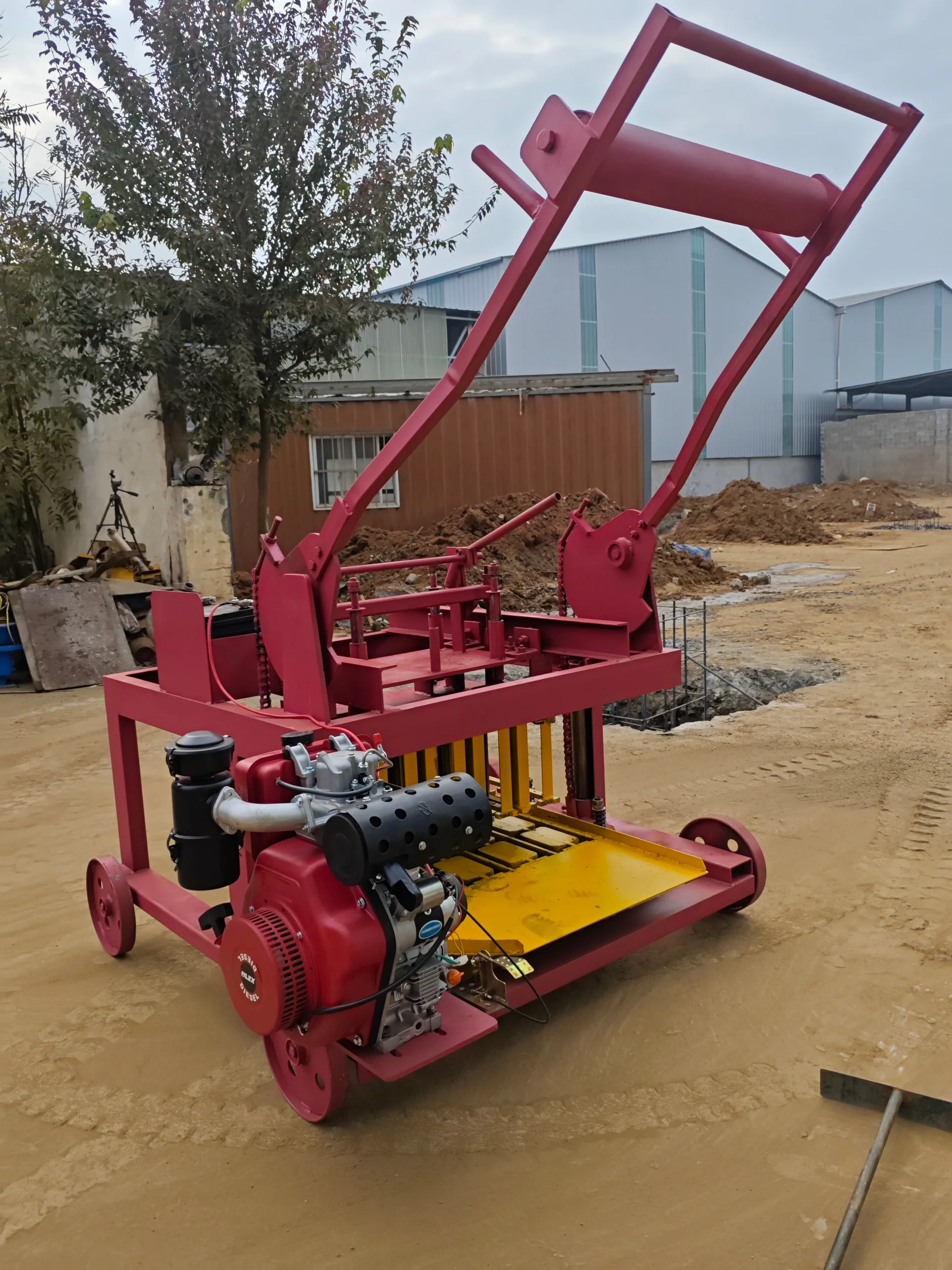
Description
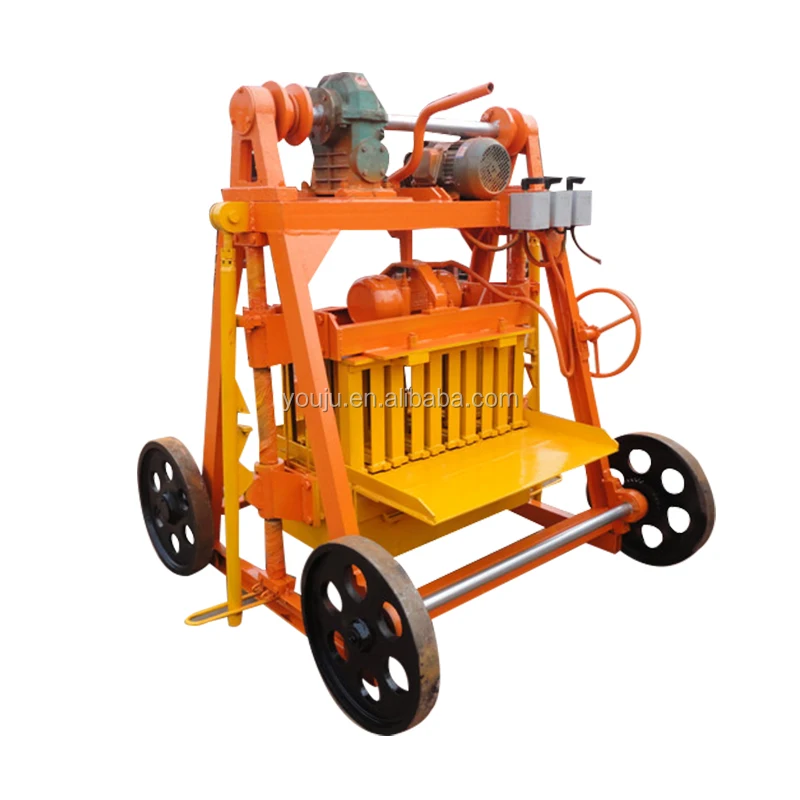
Mould Matched to Market — Every QMR4-45 configuration is sized against the hollow block format your site actually sells, with cycle time and daily output stated per mould rather than collapsed into a single headline figure.
Technical Specifications
| Parameter | Value |
|---|---|
| Model | QMR4-45 |
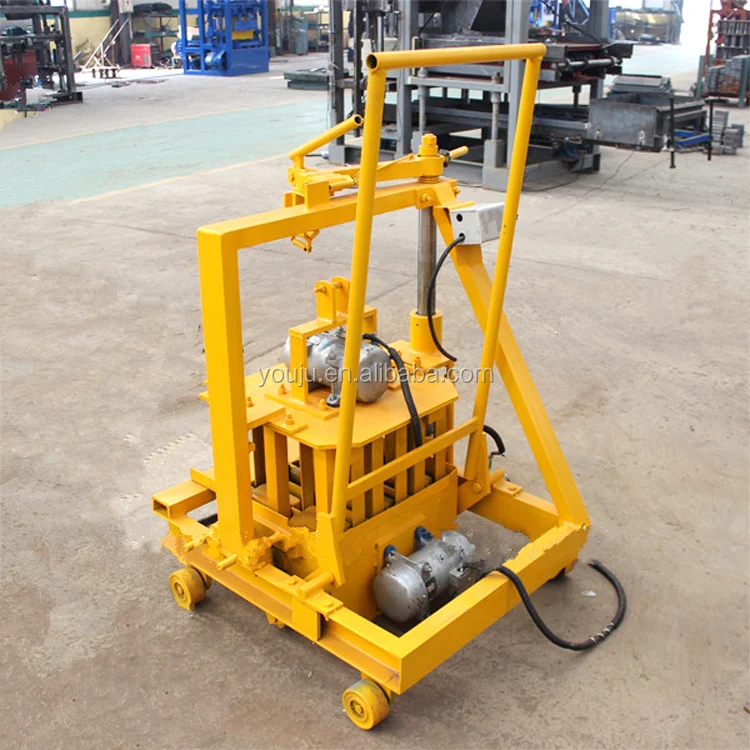
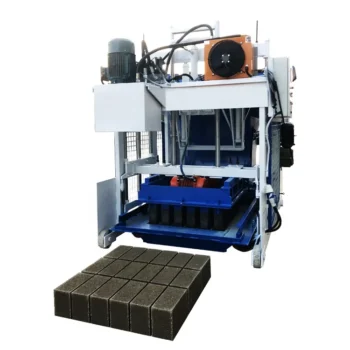
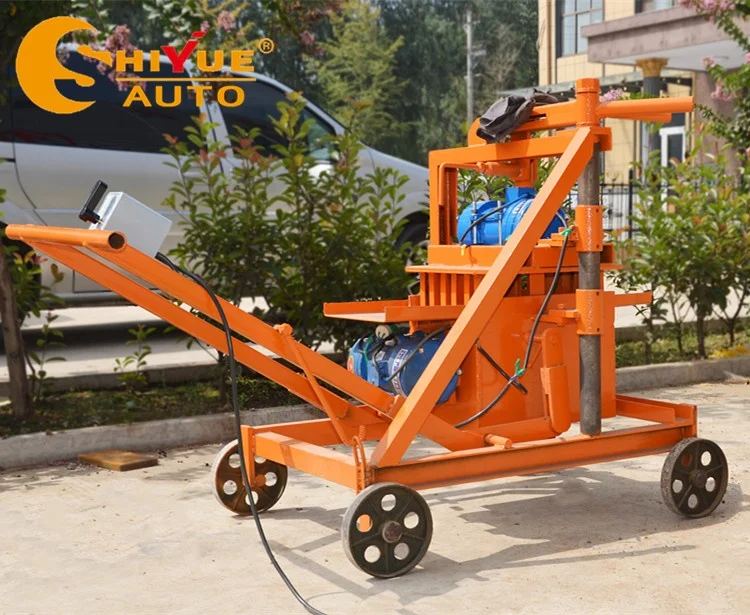
| Product Type | Mobile Concrete Block Making Machine |
| Overall Dimensions (L×W×H) | 2420×1320×1650mm |
| Net Weight | 810kg |
| Moulding Cycle | 40-45s |
| Pallet Size | No pallet required (egg-laying on ground) |
| Rated Power | 6kW |
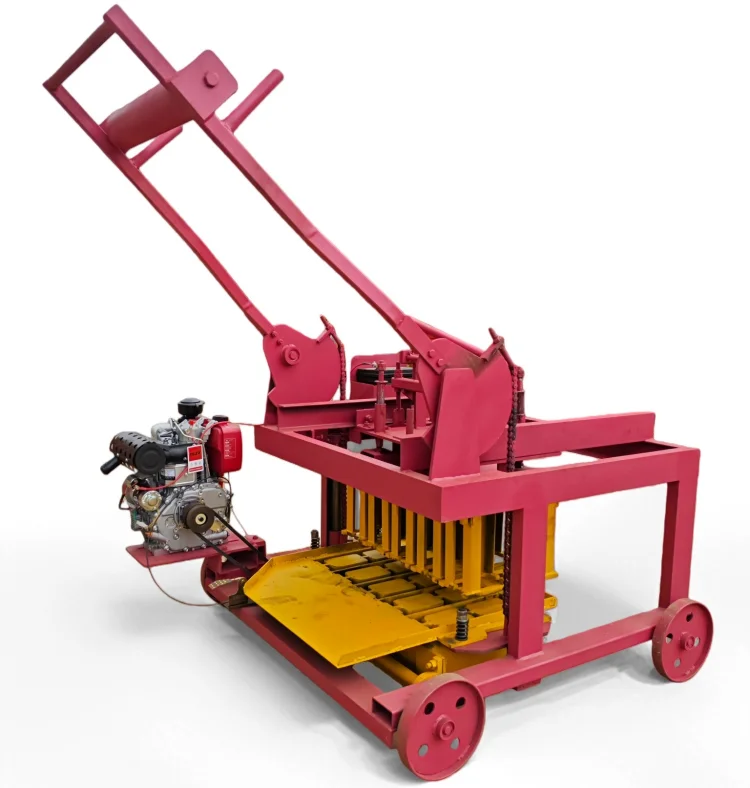
| Power Source | Diesel engine 6-8HP or electric motor |
| Voltage | 220V / 380V or configured to local supply |
| Output Capacity | 3,000 pcs/day rated on 400×200×200mm hollow block (basis to be confirmed for other formats) |
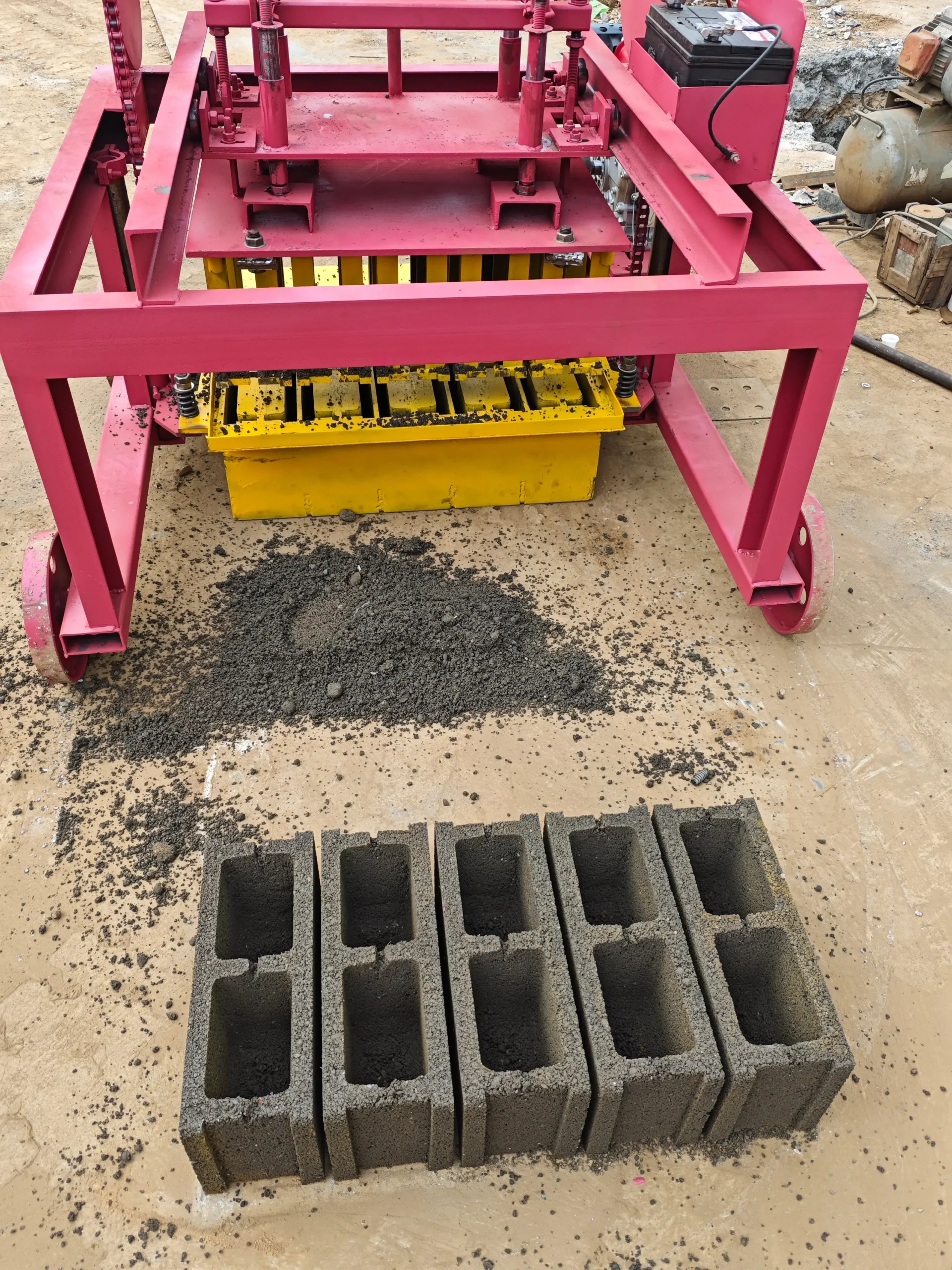
| Mould Formats | 400×200×200mm (4 pcs/mould), 400×150×200mm (5 pcs/mould), 400×120×200mm (6 pcs/mould) |
| Automation Level | Manual mobile egg-laying |
| Stacking Method | Direct ground laying, no pallet handling |
| Certification | CE referenced |
| Warranty | One year for the whole machine |
Application Suitability
| Application | Material or Output |
|---|---|
| On-site hollow block production for building contractors | Crushed stone, sand and cement mix laid directly on prepared ground |
| First block plant for rural entrepreneurs | Local aggregate with diesel power where grid supply is unstable |
| Remote housing project block supply | 400×200×200mm, 400×150×200mm and 400×120×200mm hollow blocks without fixed plant infrastructure |
| Small-scale masonry block production | Cement-bound aggregate on compacted earth or flat concrete surface |
What "3,000 Blocks per Day" Actually Assumes
The headline number only holds when the block format, mix design and cycle time all align to one specific mould.
Many mobile block machine quotations state a daily output without naming the block size behind that figure. When the buyer switches to a thicker wall or a denser mix required by local building code, the moulding cycle extends and the daily count drops. I have watched contractors on African building sites wait for bricks because the machine could not keep pace once local sand with high clay content lengthened the curing window. [NEED_CITE: effect of aggregate clay content on concrete block cycle time] The QMR4-45 mobile block machine specifications tie 3,000 pieces per day to the 400×200×200mm hollow block at a 40-45 second cycle; other formats produce different counts and must be calculated before the machine ships.
Matching Cycle Time to the Format You Sell
The 40-45 second moulding cycle applies across all three listed hollow block formats, but the pieces per mould differ. A 400×200×200mm mould produces four blocks per cycle, while the 400×120×200mm mould produces six. That difference means daily output shifts depending on which format dominates your orders. A buyer selling mostly partition-wall blocks will see higher piece counts than one focused on load-bearing walls, even on the same machine.
Ground Conditions Replace the Pallet System
The egg-laying design removes the entire pallet loop — no pallet purchase, no pallet storage, no forklift moving racks to a curing area. The trade-off is ground preparation. The machine lays wet blocks directly on the surface beneath it, so the ground must be level and firm enough to hold block geometry until initial set. Loose soil or uneven gravel will distort the bottom face of every block produced.
Reading the Numbers That Matter for Mobile Block Machine Specifications
The 6kW rated power drives both vibration and travel. On diesel configuration, the 6-8HP engine must sustain that output continuously through heat and dust; undersized engines lose RPM under load and vibration force drops, reducing block density. [NEED_CITE: relationship between vibration force and concrete block compressive strength] The 810kg net weight provides the static mass needed for vibration compaction — a lighter frame would bounce on uneven ground and produce inconsistent blocks. Voltage configuration at 220V or 380V must match the site transformer exactly; running a 380V motor on a 220V supply through an improvised step-up converter causes overheating within the first shift. The one-year warranty covers the whole machine, but wear parts like mould liners and vibration springs fall outside that scope and should be ordered with the initial shipment.
The Hidden Cost of Skipping Aggregate Testing
When the local sand carries high silt or clay, the mix demands more water to reach workability, which extends the time blocks need before they can bear their own weight. A machine tuned for clean washed sand will lay blocks that slump or crack if the aggregate changes without adjusting the moulding cycle. I saw a project in the Middle East lose an entire week of output because the operator kept the cycle at 45 seconds while the sand source switched to a wadi deposit with visible clay streaks. [NEED_CITE: impact of unwashed aggregate on concrete block dimensional stability] The blocks deformed under their own weight before the machine moved forward, and every piece had to be broken and re-mixed. Confirming the local material before configuring the vibration amplitude and cycle timing prevents that loss.
Why Source This Machine Through a Block-Line Specialist
Block machinery is the single focus here, so the QMR4-45 is specified as a matched unit — mould, power source and ground-laying mechanism chosen together rather than assembled from separate suppliers. Configuration starts from the buyer’s actual aggregate sample and target block format, not a catalogue default. Mould design covers the three hollow formats listed, and custom drawings are available if the local market sells a dimension outside that range. The diesel engine option is selected against the site’s real power availability, not assumed. Installation support includes operator training on mould change and mix adjustment at the buyer’s location.
Documentation & Verification
- Line layout showing ground preparation area required for egg-laying operation
- Capacity calculation sheet stating block format assumed for each output figure
- Mould drawing and format list matching your market dimensions
- Voltage and power source confirmation recorded before production begins
- Factory test record run on your specified mould format before dispatch
- Operation and maintenance manual with wear parts list included
Installation, Commissioning & Support
- Ground must be level and compacted across the full travel path of the 2420×1320mm machine footprint
- Electrical supply confirmed at 220V or 380V with dedicated circuit matching the 6kW rated power draw
- Diesel engine option eliminates grid dependency for remote sites with unstable power
- First-day commissioning includes mould alignment check and vibration amplitude verification on local mix
- Operator training covers 40-45 second cycle pacing and on-ground block spacing technique
- Mould wear liners and vibration springs listed for first reorder alongside the one-year warranty period
Before You Request a Quote
Provide the exact hollow block dimensions your market requires and the daily volume you need to sustain. Share a sample or description of the sand and aggregate available near the project site, including any visible clay or silt content. Confirm the voltage and frequency at the site panel, or state whether diesel power is the primary option. Note whether the ground at the production area is compacted earth, gravel or poured concrete.
Frequently Asked Questions
Q: How is daily output calculated per block format, and what does the 3,000 pcs/day figure actually assume?
A: The 3,000 pieces per day figure is rated specifically on the 400×200×200mm hollow block at a 40-45 second moulding cycle, producing four blocks per mould. Switching to a different format changes the pieces per mould count and may alter cycle timing depending on mix density. Request a per-format capacity table before confirming your order so the output matches your actual product mix.
Q: Diesel engine versus electric motor — which fits my site power conditions?
A: The diesel engine option at 6-8HP suits sites where grid electricity is absent, unreliable or insufficient for continuous 6kW draw. Electric motor configuration at 220V or 380V works where stable three-phase or single-phase supply is confirmed. If voltage fluctuates frequently, the diesel engine avoids motor burnout risk and keeps production running without a separate stabiliser investment.
Q: Which block formats can one QMR4-45 produce, and how long does a mould change take?
A: The machine supports 400×200×200mm (4 pcs/mould), 400×150×200mm (5 pcs/mould) and 400×120×200mm (6 pcs/mould) hollow block formats. Mould change is manual and performed on-site with basic tools. The exact changeover duration depends on operator familiarity and should be confirmed during commissioning training so format switches do not consume production time.
Q: What ground preparation does an egg-laying machine need if no concrete floor is required?
A: The surface must be level, firm and free of loose material across the area where blocks are laid. Compacted earth or crushed stone base works for most sites. Soft or uneven ground causes blocks to tilt or deform before initial set. The preparation area should extend well beyond the machine footprint to allow continuous forward movement throughout the production shift.
![Mobile Egg-Laying Block Machine QMJ4-45 | Technical Guide 记录ID 81394 数字之和 = 8+1+3+9+4 = 25 25 mod 6 = 1 → 句式: [站点修饰词] [品类词] for [应用或物料] 目标站 shiyuebrickmachine.com → 技术选型类角色 → 池: Specifications / Technical Guide / Model Selection 25 mod 3 = 1 → Technical Guide Technical Guide Mobile Egg-Laying Block Machine QMJ4-45 for Hollow Block](https://shiyuebrickmachine.com/wp-content/uploads/2026/04/H90feaec218fb491da0439250475a08abT.webp)