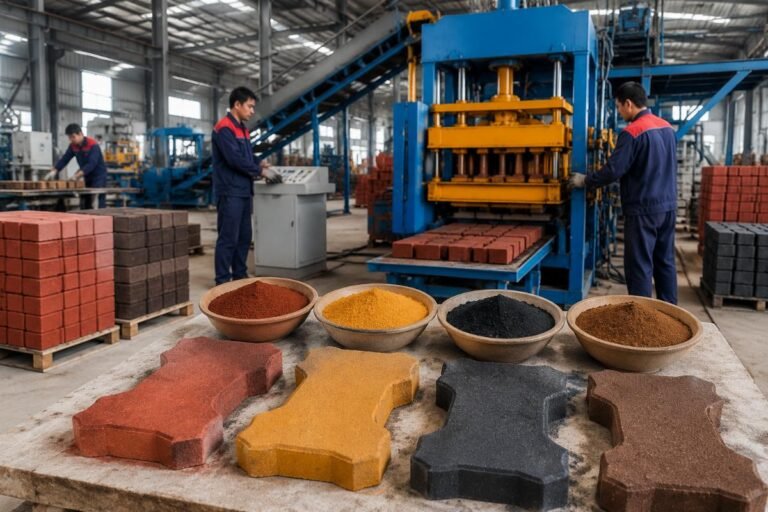
QT10-15/QT12-15 Brick Machine Price in Thailand: 2026 FOB Supplier Guide
The cheapest brick machine price in Thailand is rarely the one that saves you money. The real brick machine price in Thailand for a fully automatic line typically falls between a mid-five-figure and low-six-figure FOB range, depending on model tier, voltage customization, and shipping terms. Semi-automatic units cost substantially less upfront but demand higher labor input over their service life. Buyers who fixate on the factory gate invoice often discover that voltage adapters, ocean freight, mold modifications, and after-sales support reshape the final investment by a significant margin.
I remember a buyer from the Chonburi industrial zone who flew to our facility with three competing quotations folded in his jacket. The lowest quote looked attractive until we walked through the electrical cabinet together. The competitor had quoted a standard PLC without harmonic filtering—fine for European grids, risky for Thai industrial zones where voltage fluctuation is routine. He ended up adding isolation transformers and surge protection, which shifted his budget upward but prevented the kind of mid-production shutdowns that cost far more than the extra components. That is the reality behind any brick machine price in Thailand: the invoice number tells you almost nothing until you know what it includes.
Let me walk you through what actually determines the brick machine price in Thailand, which model matches different production goals, and where hidden costs quietly inflate the budget.
What Factors Actually Determine Brick Machine Price in Thailand?
Four cost layers shape the final number: equipment configuration, voltage adaptation, logistics, and post-sale infrastructure. Stripping any quotation down to these categories reveals why two buyers ordering the same model can end up with vastly different total investments.
The equipment configuration itself is the most visible layer. A QT10-15 block machine with a basic mixer and manual pallet return will cost noticeably less than the same model paired with an automated batching plant, color feeder system, and stacker. Hydraulic pressure capacity, mold cavity count, and PLC brand tier all move the price in meaningful increments [NEED_CITE: hydraulic pressure-output correlation in concrete block manufacturing].
Voltage adaptation is where many Thailand-focused buyers get surprised. Industrial zones in the eastern seaboard experience harmonic distortion and voltage sags that can damage sensitive control boards within weeks of operation. Adding an isolation transformer and surge protector increases the electrical cabinet cost by a modest percentage but prevents PLC failures that halt production entirely. I have seen buyers skip this step to save a small amount upfront, then spend several times that sum on emergency technician visits and replacement boards within the first year.
Logistics from Qingdao Port to Laem Chabang adds another layer. Ocean freight rates fluctuate with seasonal demand, and container type matters—a full container load for a complete line costs proportionally less per unit than multiple LCL shipments for a semi-automatic setup [NEED_CITE: Southeast Asia container freight index trends]. Customs clearance fees, port handling charges, and inland transport to the factory site all accumulate before the machine reaches the production floor.
Post-sale infrastructure is the least discussed but arguably the most consequential factor. A supplier who offers lifetime spare parts availability, remote diagnostics, and on-site commissioning builds those services into the brick machine price in Thailand. A supplier who does not may offer a lower headline number but leaves the buyer stranded when a proprietary sensor fails and no replacement exists locally.
| Cost Layer | Basic Configuration | Full Turnkey Configuration |
|---|---|---|
| Equipment Hardware | Standard hydraulic unit, basic mixer | High-pressure hydraulic system, automated batching, color feeder |
| Voltage Adaptation | Standard cabinet, no harmonic filtering | Isolation transformer, surge protection, grid-compatible PLC |
| Logistics | FOB Qingdao only | CIF Laem Chabang with insurance |
| After-Sales | Email support, buyer arranges technician | On-site commissioning, operator training, lifetime parts supply |
A private investor in Rayong once told me he chose the lowest brick machine price in Thailand he could find. Eight months later, the hydraulic pump seal failed, and the replacement part had to be air-freighted from another continent. The downtime alone cost him several times what he initially saved on the pump. The lesson was clear: the quotation line item is not the cost. The cost is what the machine does—or fails to do—over its working life.
Which Brick Machine Model Fits Your Thailand Project?
Matching model capacity to actual demand prevents both underproduction and wasted capital. The most common mistake I see among first-time buyers in Thailand is ordering the highest-capacity machine they can afford, assuming more output equals faster returns. In practice, utilization rates below full capacity shift the return-on-investment calculation dramatically in favor of smaller models.
The QT4-25 mobile egg-laying machine serves entry-level investors who need modest daily output with minimal infrastructure. It operates without a fixed production line, making it suitable for remote sites or contractors who move between projects. The brick machine price in Thailand for this tier sits at the lowest end of the spectrum, and the payback period is short because the initial investment is small.
The QT6-15 semi-automatic stationary model targets buyers who want higher output than a mobile unit can deliver but are not ready to commit to a fully automated line. It requires a fixed production area and a small crew but produces a meaningful step up in daily block volume. For investors whose market demand has not yet stabilized, this model offers a balanced entry point.
The QT10-15 fully automatic line is the workhorse for established block plants serving infrastructure and housing projects. It delivers high daily output with minimal manual intervention, provided the raw material supply chain and market demand can sustain the production rate. The brick machine price in Thailand for this model reflects its automation level, but the per-unit production cost drops noticeably compared to semi-automatic alternatives.
The QT12-15 represents the top tier for large-scale operations targeting government tenders or export markets. Its higher mold capacity and faster cycle times justify the investment only when utilization rates remain consistently high. A buyer running the QT12-15 at partial capacity will find that the semi-automatic QT6-15 would have delivered a better return on the same capital [NEED_CITE: capacity utilization impact on block plant ROI in emerging markets].
| Model | Automation Level | Daily Output Range | Ideal Buyer Profile | Infrastructure Requirement |
|---|---|---|---|---|
| QT4-25 | Mobile, manual | Low | Entry-level investors, remote contractors | Minimal, mobile operation |
| QT6-15 | Semi-automatic | Moderate | Growing private plants, stabilizing demand | Fixed production area, small crew |
| QT10-15 | Fully automatic | High | Established plants, infrastructure projects | Full line, automated batching |
| QT12-15 | Fully automatic, high-capacity | Very high | Large-scale operations, government tenders | Complete turnkey plant, skilled operators |
I worked with a contractor in Khon Kaen who initially wanted the QT12-15. After reviewing his project pipeline, we recommended the QT10-15 instead. His projected utilization for the larger model would have stayed well below the threshold where its higher output translates into lower per-unit cost. He saved a substantial portion of the initial investment and still met every delivery deadline. The brick machine price in Thailand for the QT10-15 gave him a faster break-even point than the QT12-15 would have under his actual conditions.
Hidden Costs: Voltage, Shipping, and After-Sales Support
The invoice price is only the beginning. Three hidden cost categories routinely catch Thailand buyers off guard: electrical adaptation, ocean freight variables, and spare parts accessibility.
Thailand’s industrial power grid, particularly in the eastern economic corridor, experiences voltage fluctuations and harmonic interference that can damage unprotected control systems. Standard PLC units designed for stable European or North American grids may fail prematurely under these conditions. The solution involves adding an isolation transformer and surge protection to the electrical cabinet. This adaptation increases the upfront electrical component cost by a modest percentage but prevents failures that halt production and require expensive emergency repairs [NEED_CITE: industrial power quality standards and PLC protection requirements in Southeast Asia].
I recall a installation in Samut Prakan where the buyer opted to skip the isolation transformer to reduce the brick machine price in Thailand. Within weeks, the PLC board failed during a production run. The replacement had to be shipped internationally, and the production downtime lasted several days. The total cost of the emergency repair and lost output far exceeded what the isolation transformer would have added to the original quotation.
Ocean freight from China to Laem Chabang involves variables that shift the final landed cost. Container shipping rates fluctuate with fuel prices, seasonal demand, and port congestion. Insurance coverage for high-value machinery adds a small percentage but protects against transit damage. Customs clearance at the destination port involves fees that vary by equipment classification and declared value. Buyers who request CIF pricing rather than FOB transfer more logistics responsibility to the supplier, which can simplify the process but may cost slightly more than arranging freight independently [NEED_CITE: China-Thailand ocean freight cost components and Incoterms comparison].
Spare parts accessibility is perhaps the most underestimated hidden cost. A machine that uses proprietary sensors or control components available only from the original manufacturer creates dependency. When a critical part fails, the buyer faces international shipping delays and potentially inflated replacement costs. Suppliers who use widely available components or maintain regional spare parts stock reduce this risk substantially. The brick machine price in Thailand from a supplier with strong after-sales infrastructure may appear higher initially but provides long-term operational security.
A block plant owner in Chiang Mai shared his experience with me. He purchased equipment from a supplier who offered the lowest brick machine price in Thailand but had no local service presence. When a hydraulic valve failed, he waited weeks for the replacement part to arrive from overseas. The production halt cost him contracts and customer trust. He later switched to a supplier with regional spare parts availability, and while the initial equipment cost was higher, the operational reliability justified the difference.
How to Verify Supplier Claims and Avoid Low-Price Traps?
A low brick machine price in Thailand becomes a trap when it reflects compromised components, missing certifications, or absent after-sales support. Verification requires checking specific technical details rather than accepting marketing claims at face value.
The hydraulic system is the heart of any block machine. Request the hydraulic pump brand and model number, then verify that it matches industry standards for the pressure rating claimed. Some suppliers use lower-grade pumps that cannot sustain the required pressure over extended operation, leading to premature seal failures and reduced output consistency. The pump铭牌 should clearly indicate the manufacturer, model, and pressure rating [NEED_CITE: hydraulic pump quality indicators in concrete block manufacturing equipment].
The PLC brand and model determine control system reliability. Reputable suppliers use recognized industrial PLC brands with proven track records in harsh environments. Verify the PLC model and check whether the supplier has customized it for grid conditions in Thailand. A standard PLC without harmonic filtering may function initially but will face higher failure risk in areas with unstable power quality.
Certification documentation provides another verification layer. CE marking indicates compliance with European safety standards, while SGS certification confirms independent inspection of manufacturing quality. Request copies of these certificates and verify them directly with the issuing organizations. Suppliers who cannot provide valid certification documents may be cutting corners in manufacturing or component selection.
Site visits to existing installations offer the most direct verification. Ask the supplier for references in Thailand or neighboring countries, then contact those buyers directly. Inquire about equipment performance, spare parts availability, and after-sales response time. A supplier confident in their product will provide verifiable references without hesitation.
| Verification Point | What to Check | Red Flag Indicator |
|---|---|---|
| Hydraulic Pump | Brand, model, pressure rating on nameplate | Unrecognized brand, unclear specifications |
| PLC Control System | Brand, model, grid adaptation features | Standard PLC without harmonic protection |
| Certifications | CE, SGS, ISO certificates with verification | Unable to provide or verify certificates |
| Reference Sites | Contact information for existing Thailand buyers | No local references or unwillingness to provide |
I once accompanied a buyer from Bangkok to visit a competitor’s factory. The equipment looked impressive on the surface, but when we examined the hydraulic pump nameplate, the brand was unfamiliar and the pressure rating was lower than quoted. The PLC was a basic model without any grid protection features. The brick machine price in Thailand from that supplier was noticeably lower, but the component choices revealed why. The buyer returned to our facility and placed his order the following week.
ROI Calculation: When Will Your Thailand Brick Plant Break Even?
Return on investment depends on matching production capacity to market demand, controlling per-unit costs, and minimizing downtime. The brick machine price in Thailand is only one input in the ROI equation.
The break-even timeline varies substantially based on model selection, utilization rate, and local market conditions. A QT4-25 mobile machine with low initial investment can break even quickly if the operator secures consistent small-scale contracts. However, the per-unit production cost remains higher due to manual labor requirements and lower output volume.
Semi-automatic models like the QT6-15 offer a middle ground. The initial investment is moderate, and the per-unit cost drops compared to mobile machines due to higher output and reduced labor per block. For investors with stable demand in the moderate range, this model typically delivers break-even within a reasonable timeframe.
Fully automatic lines such as the QT10-15 and QT12-15 require higher initial investment but achieve the lowest per-unit production cost when operating at high utilization rates. The break-even timeline extends longer due to the higher upfront cost, but once production reaches sustained capacity, the return accelerates significantly. However, if utilization stays low, the higher fixed costs delay break-even considerably.
Market demand assessment is critical before selecting a model. Conduct thorough research on construction activity, infrastructure projects, and housing development in your target area. Talk to contractors and developers about their block supply needs. Overestimating demand leads to underutilized capacity and delayed returns. Underestimating demand means missed opportunities and the need for costly expansion later.
Operational costs beyond the initial equipment purchase include raw materials, labor, electricity, maintenance, and spare parts. Suppliers who provide comprehensive operator training reduce early-stage inefficiencies. Access to affordable spare parts and responsive technical support minimizes downtime. These factors directly impact the per-unit production cost and overall profitability.
A block plant investor in Nakhon Ratchasima shared his ROI experience with me. He chose the QT10-15 after careful market analysis indicated strong demand from infrastructure projects. The brick machine price in Thailand for this model was higher than semi-automatic alternatives, but his utilization rate stayed consistently high. Within a reasonable period, he reached break-even and began generating strong returns. His per-unit cost was substantially lower than competitors using older or smaller equipment, giving him a pricing advantage in the market.
Conclusion
The brick machine price in Thailand reflects far more than the factory gate invoice—it encompasses voltage adaptation, logistics, after-sales infrastructure, and component quality that determine long-term operational success. Buyers who evaluate total cost of ownership rather than initial price alone make smarter investment decisions. Matching model capacity to actual market demand, verifying supplier claims through technical inspection, and accounting for hidden costs in the budget creates the foundation for profitable block production in Thailand’s construction market.