QT10-15 Brick Machine Price in Nigeria: 2026 Wholesale Supplier Guide
Most buyers ask for the FOB price first. That is the single most expensive mistake you can make when importing block-making equipment to West Africa.
The real Brick Machine Price in Nigeria is never the machine tag alone—it is the sum of FOB cost, CIF freight, import duty, voltage adaptation, mould wear under local aggregate conditions, and the daily output you actually achieve against your labour and power bills. A cheap machine that burns out every three months costs far more than a properly configured line that runs uninterrupted for years.
I still remember standing in a half-finished block yard outside Ikorodu, watching a local electrician point at a fried control panel and tell the owner the machine was junk. The owner had bought the cheapest QT6-15 he could find on a B2B platform, shipped it to Apapa with no voltage protection, and within weeks the servo drives were tripping every time NEPA fluctuated. We later retrofitted that same yard with a wide-voltage module and a stabiliser rated for the local grid, and the downtime dropped from weekly to virtually zero. That yard is now running a full QT10-15 line and expanding into a second shift. Stories like this are why I always start the conversation about Brick Machine Price in Nigeria with the site conditions, not the catalogue.
Let me walk you through what actually moves the numbers, how the models stack up, and where the hidden costs hide—so you can budget a plant that makes money instead of one that makes excuses.
What Factors Actually Determine Brick Machine Price in Nigeria?
Machine price is the tip of the iceberg; grid stability, raw material quality, and logistics are the real cost drivers.
When a buyer in Lagos or Abuja requests a quotation, the first thing I ask is not "how many blocks per day" but "what is your transformer capacity, what is your sand source, and how far is your site from the port." The reason is simple: the Brick Machine Price in Nigeria you see on a proforma invoice is only the entry ticket. The total cost of ownership is shaped by variables that no catalogue will warn you about.
Take power supply first. Nigeria’s grid is notoriously unstable, with voltage swings that can fry sensitive PLC boards and servo drivers within hours. A machine designed only for stable 380V/50Hz grids will fail repeatedly in a typical Nigerian industrial zone. The fix is not to buy a bigger transformer—it is to specify a control cabinet built with wide-voltage tolerance and integrated stabilisation. This is not an optional upgrade; it is a survival requirement. [NEED_CITE: voltage fluctuation impact on industrial motor lifespan in Sub-Saharan Africa]
Then there is the raw material. Laterite, river sand with high silt content, and crusher dust with inconsistent grading are common across Nigerian block yards. These aggregates behave very differently from the clean washed sand assumed in European machine specs. High-silt sand acts like grinding paste inside the mould cavity, accelerating wear on liner plates, core pins, and vibration tables. A mould that would last a full production season in a clean-aggregate environment may need replacement in a fraction of that time under Nigerian conditions. The solution is specifying hardened耐磨 alloy inserts and adjustable vibration parameters—details that separate a machine that lasts from one that becomes a spare-parts subscription. [NEED_CITE: aggregate abrasiveness and mould wear rate in concrete block production]
Finally, logistics. Shipping a QT10-15 line to Apapa or Onne involves not just ocean freight but inland haulage, customs clearing, and often last-mile transport on roads that can damage poorly crated equipment. A machine priced attractively FOB Shanghai can become significantly more expensive once you factor in demurrage, improper crating claims, and the cost of flying in a technician because the local installer could not interpret the wiring diagram.
How Do Different Brick Machine Models Compare in Price and ROI?
Choosing a model is not about picking the biggest—it is about matching output to your actual daily sales volume and power availability.
The Brick Machine Price in Nigeria scales sharply with automation level, but ROI does not scale linearly. A buyer who only needs a few thousand blocks per day will bleed cash on a fully automatic QT10-15 line simply because the power draw, floor space, and operator skill requirements will never be justified by sales volume. Conversely, a contractor supplying a large housing estate will lose more money every day by running an underpowered semi-automatic machine.
Here is how the typical model range stacks up for the Nigerian market:
| Model | Automation Level | Typical Daily Output | Operator Count | Power Requirement | Site Footprint | Best Suited For |
|---|---|---|---|---|---|---|
| QT4-25 | Mobile / Egg-Lay | Low output, manual handling | Minimal | Low, generator-friendly | Compact | Entry-level, rural yards, starter investors |
| QT6-15 | Semi-Automatic | Moderate output | Small team | Moderate, standard transformer | Medium | Growing private yards, small contractors |
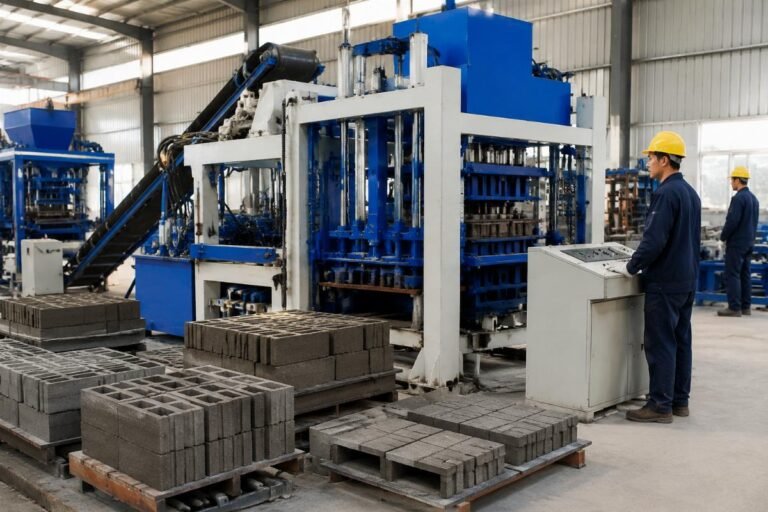
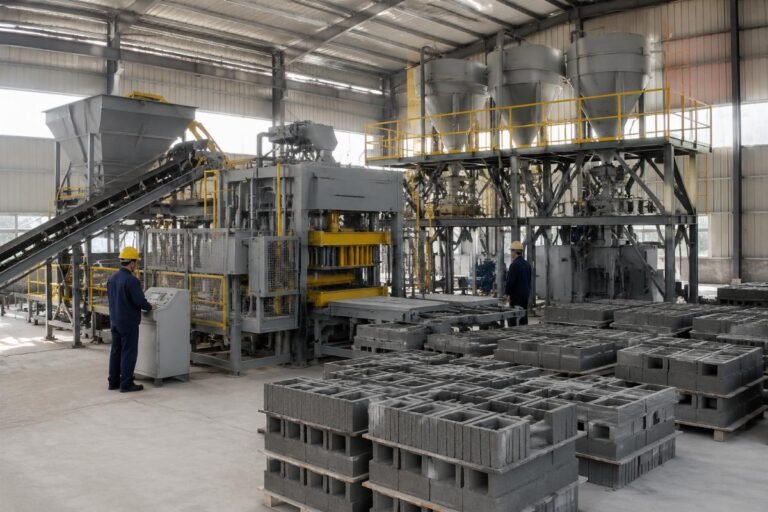
| QT10-15 | Fully Automatic PLC | High output, pallet-based | Trained crew | High, dedicated transformer + stabiliser | Large | Established plants, housing project suppliers |
A private investor in Port Harcourt once started with a QT4-25 egg-laying machine because it fit his budget and could run on a modest diesel generator. Within a year, his orders from a nearby estate developer outgrew the machine’s capacity entirely. He then upgraded to a QT6-15 semi-automatic line, which gave him the output jump he needed without requiring a grid-scale power installation. Had he started directly with a QT10-15, his electricity and labour costs would have eaten his margins before the first pallet was sold.
The key insight: the Brick Machine Price in Nigeria must be evaluated against your realistic daily sales, not your aspirational capacity. Over-specifying is as dangerous as under-specifying. [NEED_CITE: ROI comparison of semi-automatic vs fully automatic block machines in emerging markets]
What Hidden Costs Should Nigerian Buyers Expect Beyond FOB Price?
The invoice price is what you pay the factory. The real cost is what you pay the grid, the port, the aggregate quarry, and the learning curve.
Every experienced importer knows that the Brick Machine Price in Nigeria has layers that never appear on the proforma. Let me list the ones that routinely catch first-time buyers off guard.
Voltage adaptation and power infrastructure. As mentioned, a standard control cabinet will not survive Nigerian grid conditions without protection. Budget for a dedicated stabiliser, a step-up or step-down transformer matched to your site voltage, and surge arrestors on every motor circuit. Skipping this step is the single most common reason new plants fail in their first six months. [NEED_CITE: industrial power quality requirements for concrete block machinery in West Africa]
Import duty and clearing. Nigeria’s customs classification for construction machinery carries specific duty rates, and the valuation basis can shift depending on how the invoice is structured. A poorly declared shipment can attract penalties, demurrage at Apapa, or weeks of delay while documents are reconciled. Working with a clearing agent who understands HS codes for block-making equipment is non-negotiable. [NEED_CITE: Nigeria customs duty rates for concrete block making machinery HS code]
Mould and wear-part consumption. Under high-silt aggregate conditions, mould liners, core pins, and vibration table rubber mounts wear noticeably faster than in clean-sand environments. A realistic spare-parts budget for the first year should account for at least one full mould replacement set and multiple sets of wearable components. Buyers who assume the original mould will last indefinitely are in for an unpleasant surprise.
Installation and commissioning. A fully automatic QT10-15 line is not a plug-and-play product. It requires mechanical alignment, hydraulic pressure calibration, PLC parameter tuning, and operator training. Flying in a technician from China is standard practice for turnkey projects, and the cost of airfare, accommodation, and per-diem must be built into your budget. Some suppliers include this in the package; others quote it separately. Always confirm before signing.
Training and recipe development. The machine only produces what the concrete mix allows. Nigerian block yards often use local cement brands with different setting characteristics, and aggregate grading varies by quarry. Developing a workable mix recipe that produces strong, consistent blocks on your specific machine is a skill that must be taught on site. Without it, even the best machine will produce reject-heavy output.
How to Choose the Right Brick Machine for Your Nigerian Project?
Match the machine to your power, your material, your market, and your management capability—not to the brochure photo.
The right Brick Machine Price in Nigeria is the one that delivers blocks at a cost per unit that your customers are willing to pay, with a margin that sustains your business. Getting there requires an honest assessment of four variables.
Power availability. If your site runs on a generator with limited kVA capacity, a fully automatic line with multiple high-draw vibration motors is not realistic. Start with a semi-automatic or mobile egg-laying machine that matches your actual power envelope. Upgrading later is always an option; buying too big upfront is a sunk cost.
Raw material profile. Visit your sand and stone dust source. If the material is high in silt or contains fine clay particles, specify a machine with hardened mould inserts, adjustable vibration frequency, and easy-access wear parts. A standard machine running on dirty aggregate will punish you with downtime and reject rates.
Daily sales volume. Be brutally honest about how many blocks you can actually sell per day in your location. A QT10-15 line producing far beyond your market demand is a waste of capital and operating cost. A QT6-15 or even a well-managed QT4-25 may deliver superior ROI if your market is smaller.
Operator skill and maintenance culture. Fully automatic PLC-controlled lines require operators who can read alarms, adjust parameters, and perform daily maintenance. If your workforce has no prior exposure to automated equipment, factor in a longer commissioning period and invest heavily in training. A semi-automatic machine with simpler controls may be the smarter starting point.
Why Chinese Brick Machines Offer Better Value for Nigerian Market?
The price gap is real, but the real advantage is engineering adaptation to African operating conditions.
European and Turkish block machines are excellent products—built for stable grids, clean aggregates, and highly skilled maintenance teams. They are also priced accordingly. For the Nigerian market, where conditions are fundamentally different, a Chinese-manufactured line that has been specifically adapted to local realities delivers a total cost of ownership that is substantially lower, often at a fraction of the upfront price.
The Brick Machine Price in Nigeria from a reputable Chinese manufacturer typically sits well below comparable European or Turkish offerings, while delivering output quality that meets or exceeds local standards. The difference is not just in labour cost at the factory—it is in the engineering choices made for the African context.
Wide-voltage control cabinets, dust-sealed electrical enclosures, reinforced mould alloys for high-abrasion aggregates, and simplified hydraulic circuits that local technicians can maintain—these are the features that matter on the ground in Lagos, Kano, or Enugu. A machine designed in a clean European factory and shipped without modification is a liability. A machine engineered with African site conditions in mind is an asset.
Reputable Chinese manufacturers now export complete turnkey lines to markets across Africa, the Middle East, and Latin America, with on-site installation, commissioning, and operator training included as standard. International certifications such as CE, SGS, and ISO are baseline requirements, and experienced suppliers will provide full tender documentation for government and institutional projects. [NEED_CITE: Chinese block machinery export certification requirements for African markets]
The bottom line: when you evaluate the Brick Machine Price in Nigeria, look past the catalogue number and ask the supplier how their machine handles your specific voltage, your specific sand, and your specific output target. The answer will tell you everything you need to know.
Conclusion
The cheapest machine is rarely the most affordable.
The Brick Machine Price in Nigeria is a composite figure shaped by power adaptation, raw material compatibility, logistics, and after-sales support—not just the factory tag. Match your model to your real operating conditions, budget for the hidden costs upfront, and choose a supplier who engineers for Africa rather than one who simply ships to it.