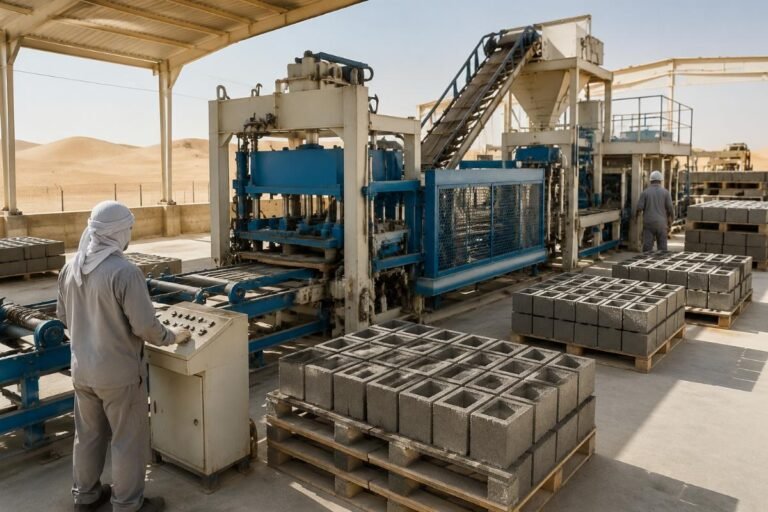
Block Machine Price in Germany: 2026 Supplier Guide
Most buyers ask for the machine price first. The real cost question is what happens after the quote lands in your inbox.
In 2026, a standard semi-automatic block machine line for the German market runs between €15,000 and €50,000 for Chinese-sourced equipment, while fully automatic lines with PLC integration range from €80,000 to €250,000. European-manufactured equivalents typically carry a premium of 40-60% on the hardware alone. However, the Block Machine Price in Germany is never just the machine price—it includes CE compliance upgrades, voltage adaptation, ocean freight, customs clearance, on-site commissioning, and operator training, which together can add 15-25% to the base equipment cost.
I still remember a container that arrived at a northern European port a few years back. The buyer, a small investor setting up his first block yard, had ordered what looked like a straightforward semi-automatic line. The machine itself was solid. But nobody had asked about the local grid voltage fluctuation tolerance, and the PLC boards fried within the first week of testing. The molds were sized for crushed limestone, while his actual raw material was river sand with high silt content. The entire line sat idle for weeks while we shipped replacement control boards and redesigned the mold cavity. That kind of hidden cost doesn’t show up on a proforma invoice. [NEED_CITE: common failure modes in imported concrete block equipment related to voltage mismatch and raw material incompatibility]
Understanding the full picture of Block Machine Price in Germany requires looking beyond the catalog number. Let me walk you through what actually drives the final number on your balance sheet.
What Is the Average Block Machine Price in Germany for 2026?
The Block Machine Price in Germany varies dramatically by automation level, output capacity, and compliance package. Manual and egg-laying machines start in the low five figures, while turnkey fully automatic lines with color feeding and stacking systems reach into the mid-six figures.
Here is how the market segments break down for equipment suitable for the German regulatory environment:
| Machine Category | Typical Output | Automation Level | Price Range (Chinese Source) | Price Range (European Source) |
|---|---|---|---|---|
| Mobile Egg-Laying (QT4-25 type) | Low, manual pallet handling | Manual/Semi | Entry-level | Noticeably higher |
| Semi-Automatic Static (QT6-15 type) | Medium, conveyor-fed | Semi with basic PLC | Mid-range | Substantially higher |
| Fully Automatic Static (QT10-15 type) | High, auto pallet cycling | Full PLC with batching | Upper mid-range | Significantly premium |
| High-Capacity Line (QT12-15/QT15-15 type) | Very high, integrated stacking | Full PLC, color feed, stacker | High | Premium tier |
The gap between Chinese-sourced and European-manufactured Block Machine Price in Germany has narrowed slightly in recent years as Chinese factories have invested heavily in CE documentation and component upgrades, but the structural cost advantage remains significant. [NEED_CITE: comparative pricing analysis of concrete block making machines sourced from China versus EU manufacturers in 2025-2026]
A small investor in eastern Germany once asked me to quote a QT6-15 line for producing standard hollow blocks for a local construction cooperative. The European brand he initially contacted quoted him a figure that included a service contract, extended warranty, and a training week at their factory in Bavaria. When I broke down the same specification from our side—CE-certified frame, Siemens-compatible PLC, 400V/50Hz motor configuration, German-language HMI panel—the hardware cost was roughly half. The buyer spent days cross-checking our CE file against the EU Machinery Directive requirements before he felt comfortable proceeding. [NEED_CITE: EU Machinery Directive 2006/42/EC compliance checklist for concrete block making equipment]
The key takeaway is that the Block Machine Price in Germany is a layered number. The machine is the visible layer. Everything beneath it determines whether your investment actually produces blocks or produces headaches.
Which Factors Affect Block Machine Cost When Importing to Germany?
The base machine price is only the starting point. CE compliance retrofitting, voltage and frequency adaptation, mold customization for local raw materials, ocean freight, import duties, on-site installation, and operator training collectively form the hidden cost layer that can shift your total investment by a significant margin.
Let me break down each layer:
CE Compliance and Documentation. Any block machine operating in Germany must comply with the EU Machinery Directive. This is not optional. The machine needs a Declaration of Conformity, a technical file, risk assessment documentation, and proper safety guarding. Some suppliers provide CE certificates that are essentially decorative—they lack the underlying test reports and risk assessments that a German Gewerbeaufsicht (trade supervision office) inspector would actually ask for. Verifying the authenticity of CE documentation is a non-negotiable step. [NEED_CITE: requirements for CE marking of concrete block making machines under EU Machinery Directive 2006/42/EC and EN ISO 12100]
Voltage and Electrical Adaptation. Germany uses a 400V three-phase / 230V single-phase system at 50Hz. Many Chinese factories default to 380V/50Hz configurations designed for domestic use or Southeast Asian markets. The difference seems minor on paper, but German grid standards are strict, and voltage fluctuations outside the acceptable band can damage sensitive PLC components. Upgrading the electrical cabinet with properly rated contactors, relays, and surge protection adds cost but prevents the kind of failure I described earlier.
Mold Customization. German block standards (DIN norms) specify dimensions and tolerances that differ from what is common in African or Southeast Asian markets. If your molds are not adapted to produce blocks that meet local dimensional requirements, you will face rejection from construction inspectors. Mold steel quality and heat treatment also matter—cheap molds wear out quickly and produce inconsistent block dimensions.
Freight, Customs, and Logistics. A full container shipment from a Chinese port to Hamburg or Bremerhaven involves ocean freight, marine insurance, EU customs clearance, and inland transport to your site. The Block Machine Price in Germany must account for all of these. DDP (Delivered Duty Paid) terms shift the logistics burden to the supplier but come at a premium. FOB (Free on Board) terms give you more control but require you to manage the freight forwarder relationship yourself. [NEED_CITE: typical ocean freight and customs duty rates for concrete block making machinery imported into Germany from China]
On-Site Commissioning and Training. A block machine is not a plug-and-play product. It requires mechanical alignment, hydraulic pressure calibration, PLC parameter tuning, and mix design optimization for your specific raw materials. Sending an engineer to Germany for on-site commissioning is standard practice for serious suppliers, and this cost—travel, accommodation, daily engineering fees—must be factored in. A typical commissioning cycle runs into multiple weeks, not days.
A distributor in Poland once told me that his biggest mistake with a previous Chinese supplier was assuming the CE certificate meant the machine was "ready for Europe." It was not. The safety guards were inadequately fixed, the emergency stop circuit did not meet category requirements, and the electrical schematic was only in Chinese. Re-certifying and retrofitting the machine locally cost him more than the original electrical upgrade would have.
How to Compare Chinese vs European Block Machine Prices?
When comparing the Block Machine Price in Germany across sourcing origins, the hardware price difference is substantial—Chinese equipment typically costs 40-60% less than comparable European machines. But the comparison must extend to delivery lead time, after-sales responsiveness, spare parts availability, and long-term total cost of ownership.
Here is a framework for evaluating the real comparison:
| Evaluation Dimension | Chinese-Sourced Equipment | European-Manufactured Equipment |
|---|---|---|
| Base Hardware Cost | Noticeably lower | Premium tier |
| CE Documentation Quality | Verifiable to Self-reported spectrum | Typically Certified and comprehensive |
| Delivery Lead Time | Noticeably shorter for complete lines | Extended, especially for custom configurations |
| Spare Parts Cost | Substantially lower | Noticeably higher |
| After-Sales Response Speed | Dependent on supplier’s overseas service capability | Typically fast within EU |
| PLC and Component Brands | Often international brands (Siemens, Schneider) | European brands standard |
| Long-Term Wear Parts Availability | Good for standard components, variable for proprietary | Excellent within EU network |
The Block Machine Price in Germany from a Chinese supplier becomes genuinely competitive when the supplier has proven experience navigating the German regulatory environment. This means more than just having a CE certificate. It means understanding TA Lärm (the German technical instructions on noise protection), knowing that German construction sites have strict noise emission limits, and being able to supply acoustic enclosures or vibration-dampening mounts if your production facility is near residential areas. [NEED_CITE: TA Lärm noise emission requirements for concrete block production facilities in Germany]
I worked with a contractor in western Germany who was building a small production facility for interlocking pavers near a residential zone. The noise concern was real. We supplied the machine with an upgraded hydraulic system that ran at lower pressure with reduced noise output, and we included acoustic paneling recommendations for the production hall. The Block Machine Price in Germany for that project was higher than a basic quote, but it prevented what could have been a costly confrontation with local authorities.
The honest truth is that not every Chinese supplier can deliver the Block Machine Price in Germany with the compliance and support package that German buyers need. But those who can offer a compelling combination of cost advantage, verified certification, and field-tested adaptability. The key is verifying claims before signing a contract—ask for the CE technical file, request references from existing German or EU customers, and confirm that the supplier has experience with 400V/50Hz configurations and German-language HMI interfaces.
What Certifications and Standards Are Required for Germany?
Entering the German market with a block machine requires compliance with a specific set of EU and national standards. CE marking under the Machinery Directive is the baseline. Beyond that, noise emission limits, electrical safety standards, and structural integrity requirements form the compliance framework that determines whether your machine can legally operate.
The core certifications and standards include:
CE Marking under Machinery Directive 2006/42/EC. This is the primary legal requirement. The manufacturer must issue an EU Declaration of Conformity, compile a technical file demonstrating compliance with essential health and safety requirements, and affix the CE mark to the machine. The technical file must include risk assessments, circuit diagrams, hydraulic schematics, and evidence of compliance with harmonized standards. [NEED_CITE: complete CE marking requirements and technical file contents for concrete block making machines under EU Machinery Directive 2006/42/EC]
EN ISO 12100 Safety of Machinery. This standard provides the framework for risk assessment and risk reduction. It covers mechanical hazards, electrical hazards, hydraulic hazards, and noise hazards. A compliant machine must have properly designed safety guards, emergency stop systems that meet performance level requirements, and interlocks that prevent operation when guards are open.
EN 60204-1 Electrical Equipment of Machines. This standard governs the electrical design of the machine. It covers wiring, protection against electric shock, overload protection, and labeling of electrical components. German inspectors pay close attention to the electrical cabinet layout and the quality of cable routing.
TA Lärm Noise Protection. While not a product certification per se, the Technische Anleitung zum Schutz gegen Lärm sets noise emission limits for industrial facilities. If your block machine production exceeds certain decibel thresholds at the property boundary, you may face operational restrictions. Selecting a machine with lower noise output or investing in acoustic enclosures is a practical consideration for German installations. [NEED_CITE: TA Lärm noise emission limits applicable to concrete block production facilities in Germany]
DIN Standards for Concrete Blocks. Your molds must produce blocks that conform to relevant DIN dimensions and tolerances. This is not a machine certification issue, but it directly affects mold design and the Block Machine Price in Germany if custom molds are required.
A buyer from a construction cooperative in southern Germany shared with me that their procurement committee spent weeks reviewing the CE documentation from different suppliers. One supplier’s CE certificate was a single page with no supporting technical file. Another provided a comprehensive folder with risk assessments, test reports from notified bodies, and component certificates. The difference in documentation quality was a direct reflection of the difference in engineering rigor behind each machine.
How to Calculate ROI for a Block Making Business in Germany?
The Block Machine Price in Germany is an investment, and like any investment, it must be evaluated against expected returns. ROI calculation for a block making business involves estimating daily production capacity, raw material costs, labor costs, block selling prices, and equipment depreciation over the payback period.
Here is the framework I use when helping buyers evaluate their investment:
Step 1: Estimate Daily Production Capacity. A semi-automatic line like a QT6-15 configuration can produce several thousand standard blocks per shift, depending on block size, mix design, and operator efficiency. A fully automatic line with integrated pallet cycling and stacking can multiply that output substantially. The actual number depends on your specific machine configuration and operating hours.
Step 2: Calculate Raw Material Costs. The cost of cement, aggregates, sand, and additives varies by region within Germany. Sourcing locally is critical. The mix design must be optimized for your specific raw materials to minimize cement usage while maintaining block strength. [NEED_CITE: typical raw material cost ranges for concrete block production in Germany]
Step 3: Factor in Labor Costs. German labor costs are among the highest in Europe. This makes automation economically attractive. A fully automatic line reduces the number of operators required per shift, directly improving your cost per block.
Step 4: Determine Block Selling Prices. Standard hollow blocks, solid blocks, and interlocking pavers command different prices. Decorative or colored products carry higher margins. Your product mix strategy directly affects revenue.
Step 5: Calculate Payback Period. Divide the total investment (machine cost plus installation, commissioning, and initial working capital) by the expected monthly profit. A well-managed block production operation in Germany can achieve payback within a reasonable timeframe, typically measured in a range of months rather than years, depending on market demand and operational efficiency.
An investor in northern Germany who started with a semi-automatic line told me that his payback came faster than he expected because he focused on a niche product—colored interlocking pavers for landscaping—rather than competing on price with standard hollow blocks. The Block Machine Price in Germany was a significant investment, but the margin on decorative products made the difference.
Conclusion
The Block Machine Price in Germany is a multi-layered figure that extends far beyond the machine itself. CE compliance, voltage adaptation, mold customization, freight, commissioning, and training all contribute to the true cost of ownership. Chinese-sourced equipment offers a substantial cost advantage, but only when the supplier has verified experience with German regulatory requirements and can deliver documented compliance. Evaluating ROI requires careful analysis of production capacity, material costs, labor, and product margins. The right machine, properly specified and supported, is a sound investment in the German construction materials market.