Block Machine Price in France: QT10-15 Manufacturer Wholesale Guide
The machine you see in the brochure is never the machine you pay for.
A realistic block machine price in France for a mid-output line in 2026 sits well above the headline FOB figure once you include batching, pallet circulation, CE adaptation, and on-site commissioning; buyers who compare only the main press are comparing fiction.
I still remember the morning a distributor from Lyon slid a Turkish quote across my desk in Linyi. The number was noticeably lower than ours on a QT10-15 press. I almost conceded. Then I asked to see their scope sheet. No batching plant. No pallet loader. No stacker. No commissioning trip. When we rebuilt our quote to match their bare scope, our price dropped to roughly the same level. When we rebuilt their quote to match our full scope, theirs climbed past ours. The lesson was not about who was cheaper; it was about what "block machine price in France" actually means on paper. [NEED_CITE: total cost of ownership for concrete block plants includes auxiliary systems beyond the main press]
That afternoon reshaped how I talk to every French buyer. Before we discuss a single euro, we agree on what is inside the box and what is not.
What Does a Block Machine Price in France Actually Cover in 2026?
A block machine price in France is a layered figure, not a single number, and the layering is where most disputes begin.
When a French investor types "block machine price in France" into a search bar, the search intent is transactional: they want a budget they can take to a bank or a partner. What they usually get is a press price from Alibaba, a press price from a Turkish catalog, and a press price from a European brochure. None of these three numbers describe the same thing. [NEED_CITE: block machine quotation scope variance across Chinese Turkish and European suppliers]
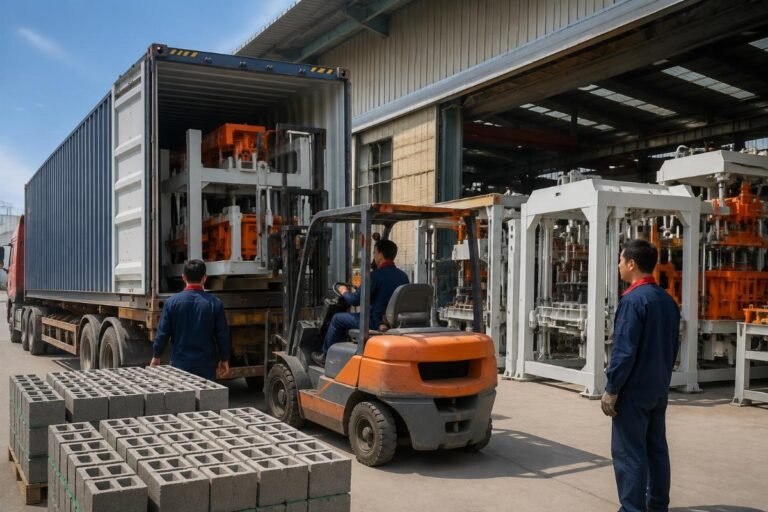
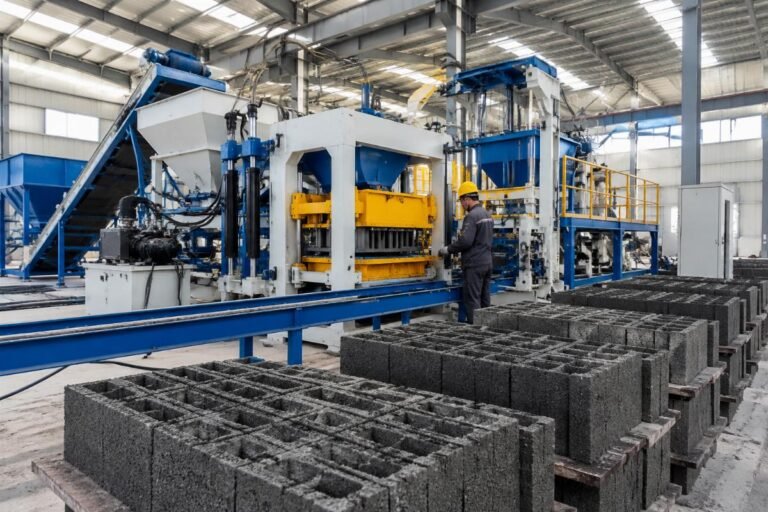
From my side of the factory floor in Shandong, near Qingdao Port where most of our lines are loaded, I see the same pattern every week. A buyer asks for a QT10-15 price. I send a full-line quotation: the press, the PL batching system with three or four aggregate bins, the cement silo, the screw conveyor, the mixer, the pallet circulation system, the stacker, the control cabinet, a set of moulds, spare wear parts, CE documentation, and a two-person commissioning team for roughly three weeks on site. The buyer forwards it to a competitor and comes back saying we are expensive. I ask for the competitor’s scope. Almost always, the competitor has quoted the press and the mixer, nothing else.
| Scope Element | Typical Chinese Full-Line Quote | Typical Turkish Bare-Press Quote | Typical European Turnkey Quote |
|---|---|---|---|
| Main press (QT10-15 class) | Included | Included | Included |
| Aggregate batching plant | Included | Not provided | Included |
| Cement silo and screw | Included | Not provided | Included |
| Pallet circulation system | Included | Not provided | Included |
| Stacker / cuber | Included | Not provided | Included |
| CE adaptation and docs | Included | On request, extra | Included |
| On-site commissioning | Included | Extra, by arrangement | Included |
| Operator training | Included | Minimal | Included |
[NEED_CITE: scope composition differences in block machine quotations across regions]
The table above is the single most important piece of paper in this entire article. If you are comparing a block machine price in France and the rows do not match, you are not comparing machines; you are comparing marketing.
A North African contractor once bought a semi-automatic line from a supplier who quoted only the press and a basic mixer. He arrived at his site in the Maghreb and realized he had no pallet system. He sourced pallets locally, built a return conveyor himself, and lost roughly a full production season troubleshooting vibration mismatches. By the time his line ran stable, a competitor using a full turnkey package from our facility had already paid back the price gap. [NEED_CITE: production downtime caused by missing auxiliary equipment in block plants]
FOB vs CIF vs Turnkey: Which Quote Structure Controls Your Real Cost?
The Incoterm on your proforma invoice often matters more than the machine price itself.
This is the part of the block machine price in France that almost no catalog mentions. FOB Qingdao, CIF Le Havre, CIF Fos-sur-Mer, or DDP your site in Auvergne—each term shifts thousands of euros between buyer and seller, and each term changes what "price" actually means.
Let me walk you through what I see in real inquiries.
- FOB Qingdao. The seller delivers the line onto the vessel. You pay ocean freight, marine insurance, French import duty, TVA at the port, customs clearance, and inland haulage to your plant. The headline number looks attractive. The final landed cost does not.
- CIF Le Havre. The seller covers freight and insurance to the French port. You still handle import duty, TVA, clearance, and inland transport. This is the most common structure for our French buyers because it balances transparency and control.
- DDP your site. The seller handles everything to your door. The headline number looks terrifying. In practice, for a first-time importer, it often protects against surprise costs that exceed the apparent saving.
[NEED_CITE: Incoterm impact on final landed cost of imported industrial machinery into France]
A French distributor in the Rhône valley once asked me to re-quote from FOB to CIF after his forwarder quoted him an ocean freight spike during peak season. The difference between the two numbers was not small. He had been comparing our FOB price against a competitor’s CIF price and assuming we were more expensive. Once both quotes sat on the same Incoterm, the gap closed noticeably.
Here is the practical checklist I give every French buyer before they sign a proforma:
- Confirm the Incoterm in bold on the first page, not buried in clause twelve.
- Confirm whether the commissioning team’s travel, accommodation, and per diem are inside the price or billed separately.
- Confirm whether CE declaration, test reports, and the technical file are included or sold as an add-on.
- Confirm whether the first set of moulds is included and how many references it covers.
- Confirm whether pallets are included and, if so, how many—because a QT10-15 line circulates several thousand pallets and buying them locally in France at European prices is a quiet budget killer.
[NEED_CITE: hidden cost items in cross-border block machine procurement]
Chinese vs Turkish vs European: How to Compare Apples to Apples
The gap between a Chinese quote and a European quote on a block machine price in France is real, but the gap between a Chinese quote and a Turkish quote is often an illusion.
I say this as someone whose factory competes directly with both. Let me be specific.
European manufacturers—German, Italian, Spanish—offer outstanding engineering, deep automation, and long service life. Their block machine price in France reflects that. You are paying for decades of refinement, local service networks, and the comfort of a brand your bank recognizes. For high-volume producers making premium architectural pavers, the European option is often the right one.
Turkish manufacturers sit in the middle on paper. In practice, their quotations are frequently structured to win the headline comparison. The press is priced aggressively. The auxiliary equipment is either excluded or quoted as options. When a French buyer lines up a Turkish press-only quote against a Chinese full-line quote, the Turkish number looks smaller. When the buyer adds the batching plant, the pallet system, the stacker, the CE file, and the commissioning visit to the Turkish side, the total often meets or exceeds the Chinese full-line number.
Chinese manufacturers, including our facility in Linyi, typically quote a full turnkey scope at a price noticeably below the European equivalent and roughly comparable to a fully-loaded Turkish quote. The difference is that our full scope is full from the start, not after three rounds of change orders. [NEED_CITE: price positioning of Chinese Turkish and European block machine suppliers]
| Comparison Dimension | Chinese Full-Line | Turkish Bare-Press | European Turnkey |
|---|---|---|---|
| Headline press price | Noticeably lower | Lower | Highest |
| Full-line scope completeness | Full | Partial | Full |
| CE certification readiness | Included | Variable | Included |
| On-site commissioning | Included | Extra | Included |
| Spare parts pricing | Noticeably lower | Moderate | Highest |
| Lead time to ship | Noticeably shorter | Moderate | Longest |
[NEED_CITE: lead time and spare parts cost comparison across block machine supply regions]
A buyer from a French overseas territory in the Caribbean was evaluating three offers for a QT10-15 line. The European quote was roughly double the Chinese quote on a full turnkey basis. The Turkish quote sat in between, but excluded the batching plant and the pallet system. When we sat down and rebuilt all three quotes to the same scope, the Turkish total climbed close to the European total, while the Chinese total stayed where it started. The buyer chose the Chinese line, and we shipped it from Qingdao within the standard production window.
Hidden Costs French Buyers Often Overlook
The items that blow a block machine price in France budget are almost never the press.
After two decades around these lines, I can tell you the four cost traps that show up again and again.
Pallet systems. A QT10-15 line runs on pallets. Thousands of them. European-spec pallets sourced locally in France cost substantially more per unit than pallets included in a Chinese turnkey quote. If your quotation does not specify pallet quantity and material—bamboo, steel-reinforced wood, or plastic—you are not comparing prices; you are guessing. [NEED_CITE: pallet system cost as a major variable in block plant total investment]
Batching plant accuracy. A cheap batching system saves money on day one and costs money every day after, in cement overuse and inconsistent block strength. The difference between a volumetric batcher and a properly calibrated weigh batcher is not visible in the brochure but is very visible in your monthly cement bill.
Voltage and control adaptation. France runs on a specific three-phase voltage and frequency standard. Control cabinets shipped without proper adaptation require a local electrician to rework them on site. That electrician bills by the hour, and the hour rate in mainland France is not trivial. Our factory builds every cabinet for the destination country’s standard before it leaves Shandong. [NEED_CITE: voltage adaptation requirements for industrial machinery imported into France]
Commissioning duration. A full QT10-15 turnkey line needs a commissioning team on site for an extended period to tune vibration, calibrate the batcher, train operators, and run trial production. If your quote says "commissioning included" but does not specify how many engineers and how many days, assume the shortest possible interpretation.
A private investor near Marseille bought a line from a supplier who quoted "commissioning included." The commissioning engineer arrived, spent a few days, and left. The line ran, but the block cycle time was well below the guaranteed output. The investor had to fly a second engineer out at his own cost. The second trip, the hotel, the per diem, and the lost production added up to a sum that erased most of the saving he thought he had made on the machine price.
How to Calculate Real ROI for Your French Block Plant
ROI is the only honest way to compare a block machine price in France across suppliers.
Price is a cost. ROI is a return. If you are spending serious capital on a block plant in France, in mainland or overseas territory, the only question that matters is how long it takes the line to pay for itself.
Here is the framework I walk every serious buyer through.
- Fix your daily output target. A QT10-15 line, running two shifts on standard hollow blocks, produces a substantial daily volume. The exact number depends on block height, mix design, and pallet circulation speed. Get the supplier to commit to a guaranteed cycle time in writing.
- Fix your contribution margin per block. Selling price minus variable cost—cement, aggregate, sand, pigment, power, labor, pallet wear. This number is local and you know it better than any supplier does.
- Fix your daily operating cost. Fixed labor, maintenance, site overhead.
- Calculate daily gross margin. Daily output times contribution margin minus daily operating cost.
- Divide total turnkey investment by daily gross margin. The result is your payback period in working days.
[NEED_CITE: ROI calculation methodology for concrete block manufacturing investment]
Two buyers can look at the same block machine price in France and reach opposite conclusions, because one is calculating on a full turnkey basis with a guaranteed output and the other is calculating on a press-only basis with an assumed output. The first buyer’s payback period is real. The second buyer’s payback period is a hope.
A contractor in sub-Saharan Africa, supplying blocks for a government housing program, compared a European turnkey quote against our Chinese turnkey quote. The European price was roughly double. On identical output assumptions and identical local block selling prices, the European line’s payback period stretched substantially longer. He chose the Chinese line, and the payback period matched his original model within the first production quarter.
Conclusion
A block machine price in France is a scope question, not a price question.
The buyers who get into trouble are the ones who compare headline press prices across suppliers who are quoting different scopes, different Incoterms, and different commissioning commitments. The buyers who succeed are the ones who force every supplier onto the same scope sheet, the same Incoterm, and the same output guarantee before they look at a single number. Price without scope is marketing. Price with scope is a business decision.