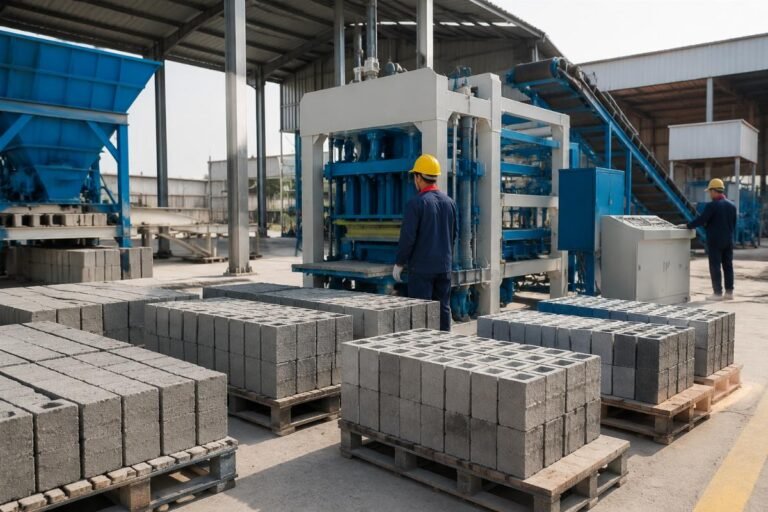
Buy QT5-15 Block Machine for Sale | Manufacturer Direct
Most buyers think the QT5-15 is just a bigger version of the QT4-15. It is not — the vibration load pattern changes entirely, and that single misunderstanding has sunk more factory floors than any other installation mistake I have seen.
The QT5-15 block machine is a semi-automatic concrete block forming system designed for mid-scale investors targeting daily outputs in the range of several thousand standard blocks. The real purchasing decision is not about the machine’s rated capacity — it is about whether your foundation bearing capacity, mold compatibility, and local power grid conditions can support continuous operation without unplanned downtime.
I still remember the phone call at two in the morning from a West African client. His QT5-15 block machine had been running for just a few weeks when the entire production line tilted. The molds jammed mid-cycle. The root cause was never the machine — it was the ground beneath it. He had poured the foundation directly onto backfilled soil without any geotechnical assessment [NEED_CITE: foundation settlement mechanisms under cyclic vibration loads per geotechnical engineering standards]. The repair cost ended up being a significant fraction of the original equipment investment. Moments like that reshaped how I approach every single inquiry — the first question I ask is never about budget, it is about soil conditions.
Getting the groundwork right before the machine arrives is what separates a profitable operation from a costly lesson. Let me walk you through what actually matters when you are evaluating a QT5-15 block machine for your project.
What Is the QT5-15 Block Machine and Who Is It For?
The QT5-15 block machine occupies the middle tier of semi-automatic block production — positioned above entry-level manual systems and below fully automated PLC-driven lines.
It is built for private investors and small-to-medium contractors who need reliable daily output without the capital commitment of a fully automatic plant. The typical buyer operates in emerging construction markets where demand for hollow blocks, solid bricks, and paving stones is growing but where labor costs remain relatively low — making semi-automatic equipment the economic sweet spot.
From my experience shipping units across multiple regions, the buyers who get the best results from a QT5-15 block machine share a few characteristics: they have access to a stable raw material supply, they have a flat and properly prepared site, and they understand that the machine is only one component of a production system — not the entire system.
The machine itself handles the forming cycle: material feeding, compression, vibration, and mold stripping. But the supporting equipment — mixers, conveyors, pallet circulation, curing arrangements — determines whether you hit your output targets or fall short [NEED_CITE: semi-automatic block machine production system integration requirements per concrete product manufacturing guidelines].
A common mistake I see is buyers who assume the QT5-15 block machine will automatically deliver a certain number of blocks per day based on the cycle time listed in the brochure. The real throughput ceiling is set by how fast your mixer can batch material, how quickly your pallets cycle back through the system, and whether your curing area can handle the volume. The forming unit is rarely the bottleneck — everything around it usually is.
QT5-15 Block Machine Specifications vs. Neighboring Models: How Do You Choose the Right Tier?
Specification sheets look similar across models — but the differences in forming area, vibration configuration, and power draw determine which model actually fits your production goals and site constraints.
When buyers compare the QT5-15 block machine against the QT4-15 below it and the QT6-15 above it, they often focus only on the mold cavity count. That is a starting point, but it misses the operational implications that affect daily profitability.
| Parameter | QT4-15 Class | QT5-15 Block Machine | QT6-15 Class |
|---|---|---|---|
| Forming Area | Compact | Medium | Extended |
| Vibration Configuration | Standard dual | Enhanced multi-point | Heavy-duty multi-point |
| Total Power Draw | Moderate | Medium-high | High |
| Daily Output Range | Entry-level | Mid-scale | Upper-mid scale |
| Foundation Load | Standard | Elevated | Significantly elevated |
| Operator Requirement | Minimal | Moderate | Skilled team needed |
| Mold Versatility | Limited range | Broad range | Broad range |
[NEED_CITE: block machine model classification by forming area and vibration capacity per industry technical manuals]
The QT5-15 block machine sits in a position where it offers meaningful output capacity without requiring the heavy industrial infrastructure that the QT6-15 demands. This matters because foundation costs scale disproportionately as you move up — the concrete volume and reinforcement needed for a QT6-15 can be substantially more than for the QT5-15.
I worked with a Southeast Asian buyer who initially wanted the larger model, convinced that bigger meant better ROI. After reviewing his site conditions — limited space, single-phase power availability in parts of the facility, and no existing heavy foundation — we recommended the QT5-15 block machine instead. He achieved his target output, his foundation costs stayed manageable, and his power infrastructure handled the load without upgrades. The larger model would have created problems he was not prepared to solve.
The key takeaway: do not choose based on the maximum number on the spec sheet. Choose based on what your site, your power supply, and your budget can sustain over years of operation — not weeks.
Site Preparation: Foundation, Power & Layout Requirements Most Buyers Overlook
The foundation is not a formality — it is a structural component of the production system, and treating it as an afterthought is the single most expensive mistake a buyer can make.
Here is what happens when vibration loads meet inadequate ground support: the concrete slab cracks, the machine frame shifts out of alignment, the mold guides bind, and production stops. I have seen this pattern repeat across multiple continents. The machine was never defective — the ground failed.
For a QT5-15 block machine, the vibration forces concentrate at four primary mounting points. These points transfer cyclic dynamic loads into the foundation continuously throughout every shift. If the underlying soil is backfilled, loosely compacted, or has a high clay content with poor drainage, settlement is not a question of if — it is a question of when [NEED_CITE: vibration-induced foundation settlement mechanisms in industrial equipment installation standards].
The foundation must be designed based on a proper assessment of soil bearing capacity. In most cases, this means excavating to stable subsoil, compacting in layers, and pouring a reinforced concrete slab of adequate thickness and grade. Skipping the soil assessment to save a small amount upfront will cost many times that amount when the machine starts sinking unevenly.
Power supply is the second overlooked factor. In many emerging markets, grid voltage fluctuates well outside the tolerance range that the machine’s electrical components are designed for. I have seen PLC systems on a QT5-15 block machine throw repeated fault codes and shut down multiple times per shift — not because the controller was faulty, but because the local supply was dipping and surging unpredictably. The solution is straightforward: install a voltage stabilizer sized for the machine’s total connected load. The cost is minor compared to the production losses from unplanned stops.
Layout matters too. The QT5-15 block machine needs clear access for pallet circulation, raw material delivery, and finished product removal. Cramping the layout to fit a smaller footprint creates operational bottlenecks that reduce daily output far more than any machine limitation would.
Mold Selection: How to Match Cavity Count, Wall Thickness & Product Mix
The mold determines your product range, your per-block cost, and your long-term maintenance burden — choosing based on price alone is a false economy.
A QT5-15 block machine accepts interchangeable molds, which is one of its core advantages. You can produce hollow blocks, solid bricks, paving stones, and curbstones from the same base machine by swapping molds. But not all molds are built equal, and the difference shows up not on day one — it shows up month after month as wear patterns develop.
The critical factors in mold selection are cavity count, wall thickness of the mold shell, and the heat treatment process applied to the steel. A mold with insufficient wall thickness will deform under repeated vibration and compression, producing blocks with dimensional inconsistencies. A mold that has not been properly heat-treated will wear rapidly when processing abrasive aggregate mixes, shortening its usable life substantially [NEED_CITE: mold steel wear resistance and heat treatment standards for concrete block manufacturing].
I recall a buyer in Latin America who ordered the lowest-cost mold set available for his QT5-15 block machine. Within a short period, the cavity dimensions had drifted, the block faces were chipping, and the rejection rate had climbed noticeably. He ended up ordering replacement molds — and the cumulative cost of the cheap molds plus the replacements plus the wasted material exceeded what a properly manufactured mold set would have cost from the start.
When selecting molds for a QT5-15 block machine, consider your product mix carefully. If you plan to produce multiple block types, ensure the mold changeover process is practical for your operation. Some mold configurations require more time and labor to swap than others. Factor in the total cost per block over the mold’s full service life — not just the purchase price.
| Mold Quality Factor | Low-Cost Import | Properly Manufactured |
|---|---|---|
| Steel Thickness | Thin | Adequate |
| Heat Treatment | Inconsistent | Controlled |
| Dimensional Stability | Degrades rapidly | Maintained over extended cycles |
| Per-Block Mold Cost Over Life | Substantially higher | Noticeably lower |
| Block Rejection Rate | Elevated | Minimal |
[NEED_CITE: mold service life comparison based on heat treatment quality per concrete product manufacturing standards]
Total Cost of Ownership: Machine Price vs. Hidden Expenses
The invoice price of a QT5-15 block machine is only the starting point of your total investment — the real cost picture includes shipping, foundation work, mold wear, spare parts, and operator training.
Buyers who focus exclusively on the machine price often find themselves surprised by the additional expenditures required to get a production line running and keep it running. Understanding the full cost structure before you commit prevents budget shortfalls later.
Shipping and import costs vary significantly depending on your location and local customs requirements. The QT5-15 block machine is a substantial piece of equipment, and freight costs can represent a meaningful addition to the base price. Factor in insurance, port charges, and inland transportation to your site.
Foundation preparation, as discussed earlier, is a real cost — not an optional one. Concrete, reinforcement steel, excavation labor, and potentially geotechnical consultation all add up. Skipping this step does not save money — it defers the cost and adds the expense of emergency repairs later.
Mold consumption is an ongoing operational cost. Depending on your aggregate type and daily production volume, molds will need replacement periodically. Budgeting for this from the start keeps it from becoming a cash flow surprise.
Spare parts — particularly wear components like vibration motor bearings, hydraulic seals, and conveyor belts — should be stocked from the beginning. Waiting for a part to fail and then ordering it internationally means downtime that costs far more than the part itself.
Operator training is another area where cutting corners backfires. A well-trained operator runs the QT5-15 block machine more efficiently, produces fewer defective blocks, and catches small issues before they become major breakdowns. Investing in proper training at the commissioning stage pays for itself quickly through higher output and lower waste.
When you add these elements together, the total cost of ownership for a QT5-15 block machine is higher than the machine price alone — but it is also more predictable, and the return on investment becomes clearer when you account for sustained production rather than optimistic assumptions.
Conclusion
Purchasing a QT5-15 block machine is a commitment to a production system — not just a piece of equipment. The machine’s capabilities are well-proven, but its performance in your operation depends entirely on whether your foundation, power supply, mold selection, and operational planning are aligned with its requirements. Evaluate the full picture before you sign, and the QT5-15 block machine will deliver the reliable mid-scale output that has made it a popular choice across emerging construction markets.