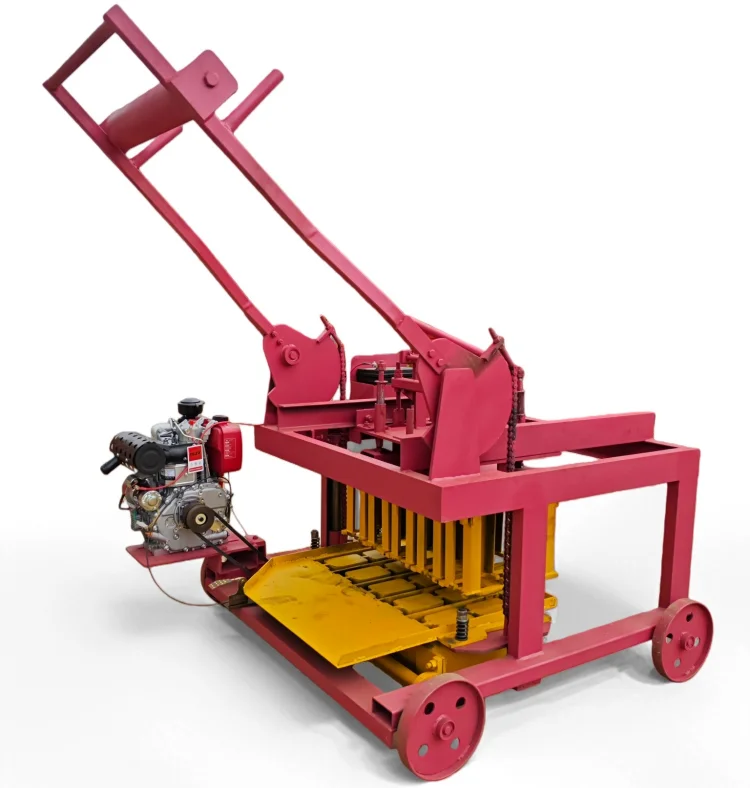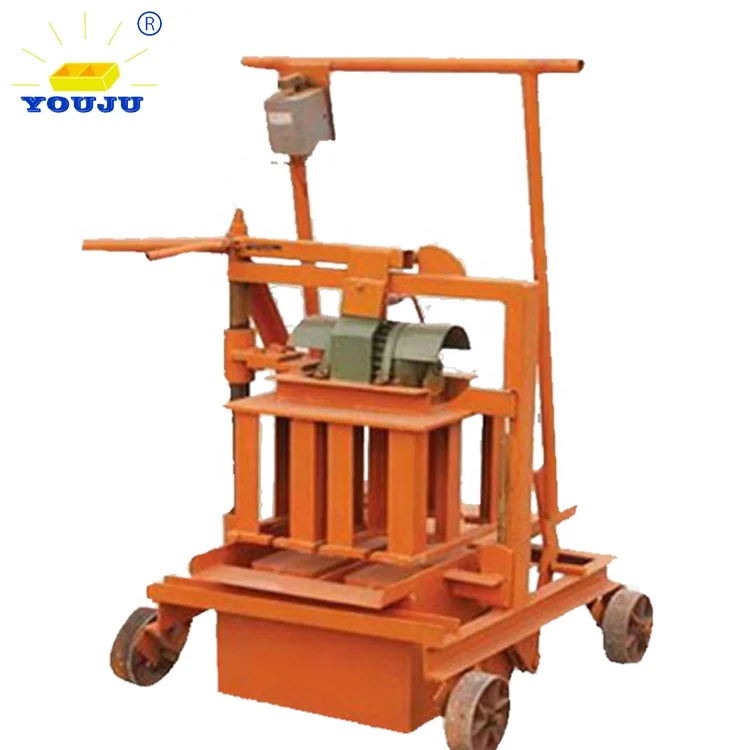


Description
Mould Format Capacity — output figures broken down per hollow brick dimension so daily planning matches the block your market actually buys, not a catalogue default.
Technical Specifications
| Parameter | Value |
|---|---|
| Model | QMJ2-45 |
| Product Type | Mobile Concrete Block Making Machine |
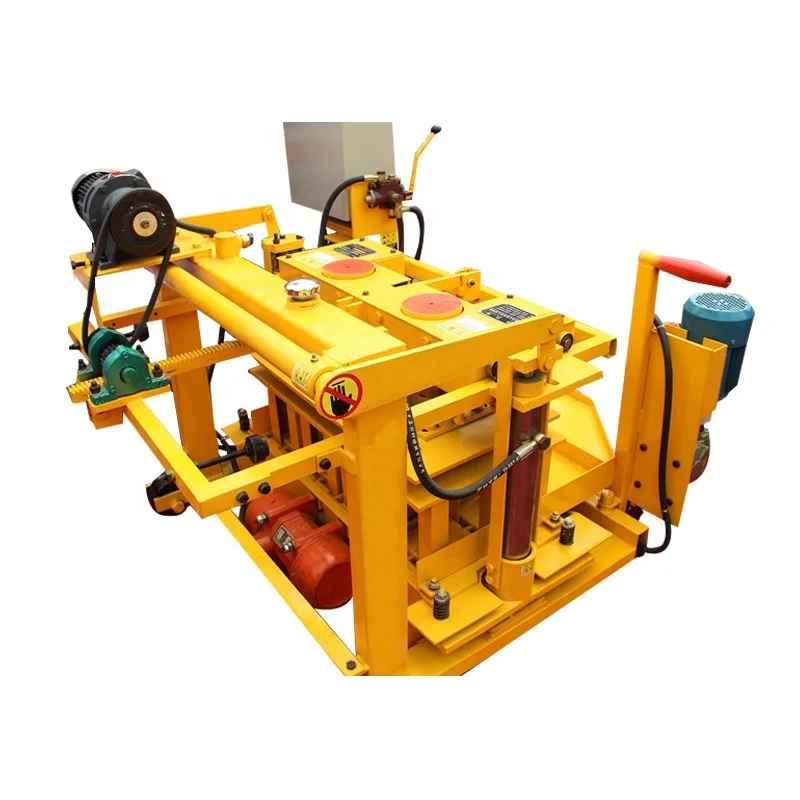
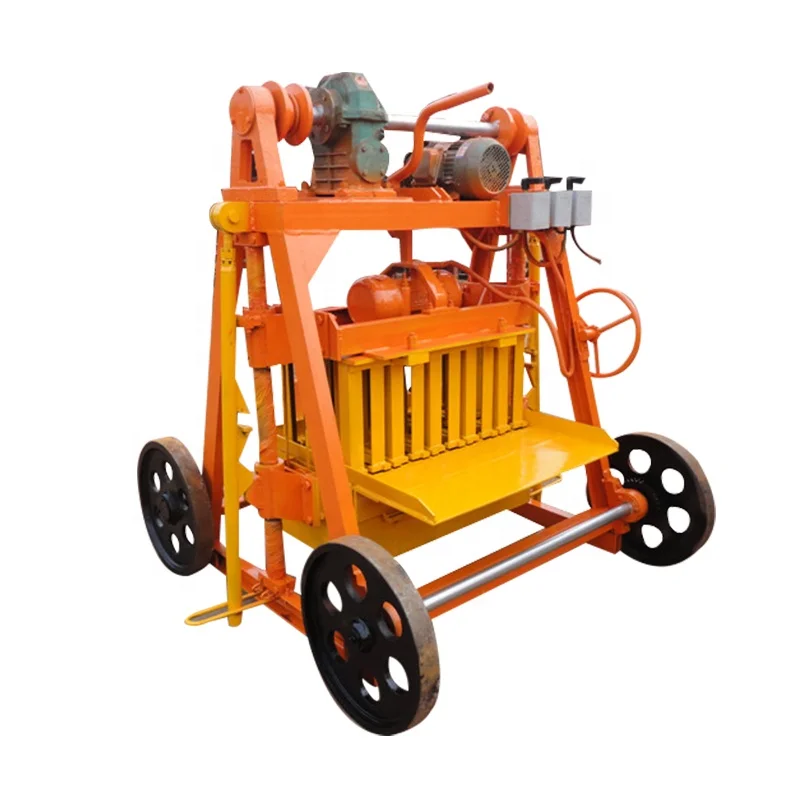
| Machine Type | Manual mobile block machine (egg-laying type) |
| Pallet Requirement | No pallets required |
| Labor Requirement | 1 to 3 workers |
| Cycle Time | 25–30s |
| Output (400×200×200mm hollow brick) | 2 pcs/mould, 160 pcs/hour, 1280 pcs/8hr |
| Output (400×150×200mm hollow brick) | 3 pcs/mould (basis to be confirmed) |
| Output (400×100×200mm hollow brick) | 4 pcs/mould, 320 pcs/hour, 2560 pcs/8hr |
| Mould Format Range | 400×200×200mm, 400×150×200mm, 400×100×100mm hollow brick |
| Automation Level | Manual / hand-pushed mobile |
| Mobility | Hand-pushed, free movement |
| Control System | Manual operation (no PLC) |
| Stacking Method | Manual |
| Voltage & Frequency | Configurable (basis to be confirmed before dispatch) |
| Standards | ISO9001:2000, CE |
Application Suitability
| Application | Material or Output |
|---|---|
| Small-scale hollow brick production on-site | Crushed stone, sand, cement, water |
| Low-investment block production for local projects | Crusher dust, gravel, cement blend |
| Entrepreneur first block plant with limited space | River sand, stone powder, cement mix |
| Construction contractor on-site production | Local aggregate, cement, water |
| Housing project contractor local production | Available regional aggregate and cement |
What "Cycles per Hour" Leaves Out About QMJ2-45 Mobile Block Machine Specifications
Capacity only means something when tied to the exact block format you intend to sell.
Many mobile block machines are advertised with a single headline output figure that assumes a specific hollow brick size. When the buyer switches to a different mould, the actual daily production can fall noticeably short of expectation. The QMJ2-45 mobile block machine specifications here list output per hollow brick format — 400×200×200mm, 400×150×200mm, and 400×100×200mm — so the cycle time of 25–30s translates into a transparent daily number for each product. [NEED_CITE: block machine capacity calculation standards by format]
I have seen mobile egg-laying machines arrive at West African project sites where the supplier quoted a single hourly figure without clarifying which block size it assumed. The buyer planned an entire housing phase around that number, only to find the 150mm wall blocks required for the design produced noticeably fewer units per shift. Honest capacity disclosure per format prevents that mismatch before the purchase order is signed.
Matching Mould Format to Local Market Demand
The QMJ2-45 mobile block machine supports three hollow brick formats through mould change: 400×200×200mm for load-bearing walls, 400×150×200mm for partition and infill, and 400×100×200mm for non-structural interior use. Each format produces a different number of pieces per mould — two, three, or four respectively — which directly affects shift output. Buyers who know which format dominates their local market can select the mould set that maximises daily production against their order book.
No-Pallet Production and What It Simplifies
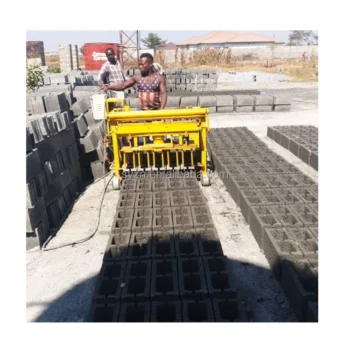
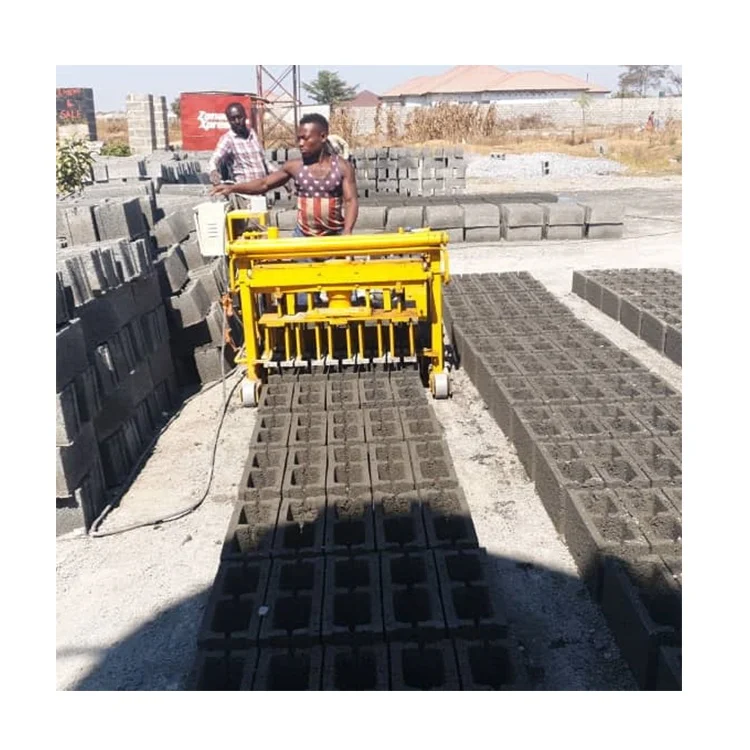
The egg-laying design means the QMJ2-45 mobile block machine deposits blocks directly onto the ground or a prepared curing surface, eliminating pallet cost entirely. For a small-site producer, this removes the need to purchase, store, rotate, and replace hundreds of production pallets. Curing area layout becomes straightforward: blocks are laid in rows where the machine walks, and workers simply cover and water them without moving pallets through a separate handling loop. [NEED_CITE: pallet versus palletless mobile block production logistics]
Reading the Specification Sheet Beyond Headline Numbers
Cycle time of 25–30s is the core rhythm that governs output across all three formats. With the 400×200×200mm mould producing two pieces per cycle, the realistic rate sits at roughly 160 blocks per hour, reaching approximately 1280 in an eight-hour shift under continuous operation. The 400×100×200mm mould doubles the pieces per cycle to four, lifting the hourly rate to around 320. Understanding these relationships lets a buyer plan labour, raw material delivery, and curing space against the actual format in production rather than a generic promise.
Voltage and frequency remain configurable, and this is where I insist on confirmation before any machine of this class leaves the factory. A manual mobile machine still relies on an electric motor for vibration, and plugging a 380V/50Hz motor into a 220V/60Hz site supply will either stall the motor or burn the winding within minutes. Every QMJ2-45 dispatch should be preceded by written confirmation of the buyer’s site voltage, frequency, and phase.
The Cost of Overlooking Format and Voltage Details
When a mobile block machine is ordered without confirming which hollow brick format drives local demand, the buyer often discovers after arrival that the standard mould does not match the project specification. Mould change is possible, but if the alternative mould was never ordered, production halts until a replacement arrives. Similarly, unconfirmed voltage leads to motor replacement on site, adding weeks of idle time to a project that expected immediate output. [NEED_CITE: on-site motor replacement delays for exported machinery]
Why Sourcing the QMJ2-45 Here Reduces Specification Risk
Block machinery is the single focus of this operation, meaning the machine, mould, and handling approach are specified as one matched system rather than assembled from unrelated suppliers. Configuration is set against the buyer’s actual mix design and local aggregate, not a catalogue default. Mould design covers the exact hollow brick dimensions the buyer’s market requires, including custom drawings where standard formats do not apply. The QMJ2-45 ships only after voltage, frequency, and motor specification are confirmed in writing against the buyer’s site supply, drawing on lessons learned from early field experience where unconfirmed electrical specs caused project-wide delays.
Documentation & Verification
- Line layout and capacity calculation stating the hollow brick format assumed for daily output
- Mould drawing and format list confirming the exact dimensions your market requires
- Voltage and frequency confirmation sheet signed before production begins
- Factory test record on your specified hollow brick format before dispatch
- Operation and maintenance manual covering mould change and daily checks
- Wear parts and mould list identifying items for first replacement
Installation, Commissioning & Support
- Level compacted ground or concrete floor required for egg-laying block deposition without pallet support
- Site electrical supply matching confirmed voltage and frequency must be available before the QMJ2-45 motor is connected
- Machine arrives assembled; hand-pushed mobility allows positioning without crane or forklift on small sites
- First production run supervised to verify cycle time, block density, and mould alignment on local aggregate
- Mould change procedure trained on site so operators switch between hollow brick formats within a shift
- Wear parts list provided with recommended replacement intervals based on local material abrasiveness
Before You Request a Quotation
To size a QMJ2-45 mobile block machine to your project, share the hollow brick format your market sells most, your target daily output, and the local aggregate you plan to use. Confirm your site voltage, frequency, and phase so the motor specification is locked before production. If you have an existing curing area or constrained site footprint, provide approximate dimensions so we can verify the machine’s walking path and block spacing will fit.
Frequently Asked Questions
Q: How is daily output calculated per hollow brick format on the QMJ2-45?
A: Output is derived from the 25–30s cycle time multiplied by the number of pieces each mould produces per cycle. For the 400×200×200mm format, two pieces per cycle yields approximately 160 blocks per hour. Each format has its own calculation, so the buyer sees the real shift number for the block they actually plan to sell rather than a single generic figure.
Q: What block formats can the QMJ2-45 produce and how long does a mould change take?
A: The machine covers 400×200×200mm, 400×150×200mm, and 400×100×200mm hollow brick through mould swap. Mould change is a manual process completed with basic hand tools. Operators trained during commissioning can typically switch formats and resume production within the same shift, keeping format flexibility practical rather than theoretical.
Q: Does the QMJ2-45 require pallets for production?
A: No. The egg-laying design deposits blocks directly onto the ground or a prepared curing surface. This eliminates pallet purchase, storage, and rotation costs entirely. The curing area simply needs to be level and accessible, with blocks laid in rows as the machine moves forward across the site.
Q: What mix design does the QMJ2-45 need for consistent block strength?
A: The machine works with standard cement, local aggregate, sand, and water mixes typical for hollow block production. Consistent block strength depends on matching vibration time and mix proportion to the local material. Configuration is reviewed against the buyer’s available aggregate before the machine ships so the mix does not need costly adjustment after arrival.
Q: What electrical details must be confirmed before the QMJ2-45 is dispatched?
A: Site voltage, frequency, and phase must be confirmed in writing before the motor is specified. Even a manual mobile machine relies on an electric motor for vibration, and an incorrect match will stall or burn the winding on site. Written confirmation prevents the delays that occur when electrical specs are assumed rather than verified.