Brick Machine Price in Kazakhstan: 2026 Buyer Guide
The quoted brick machine price in Kazakhstan is never the final landing cost. Buyers who focus solely on the FOB invoice routinely discover that freight, customs clearance, voltage adaptation, and on-site commissioning inflate the real investment by a substantial margin. For a standard semi-automatic line, the brick machine price in Kazakhstan typically falls into a mid-five-figure USD range at the factory gate, but the total project cost can climb noticeably higher once logistics and local infrastructure adjustments are factored in.
From my years walking factory floors in Linyi and standing beside machines in Almaty suburbs, I have seen the gap between brochure price and operational reality close only when buyers understand what actually drives cost. The brick machine price in Kazakhstan depends on three variables: production capacity class, automation level, and electrical grid adaptation. [NEED_CITE: concrete block machine pricing factors in Central Asian markets]
Let me walk you through each layer so you can evaluate any quotation with confidence.
What Determines Brick Machine Price in Kazakhstan?
Capacity tier, automation depth, and electrical compatibility form the pricing triangle. A mobile egg-laying unit sits at the entry end, while a fully automatic line with batching plant and stacking system occupies the top tier. Between them, the brick machine price in Kazakhstan shifts according to how much human labor the machine replaces and how robust its control system must be for local power conditions.
Kazakhstan’s industrial grid, particularly outside Almaty and Astana, suffers from frequent voltage fluctuations. [NEED_CITE: industrial power quality standards in Central Asian republics] I remember a project near Shymkent where a newly installed automatic line lost two main control boards within the first week because the local supply dropped below acceptable thresholds repeatedly. The machine itself was fine, but the unprotected electronics could not survive the environment. That incident reshaped how we approach electrical specification for every unit heading to the region.
The pricing structure breaks down as follows:
| Factor | Entry-Level | Mid-Range | Fully Automatic |
|---|---|---|---|
| Automation | Manual/Semi-Manual | Semi-Auto with PLC | Full PLC with Auto-Stacking |
| Electrical Adaptation | Basic Surge Protection | Standard Voltage Regulator | Custom Grid Simulation Tested |
| Voltage Stability Tolerance | Narrow | Moderate | Robust |
| Operator Requirement | Multiple | Reduced | Minimal |
| Price Tier | Lowest | Moderate | Highest |
[NEED_CITE: brick machine automation levels and cost correlation]
Buyers comparing the brick machine price in Kazakhstan across suppliers must ensure they are comparing equivalent automation and electrical protection levels. A cheaper quotation often means thinner steel in the mold box, basic relay logic instead of PLC control, and no voltage regulation equipment. Those savings disappear quickly when the machine cannot run continuously or when control boards need replacement every few months.
How Much Do Different Brick Machine Models Cost?
The brick machine price in Kazakhstan follows a clear阶梯 structure based on daily output capacity. Manufacturers in Shandong province offer a product range that covers every scale of operation, from a single entrepreneur starting with a mobile layer to a government contractor building a large-scale housing material plant.
Here is how the typical model lineup compares:
| Model | Daily Output Range | Automation Level | Typical Application | FOB Price Position |
|---|---|---|---|---|
| QT4-25 | Low | Mobile Egg-Laying | Entry-level, rural blocks | Most Affordable |
| QT4-15 | Low-Moderate | Semi-Auto Stationary | Small yard operations | Affordable |
| QT6-15 | Moderate | Semi-Auto with Conveyor | Growing private plants | Mid-Range |
| QT10-15 | High | Full Auto with Batching | Commercial block yards | Upper Mid-Range |
| QT12-15 | Very High | Full Auto with Stacking | Large-scale production | High |
| QT15-15 | Maximum | Full Auto with Multi-Line | Industrial plant | Premium |
[NEED_CITE: concrete block machine model specifications and output ranges]
A private investor in Karaganda recently started with a QT4-25 mobile machine. The unit cost was modest, and he produced standard hollow blocks using locally sourced sand and cement. Within a short period, he recovered his equipment investment and expanded to a second unit. The key was matching the machine scale to his available capital and local demand, not overreaching into a larger model he could not fully utilize.
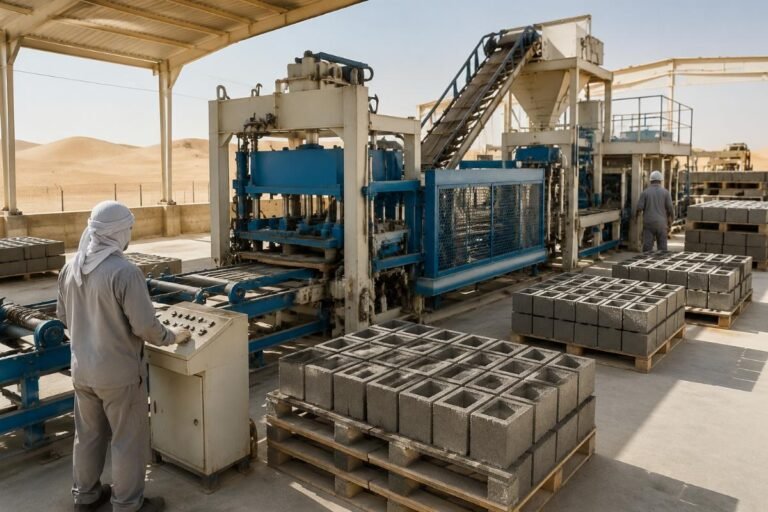
For mid-sized operations replacing older manual equipment, the QT6-15 or QT10-15 represents the practical upgrade path. These models bring conveyor-fed material handling, PLC-controlled cycle timing, and hydraulic vibration that produces denser, more consistent blocks. The brick machine price in Kazakhstan for these models remains accessible for established yard owners who have cash flow from existing operations.
Government infrastructure projects typically specify the QT12-15 or QT15-15 class. These lines include automatic batching plants, color feeders for paver production, pallet circulation systems, and high-rack stackers. The total line investment is significantly higher, but the per-block labor cost drops dramatically, and output volume meets tender requirements for large housing or road paving contracts.
Shandong Shiyue manufactures the full spectrum from QT4-25 through QT15-15, with each model undergoing electrical simulation testing before shipment to ensure compatibility with Kazakhstan’s grid conditions. The factory maintains standard configurations for quick delivery while offering customization for specific raw material characteristics or site layout constraints.
What Are the Hidden Costs of Importing to Kazakhstan?
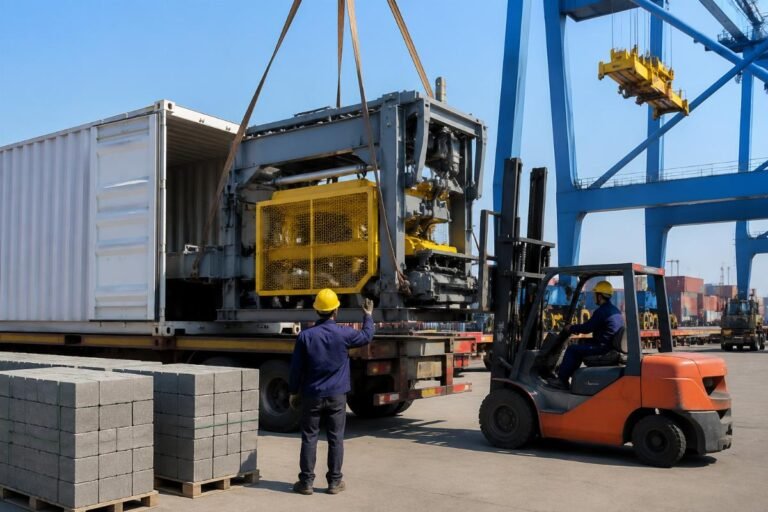
The brick machine price in Kazakhstan at the factory gate represents only a portion of your total project expenditure. Freight, customs duties, voltage adaptation equipment, foundation work, and commissioning labor collectively add a substantial layer to the final cost. Buyers who budget only for the machine invoice frequently face cash shortfalls during installation.
The cost structure for a complete import project includes:
| Cost Component | Description | Budget Impact |
|---|---|---|
| FOB Machine Price | Equipment cost at Shandong factory | Base |
| Sea Freight to Poti/Batumi | Container shipping to Black Sea port | Moderate |
| Overland Transport to Kazakhstan | Truck or rail from port to site | Moderate to High |
| Customs Clearance & Duties | EAEU tariff classification and VAT | Noticeable |
| Voltage Regulation Equipment | Stabilizers, transformers, control upgrades | Moderate |
| Foundation & Civil Works | Concrete pads, drainage, power connection | Variable |
| Installation & Commissioning | Technician travel, lodging, labor | Moderate |
| Operator Training | On-site instruction, recipe development | Low to Moderate |
[NEED_CITE: machinery import logistics costs to Central Asian landlocked countries]
A buyer in Aktau learned this lesson the hard way. He negotiated an excellent brick machine price in Kazakhstan for a QT6-15 line, but when the container arrived, he had not budgeted for the three-phase power upgrade his facility required. The local grid connection only supported single-phase, and bringing in three-phase service involved transformer installation and municipal approval delays. The project stalled for weeks while he scrambled to arrange funding.
Voltage adaptation deserves special attention. Kazakhstan uses a 380V/50Hz three-phase standard, but actual supply at many industrial sites fluctuates well outside acceptable tolerances for sensitive PLC equipment. [NEED_CITE: industrial voltage standards and tolerance requirements in EAEU countries] Installing a dedicated voltage stabilizer is not optional for automatic lines; it is essential insurance against control board failure. The stabilizer cost is modest compared to the expense of replacing fried electronics or losing production days.
Shandong Shiyue addresses this by performing grid simulation testing on every control cabinet before shipment. The electrical team replicates the voltage fluctuation patterns common in Central Asian industrial zones and verifies that the PLC, inverters, and sensor circuits operate reliably under those conditions. This pre-departure validation eliminates the most common cause of early-field electronic failure.
How to Calculate ROI for Your Brick Plant Investment?
Return on investment for a block manufacturing operation depends on local material costs, block selling price, labor expenses, and machine utilization rate. The brick machine price in Kazakhstan is your starting capital outlay, but the payback timeline is determined by how efficiently you convert raw materials into sellable product.
The ROI calculation framework includes:
| Variable | Impact on Payback |
|---|---|
| Raw Material Cost (cement, sand, aggregate) | Direct margin driver |
| Local Block Selling Price | Revenue per unit |
| Labor Cost per Shift | Operating expense |
| Machine Utilization Rate | Fixed cost absorption |
| Maintenance & Spare Parts | Ongoing operational cost |
| Electricity Consumption | Utility expense |
[NEED_CITE: concrete block manufacturing profitability analysis methods]
A private investor in Pavlodar operated a QT4-25 mobile machine producing standard 400x200x200mm hollow blocks. His cement cost was moderate, sand was sourced from a nearby quarry at low expense, and he sold blocks to local builders at a competitive price. With minimal labor, running the machine during daylight hours, he recovered his equipment cost within a relatively short period. The mobile design allowed him to produce directly at small construction sites, eliminating transport cost for the customer and commanding a slight price premium.
For larger operations running QT10-15 or QT12-15 lines, the ROI model shifts toward volume efficiency. The higher automation reduces labor cost per block, and the consistent quality supports sales to larger contractors who require certified material. The brick machine price in Kazakhstan for these models is higher, but the per-block production cost drops substantially, and the payback period remains attractive when utilization rates are high.
The critical factor is utilization. A machine sitting idle for half the day cannot generate sufficient revenue to justify its capital cost. Successful operators in the region plan production schedules around local construction seasons, secure forward contracts with builders before the machine arrives, and maintain spare part inventory to minimize downtime. The brick machine price in Kazakhstan becomes a sound investment only when the equipment runs consistently and the market absorbs the output.
Why Choose Chinese Manufacturers Over European or Turkish Suppliers?
Chinese manufacturers offer a compelling combination of competitive pricing, proven adaptation to emerging market conditions, and responsive after-sales support. When evaluating the brick machine price in Kazakhstan against European or Turkish quotations, buyers must consider total value, not just initial invoice amount.
The comparison landscape looks like this:
| Factor | Chinese Manufacturer | European Manufacturer | Turkish Manufacturer |
|---|---|---|---|
| Equipment Price | Most Competitive | Premium | Moderate |
| Electrical Adaptation Experience | Extensive for Central Asia | Limited | Moderate |
| Spare Parts Availability | Readily accessible | Expensive, long lead time | Moderate |
| On-Site Installation Support | Included, rapid response | Extra cost, delayed scheduling | Variable |
| Customization Flexibility | High | Low | Moderate |
| Certification (CE/SGS/ISO) | Standard | Standard | Standard |
[NEED_CITE: concrete block machine manufacturer comparison by region]
A government contractor in Astana was preparing a tender for a public housing project requiring a fully automatic block line. He received quotations from a German supplier, a Turkish supplier, and Shandong Shiyue. The European price was substantially higher, and the delivery timeline extended well beyond the project schedule. The Turkish option was moderate in price but lacked specific experience with Kazakhstan’s voltage instability. The Chinese quotation came in at a significantly lower price point, included on-site installation and operator training, and the electrical team had already adapted multiple lines for similar grid conditions in the region.
The contractor chose the Chinese supplier. The machine arrived, was installed, commissioned, and the local operators were trained within a compact timeframe. The line met the tender’s output requirements, and the voltage adaptation held up through the first summer of continuous operation. The brick machine price in Kazakhstan from the Chinese manufacturer delivered the performance needed at a budget the project could support.
Shandong Shiyue operates from a substantial facility in Linyi, Shandong province, with a large engineering team supporting design, production, and after-sales service. The factory exports to numerous countries across multiple regions, and the experience gained in diverse operating environments informs every machine built. For Kazakhstan buyers, this means the brick machine price in Kazakhstan comes with the confidence that the equipment has been field-proven in conditions similar to their own.
Conclusion
The brick machine price in Kazakhstan is a function of capacity, automation, and electrical adaptation, with hidden import costs adding substantially to the factory invoice. Buyers who evaluate total project cost, verify electrical compatibility, and calculate ROI based on local market conditions make sound investment decisions. Chinese manufacturers deliver competitive pricing combined with emerging market adaptation experience, offering a practical path to profitable block production in Kazakhstan.