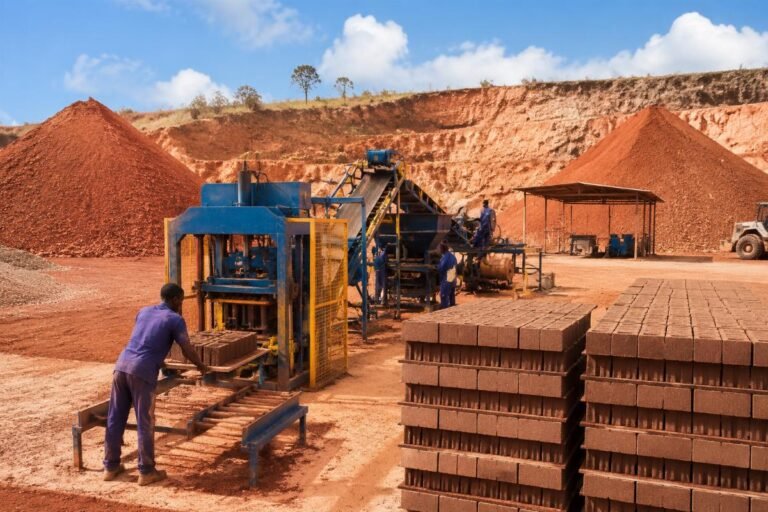
QT10-15/QT12-15 Block Machine Manufacturer for Sale
Buying the highest-output block machine does not guarantee the fastest return — it often guarantees the biggest idle capacity bill.
A block machine business setup investment succeeds only when equipment tier, local raw material supply, site infrastructure, and actual market absorption rate are matched before the purchase order is signed.
I have stood inside block plants from Jeddah to Lagos, watching fully automatic lines sit half-loaded because the local market could not absorb the daily output, while a modest semi-automatic setup two streets away ran three shifts and turned a profit inside a year. The difference was never the brand on the control panel — it was whether the investor had done the homework on demand volume, cement grade availability, and power stability before committing capital. [NEED_CITE: equipment selection criteria for concrete block plants in emerging markets]
Let me walk through what actually determines whether a block machine business setup investment pays off — based on field observations, not brochure specs.
What Equipment Tier Matches Your Target Market?
The correct machine model is the one that matches your confirmed daily sales volume, not the one with the most impressive cycle time on paper.
Investors routinely overestimate demand in the first year. I have seen buyers in the Gulf region order top-tier fully automatic lines based on projected government housing contracts, only to find that procurement cycles stretched far longer than expected and the machine sat idle for months. Meanwhile, the rental income on the oversized factory lot kept burning cash.
| Factor | Semi-Automatic Tier | Mid-Range Automatic Tier | High-Output Automatic Tier |
|---|---|---|---|
| Typical Daily Output Range | Moderate volume, single-shift viable | Substantial volume, two-shift capable | Maximum volume, continuous operation |
| Operator Skill Requirement | Basic mechanical familiarity | PLC navigation competence | Dedicated maintenance technician |
| Mold Changeover Flexibility | Noticeably quick | Standard procedure | Requires extended calibration |
| Suitable Site Footprint | Compact footprint | Standard industrial lot | Large-scale facility required |
| Raw Material Consumption Rate | Manageable for local sourcing | Requires organized bulk supply | Demands silo-level storage infrastructure |
[NEED_CITE: block machine capacity selection methodology based on regional construction demand]
A private investor in the Middle East started with a mid-range automatic configuration. His reasoning was straightforward: the local market consumed standard hollow blocks and interlocking pavers in moderate daily volumes, and labor turnover was high. A fully automatic line would have required a dedicated PLC technician — a role that saw turnover every few months in that specific area. The semi-automatic tier would have left money on the table during peak season. The mid-range tier gave him room to scale without creating a dependency on scarce technical labor.
The lesson: match the machine to the confirmed order book, not the aspirational one.
How Much Does a Complete Block Plant Actually Cost?
Equipment purchase price typically represents only a portion of total project cost — raw material stockpiling, site preparation, and power infrastructure often consume an equal or larger share.
First-time investors fixate on the machine quotation and treat it as the total investment figure. This is a dangerous miscalculation. I have reviewed project budgets where the equipment was delivered on schedule, but the investor had not budgeted for electrical transformer upgrades, water reservoir construction, or the initial bulk cement and aggregate procurement needed to run commissioning trials.
| Cost Category | Relative Weight in Total Investment |
|---|---|
| Core production equipment and molds | Major share |
| Site preparation and foundation work | Significant share |
| Raw material initial procurement | Substantial share |
| Power infrastructure upgrade | Noticeable share |
| Logistics, installation, and commissioning | Moderate share |
| Working capital reserve | Critical share |
[NEED_CITE: total project cost breakdown for concrete block manufacturing plant]
A contractor in West Africa budgeted carefully for the production line itself but underestimated the cost of importing the first several containers of cement before local supply chains were established. The delay compressed his operating cash flow severely. The equipment was world-class; the financial planning was incomplete.
Another investor in Latin America adopted a lease-first approach — renting a site and running a smaller configuration to validate demand before committing to a permanent facility and higher-output equipment. This phased strategy kept his initial capital exposure controlled and allowed him to negotiate better terms on raw material supply once volumes were proven.
The takeaway: build your budget around the total system, not the invoice price of the machine.
What Infrastructure Conditions Must Your Site Meet?
Voltage stability, reliable water supply, and adequate raw material storage area are the three non-negotiable prerequisites before any block machine business setup investment proceeds.
I have walked into sites where the machine was installed perfectly, the molds were precision-machined, and the batch plant was calibrated — but the local grid could not sustain the voltage required during peak motor startup. The result: repeated breaker trips, control board damage, and production delays that lasted weeks until a dedicated transformer was procured and installed.
In arid regions, dust infiltration is the silent killer of hydraulic systems and sensor arrays. A plant in the Gulf region went through multiple proximity sensor replacements in its first months because the electrical cabinets were not specified with adequate dust ingress protection for the local environment. Once sealed enclosures and positive-pressure filtration were added, the failure rate dropped dramatically.
Water supply is equally critical. Concrete block production is water-intensive. Sites that rely on municipal supply without backup reservoir capacity face production halts during seasonal shortages. A minimum on-site water storage buffer is essential.
| Infrastructure Element | Requirement Level |
|---|---|
| Power supply stability | Strictly controlled |
| Water availability and storage | Substantially buffered |
| Raw material yard space | Adequately sized for multi-week stockpile |
| Drainage and sediment management | Standard compliance |
| Access road for heavy vehicle delivery | Robust construction |
[NEED_CITE: site infrastructure prerequisites for concrete block plant commissioning]
A manufacturer’s field engineering team typically conducts site assessments before confirming equipment specifications. This step is not a sales formality — it prevents costly retrofits after installation. Investors who skip this stage and assume their site is "good enough" frequently discover otherwise during commissioning.
How Long Until the Investment Pays Back?
Payback speed is determined by capacity utilization rate, not by the machine’s maximum rated output.
A machine that can produce at full rated capacity but runs at partial utilization due to weak market demand will never recover its investment on schedule. The critical threshold is sustained utilization above a defined level — below that threshold, fixed costs erode margins faster than production revenue can rebuild them.
[NEED_CITE: capacity utilization break-even analysis for concrete block manufacturing]
The payback calculation depends on three variables working in concert:
- Unit production cost — determined by local cement price, aggregate sourcing distance, labor rates, and electricity tariff
- Local market selling price — determined by competition density, product differentiation, and transportation radius
- Daily capacity utilization — determined by confirmed order volume and shift planning
An investor in East Africa ran his mid-range automatic line at two shifts for the first several months, achieving utilization rates that allowed him to recover the equipment cost well ahead of the conservative projection. His advantage was not the machine — it was a pre-existing relationship with a housing contractor that guaranteed baseline daily offtake.
Conversely, an investor who purchased a high-output line based on a projected infrastructure boom found that the projects were delayed by permitting processes. His utilization rate stayed well below the break-even threshold for an extended period, and the working capital reserve was exhausted before demand materialized.
The principle: secure demand commitments before sizing the equipment, not after.
What Hidden Costs Do First-Time Investors Overlook?
Mold wear rates, cement grade adaptation costs, and operator training duration are the three most consistently underestimated expense items in a new block plant.
Mold wear is a function of aggregate hardness and production volume. In regions where local aggregate contains high silica content or is sourced from crushed rock rather than river gravel, mold wear accelerates noticeably. An investor who budgets mold life based on standard assumptions may find replacement cycles arriving far sooner than expected. The cost of replacement mold sets over the first few years can represent a meaningful portion of total operating expense.
Cement grade variation across regions is another hidden variable. The mix design that produces optimal block strength in one country may require adjustment when cement chemistry differs. I have observed plants where the initial commissioning batch used the manufacturer’s standard recipe, only to discover that local cement required a different water-to-cement ratio and admixture proportion to achieve the same compressive strength. The trial-and-error period to optimize the local recipe consumes raw material and delays full production — costs that rarely appear in the initial budget.
| Hidden Cost Category | Typical Impact |
|---|---|
| Mold replacement frequency | Substantially extended beyond standard assumption in hard-aggregate regions |
| Mix design adaptation | Noticeably delayed production ramp-up |
| Operator training curve | Extended period before full shift efficiency |
| Spare parts inventory buildup | Moderate upfront capital lock |
| Seasonal demand fluctuation reserve | Critical for cash flow continuity |
[NEED_CITE: common cost underestimation factors in new concrete block plant projects]
Operator training deserves specific attention. A fully automatic line with PLC-controlled cycles requires operators who can interpret alarm codes, perform basic sensor checks, and execute mold changeover procedures. In markets with high labor turnover, the training investment is recurring. Some investors address this by maintaining detailed visual standard operating procedures on-site and cross-training multiple operators — a practice that reduces vulnerability to individual departures.
A manufacturer’s after-sales support structure becomes critical here. Access to remote technical guidance, spare parts supply, and periodic on-site service visits determines whether a minor fault becomes a multi-day shutdown or a same-day resolution.
Conclusion
A successful block machine business setup investment is built on demand validation, infrastructure readiness, and total cost visibility — not on equipment specifications alone. Match your machine tier to confirmed market absorption, budget for the complete system rather than the machine invoice, verify site infrastructure before installation, and plan for the hidden costs that emerge during the first operating year. The machine is the engine — but the business model is the fuel.