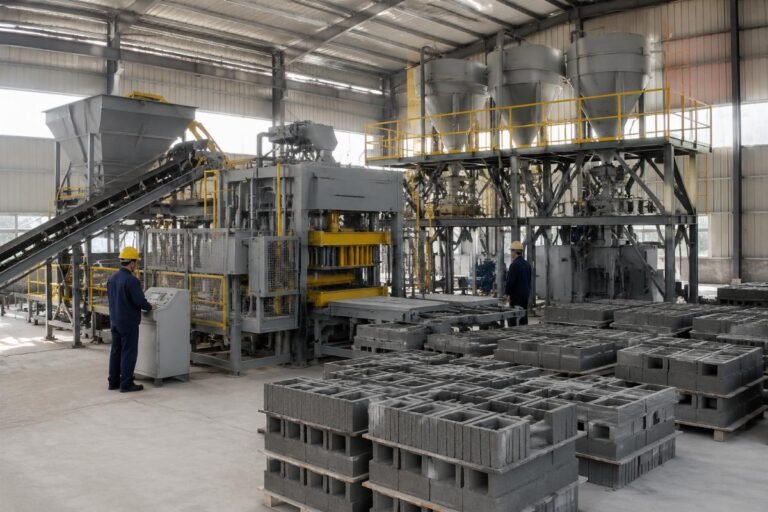
Concrete Block Machine Price in Thailand: QT10-15 Wholesale Supplier 2026
The hydraulic cooling circuit and PLC component grade determine machine survival in tropical heat far more than the base frame price ever will.
A complete concrete block machine price in Thailand for a mid-scale investor typically covers the main host unit, hydraulic station with tropical-spec cooling, mold sets, batcher, conveyor system, pallet handling, electrical cabinet with voltage stabilization, plus sea freight, site foundation, and commissioning. Focusing solely on the host machine quote while ignoring climate adaptation and hidden logistics costs is the single most common reason Thai buyers face extended downtime and mid-six-figure penalty losses.
I still remember a video call at two in the morning from a Thai client whose newly arrived line had stopped three times in a single week. The electrical cabinet kept frying. Their local grid voltage swung wildly during monsoon season, and the machine they had purchased was wired with basic-grade contactors and zero surge isolation. Every restart meant a full mold change, lost curing cycles, and penalties from their housing contractor. The改造 cost to rewire the cabinet and add industrial-grade stabilization ended up costing several times what a proper tropical-spec electrical package would have added at the factory. [NEED_CITE: voltage fluctuation impact on industrial control equipment lifespan per IEC 61131-2] That incident reshaped how every quotation for a concrete block machine price in Thailand is structured today — starting with the site power supply survey before a single component is selected.
Let us break down what actually goes into the real concrete block machine price in Thailand, which model fits which project scale, why tropical climate kills poorly specified machines, and what hidden costs catch buyers off guard.
How Much Does a Concrete Block Machine Actually Cost in Thailand?
The host machine is only the visible tip of a much larger investment iceberg, with auxiliary systems, climate adaptation, molds, and logistics forming the submerged bulk.
When Thai investors first request a concrete block machine price in Thailand, they usually receive a number for the main block forming unit alone. This creates a dangerous illusion. A complete production line requires a batcher, cement silo, screw conveyor, belt conveyor, pallet loader, stacker, mixer, and the entire hydraulic and electrical infrastructure. Stripping these out to show a lower headline price is a common tactic among low-cost suppliers, but the buyer will inevitably spend multiples of the "savings" on local sourcing, mismatched integration, and retrofitting. [NEED_CITE: typical auxiliary equipment ratio in concrete block plant total investment]
| Cost Component | Entry-Level Package | Mid-Range Package | Full Turnkey Package |
|---|---|---|---|
| Host Machine | Basic frame, standard hydraulics | Reinforced frame, tropical cooling | Heavy-duty frame, dual cooling circuits |
| Electrical Cabinet | Domestic contactors, no stabilization | Industrial-grade, basic surge protection | PLC with voltage tolerance, full isolation |
| Mold Sets | One size included | Multiple sizes, wear-resistant treatment | Custom molds + spare set |
| Batching System | Manual volume measurement | Semi-auto weigh batcher | Fully automatic with moisture compensation |
| Logistics & Installation | FOB port only | CIF + basic guidance | Door-to-door + foundation + training |
A private investor in Chonburi once compared two quotations for a concrete block machine price in Thailand. The cheaper option looked attractive until the buyer realized the hydraulic station had no oil cooler — in Thailand’s ambient temperatures pushing into the high thirties, hydraulic oil would degrade rapidly, seals would harden, and valve spools would stick. The "savings" would have been wiped out within a single hot season through seal replacements and unplanned stops. [NEED_CITE: hydraulic fluid degradation rate at elevated ambient temperatures]
The lesson is straightforward: the real concrete block machine price in Thailand must be evaluated as a complete system, not a single machine. Shandong Shiyue approaches every Thai quotation by first mapping the buyer’s site conditions — grid stability, ambient temperature range, humidity, raw material availability — and then building the specification around those constraints. This is why the electrical cabinets shipped to Thailand use industrial-grade PLCs with wide voltage tolerance and the hydraulic stations come fitted with oversized cooling circuits as standard, not as paid extras.
Which Block Machine Model Fits Your Thai Project?
Model selection must start from daily output targets and available site footprint, not from the lowest unit price on a spreadsheet.
Thai buyers typically fall into three categories: small-scale entrepreneurs entering the market, mid-size contractors expanding into block production, and established players upgrading from manual or semi-auto lines. Each needs a different point on the model spectrum, and the concrete block machine price in Thailand shifts dramatically across these tiers. [NEED_CITE: block machine model selection criteria based on production capacity and site constraints]
| Parameter | QT4-25 Mobile Type | QT6-15 Semi-Auto Line | QT10-15 Fully Auto Line |
|---|---|---|---|
| Daily Output Capacity | Low, suitable for starter operations | Medium, covers most housing projects | High, serves large infrastructure contracts |
| Automation Level | Manual mold change, egg-laying type | Semi-automatic with pallet circulation | Full PLC control, auto feeding, stacking |
| Labor Requirement | Noticeably higher per block | Moderate crew needed | Substantially reduced, minimal operators |
| Site Footprint | Compact, mobile positioning | Standard layout | Large, requires dedicated foundation |
| Investment Range | Entry-level budget | Mid-range commitment | Significant capital outlay |
A contractor in Rayong was producing standard hollow blocks for a government housing project using a QT6-15 configuration. Their daily output was sufficient, but labor costs were eating into margins. When they evaluated upgrading to a QT10-15 fully automatic line, the concrete block machine price in Thailand for the upgrade looked steep initially. However, the labor savings alone — reducing the crew by a substantial proportion — meant the investment recovered within a single construction season. The higher output capacity also let them take on a second contract simultaneously. [NEED_CITE: labor cost reduction ratio when upgrading from semi-auto to fully automatic block lines]
Conversely, a first-time investor in Chiang Mai started with a QT4-25 mobile egg-laying machine. The low concrete block machine price in Thailand for this entry model allowed them to test the local market, learn curing cycles, and build a customer base without heavy capital risk. Once demand stabilized, they upgraded to a QT6-15 stationary line with confidence.
Shandong Shiyue maintains the full model range from QT4-25 through QT10-15 and QT12-15, allowing Thai buyers to start small and scale up within the same equipment ecosystem. Mold compatibility across upgrades means the initial mold investment is not wasted, and the control system architecture remains familiar to operators.
Why Do "Cheap" Machines Fail in Thailand’s Climate?
Tropical heat, monsoon humidity, and unstable grids destroy machines built to temperate-climate specifications, regardless of how robust the steel frame appears.
This is the single most underappreciated factor in the concrete block machine price in Thailand equation. A machine designed for European or northern Chinese conditions will look identical on the outside to one built for Southeast Asia. The differences are internal — in the hydraulic cooling capacity, the electrical component ratings, the seal materials, and the cable insulation grades. [NEED_CITE: environmental stress factors on hydraulic and electrical systems in tropical industrial equipment]
Thailand’s climate presents a triple threat:
First, ambient temperatures regularly exceed the design comfort zone of standard hydraulic systems. Without adequate cooling, hydraulic oil temperature climbs, viscosity drops, internal leakage increases, and the machine loses pressing force. Cycle times stretch, block density drops, and the product fails compressive strength tests. The operator blames the mold; the real culprit is the oil temperature.
Second, monsoon humidity penetrates electrical cabinets through condensation cycles. Basic-grade contactors corrode at the contact points. PLC input cards short out. The machine throws fault codes that reset temporarily but return within hours. A tropical-spec cabinet uses sealed enclosures with pressurized air filtration, stainless steel contactors, and conformal-coated circuit boards. [NEED_CITE: electrical component failure modes in high humidity tropical environments]
Third, and most critically, Thailand’s industrial power grid in many provincial areas experiences voltage sags and surges, particularly during thunderstorm seasons. Standard electrical cabinets with narrow voltage tolerance will shut down or, worse, allow damaged components to operate intermittently — creating ghost faults that are nearly impossible to diagnose.
A buyer in Nakhon Ratchasima purchased a machine from a supplier who quoted the lowest concrete block machine price in Thailand by stripping out the cooling system and using basic electrical components. Within weeks, the hydraulic oil was running so hot that seals were failing repeatedly. The electrical cabinet tripped almost daily during afternoon thunderstorms. The total downtime cost — measured in lost production, emergency seal shipments, and electrician callouts — dwarfed the initial price difference.
Shandong Shiyue engineers every machine destined for Thailand with tropical climate as the baseline assumption. Hydraulic stations include oversized plate-type oil coolers sized for continuous operation in high ambient temperatures. Electrical cabinets are built with wide-tolerance power supplies, industrial-grade surge protection, and sealed enclosures rated for tropical humidity. These are not optional upgrades — they are standard specification. This approach is why machines operating in Thailand under the Shandong Shiyue configuration consistently achieve extended service intervals compared to units built to temperate specifications.
What Hidden Costs Should Thai Buyers Prepare For?
Sea freight, site foundation work, installation supervision, operator training, and spare parts inventory form a substantial layer of cost that never appears in the initial machine quotation.
The advertised concrete block machine price in Thailand rarely tells the full story. Savvy buyers budget for the complete landing cost, which includes several elements that only become visible after the purchase order is signed. [NEED_CITE: hidden cost components in imported industrial equipment procurement]
Ocean Freight and Insurance. Shipping a complete block line from China to Laem Chabang or Bangkok port involves multiple containers for the host machine, batcher, silo, and conveyors. Freight rates fluctuate, and insurance for heavy machinery is a separate line item. Buyers who only compared FOB prices were shocked when the CIF reality landed.
Customs Clearance and Port Charges. Thailand’s import procedures for industrial machinery require specific documentation, including certificates of origin and conformity. Delays at port generate demurrage charges that accumulate daily. Working with an experienced shipping team matters enormously here. Shandong Shiyue’s export documentation team has long experience with Southeast Asian port requirements, ensuring paperwork is complete before the vessel departs.
Site Foundation and Civil Works. A fully automatic line like the QT10-15 requires a reinforced concrete foundation with precise embedded bolts and level tolerances. This civil work is the buyer’s responsibility and can represent a noticeable portion of the total project cost. Poor foundation work leads to machine misalignment, uneven block quality, and premature wear.
Installation, Commissioning, and Training. Flying engineers from China for on-site installation and commissioning involves travel, accommodation, and per-diem costs. However, skipping professional commissioning to save money is a false economy. Improperly calibrated machines produce out-of-spec blocks, waste raw materials, and develop mechanical issues that void warranty claims. Shandong Shiyue includes installation supervision and operator training in their turnkey packages for Thailand, ensuring the line runs correctly from day one and the local crew understands daily maintenance routines. [NEED_CITE: importance of professional commissioning for imported block machine lines]
Spare Parts Inventory. The tropical operating environment accelerates wear on seals, hydraulic hoses, and electrical contacts. Maintaining a basic spare parts inventory on site prevents a minor component failure from becoming a multi-day shutdown. Buyers who did not budget for an initial spare parts package found themselves paying emergency air freight for single seals — at many times the normal cost.
A mid-size Thai investor learned this the hard way. They had budgeted carefully for the host machine concrete block machine price in Thailand but had not allocated funds for foundation work or spare parts. When a hydraulic hose burst during the first month, emergency air freight for a replacement hose cost several times what a full initial spare kit would have set them back. The lesson was expensive but clear: the real investment is the total landing cost, not the machine invoice.
Conclusion
The true concrete block machine price in Thailand is a system-level investment shaped by climate adaptation, model selection, and complete logistics planning — not a single machine invoice. Buyers who evaluate total cost of ownership, demand tropical-spec hydraulic and electrical configurations, and budget for foundation through spare parts consistently achieve faster payback and longer equipment life than those who chase the lowest headline number.