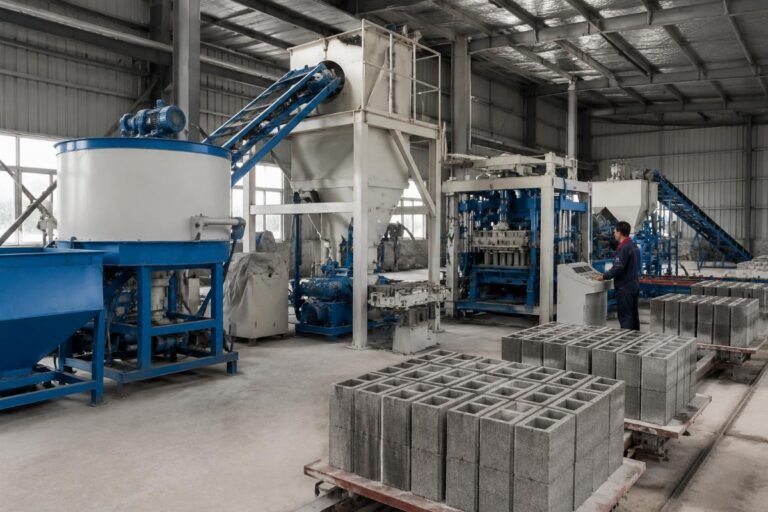
Buy Interlocking Brick Machine Bulk Order Deal
Most buyers think the lowest unit price wins the bid. The real cost killer is a servo valve frying on day three because the grid in your industrial zone swings wider than the machine’s tolerance.
When you place an interlocking brick machine bulk order, the three specs that actually determine whether your plant runs or sits idle are mould compression ratio customization for your local aggregate, hydraulic filtration rated for high-dust sites, and servo electronics built for wide-voltage fluctuation. Ignore any one of them, and your downtime losses will dwarf whatever you saved on the invoice.
I spent years sourcing block lines for a Dubai-based contractor who insisted on a European-branded interlocking brick machine bulk order because the brochure looked clean. The equipment landed at Ruwais Industrial City, and within a week the servo valves started burning out every time the site voltage dipped. Local dust clogged the hydraulic filters so fast that maintenance crews were swapping cartridges weekly instead of monthly. The machine sat dead for over a month. The client threw the contract at me. That job reshaped how I evaluate every interlocking brick machine bulk order that crosses my desk — I now start with the site conditions, not the spec sheet. [NEED_CITE: voltage fluctuation impact on servo valve lifespan in emerging market grids]
Let me walk you through what actually matters when you are comparing machines, pricing structures, and contract terms for a full-line purchase.
What Specs Matter Most When Bulk Ordering Interlocking Brick Machines?
Capacity matching, mould customization, and hydraulic contamination control form the non-negotiable spec triad for any interlocking brick machine bulk order.
Buyers often fixate on the advertised daily output number. That figure assumes ideal raw material, stable power, and zero downtime — conditions that do not exist on most emerging-market sites. What you need to compare is the effective output under your actual operating environment.
| Spec Dimension | Entry-Level Mobile | Semi-Auto Stationary | Fully-Auto Stationary |
|---|---|---|---|
| Typical Application | Small paver yards, rural housing | Mid-size block plants, municipal projects | Large-scale industrial parks, government tenders |
| Mould Flexibility | Fixed compression ratio | Swappable moulds, standard ratios | Custom compression ratio per aggregate profile |
| Hydraulic Filtration | Basic cartridge | Standard inline filter | Multi-stage filtration with contamination indicator |
| Electrical Protection | Basic contactor logic | PLC with standard surge protection | Wide-voltage servo drive with IP-rated enclosure |
| Dust Environment Suitability | Vulnerable | Standard | Robust |
The mould compression ratio is where most interlocking brick machine bulk order deals go wrong silently. Interlocking bricks require precise tongue-and-groove geometry. If your local aggregate has high clay or silt content — common across West Africa and parts of the Middle East — a standard mould will produce bricks that look fine coming out of the machine but fail the interlock test after curing. The compression ratio must be adjusted to compensate for the fines in your specific sand and stone mix. [NEED_CITE: effect of aggregate clay content on interlocking brick compressive strength and dimensional accuracy]
Hydraulic filtration is the second spec that gets quietly downgraded on bulk orders. In dusty environments, airborne particles infiltrate the hydraulic reservoir through breathers and cylinder rod seals. A basic inline filter will clog within days. What you need is a multi-stage filtration setup with a contamination indicator that alerts operators before the bypass valve opens. The maintenance interval difference between a basic filter and a properly specified system is the difference between weekly teardowns and monthly checks.
Electrical protection rounds out the triad. Grids in many target markets for an interlocking brick machine bulk order experience voltage swings that would trip a standard European-spec servo drive into fault mode. The control cabinet must house servo drives rated for a wide input voltage range, and the enclosure itself needs a dust ingress rating appropriate for the site. [NEED_CITE: IP enclosure rating requirements for industrial machinery in high-dust arid environments]
How Do You Compare Chinese vs Turkish vs European Interlocking Machines?
The price gap between Chinese and European or Turkish machines is real, but the reason is not just labor cost — it is that European and Turkish designs were engineered for stable grids and clean workshops, not for the conditions where most bulk buyers actually operate.
When I evaluate an interlocking brick machine bulk order against competing quotes, I break the comparison into three layers: mechanical build, control system adaptability, and field service infrastructure.
| Comparison Layer | European / Turkish Origin | Chinese Origin (Export-Adapted) |
|---|---|---|
| Mechanical Build Quality | Certified | Certified |
| Control System Voltage Tolerance | Narrow — designed for stable grid | Wide — adapted for fluctuating grid |
| Dust Ingress Protection on Cabinets | Standard | Enhanced for arid and dusty sites |
| Spare Parts Lead Time to Emerging Markets | Noticeably extended | Substantially shorter |
| On-Site Commissioning Included | Rarely | Typically included |
| Pricing Relative to European Baseline | Baseline | Noticeably lower |
The mechanical build quality gap has narrowed substantially over the past decade. Chinese manufacturers exporting at volume now use comparable steel grades, hydraulic component brands, and welding standards. Where the real divergence sits is in the control philosophy. A machine designed in Southern Europe assumes a grid that stays within a tight tolerance. When you ship that same machine to a plot in Lagos or Riyadh where the voltage can swing wildly during peak hours, the servo drives fault out repeatedly. Some buyers solve this by adding external voltage stabilizers — which adds cost, footprint, and another failure point.
The alternative approach, which I have seen working reliably across deployments in over a hundred countries, is to build the voltage tolerance directly into the servo drive specification and seal the control cabinet to a higher ingress protection rating. This is not a feature you will find on a brochure — you have to ask for it explicitly when placing your interlocking brick machine bulk order. [NEED_CITE: servo drive fault rate comparison under unstable voltage conditions]
On the service side, the calculation is straightforward. If a critical component fails and the replacement part ships from a warehouse in Brescia or Istanbul, you are looking at a lead time measured in weeks, not days. A manufacturer with established export logistics to your region can typically get the part to you substantially faster. For a plant that bills by the pallet, every day of downtime is revenue you will never recover.
I watched a North African contractor choose a Turkish line over a Chinese one because the per-unit price was marginally lower. Six months in, a proprietary control board failed. The Turkish supplier’s nearest service engineer was two countries away. The Chinese supplier in our comparison had a technician on a flight within days. The Turkish machine sat idle long enough to erase any initial savings. [NEED_CITE: average equipment downtime cost per day for block production plants in emerging markets]
What Hidden Costs Kill ROI on Bulk Brick Machine Orders?
Voltage-induced servo failures, dust-clogged hydraulics, and spare parts stockouts are the three hidden cost categories that turn a good-priced interlocking brick machine bulk order into a financial disaster.
Let me quantify the damage pattern I have seen repeatedly, without getting into specific numbers that vary by market.
The first hidden cost is electrical. When a servo valve burns out because the grid dipped below the drive’s tolerance, you do not just pay for the replacement valve. You pay for the shipping, the customs clearance, the technician flight, and the production revenue lost during the entire waiting period. For a fully automatic line, that cumulative cost runs into multiples of what a properly specified drive would have added to the original interlocking brick machine bulk order invoice.
The second is hydraulic contamination. In high-dust environments — and most block plants in arid regions qualify — airborne particulate enters the hydraulic system continuously. A basic filtration setup forces the maintenance team to open the reservoir frequently to swap clogged cartridges. Each opening introduces more contamination. The cascade effect accelerates wear on pumps and valve spools. What started as a filter cost becomes a pump rebuild cost, then a full system flush, then unplanned downtime. [NEED_CITE: hydraulic system contamination impact on component wear rate in dusty industrial environments]
The third hidden cost is spare parts dependency. Some manufacturers design their machines with proprietary components that only they supply. If their logistics to your region are slow, or if they go out of business, your machine becomes a monument. The fix is to specify, at the interlocking brick machine bulk order stage, that all critical wear parts must be either standardized commercial components or come with a committed local spare parts package.
| Hidden Cost Category | Root Cause | Contract-Level Fix |
|---|---|---|
| Electrical Failures | Narrow voltage tolerance on servo drives | Specify wide-voltage drives and IP-rated cabinets in purchase agreement |
| Hydraulic Contamination | Inadequate filtration for dusty site | Require multi-stage filtration with contamination indicator |
| Spare Parts Stockout | Proprietary components with slow logistics | Mandate standardized parts and local spare parts package in delivery terms |
A West African investor once told me his first interlocking brick machine bulk order seemed like a bargain until the third month, when a proprietary mixer gear failed and the supplier could not ship a replacement for over a month. The machine sat. His crew sat. The revenue model collapsed. He switched to a line with standardized hydraulic and mechanical components on his second order and has not had a comparable outage since.
How to Structure a Bulk Order Contract That Protects Your Investment?
The contract for an interlocking brick machine bulk order must bind the supplier to on-site commissioning, operator training, and a defined spare parts supply window — not just to a machine delivery date.
Most buyers negotiate the unit price down to the last dollar and then sign a purchase agreement that says "FOB port, delivery in X weeks." That contract protects the supplier, not you. Once the machine clears your port, the supplier’s obligation ends. If the machine does not produce合格 bricks because the mould was wrong for your aggregate, or if the PLC is in a language your operators cannot read, those are your problems.
The contract structure I recommend for any interlocking brick machine bulk order includes four binding clauses beyond the basic commercial terms.
First, tie the final payment milestone to successful on-site commissioning and a defined test run that produces bricks meeting your local standard. This ensures the supplier has skin in the game through installation, not just through shipping.
Second, specify the mould compression ratio in the technical annex, referencing your actual aggregate test report. If the bricks produced during commissioning do not pass the interlock geometry check, the supplier must re-machine or replace the mould at their cost. [NEED_CITE: interlocking brick dimensional tolerance standards per regional construction codes]
Third, include a spare parts package in the initial shipment — not as an optional add-on, but as a contract line item. The package should cover wear parts for the first extended operating period, sized to your production target. Waiting for your first filter or seal failure to discover that parts take weeks to arrive is not a strategy.
Fourth, require operator training delivered on-site by the supplier’s technician, in a language your crew understands, with a signed training completion record. A machine operated incorrectly will fail regardless of how well it was built.
| Contract Clause | What It Covers | Risk If Omitted |
|---|---|---|
| Commissioning-Bound Final Payment | Supplier stays until machine produces spec bricks | Machine sits uncommissioned, payment already released |
| Mould Spec Tied to Aggregate Report | Compression ratio matches your actual raw material | Bricks fail interlock test, mould rework at buyer cost |
| Mandatory Spare Parts Package | Wear parts for initial operating period included | First breakdown triggers weeks-long parts wait |
| On-Site Operator Training | Technician trains crew in local language | Misoperation causes premature wear or failure |
I have seen interlocking brick machine bulk order deals where the buyer saved a small amount on unit price by dropping the commissioning clause, only to spend multiples of that saving flying in a third-party technician to figure out why the machine was not performing. The lesson is consistent: the contract is your insurance policy, and the cheapest policy is the one that does not pay out.
Conclusion
An interlocking brick machine bulk order is won or lost on the specs that do not make the brochure headline: mould compression matched to your aggregate, hydraulic filtration matched to your dust level, and servo electronics matched to your grid.
Compare machines on adaptability to your actual site conditions, not on catalog output numbers. Structure your contract so the supplier’s incentive aligns with your production start date, not their shipping date. The lowest invoice price means nothing if the machine does not run when it arrives.