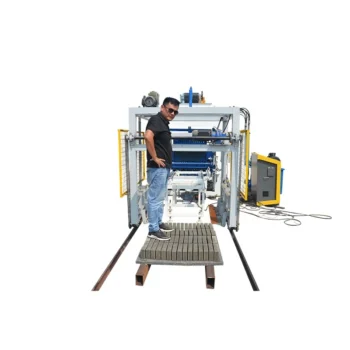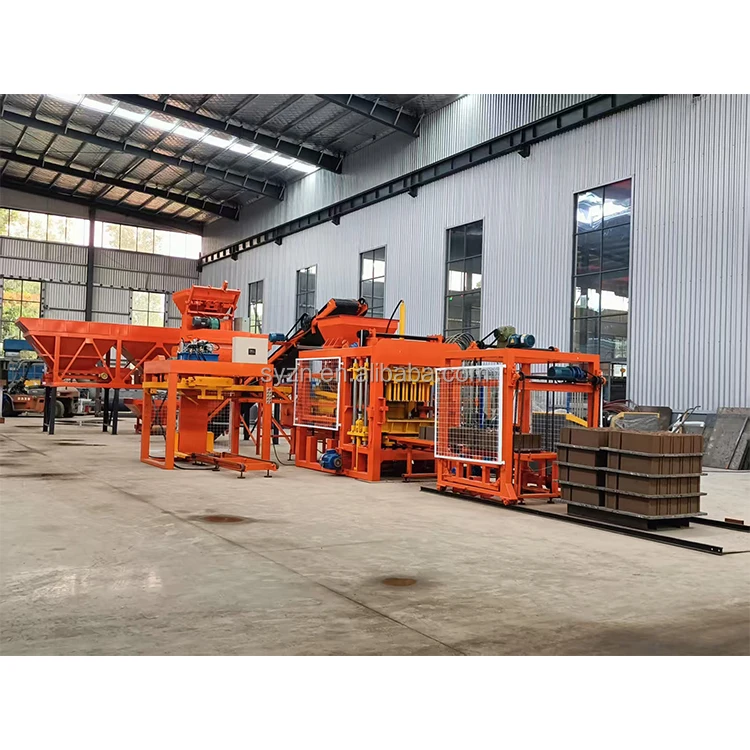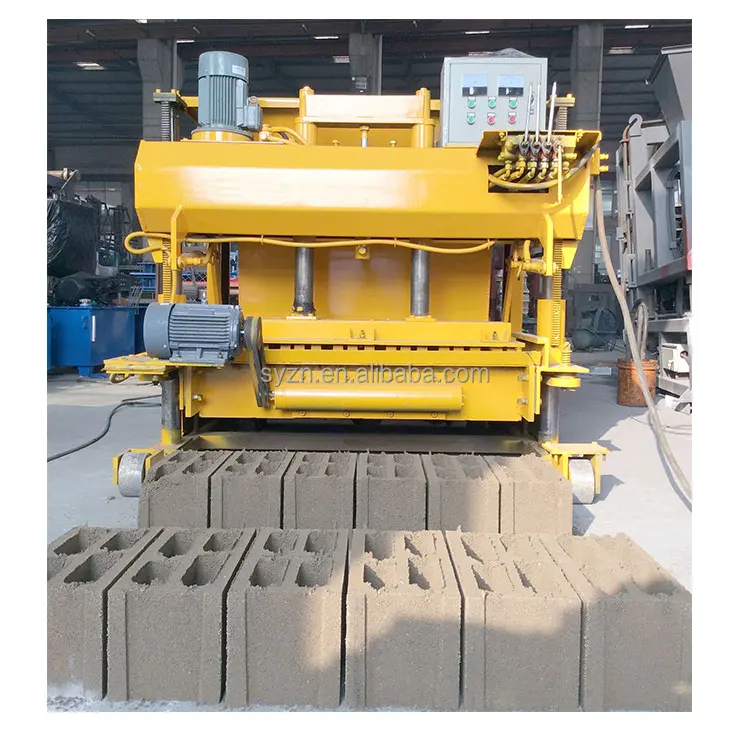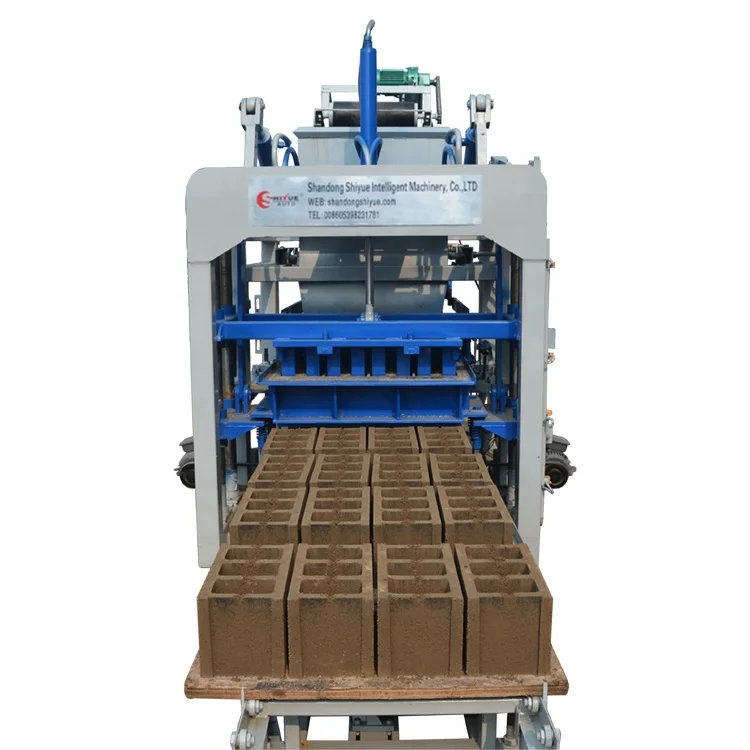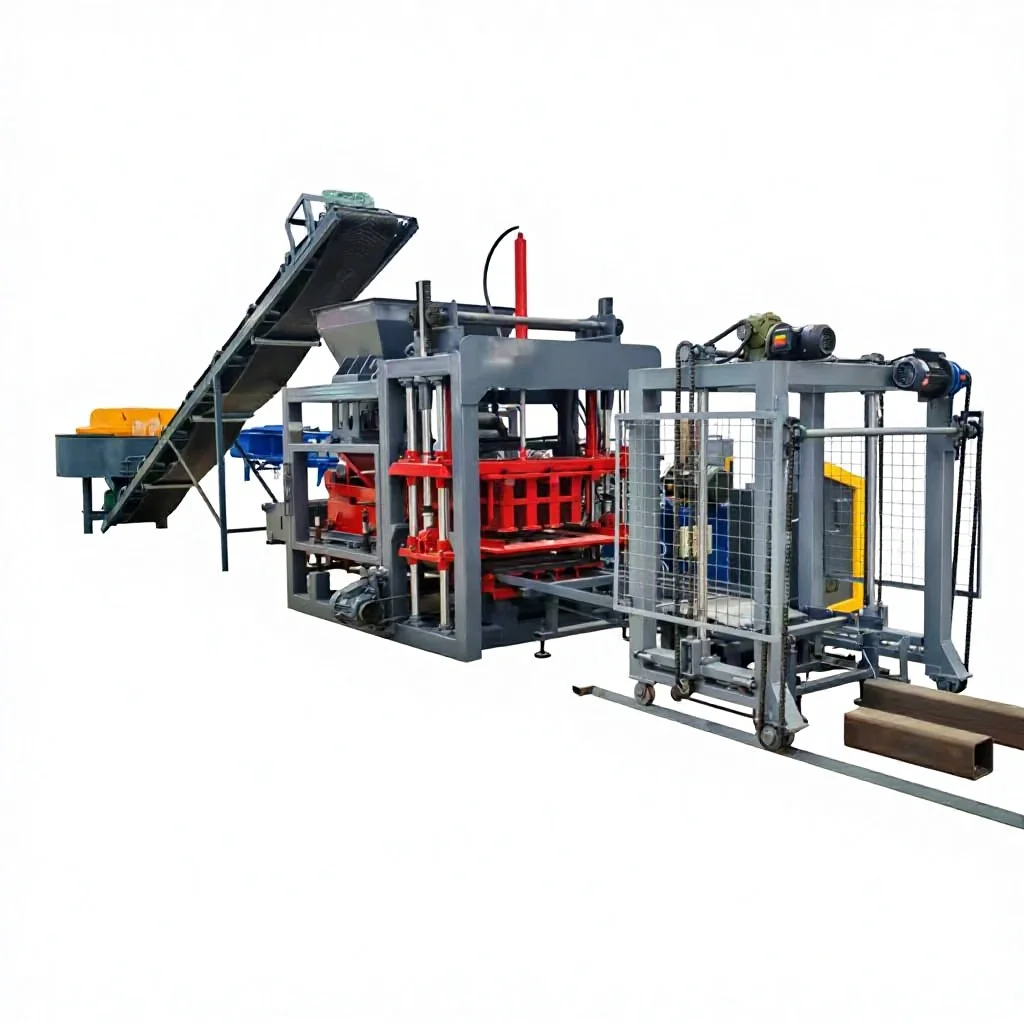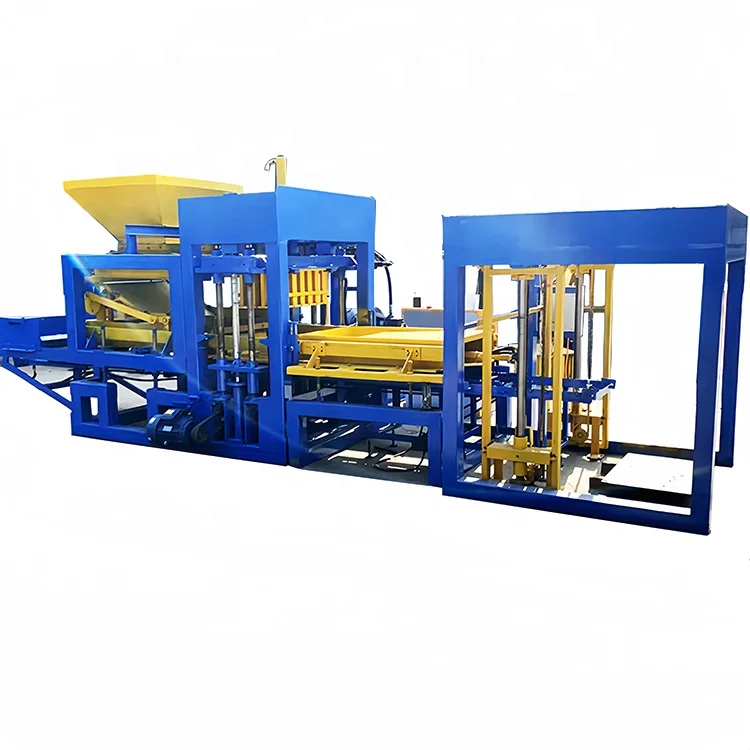
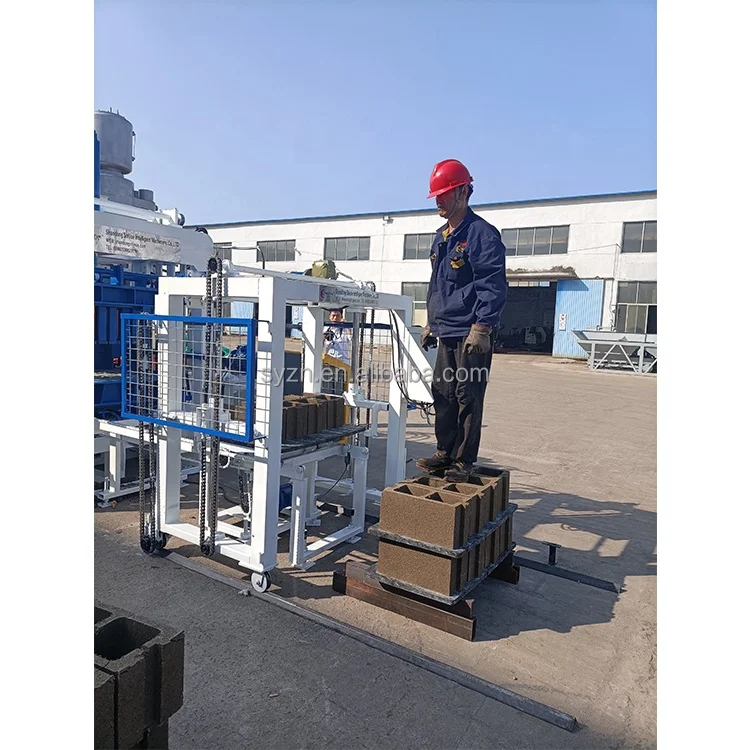


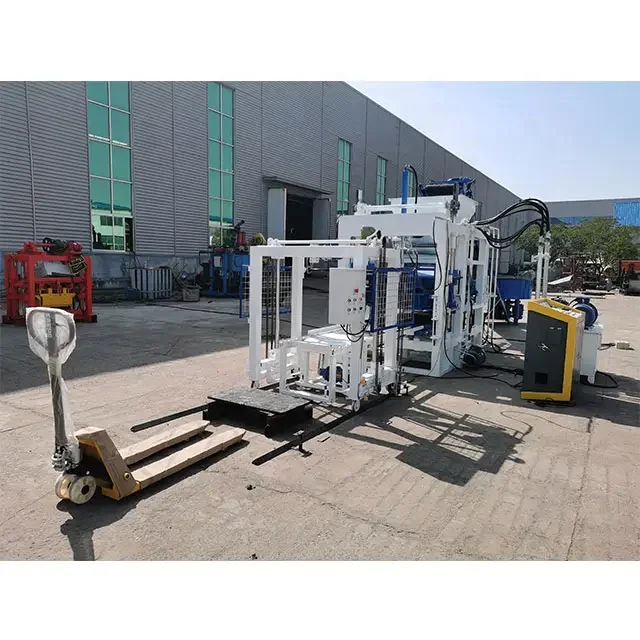

Description
Matched System Approach — every QT4-18 block machine configuration pairs the press, pallet and mould to your actual block format, so capacity calculations reflect what you will produce, not a catalogue default.
Technical Specifications
| Parameter | Value |
|---|---|
| Model | QT4-18 |
| Product Type | Hydraulic Concrete Block Making Machine |
| Overall Dimensions (L×W×H) | 3900×1600×2300 mm |
| Moulding Cycle | 15–25 s |
| Vibration Force (Exciting Power) | 40–50 kN |
| Rated Power | 24 kW |
| Mixer Model | JQ350 |
| Pallet Size | 850×550×25 mm |
| Net Weight | 3 T |
| Applied Products | Paver, solid block, hollow block, curbstone |
| Raw Materials | Crushed stones, sand, cement, dust, fly ash |
| Control System | PLC control system |
| Hydraulic Station | Included (high pressure, stable operation) |
| Included Auxiliary Equipment | Block making machine, hydraulic station, PLC control system, pallet feeder, brick conveyor, block sweeper |
| Free Accessories | Manual hydraulic trolley, spare parts and tools |
| Output Capacity | 1200–1680 pcs/h (basis: 400×200×200 mm hollow block) |
| Output Capacity | 1800–2400 pcs/h (basis: 400×150×200 mm hollow block) |
| Output Capacity | 3240 pcs/h (basis: 240×115×53 mm solid brick) |
| Daily Output (8 hr) | 9600–13440 pcs (basis: 400×200×200 mm hollow block) |
| Daily Output (8 hr) | 14400–19200 pcs (basis: 400×150×200 mm hollow block) |
| Daily Output (8 hr) | 16200–19440 pcs (basis: 240×115×53 mm solid brick) |
| Automation Level | Semi-automatic (PLC controlled with pallet feeder and conveyor) |
Application Suitability
| Application | Material or Output |
|---|---|
| Hollow block production for masonry walls | Crushed stone, sand, cement and fly ash mixes forming 400×200×200 mm or 400×150×200 mm units |
| Solid brick manufacturing for load-bearing structures | Dense aggregate and cement blends producing 240×115×53 mm bricks |
| Paver production for walkways and driveways | Fine aggregate and pigment mixes for interlocking or rectangular paving formats |
| Curbstone fabrication for road edging | Coarse aggregate with higher cement content for heavy-duty kerb profiles |
| On-site block production for housing projects | Locally sourced crushed stone and sand reducing transport cost to the build site |
What QT4-18 Block Machine Specifications Reveal About Real Capacity
Capacity figures only matter when the block format is named alongside the number.
I have watched buyers sign contracts based on a single hourly output number, only to discover on commissioning day that the quoted figure assumed a small solid brick while their market demands 200 mm hollow blocks. The QT4-18 block machine specifications on this page list output separately for each format — 400×200×200 mm hollow block, 400×150×200 mm hollow block and 240×115×53 mm solid brick — because the mould cavity count and cycle time change with every switch. Without that breakdown, a buyer has no honest basis for planning shifts, curing space or truck loading [NEED_CITE: capacity calculation methods in block machinery procurement].
Matching Mould Format to Market Demand
The QT4-18 accepts moulds for hollow block, solid brick, paver and curbstone formats. Each format requires its own cavity plate, and the cycle time sits in the 15–25 s range depending on the depth and draw of the mould. When a buyer’s primary product is the 400×200×200 mm hollow block, the press runs at that format’s cycle and the daily output is calculated from it — not from a faster solid brick cycle that the buyer may never run.
Pallet Size and the Curing Area Connection
The 850×550×25 mm pallet is the carrier that moves every green block from the press to the curing zone. If the buyer’s existing curing racks or forklift tines were sized for a different pallet dimension, the entire line stalls at the transfer point. Confirming pallet size against the curing area and handling equipment before the QT4-18 leaves the factory prevents a situation where freshly pressed blocks pile up on the conveyor with nowhere to go [NEED_CITE: pallet and curing rack compatibility in block plants].
Reading the Vibration and Hydraulic Numbers Together
The 40–50 kN vibration force works with the hydraulic station to compact the mix inside the mould cavity. Vibration alone settles the aggregate; hydraulic pressure applied through the head shoe finishes the compaction and determines the green strength when the block is stripped. A mix with coarse crushed stone needs higher vibration amplitude, while a fly-ash-heavy mix relies more on hydraulic pressure. The QT4-18 block machine specifications list both values so the buyer’s lab can cross-check against their local aggregate sieve analysis and target compressive strength. The PLC control system repeats the same cycle parameters across every pallet, removing the variance that manual lever operation introduces between operators and shifts.
What Happens When Mould Change Takes a Full Shift
A machine sold with multiple mould formats delivers flexibility only if the operator can swap them without losing a production day. If the mould clamp bolts corrode or the alignment pins are not standard, a format change that should take minutes stretches into hours, and the buyer who paid for four formats ends up running only one. Every quotation should name the mould change method and confirm that lifting eyes and guide pins match the tools available on site [NEED_CITE: mould change procedures in semi-automatic block production].
Why Configuration Confirmation Belongs Before Production Starts
A machine built for 380 V / 50 Hz shipped to a 440 V / 60 Hz market will burn out the vibration motor within weeks, and a PLC display in a language the operator cannot read turns fault diagnosis into guesswork. Voltage, frequency and control language are not afterthoughts — they are parameters that must be locked before the QT4-18 enters assembly. Getting them wrong means the machine sits idle while replacement components are shipped overseas, and the buyer’s project deadline passes with an unpowered press in the yard.
Why Procurement Here Reduces Format Risk
Block machinery is the single focus of this production line, so the QT4-18 is specified as a matched system of press, mould, pallet and handling equipment rather than a collection of separate purchases. Configuration starts from the buyer’s actual block format, local aggregate and daily output target — not a catalogue default row. Mould design covers the formats the buyer’s market demands, with custom drawings accepted for non-standard dimensions. The automation level is selectable, allowing a plant to begin with the included semi-automatic pallet feeder and conveyor and add automatic stacking later. Installation support includes on-site commissioning and operator training so the crew can run the press and perform mould changes independently from the first week.
Documentation & Verification
- Line layout drawing showing QT4-18 position relative to mixer, pallet return and curing racks
- Capacity calculation sheet listing output per block format with cycle time assumed
- Mould drawing and format list confirming included cavity plates and custom sizes
- Pallet specification sheet matched to buyer’s curing rack and forklift dimensions
- Hydraulic and electrical schematic for the QT4-18 station with component part numbers
- Factory test record pressing the buyer’s target block format before dispatch
Installation, Commissioning & Support
- Foundation pad leveled to support 3 T net weight and vibration load from the QT4-18 press
- Dedicated power circuit rated for 24 kW with voltage and frequency confirmed before wiring
- Machine arrives with hydraulic station, PLC panel and pallet feeder separated for container loading
- First-run cycle parameters set against the buyer’s mix design and target block strength
- Operator training covers PLC fault codes, mould change procedure and daily lubrication points
- Spare parts kit includes hydraulic seals, vibration motor bearings and proximity sensors
What to Include in Your QT4-18 Inquiry
A useful first message names the block formats your market sells and the daily output you need for each one. Share the local aggregate type — crushed stone, river sand, fly ash — along with any compressive strength requirement your building code specifies. Confirm the voltage and frequency at your site, the PLC display language your operators read, and the pallet dimensions your existing curing racks and forklift can handle. If you already run a mixer or batching plant upstream, mention its model so the feeder can be matched.
Frequently Asked Questions
Q: How is the QT4-18 output capacity calculated per block format?
A: Output is calculated by dividing the working hour by the moulding cycle for that specific format, then multiplying by the cavity count. The 1200–1680 pcs/h figure applies to the 400×200×200 mm hollow block, while the 3240 pcs/h figure applies to the 240×115×53 mm solid brick. Every capacity number on this page names its format so your daily plan is built on real data.
Q: Which mould formats are available and what is the mould change time?
A: Standard moulds cover hollow block, solid brick, paver and curbstone. Custom formats can be designed from buyer drawings. Mould change time depends on the clamp system and operator familiarity — confirm the exact procedure and required tools before shipment so your crew can perform the swap within a planned maintenance window.
Q: How do I confirm pallet size matches my curing area and forklift?
A: The standard pallet is 850×550×25 mm. Measure your curing rack shelf width and forklift tine spacing before confirming the order. If your existing infrastructure was built around a different pallet dimension, a custom size can be arranged so green blocks transfer directly from the conveyor to the rack without rehandling.
Q: What voltage and PLC language options are available for my market?
A: Voltage and frequency must be confirmed before the electrical panel is built — common configurations include 380 V / 50 Hz and 440 V / 60 Hz. The PLC display language is set during programming. State both requirements in your inquiry to avoid commissioning delays caused by incompatible power supply or unreadable fault messages.
Q: How is vibration force and hydraulic pressure matched to my local aggregate and mix design?
A: The 40–50 kN vibration force and hydraulic station pressure are adjusted during commissioning based on the buyer’s aggregate sieve analysis and cement ratio. Coarse crushed stone typically demands higher vibration, while fine fly ash mixes rely more on hydraulic compaction. Providing your mix design early allows the factory test to replicate your production conditions.