

AAC Block Line Specifications & Buyer Reference: Shiyue Manufacturer for Sale
Bigger autoclaves do not guarantee faster output.
The critical bottleneck in Autoclaved Aerated Concrete production is rarely the steam chamber capacity, but rather the precision of raw material grinding and slurry stability relative to local humidity. For investors in Latin America, selecting an AAC block production line specifications package requires matching autoclave cycles to regional climate conditions and grid frequency, not just copying European data sheets.
I learned this the hard way during a project in central Mexico. I had prepared a standard technical proposal based on our domestic factory’s optimal cycle times. The client, a seasoned contractor building lightweight wall panels, accepted the initial quote. However, once the equipment arrived and commissioning began during the rainy season, the curing process stalled. The blocks lacked the required compressive strength because the high ambient humidity interfered with the pre-curing phase. I spent two weeks on-site adjusting the steaming parameters and extending the curing duration by a noticeable margin to compensate for the moisture load. That experience reshaped how I approach every inquiry from Brazil, Chile, or Colombia. It is not about selling a machine; it is about engineering a process that survives the local environment.

This guide breaks down the technical realities behind AAC block production line specifications, focusing on the parameters that actually determine return on investment for turnkey projects in emerging markets.
Why Standard AAC Specs Fail in Latin America?
Copying a specification sheet from a temperate European climate and applying it to a tropical or subtropical zone is a common error that leads to significant efficiency losses. The core issue lies in the interaction between atmospheric conditions and the chemical reactions of aerated concrete.
In regions like coastal Brazil or southern Mexico, high humidity affects the slurry’s water evaporation rate during the pre-curing stage. If the AAC block production line specifications do not account for this, the green cake may remain too soft for cutting or too wet for efficient steaming. Conversely, in arid zones of northern Chile, rapid surface drying can cause cracking before the block even enters the autoclave.
Another frequent oversight is power grid stability. Many Latin American industrial zones operate on a 60Hz frequency, whereas some Asian manufacturers design PLC systems and motors for 50Hz. [NEED_CITE: impact of frequency mismatch on motor efficiency and PLC timing] Ignoring this difference can lead to a substantial drop in mixing consistency and conveyor speed accuracy. I have seen plants where the milling fineness varied wildly because the motor speed drifted under unstable voltage, resulting in uneven pore structures in the final blocks.
When reviewing AAC block production line specifications, buyers must demand a climate adaptation analysis. This includes adjusting the water-to-cement ratio controls, modifying the pre-curing room ventilation capacity, and ensuring all electrical components are rated for the local voltage and frequency. Without these adjustments, the theoretical annual capacity listed in the brochure will never be achieved in practice.

Key Specifications: What Really Matters for ROI?
Investors often fixate on the nominal annual capacity, such as "100,000 cubic meters per year." However, this number is meaningless without understanding the underlying process efficiency. The true drivers of ROI are milling precision and autoclave cycle optimization.
The grinding fineness of sand or fly ash dictates the reactivity of the mixture. If the particle size is not controlled within a tight variance, the aluminum powder reaction becomes unpredictable. This leads to either over-expansion, causing waste, or under-expansion, resulting in dense, heavy blocks that fail to meet lightweight standards. [NEED_CITE: correlation between particle size distribution and AAC compressive strength]
Consider the case of a buyer in São Paulo who required high-density blocks for load-bearing walls. The standard configuration produced blocks with inconsistent density. By upgrading the milling system to achieve finer particle control, we stabilized the slurry viscosity. The result was a noticeable improvement in strength uniformity, allowing the plant to meet strict local building codes without increasing cement consumption.
| Specification Parameter | Basic Configuration | Optimized Configuration for LatAm | Impact on Production |
|---|---|---|---|
| Milling Fineness Control | Standard Sieve Analysis | Precision Laser Diffraction Monitoring | Stabilizes slurry reactivity and reduces waste |
| Autoclave Cycle Time | Fixed Timer Based | Pressure-Temperature Curve Optimized | Reduces energy consumption and increases throughput |
| PLC System Frequency | 50Hz Default | Dual Frequency Compatible (50/60Hz) | Ensures consistent motor speed and mixing quality |
| Curing Room Ventilation | Natural Airflow | Humidity-Controlled Mechanical Ventilation | Prevents cracking in arid zones and mold in humid zones |
When evaluating AAC block production line specifications, look for systems that offer real-time monitoring of slurry density and cutting hardness. These features allow operators to make immediate adjustments, minimizing the risk of producing an entire batch of defective blocks. Shiyue’s turnkey design service includes this level of process customization, ensuring that the equipment performs as intended from day one.
Raw Material Prep: The Hidden Bottleneck
Many buyers assume that the autoclave is the heart of the plant. In reality, the raw material preparation section is the foundation. If the input materials are not properly processed, no amount of steaming pressure can fix the final product.
Sand and fly ash quality vary significantly across Latin America. In some parts of Brazil, the silica content in river sand is lower, requiring a higher proportion of cement or lime to achieve the same strength. In other areas, the sand contains excessive clay, which inhibits the gas-forming reaction. [NEED_CITE: effect of clay content on AAC gas formation efficiency]
A practical example involves a project in Argentina where the local sand had high moisture variability. The standard dosing system could not compensate for the changing water content in the sand, leading to fluctuating slurry density. We implemented a moisture detection sensor in the feeding hopper, which automatically adjusted the water addition. This simple modification stabilized the production process and eliminated the need for constant manual intervention.
For investors, this means that AAC block production line specifications must include robust pre-processing capabilities. This covers screening units to remove oversized particles, magnetic separators to protect milling equipment, and precise dosing systems for cement, lime, and gypsum. Ignoring these details leads to frequent equipment breakdowns and inconsistent product quality.
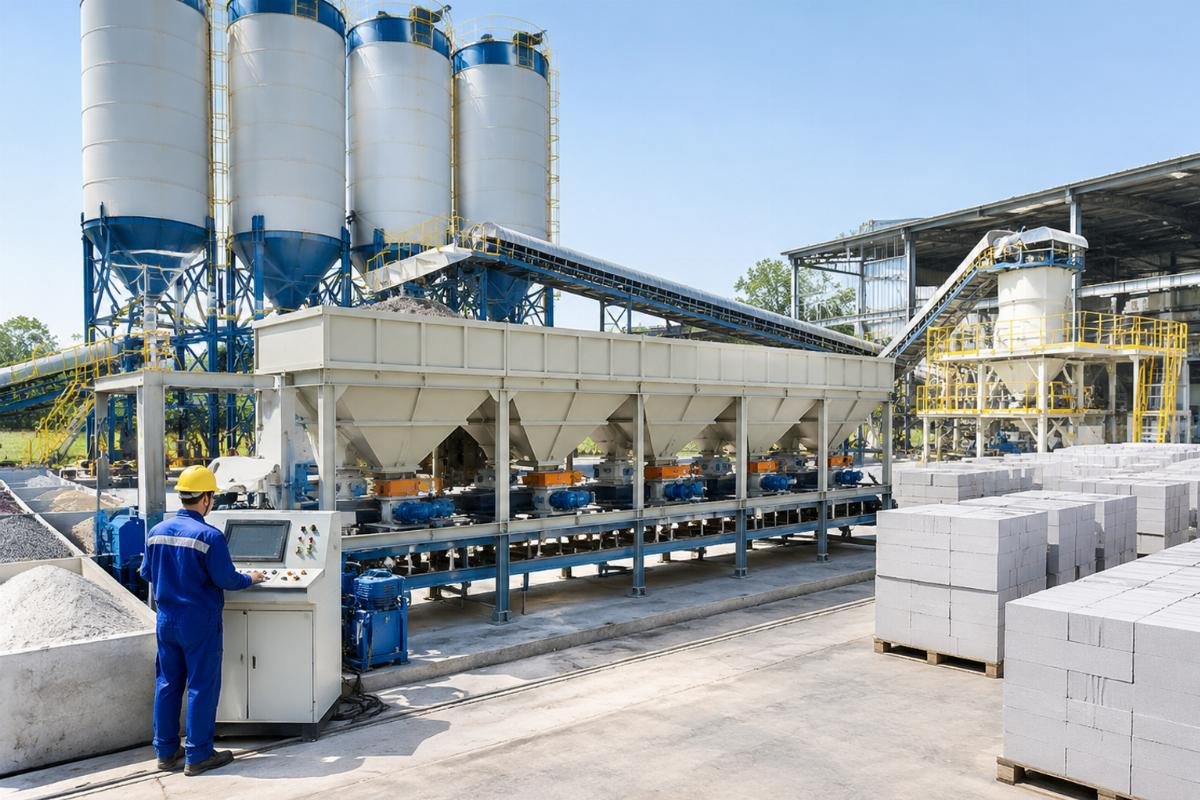
Furthermore, the storage capacity for raw materials should be sized to handle local supply chain irregularities. In regions where road transport is affected by seasonal rains, having sufficient silo capacity ensures continuous production even when deliveries are delayed.
Installation & Commissioning: Avoiding the "Rainy Season" Trap
Timing the installation and commissioning phase is as critical as the equipment selection itself. Starting up a new plant during the peak rainy season in tropical climates can lead to prolonged debugging periods and frustrated operators.
Moisture affects not only the curing process but also the electrical systems and mechanical components. High humidity can cause short circuits in control panels and rust on exposed metal surfaces if proper protection is not in place. Additionally, the foundation concrete requires specific weather conditions to cure properly. Pouring foundations in heavy rain compromises their structural integrity, leading to alignment issues for the heavy machinery later on.
I recall a project in Colombia where the commissioning was scheduled during the wettest month. The team struggled to keep the pre-curing rooms dry, and the outdoor conveyor belts slipped frequently due to mud. We had to pause production for several days to install temporary dehumidifiers and improve drainage around the plant. This delay cost the investor valuable time and money.
To avoid this, align the installation timeline with the local dry season. Ensure that the AAC block production line specifications include weather-resistant coatings for outdoor components and sealed enclosures for electrical cabinets. [NEED_CITE: best practices for industrial equipment installation in tropical climates]
Moreover, operator training should begin before the machines are fully installed. Familiarizing the local team with the control logic and maintenance routines during the assembly phase helps them take ownership of the plant more quickly. This reduces the learning curve and minimizes operational errors once full production begins.

Conclusion
Success in AAC manufacturing depends on process adaptation, not just hardware capacity.
Selecting the right AAC block production line specifications requires a deep understanding of local climate, raw material characteristics, and grid conditions. By focusing on milling precision, autoclave cycle optimization, and climate-resilient design, investors can avoid costly mistakes and achieve sustainable profitability. Shiyue supports this approach by integrating local adaptation into every turnkey solution, ensuring that your plant performs reliably from the first batch.
