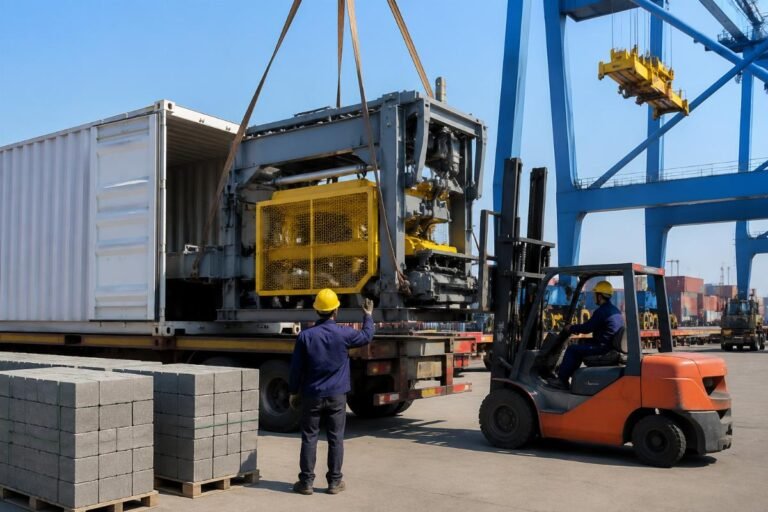
Concrete Block Machine Supplier for Spain: China Factory Direct
Most buyers assume Chinese machinery fails in Europe due to poor build quality. The real culprit is almost always unverified grid harmonics and improper factory grounding.
Sourcing a concrete block machine supplier for Spain directly from China requires three non-negotiables: CE Machinery Directive compliance, 400V/50Hz three-phase electrical adaptation with harmonic filtering, and CIF Barcelona or Valencia shipping with full customs documentation pre-cleared. A qualified concrete block machine supplier for Spain will provide verified CE test reports, customized electrical schematics for the Iberian grid, and turnkey delivery within a standard production window.
I still think about that Barcelona shipment. We had loaded a full automatic line, containers sealed, bill of lading issued. Three weeks later, the client called—two frequency inverters had burned out during commissioning. The local electrician measured total harmonic distortion well above acceptable limits, and the facility’s grounding resistance was never tested before installation. The replacement parts had to be air-freighted, and the crew stood idle for over a week. That mid-five-figure loss came entirely from skipping a single pre-shipment electrical audit. Since then, every export order gets a grid compatibility checklist run before the first weld is inspected [NEED_CITE: Iberian grid power quality standards per UNE-EN 50160].
If you are evaluating a concrete block machine supplier for Spain, the technical and logistical details below separate a smooth commissioning from an expensive lesson.
What Electrical and Certification Traps Wait for a Concrete Block Machine Supplier for Spain?
A concrete block machine supplier for Spain must deliver machines pre-configured for 400V/50Hz three-phase supply with documented harmonic mitigation, not just a nameplate voltage change.
Spain’s industrial grid follows UNE-EN 50160 voltage characteristics, but actual site conditions vary significantly between Andalusia, Catalonia, and inland regions. Older industrial parks near Valencia or Murcia often share transformers with heavy agricultural irrigation pumps, creating voltage sags and harmonic injection that standard variable frequency drives cannot handle without protection [NEED_CITE: harmonic distortion limits in European industrial supply networks].
Here is what separates a compliant delivery from a field failure:
| Parameter | Non-Compliant Setup | Standard Adaptation | Full Iberian-Grid Protection |
|---|---|---|---|
| Voltage Range | Fixed 380V only | 380-415V tolerance | Wide-range input with auto-tapping |
| Harmonic Filtering | None | Basic line reactor | Active front-end or DC choke rated for THD |
| CE Documentation | Self-declared only | Notified body test report | Full technical file with risk assessment per 2006/42/EC |
| Grounding Scheme | Assumed TN-C | TN-S specified | Site survey confirmed with earth resistance test |
| Component Brand | Unverified | Recognized European brand | Siemens/Schneider with local service availability |
A private investor in Andalusia once ordered a semi-automatic line from a trader who simply swapped the motor nameplate. The machine arrived, the local authority inspector asked for the CE technical file, and the trader could only produce a generic certificate covering a different machine family. The installation was blocked for months. When the same investor later sourced from a concrete block machine supplier for Spain that provided a machine-specific CE file with serial-number traceability, the inspector signed off within a single visit [NEED_CITE: EU Machinery Directive 2006/42/EC documentation requirements].
The lesson is simple: certification is not a sticker, it is a dossier. Ask for the full technical construction file before signing any purchase agreement.
How Does a Concrete Block Machine Supplier for Spain Manage Logistics from China to Iberian Ports?
The true landed cost of importing from a concrete block machine supplier for Spain extends well beyond the FOB invoice—port handling, inland transport, and customs clearance routinely add a substantial premium if not planned in advance.
Shipping heavy machinery from Qingdao to Barcelona or Valencia follows established container and break-bulk routes, but the details determine whether your machine sits at the terminal for weeks or rolls directly to your factory gate. Full production lines often require multiple forty-foot containers plus flat-rack shipments for oversized components like the main press frame and cement silos.
The critical logistics stages:
- Factory loading and rust protection: Marine-grade packaging with VCI paper and desiccant bags is mandatory for Mediterranean transit, where container sweat during the Suez passage causes severe corrosion on untreated surfaces [NEED_CITE: marine packaging standards for heavy machinery export].
- Bill of lading and origin documentation: The certificate of origin must match the CE declaration exactly. Any discrepancy triggers customs holds at Barcelona’s Zona Franca or Valencia’s Puerto.
- Inland transport from port: Heavy components require low-bed trailers with route surveys for bridge weight limits, especially for inland sites in Castilla-La Mancha or Aragón.
- On-site unloading and rigging: The concrete block machine supplier for Spain should provide rigging drawings with center-of-gravity markings—local crane operators will not lift without them.
A distributor in the Valencian Community once booked a mobile egg-laying line under FOB terms to save on freight. The machine arrived at the port, but the distributor had not arranged customs clearance in advance. Storage demurrage accumulated daily, and the final inland delivery cost nearly matched the original ocean freight. The total hidden expense erased the entire savings from choosing FOB over CIF [NEED_CITE: port demurrage and customs clearance procedures at Spanish Mediterranean ports].
Experienced suppliers build the logistics plan into the quotation, specifying Incoterms clearly, pre-packing containers for maximum cube utilization, and coordinating with freight forwarders who specialize in heavy industrial cargo to Iberian destinations.
Fully Automatic vs. Semi-Automatic: How Should Spanish Investors Choose from a Concrete Block Machine Supplier for Spain?
The right machine type depends on local labor costs, production volume targets, and available footprint—not on the supplier’s preference for higher-value orders.
Spain’s construction sector has specific characteristics that affect the ROI calculation. Labor costs remain relatively high compared to emerging markets, but land in peri-urban industrial zones is expensive and often constrained by municipal zoning. This combination pushes serious investors toward automation, but the threshold where full automation pays for itself depends on your specific output target.
| Factor | Semi-Automatic Line | Fully Automatic Line |
|---|---|---|
| Operator Requirement | Multiple manual stations | Minimal supervision with PLC control |
| Output Consistency | Operator-dependent | Repeatable cycle-to-cycle |
| Floor Space | Compact layout possible | Larger footprint for conveyors and stackers |
| Initial Investment | Noticeably lower | Substantially higher |
| Payback Period | Shorter for low volume | Shorter for sustained high volume |
| Maintenance Complexity | Simpler mechanical | Requires trained PLC technicians |
A client near Madrid operated a legacy manual block yard and wanted to upgrade. They initially requested the largest fully automatic model available. After reviewing their actual daily order patterns and available shifts, we recommended a mid-range semi-automatic configuration with an upgrade path. The machine paid for itself quickly, and they added full automation modules two years later when volume justified the investment. Choosing the correct concrete block machine supplier for Spain means getting honest capacity consulting, not just the most expensive quotation [NEED_CITE: ROI analysis methodology for concrete block production investment].
Mobile egg-laying machines serve a different niche—remote infrastructure projects, rural road paving, or temporary production sites where transporting palletized blocks is impractical. These units offer remarkable flexibility but lower total output, making them ideal for contractors rather than permanent yard operators.
Why Source from a Chinese Concrete Block Machine Supplier for Spain Instead of European Manufacturers?
The cost advantage of Chinese manufacturing extends beyond labor rates—it encompasses the entire supply chain density, from steel fabrication to hydraulic component sourcing, all concentrated within a single industrial region.
European block machine manufacturers offer excellent engineering and local support, but their pricing reflects decades of overhead accumulation, high domestic labor costs, and layered distribution margins. A direct quotation from a Chinese concrete block machine supplier for Spain typically represents a substantial reduction compared to equivalent European or Turkish offerings, even after adding shipping and customs duties.
The cost structure comparison reveals where savings originate:
| Cost Element | European Manufacturer | Chinese Factory Direct |
|---|---|---|
| Steel Fabrication | High-cost domestic | Integrated regional supply chain |
| Hydraulic Components | Premium branded | Same brands sourced at volume pricing |
| Electrical Components | European standard | European brands with China procurement |
| Assembly Labor | Significantly higher | Competitive with skilled workforce |
| Engineering Overhead | Fully loaded | Lean structure with focused R&D |
| Distribution Margin | Multi-tier dealer network | Direct factory to end user |
A construction equipment distributor based in southern Europe had previously sourced from a Turkish manufacturer. When they evaluated switching to a concrete block machine supplier for Spain from China, they discovered that even with ocean freight and import duties, the landed cost remained noticeably lower—while the electrical components were identical Siemens and Schneider units they already serviced locally.
The after-sales model also differs fundamentally. Chinese factories serving the European market have learned that remote support is insufficient. Leading suppliers now provide on-site installation supervision, operator training during commissioning, and remote PLC diagnostics. Spare parts availability is maintained through regional stocking or expedited air freight from the factory’s own warehouse [NEED_CITE: after-sales service models for Chinese machinery exporters to Europe].
The key is selecting a concrete block machine supplier for Spain that has verifiable European installation references and maintains documented spare parts inventory—not a trading company that disappears after the container leaves the port.
Conclusion
Importing block machinery from China to Spain succeeds when electrical compliance, logistics planning, and honest capacity matching replace price-only comparisons. A qualified concrete block machine supplier for Spain delivers verified CE documentation, Iberian-grid electrical adaptation, and transparent landed-cost calculations. The savings remain substantial, but only when the supplier demonstrates proven commissioning experience in Southern Europe and maintains accessible after-sales support.